
An arrangement that allows buyers and sellers to exchange things is called:
A) a contract.
B) a market.
C) money.
D) efficient.
Which of the following statements about the gender gap in income is INCORRECT?
A) Women are underrepresented in more lucrative majors such as computer science and
engineering.
B) Women in many occupations have less experience, compared to men.
C) Women have been denied access to high-paying male-dominated occupations.
D) none of the above
The word “competition” in the label “monopolistic competition” refers to the fact that:
A) there are very few firms producing in the market.
B) firms have no control over the price they charge.

C) firms vie against each other to get customers to buy their version of the product.
D) none of the above
Suppose you receive a consumer surplus of $50. The $50 represents:
A) a monetary payment from the store.
B) a monetary payment from the government.
C) a reduction in the original price of the good.
D) the fact that you paid $50 less than you were willing to pay for the good.
The Law of Demand can be explained as:
A) a lot of people wanting the same thing.
B) the higher the price, the smaller the quantity demanded, ceteris paribus.
C) people are willing to make limited sacrifices to acquire products.
D) legal reasons people make purchases in the marketplace.
If a competitive firm is in short-run equilibrium, then:
A) marginal revenue is equal to marginal cost.
B) price is greater than marginal cost.
C) price is equal to average variable cost.
D) price is greater than marginal revenue.
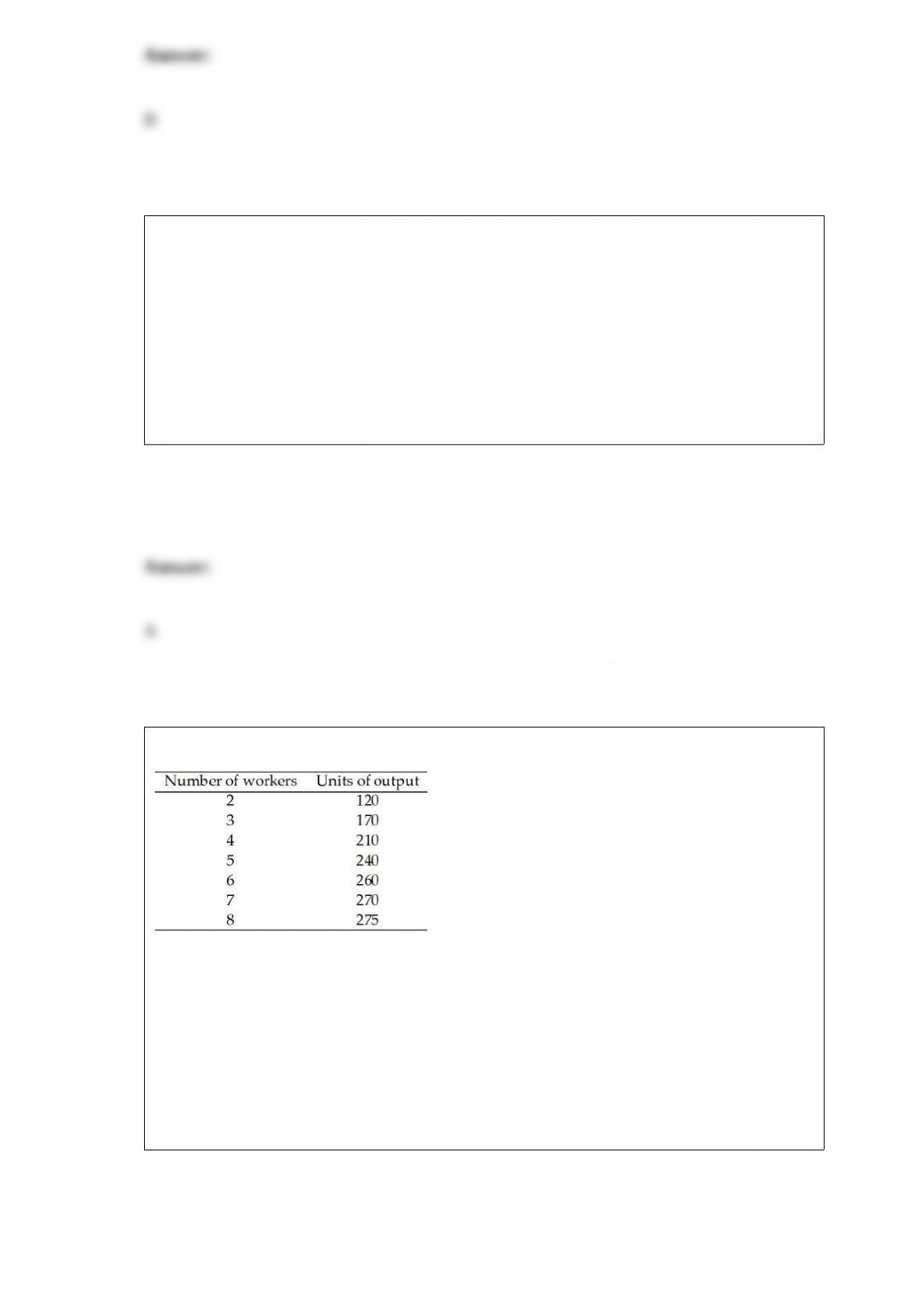
Refer to Table 17.2. The marginal product of the seventh unit of labor is:
Table 17.2
A) 50.
B) 40.
C) 30.
D) 10.

If the price of crude oil (an input to the production of gasoline) decreases, then we will
expect to see:
A) a movement along the supply curve for gasoline upwards.
B) a movement along the supply curve for gasoline downwards.
C) a shift in the supply of gasoline to the left.
D) a shift in the supply of gasoline to the right.
From the Application, we can infer that the wine lakes will disappear if:
A) the government set the minimum price below the equilibrium.
B) the government set minimum prices above the equilibrium.
C) the government takes over the production of wine.
D) All of the above are correct.

Recall the Application. During “happy hour,” many bars and restaurants face an
increase in demand for food and drink, and these establishments often cut prices during
these times of increased demand. When this demand increases, the demand curve facing
these bars and restaurants becomes:
A) vertical.
B) horizontal.
C) steeper.
D) flatter.
A firm’s marginal cost curve above the minimum of the average variable cost curve is
also:
A) the firm’s demand for production curve.
B) the firm’s producer surplus curve.
C) the firm’s short-run supply curve.
D) the market supply curve.
Refer to Figure 9.3. This farmer’s profit-maximizing level of output is ________ units
of output.
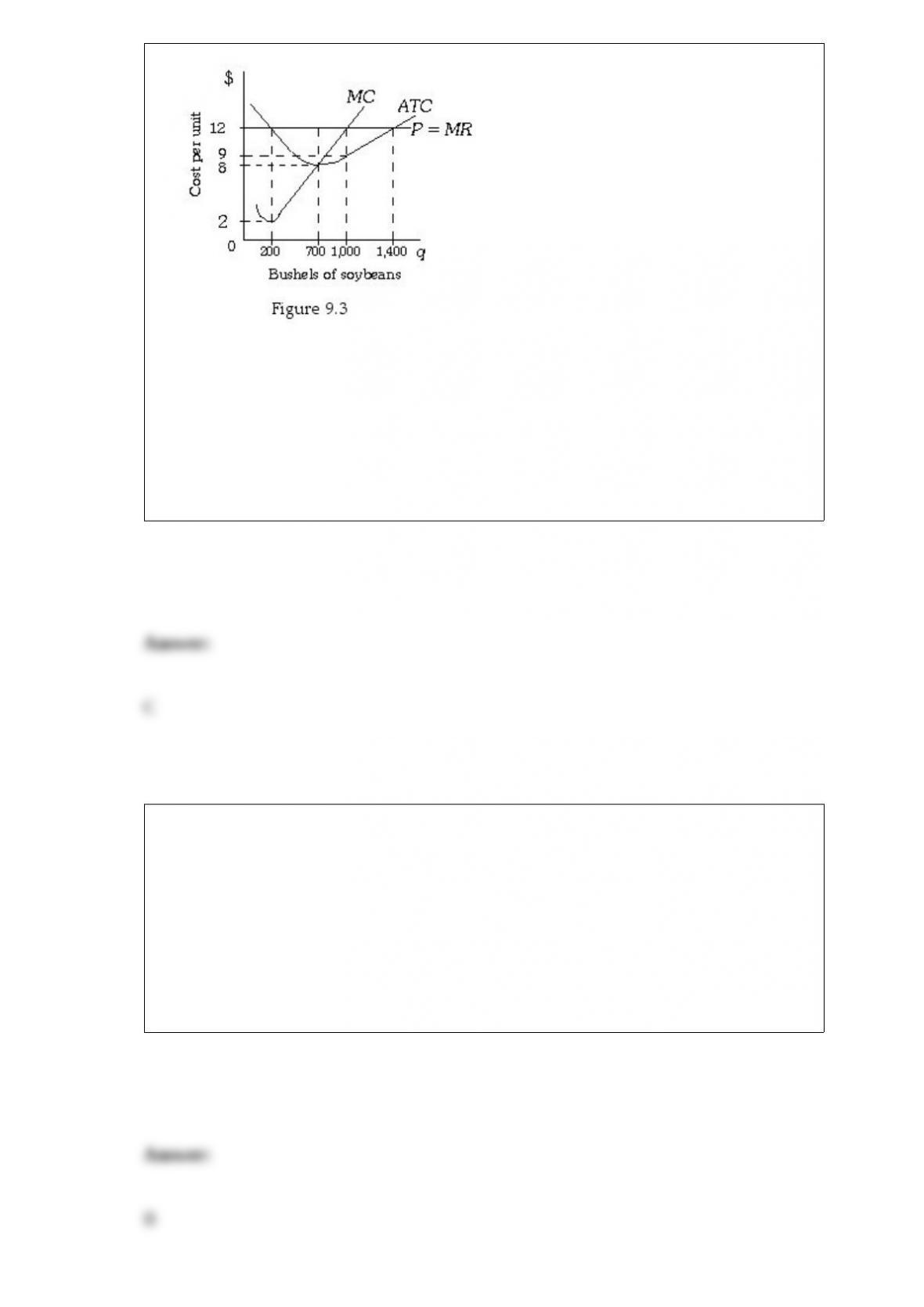
A) 200
B) 700
C) 1,000
D) 1,400.
If you remove resources from factory production, the quantity of factory goods will:
A) increase.
B) decrease.
C) remain the same but their price will decrease.
D) be diverted to other production.
Price and total revenue are inversely related when demand is:
A) elastic.
B) inelastic.
C) unitary elastic.
D) perfectly inelastic.
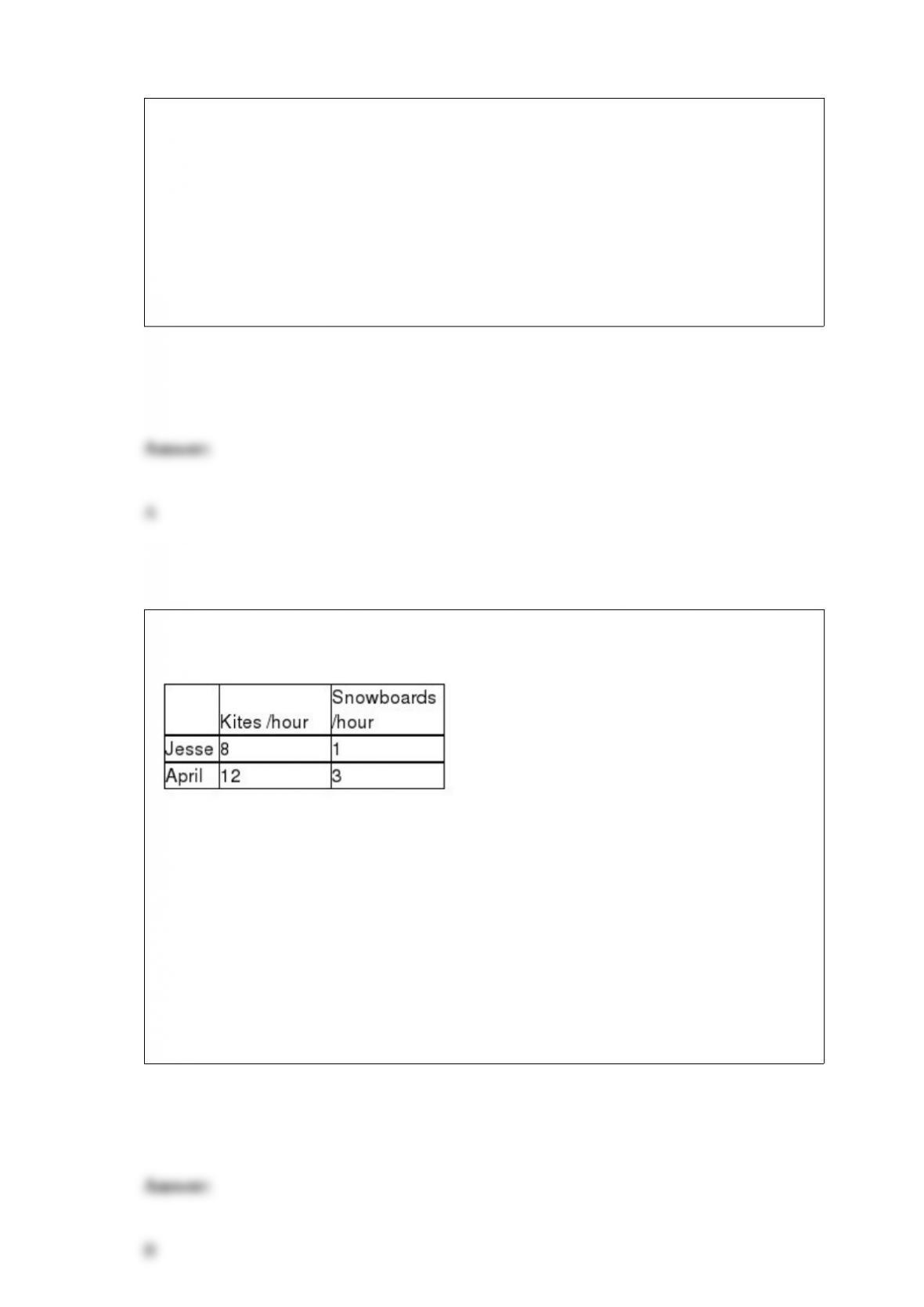
Consider two individuals, Jesse and April, who hand paint kites and snowboards. Table
3.1 shows how much of each good Jesse and April can paint in one hour.
Table 3.1
April’s opportunity cost of painting one kite is painting:
A) 1/12 of a snowboard.
B) 1/4 of a snowboard.
C) 3 snowboards.
D) 4 snowboards.

Steven lives in a big city where there is a shortage of parking. He has a parking spot in
his driveway where he parks his car. Which of the following statements is most correct?
A) Steven has a lower opportunity cost of owning a car than his neighbor, who must
rent a parking spot.
B) The opportunity cost of using the spot is zero, because Steven owns the house.
C) The opportunity cost of using the parking spot is the price he could charge someone
else for using the spot.
D) The opportunity cost depends on how much Steven’s mortgage payment is.
If short-run economic profits are greater than zero for firms in a monopolistically
competitive market, in the long run we expect:
A) entry barriers to prevent competing firms from entering this market.
B) the demand curve for firms in the market to shift to the right.
C) the average cost of production to decrease.
D) the average cost of production to increase.
Figure 17.2 depicts a firm’s marginal revenue product curve. If the wage rate is $15,
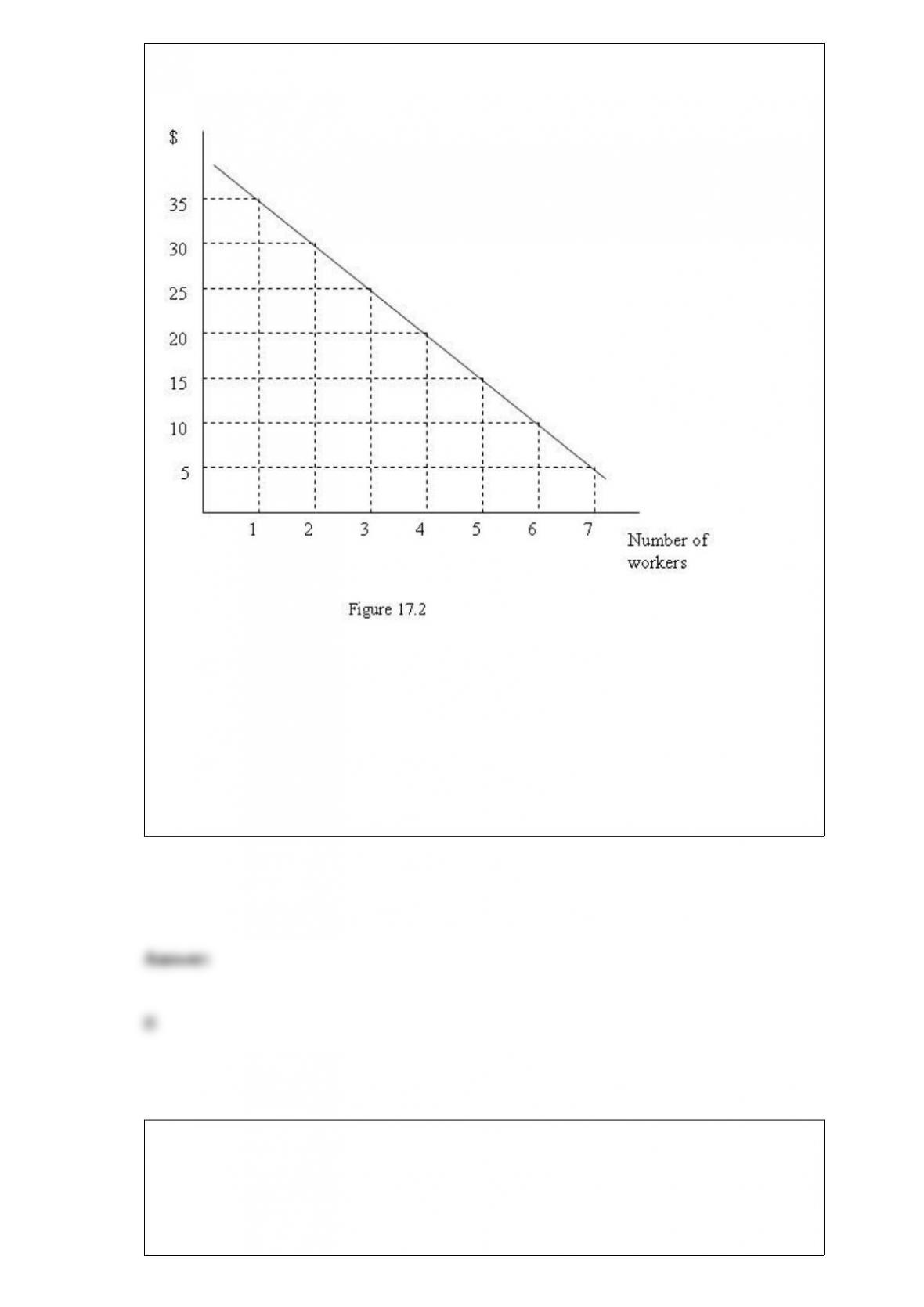
how many workers does the firm demand?
A) four workers
B) five workers
C) six workers
D) seven workers
The private market does NOT provide national defense because:
A) the resources needed to provide national defense are not available in the private
market.
B) the fixed cost of providing national defense is too high.
C) it is impossible to prevent anyone from enjoying the benefit of national defense.
D) it is an excludable and rival good.
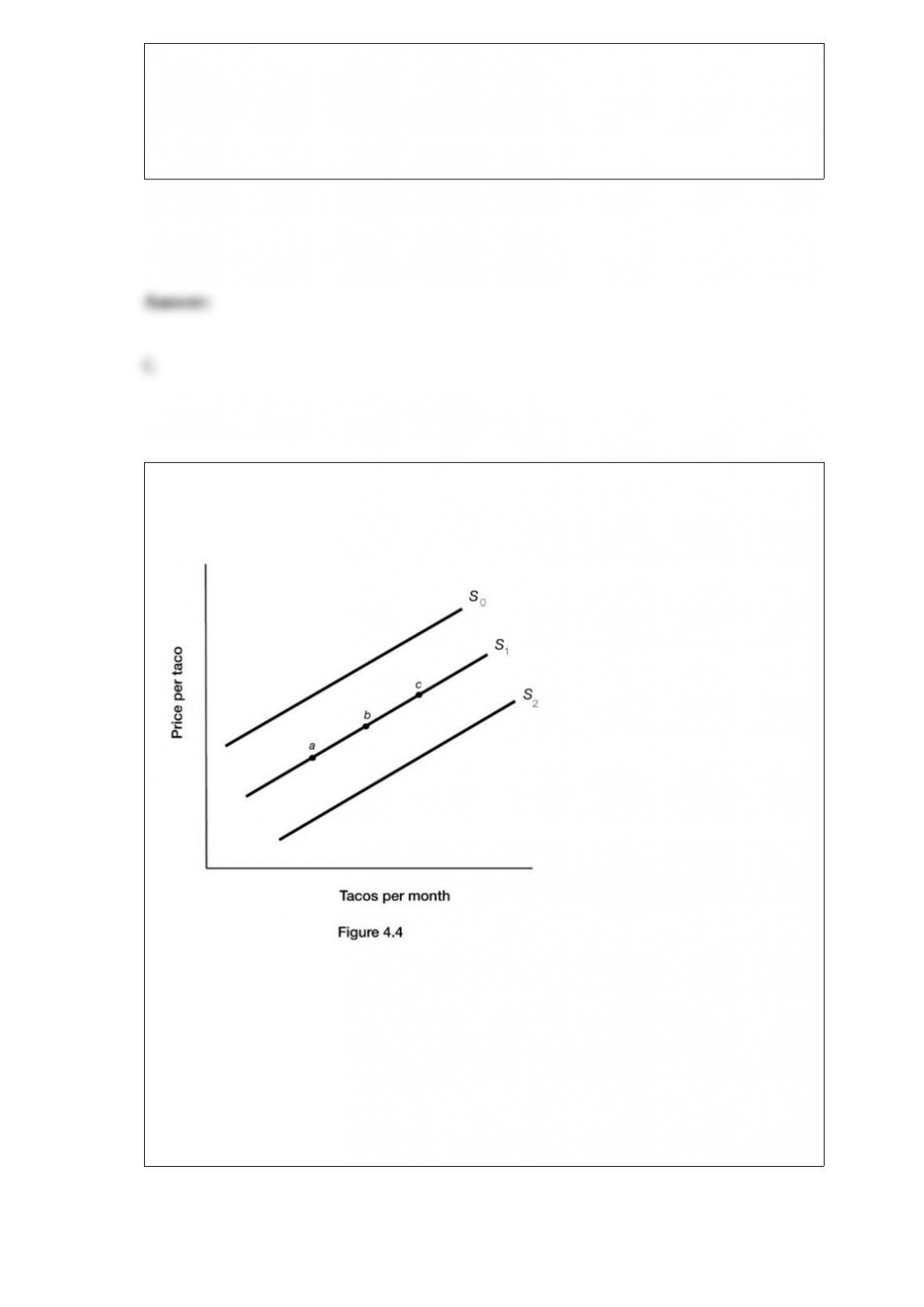
Figure 4.4 illustrates the supply of tacos. An increase in the supply of tacos is
represented by a movement from:
A) point a to point b.
B) point c to point b.
C) S2 to S1.
D) S0 to S1.

For a non-price discriminating monopolist to sell more units of output:
A) the price must be increased.
B) the price must be reduced.
C) demand must become more elastic.
D) the other competing firms must sell fewer units.
Which of the following factors would indicate less elastic demand?
A) The good represents a large fraction of the budget.
B) Demand is measured over a shorter period of time.
C) The price of the good is low.
D) New substitutes are created.

Judy demands more peanuts as her income increases. From this, we can conclude that,
for Judy:
A) peanuts are a normal good.
B) peanuts are an inferior good.
C) peanuts are a complementary good.
D) peanuts are a substitute good.
The purpose of antitrust policy is to:
A) promote competition among firms.
B) increase profits to firms.
C) protect domestic firms from foreign trade.
D) achieve scale economies in production.
When the price of apples goes up:
A) the demand for apples will decrease, ceteris paribus.
B) the demand for apples will increase, ceteris paribus.

C) the quantity of apples demanded will decrease, ceteris paribus.
D) the quantity of apples demanded will increase, ceteris paribus.
The government can facilitate the transfer of unskilled workers to high-skilled jobs by:
A) increasing tariffs to help unskilled workers.
B) increasing tariffs to speed the development of jobs requiring skilled labor.
C) providing assistance for education and training for unskilled workers.
D) laying off skilled workers to provide jobs for unskilled workers.
Which of the following can increase the number of pizzas a seller is willing to sell at a
given price?
A) The cost of inputs such as pepperoni and cheese goes up.
B) The number of workers working in the pizza factory decreases.
C) The amount of subsidies that pizza makers receive from the government decreases.
D) A new technology is developed that allows producers to make the same sized pizza
using less cheese and dough.

Under price leadership, when firm A suddenly drops its price what could its competitors
interpret by the drop in price?
A) Firm A is breaking an explicit pricing agreement.
B) Firm A is forming a cartel.
C) Firm A is not cooperating with the price fixing.
D) Firm A observed a change in demand or production.
If the seller knows more about the good than the buyer knows there exists:
A) an externality.
B) asymmetric information.
C) moral hazard.
D) a public goods problem.

If the demand for tennis shoes increases and a firm’s supply curve is upward sloping,
then:
A) producer surplus decreases.
B) producer surplus does not change.
C) producer surplus increases.
D) producer surplus may either increase or decrease.