A voluntary export restraint is an agreement negotiated between two countries that
places a numerical limit on the quantity of a good that can be imported by one country
from the other country.
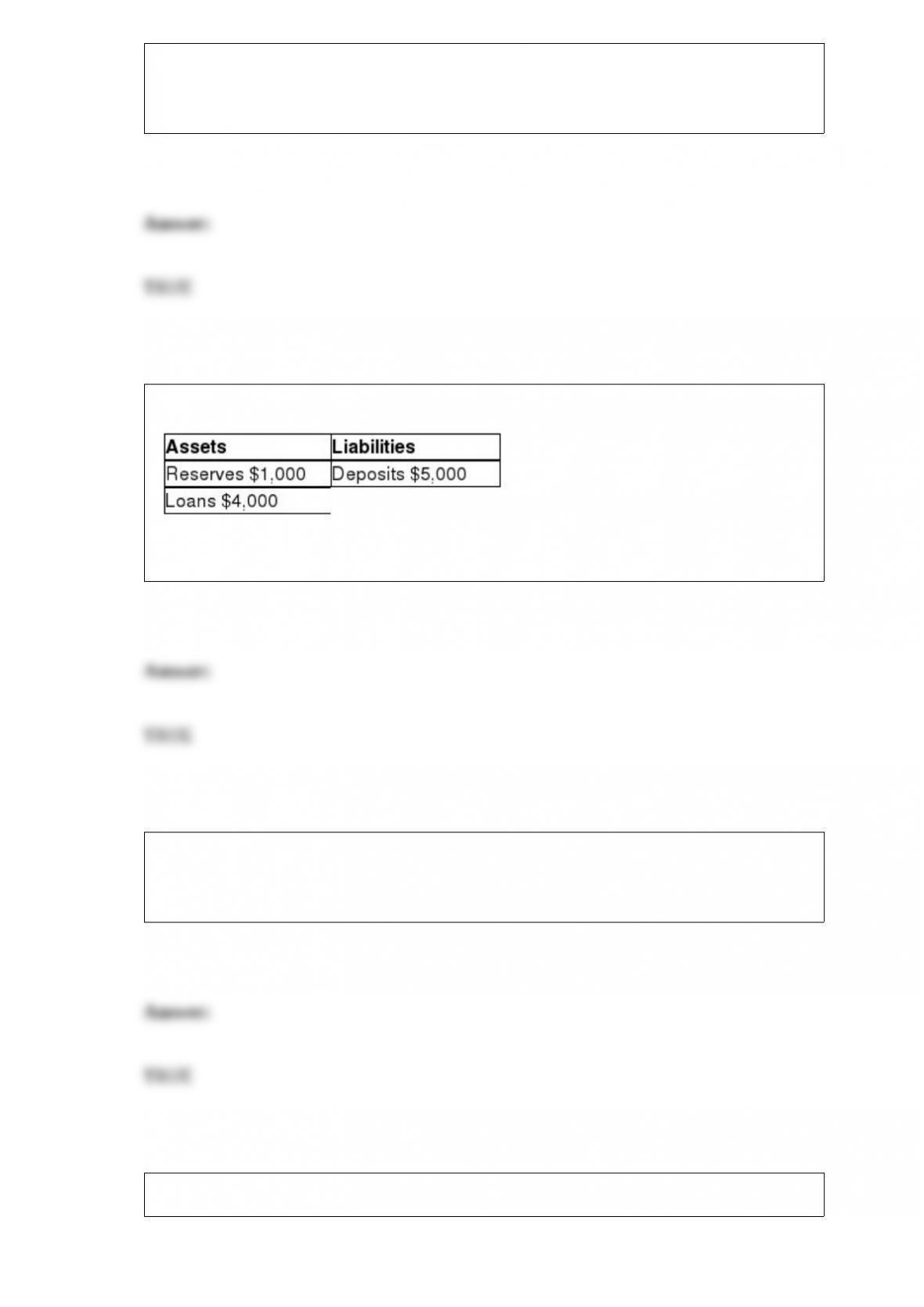
Consider the following T-account for a bank:
If the required reserve ratio is 20 percent and the bank is holding no excess reserves, the
bank at this point can make no more loans.
In response to a surplus the market price of a good will fall; as the price falls, the
quantity demanded will increase and quantity supplies will decrease until equilibrium is
reached.
If the multiplier is 5, the marginal propensity to consume must be 0.8.

The government makes all economic decisions in a market economy.
Fiscal policy has a greater impact in a closed economy than it does in an open economy.
One way by which firms differentiate their products is to find a market niche.
Suppose that to increase sales of hybrid vehicles, auto manufacturers are offering large
cash incentives. This is an example of a macroeconomics topic.

The Fed has adopted an interest rate target for most of the time since World War II.
Perfect competition is characterized by all of the following except
A) heavy advertising by individual sellers.
B) homogeneous products.
C) sellers are price takers.
D) a horizontal demand curve for individual sellers.
Which of the following describes how a negative externality affects a competitive
market?
A) The externality causes a difference between the private cost of production and the
social cost.
B) The externality causes a difference between the private cost of production and the
private benefit from consumption.
C) The externality causes consumer surplus to exceed producer surplus.

D) The externality causes a difference between the private cost of production and the
equilibrium price.
If the nominal interest rate is 6% and the inflation rate is 2% then the real interest rate is
A) 8%.
B) 4%.
C) 3%.
D) 2%.
E) 1%.
Suppose a bank has $100 million in checking account deposits with no excess reserves
and the required reserve ratio is 20 percent. If the Federal Reserve reduces the required
reserve ratio to 15 percent, then the bank will now have excess reserves of
A) $0.
B) $5 million.
C) $15 million.
D) $20 million.

A decision by foreign central banks to sell their holdings of U.S. Treasury bonds will
A) lower bond prices and interest rates in the United States.
B) increase bond prices and interest rates in the United States.
C) increase bond prices and lower interest rates in the United States.
D) lower bond prices and increase interest rates in the United States.
Which of the following will not happen as a consequence of a monopolistically
competitive firm suffering economic losses in the short run?
A) The firm’s demand curve will shift to the right if it stays in business in the long run.
B) The firm will exit the industry if it continues to suffer economic losses.
C) The firm will break even if its stays in business in the long run.
D) In the long run the firm will be able to charge a price that is greater than its average
total cost.
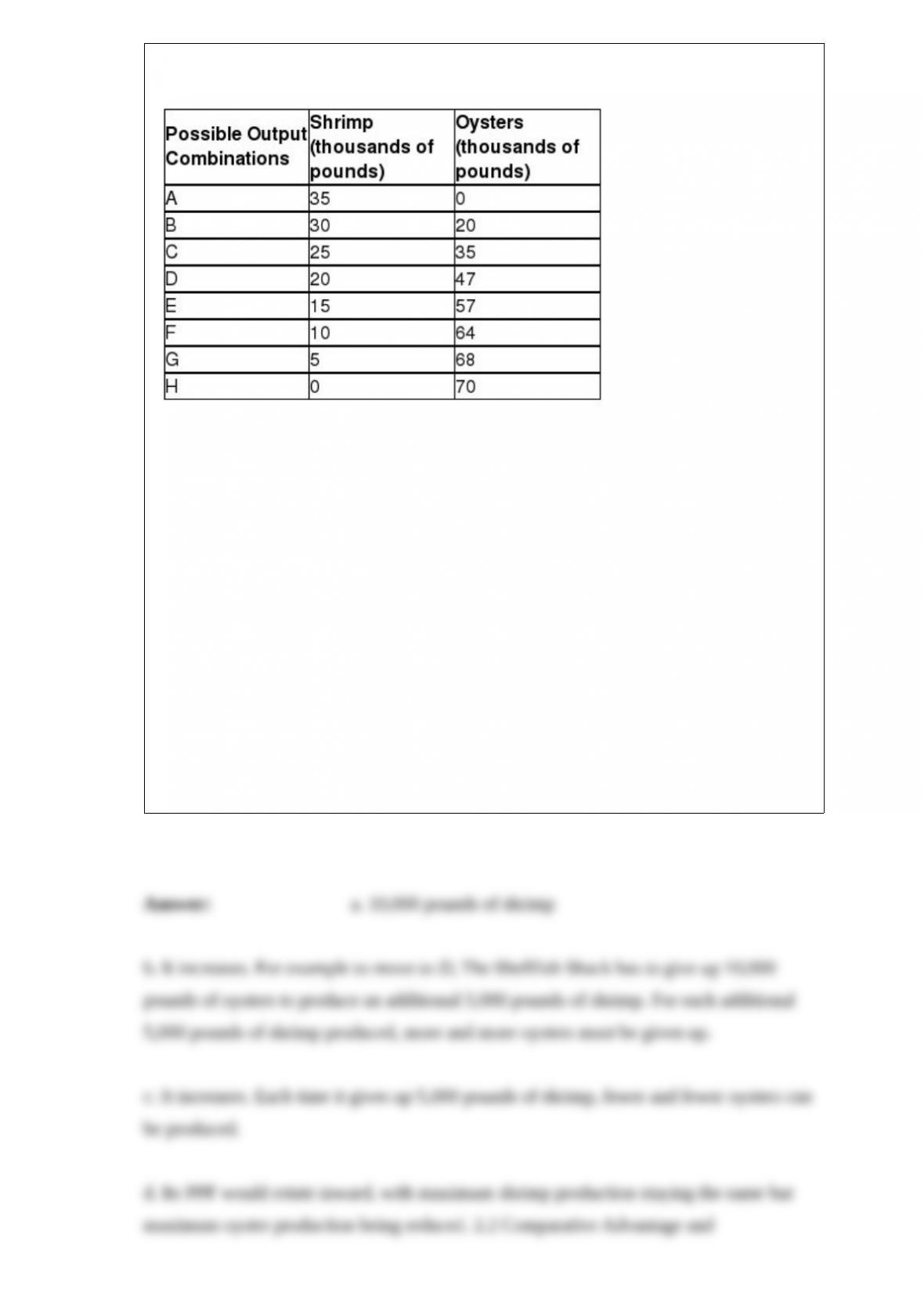
Table 2-5
The Shellfish Shack produces only shrimp and oysters. The table aboveshows the
maximum possible output combinations of the two types of shellfish using all resources
and currently available technology. a. Suppose The Shellfish Shack is currently
producing at point E. What is the opportunity cost of producing an additional 11,000
pounds of oysters?
b. Suppose The Shellfish Shack is currently producing at point E. What happens to the
opportunity cost of producing more and more shrimp? Does it increase, decrease or
remain constant? Explain your answer.
c. Suppose The Shellfish Shack is currently producing at point B. What happens to the
opportunity cost of producing more and more oysters? Does it increase, decrease or
remain constant? Explain your answer.
d. Suppose The Shellfish Shack is plagued by a disease which destroys oyster beds but
not shrimp habitats. What would happen to its PPF?
The difference between GDP and net taxes is
A) personal income.
B) actual investment spending.
C) disposable income.
D) unplanned investment spending.
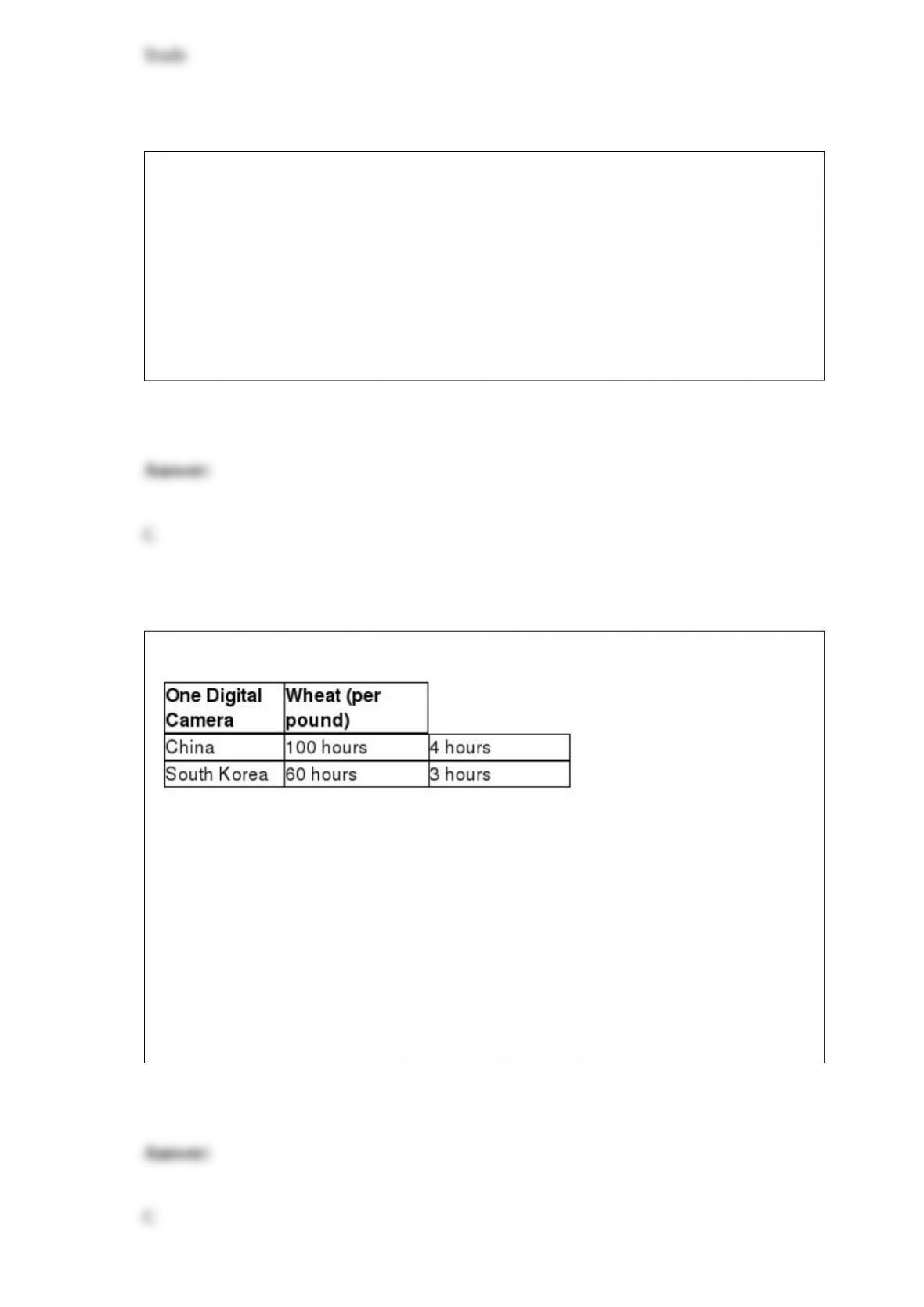
Table 2-8
Table 2-8 shows the number of labor hours required to produce a digital camera and a
pound of wheat in China and South Korea. Does either China or South Korea have an
absolute advantage and if so, in what product?
A) South Korea has an absolute advantage in wheat.
B) China has an absolute advantage in wheat.
C) South Korea has an absolute advantage in both products.
D) China has an absolute advantage in digital cameras.

If the Phillips curve represents a ‘structural relationship,” then
A) the trade-off between unemployment and inflation is permanent.
B) the trade-off between unemployment and inflation holds only for the short run.
C) the trade-off between unemployment and inflation holds in the long run, but not in
the short run.
D) the Phillips curve will be vertical in the long run.
________ is the ability of an individual, a firm, or a country to produce a good or
service at a lower opportunity cost than competitors.
A) Absolute advantage
B) Specialization
C) Autarky
D) Comparative advantage
Suppose a competitive firm is paying a wage of $12 an hour. Assume that labor is the
only input. If hiring another worker would increase output by four units per hour, then
to maximize profits the firm should
A) not change the number of workers it currently hires.

B) hire the extra worker.
C) layoff some workers.
D) There is not enough information to answer the question.
In the countries that have adopted inflation targeting, the inflation rate has typically
A) increased.
B) decreased.
C) decreased to zero.
D) not changed.
Increases in government spending result in ________ in the short run, and permanent
increases in government spending result in ________ in the long run.
A) partial crowding out; partial crowding out
B) partial crowding out; complete crowding out
C) complete crowding out; complete crowding out
D) complete crowding out; partial crowding out
Select the phrase that correctly completes the following statement. “A decrease in the
expected future price caused an increase in the supply of smartphones. As a result,
A) the price of smartphones decreased and the demand for smartphones increased.”
B) the equilibrium quantity of smartphones decreased.”
C) the price of smartphones decreased and the quantity demanded of smartphones
increased.”
D) the price of smartphones decreased. The lower price caused the supply of
smartphones to decrease.”
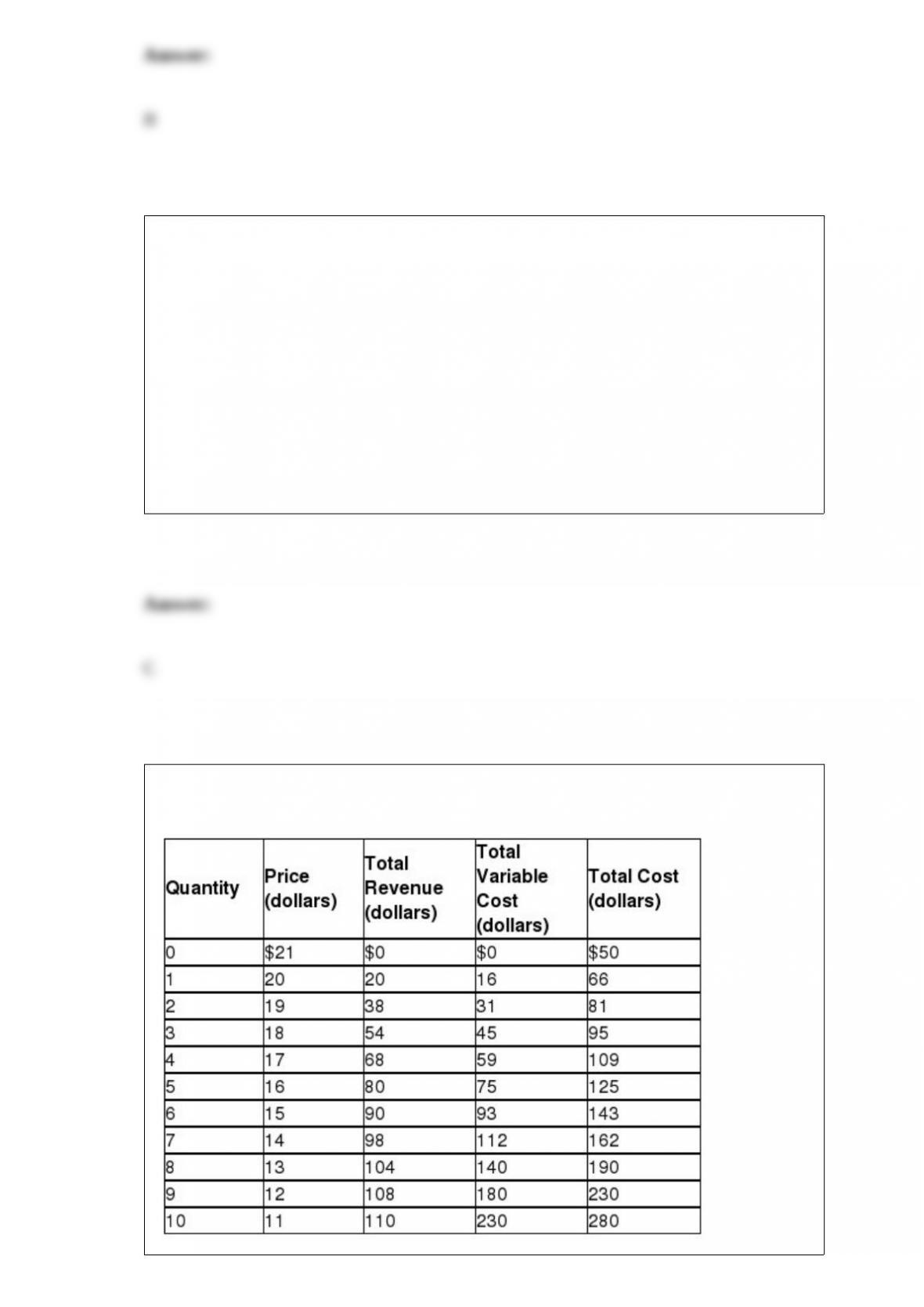
Table 13-3

Table 13-3 shows the demand and cost schedules for a monopolistically competitive
firm.
What is the best course of action for the firm in the short run?
A) It should shut down.
B) It should stay in business because it covers some of its fixed cost.
C) It should increase its sales by lowering its price.
D) It should not cut its price, but it should increase its sales by advertising.
Assume that Bulgaria has a comparative advantage in producing sandals and Finland
imports sandals from Bulgaria. We can conclude that
A) Bulgaria also has an absolute advantage in producing sandals relative to Finland.
B) Bulgaria has a lower opportunity cost of producing sandals relative to Finland.
C) Finland has an absolute disadvantage in producing sandals relative to Bulgaria.
D) labor costs are higher for sandal producers in Finland than in Bulgaria.
Compare two situations. (A) A firm is not legally responsible for damages that result
from air pollution caused by its production of steel. (B) A firm is legally responsible for
damages that result from its production of steel. Ronald Coase argued that
A) bargaining between the firm and the victims of the air pollution caused by the firm
will result in little reduction of pollution in either situation (A) or (B) because the firm

has greater economic and political power than the victims.
B) bargaining between the firm and the victims of the air pollution caused by the firm
would lead to a greater reduction in pollution in situation (A) than situation (B).
C) bargaining between the firm and the victims of the air pollution caused by the firm
would lead to a smaller reduction in pollution in situation (A) than situation (B).
D) bargaining between the firm and the victims of the air pollution caused by the firm
would lead to an equal reduction in pollution in situation (A) and situation (B).
The branch of economics which studies how households and firms interact in markets is
called
A) macroeconomics.
B) microeconomics.
C) positive economics.
D) normative economics.
A country with no trade and no borrowing and lending relationships with other
countries is known as a(n)
A) planned economy.
B) market economy.
C) open economy.
D) closed economy.
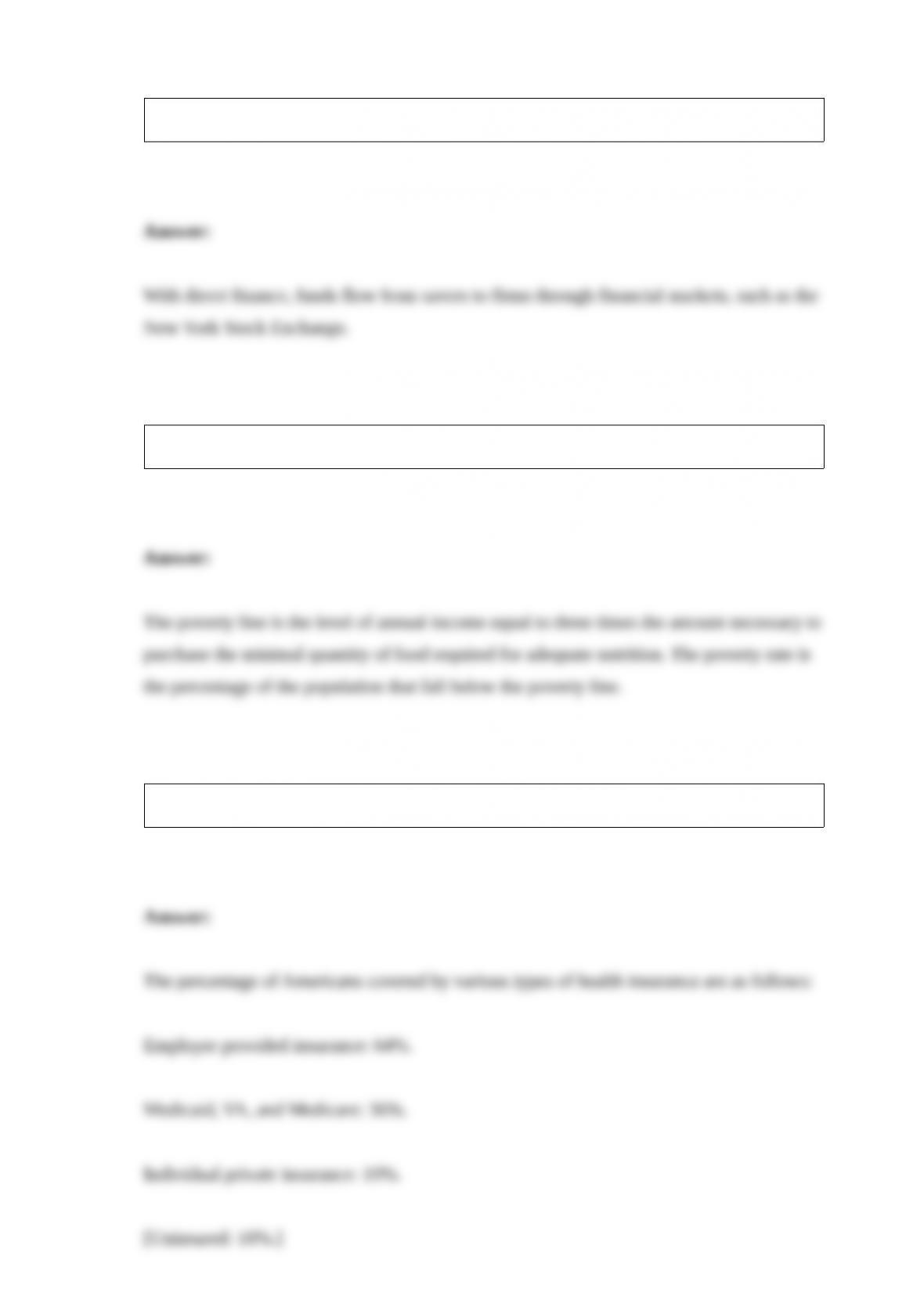
Starting from long-run equilibrium, use the basic aggregate demand and aggregate
supply diagram to show what happens in both the long run and the short run when there
is an increase in wealth.
How does a firm raise external funds through direct finance?
What is the difference between the poverty line and the poverty rate?
What are the main sources of health insurance in the United States?
Suppose the United States experiences a long period of inflation relative to other
countries. How will this affect U.S. net exports?