The efficient level of pollution is the quantity at which:
A) its total benefits exceed its total costs to society by the greatest possible amount.
B) its total benefits to society equal its total costs to society.
C) the marginal social benefit of an additional unit of pollution is greater than the
marginal social cost of the additional unit.
D) the marginal social benefit of an additional unit of pollution is less than the marginal
social cost of the additional unit.
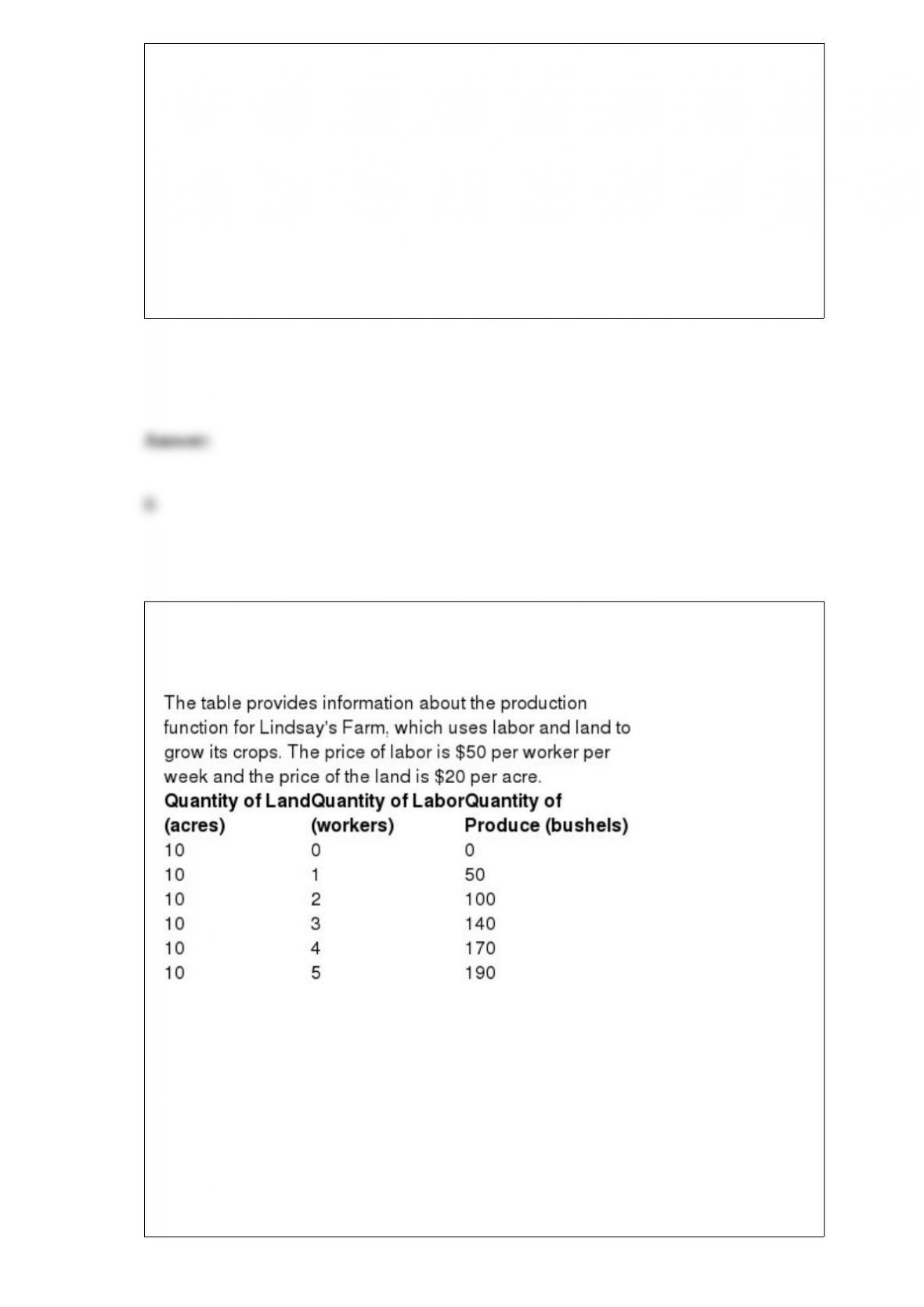
Table: Lindsay’s Farm
(Table: Lindsay’s Farm) Look at the table Lindsay’s Farm. Lindsay’s fixed cost of
production is:
A) $200.
B) $450.
C) $2,500.
D) $2,700.
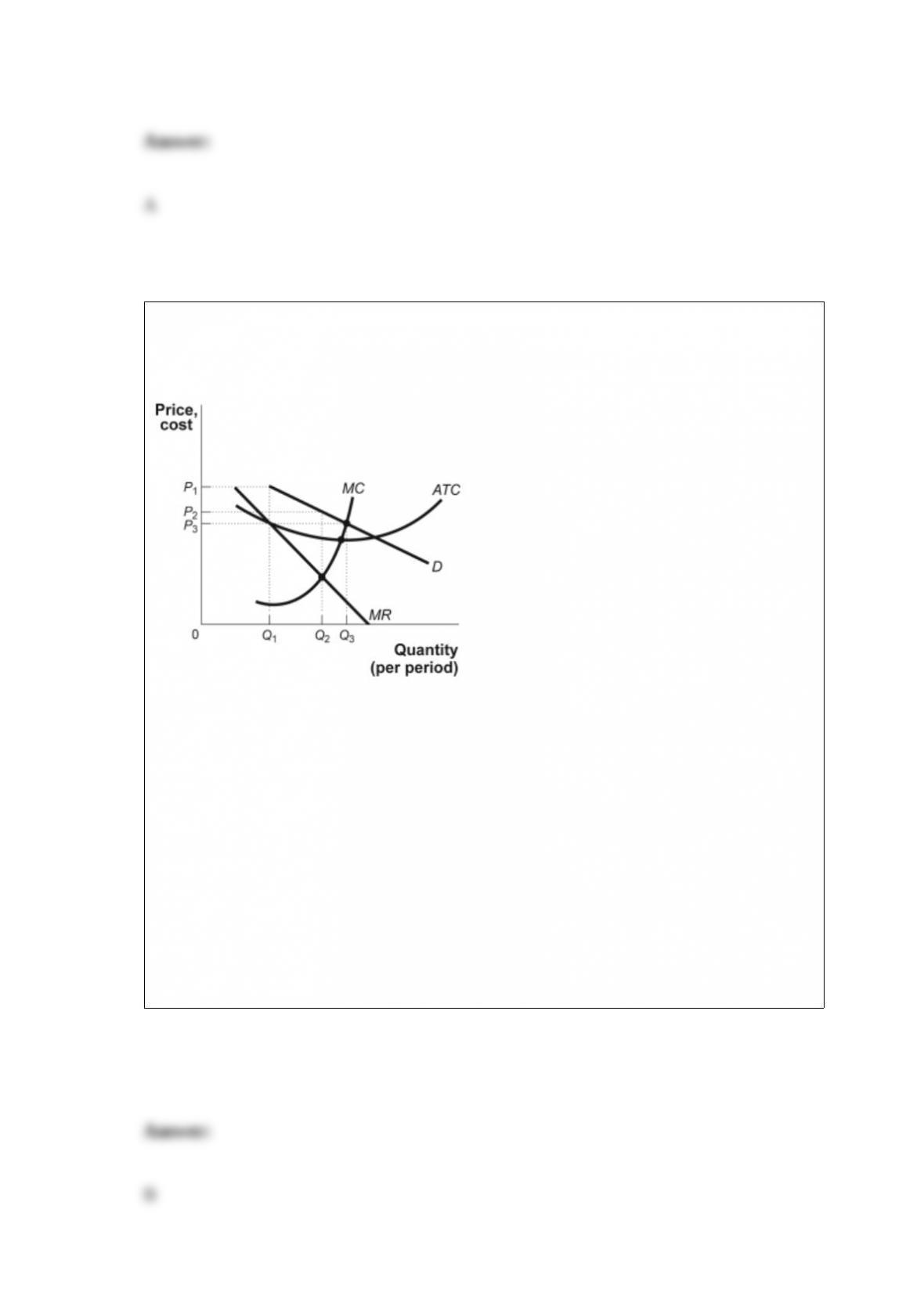
Figure: The Market for Gas Stations
(Figure: The Market for Gas Stations) Look at the figure The Market for Gas Stations.
Assume that the market for gas stations is characterized by many firms, differentiated
products, easy entry, and easy exit. For the typical gas station the profit-maximizing
price would be:
A) P1.
B) P2.
C) P3.
D) Not enough information is given to answer the question.
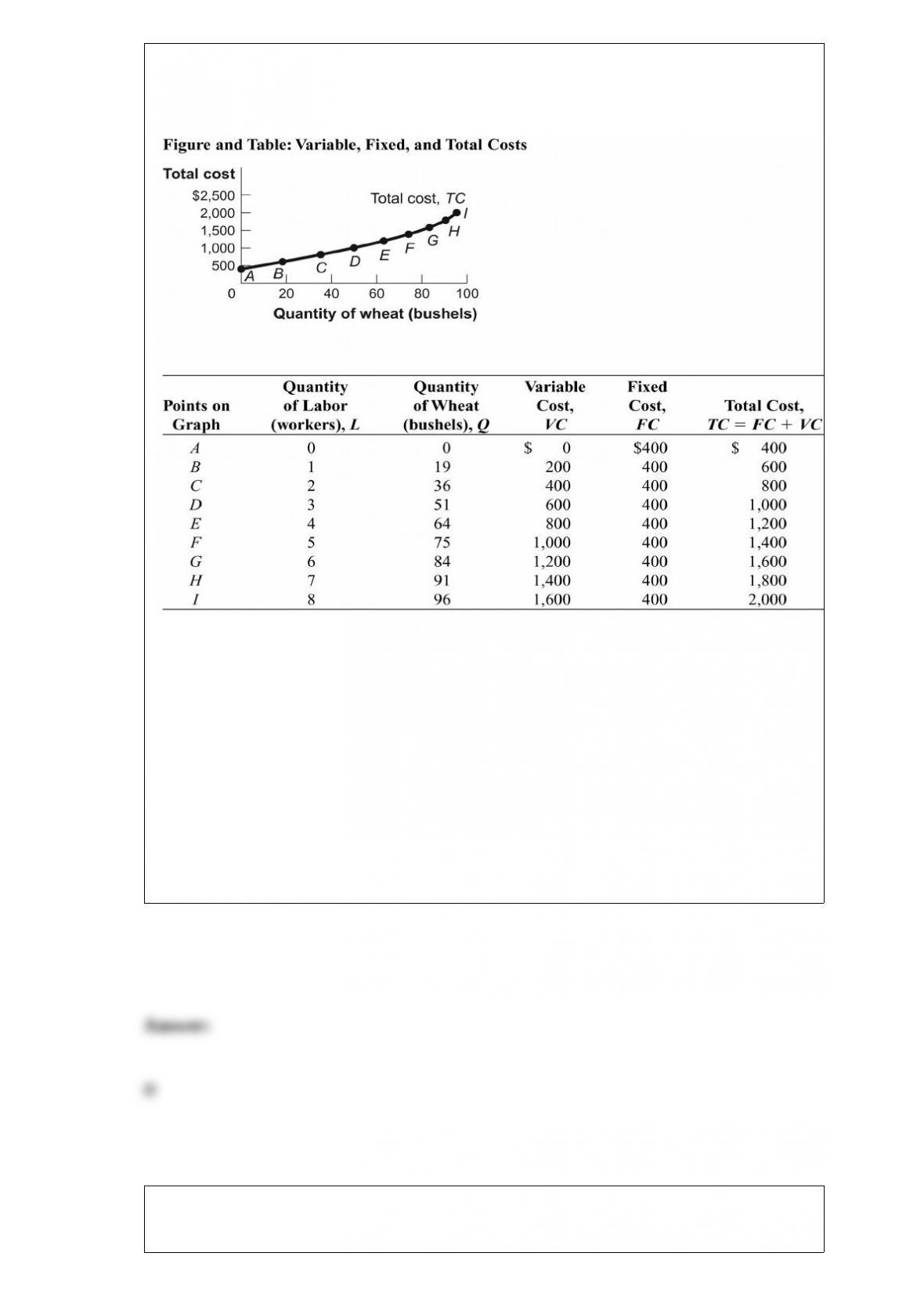
(Figure and Table: Variable, Fixed, and Total Costs) Look at the figure and table
Variable, Fixed, and Total Costs. The marginal cost of increasing production from 19 to
36 bushels of wheat is:
A) $23.53.
B) $11.76.
C) $22.22.
D) $11.11.
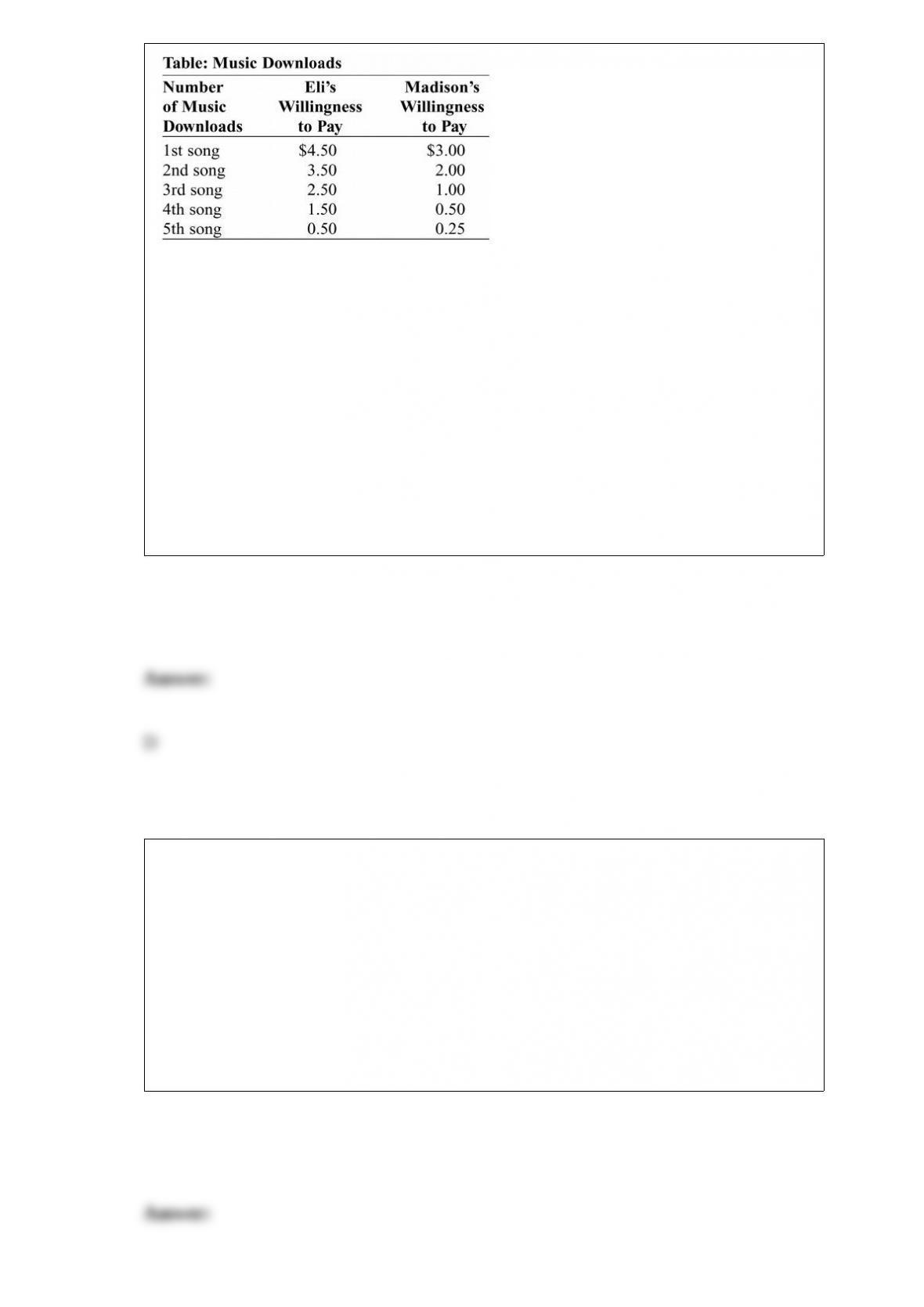
(Table: Music Downloads) Two consumers, Eli and Madison, like to download songs to
their iPhones, and the table Music Downloads represents their willingness to pay for
each downloaded song. If an individual song can be downloaded for $1, what is the
total consumer surplus received by these consumers?
A) $19.25
B) $18
C) $10
D) $11
Which of the following is TRUE?
A) Profit per unit is price minus MC.
B) Total economic profit is per-unit profit times quantity.
C) If price is less than ATC, the firm will break even in the short run.
D) If price is less than marginal cost, the perfectly competitive firm should raise the
price and increase output.

Which of the following is TRUE?
A) For choosing the profit-maximizing quantity, the short-run decision-making process
of a firm in perfect competition is the same as that of a firm in monopolistic
competition, since they produce so that P > MC.
B) In the long run in perfect competition, economic profits equal zero, and in
monopolistic competition in the long run, economic profits are very large.
C) In perfect competition, P = MC, and in monopolistic competition, MR = MC, but P >
MC and there is excess capacity.
D) In both perfect competition and monopolistic competition, P equals minimum
average total cost in the long run.
The NFL wants to give the “common fan” the opportunity to attend the Super Bowl, so
it sets Super Bowl prices “low”tickets for a regular seat at Super Bowl XXXVII cost
just $400. Scalpers, however, sell tickets for $1,500 or more. If there are no transaction
costs to selling a ticket, the true cost of a regular ticket to Super Bowl XXXVII is:
A) at most $400.
B) at least $1,500.
C) the monetary price paid to obtain the ticket.
D) $1,100 less than the opportunity cost of a ticket.

When people want more goods and services than are available, the economy undergoes
inflation. This statement best represents this economic concept:
A) Resources are scarce.
B) When markets don’t achieve efficiency, government intervention can improve
society’s welfare.
C) Overall spending sometimes gets out of line with the economy’s productive capacity.
D) Government policies can change spending.
Average variable cost equals all of the following EXCEPT:
A) variable cost divided by output.
B) the quantity total cost minus fixed cost divided by output.
C) average total cost minus average fixed cost.
D) variable cost times output.
An urbanized country has 100 million workers living on 100 square miles of land. A
country that is principally rural has 1 million workers living on 10 square miles of land.
From this information we know that the urbanized country is _____ relative to the rural
country.
A) land-abundant
B) labor-abundant
C) land-intensive
D) labor-intensive
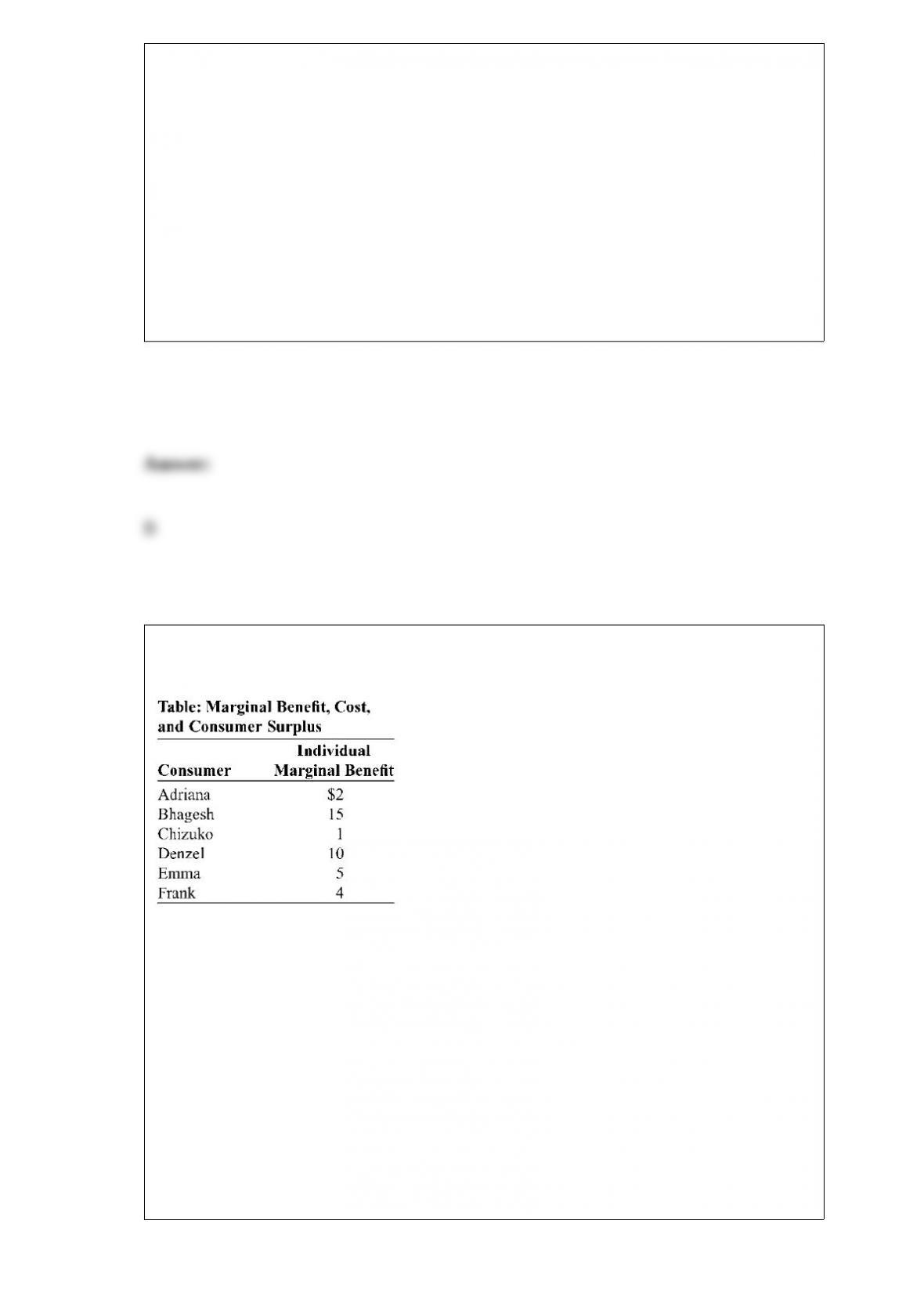
(Table: Marginal Benefit, Cost, and Consumer Surplus) The table Marginal Benefit,
Cost, and Consumer Surplus shows six consumers’ willingness to pay for one iTunes
download. If the marginal social cost is constant at _____, then _____ consumers will
purchase this good and consumer surplus is _____.
A) $4; four; $34
B) $2; five; $36
C) $5; five; $30
D) $2; five; $26

The _____ is widely used to measure income inequality.
A) Gini coefficient
B) median household income
C) poverty rate
D) ability-to-pay principle
Which of the following statements is TRUE?
A) If W < VMPL, the firm should hire more labor.
B) If W > VMPL, the firm should hire more labor.
C) If W = VMPL, the firm should hire more labor.
D) If W > 0, the firm should shut down.
A perfectly competitive firm will earn a profit in the short run when it produces the
profit-maximizing quantity of output and the price is:
A) greater than marginal cost.
B) less than marginal cost.
C) less than average variable cost.
D) greater than average total cost.
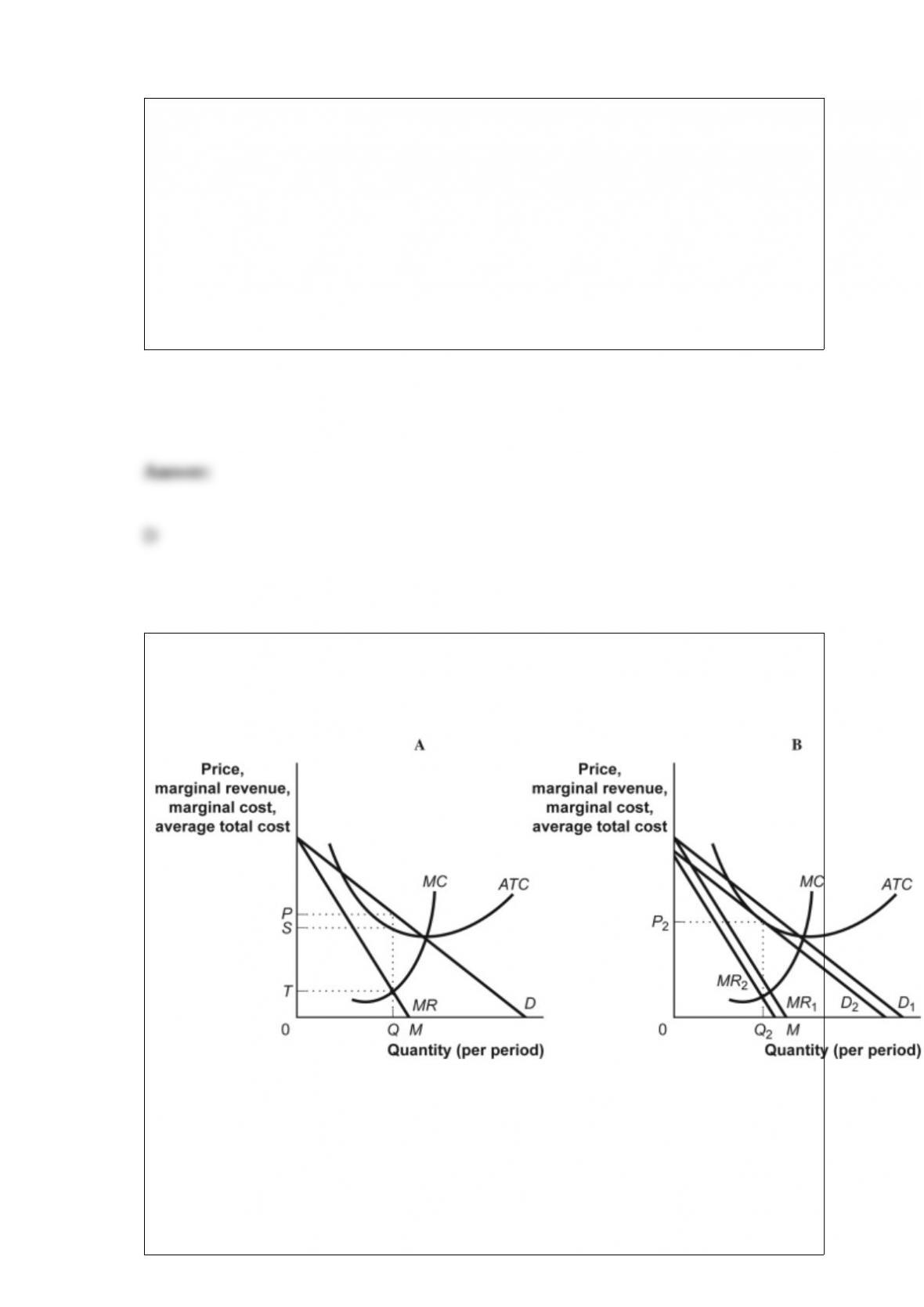
Figure: Profit Maximization in Monopolistic Competition
(Figure: Profit Maximization in Monopolistic Competition) Look at the figure Profit
Maximization in Monopolistic Competition. If other firms see economic profits in the
industry, they will enter it, and the demand curve for firms already in the industry will
shift to the _____; in the long run, this will result in an economic profit _____ and a
price _____.
A) right; equal to zero; equal to ATC
B) right; greater than zero; greater than ATC
C) left; less than zero; less than ATC
D) left; equal to zero; equal to ATC
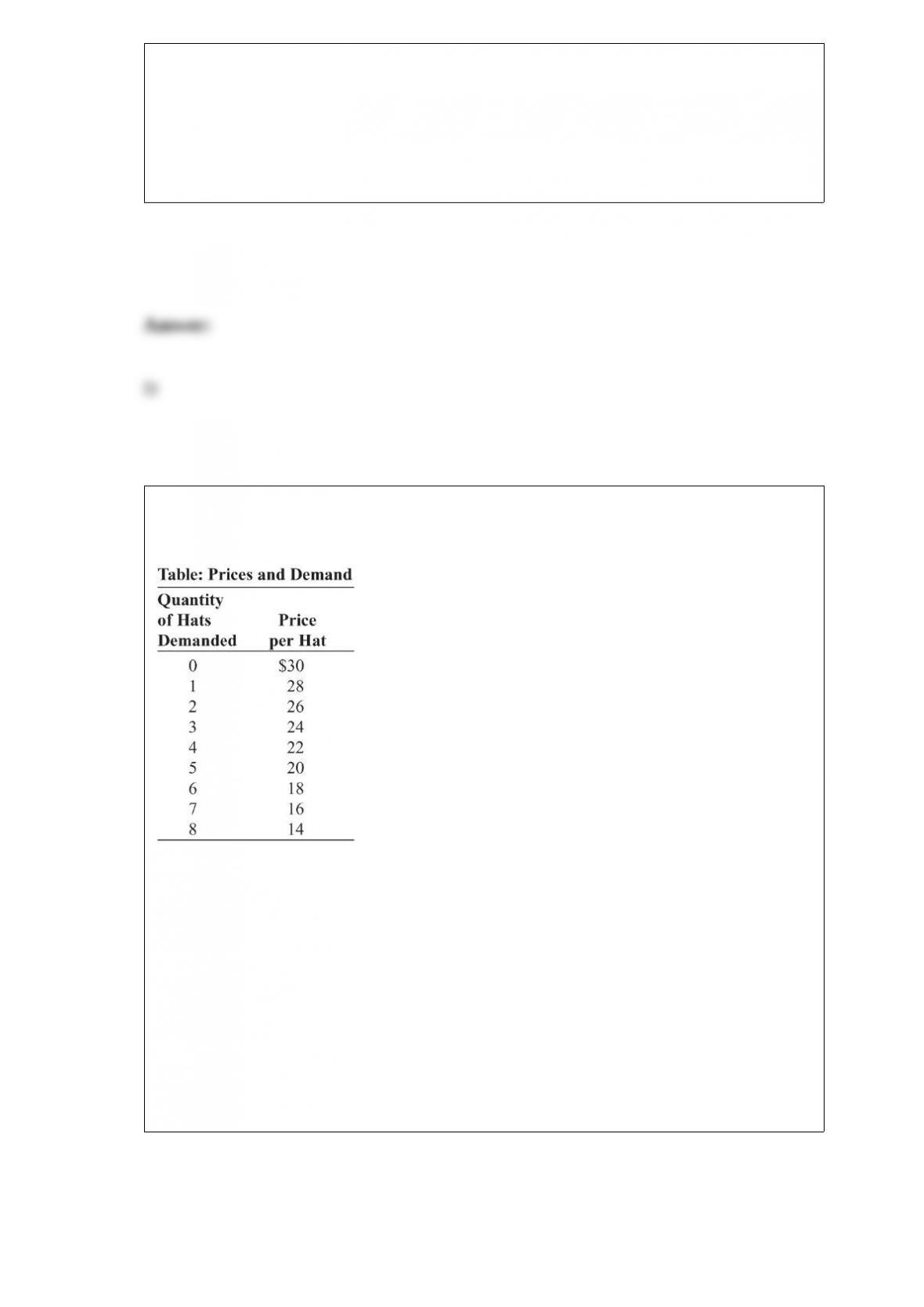
(Table: Prices and Demand) The New Orleans Saints have a monopoly on Saints logo
hats. The marginal cost of producing a hat is $18. If the Saints increase the number of
hats they sell from four to five, marginal revenue is:
A) $20.
B) $22.
C) $8.
D) $12.
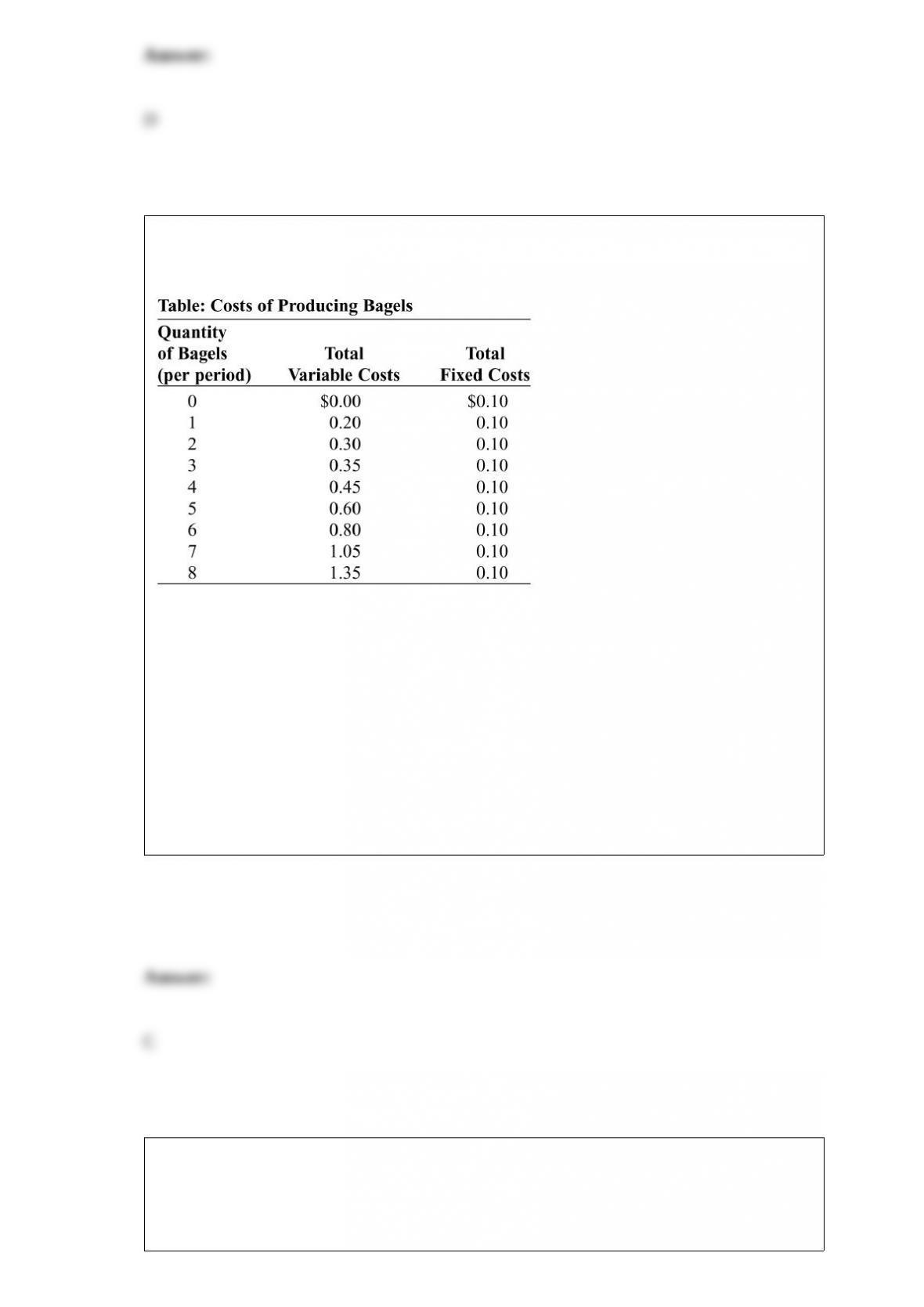
(Table: Costs of Producing Bagels) Look at the table Cost of Producing Bagels. The
marginal cost of producing the sixth bagel is:
A) $0.10.
B) $0.15.
C) $0.20.
D) $0.80.
Specialization and trade usually lead to:
A) lower economic growth.

B) the exchange of goods and services in markets.
C) lower living standards.
D) higher prices.
The richest 20% of families in the United States pay a much _____ share of total
income taxes collected and a _____ share of FICA taxes than their share of total
income.
A) higher; lower
B) lower; higher
C) higher; higher
D) lower; lower
Which of the following statements is TRUE?
A) The concept of equilibrium requires that all individuals have an equal amount of
income.
B) If a market is in equilibrium, the price in that market will not fluctuate by more than
5%.
C) If a market is in equilibrium, there will be no remaining opportunities for individuals

to make themselves better off.
D) A market is in equilibrium when the number of buyers is equal to the number of
sellers.
If Japan levies tariffs on U.S. goods entering Japan, this will tend in the short run to
_____ U.S. producers and _____ Japanese producers.
A) benefit; benefit
B) damage; benefit
C) benefit; damage
D) damage; damage
Prices are important economic signals because they convey information about how
much producers are willing to pay for a good and how much it costs consumers to
produce a good.

The deadweight loss from an excise tax comes about because:
A) the number of transactions in the market is smaller than the no-tax equilibrium.
B) some mutually beneficial transactions do not take place.
C) a quota rent exists.
D) the number of transactions in the market is reduced and some mutually beneficial
transactions do not take place.
The curve that illustrates the relationship between output and average total cost when
the fixed cost has been chosen to minimize average total cost for each level of output is
the _____ curve.
A) short-run average total cost
B) long-run average total cost
C) marginal cost
D) total product

Scenario: Tom’s Budget Constraint
Tom is trying to decide how to allocate his $50 budget for music downloads and online
movie streaming when the price of a music download is $1 and the price of a movie is
$5.
(Scenario: Tom’s Budget Constraint) Read the scenario Tom’s Budget Constraint. If we
measure music downloads on the horizontal axis and movies on the vertical axis, the
slope of Tom’s budget line is:
A) “10.
B) “1/5.
C) “2.
D) “1/2.
A monopolistic competitor will advertise to:
A) reduce excess capacity.
B) increase demand for its product.
C) collude more effectively with other firms.
D) produce on the upward-sloping portion of its ATC curve.

The total product curve:
A) shows the relation between output and the quantity of a variable input for varying
levels of the fixed input.
B) will become flatter as output increases if there are diminishing returns to the variable
input.
C) will be downward-sloping if there are diminishing returns to the variable input.
D) will become horizontal when the marginal product of the variable input is constant.
On hot summer days, beach parking lots are usually full by early morning even though
one must pay to park there. Parking at such lots is _____ in consumption and _____.
A) rival; nonexcludable
B) rival; excludable
C) nonrival; nonexcludable
D) nonrival; excludable

Paolo owns a pizza shop. The price of pizza recently increased from $3 to $5 a slice.
Paolo responded by increasing the quantity of slices he supplied from 100 to 150 slices
per day. By the midpoint method, Paolo’s price elasticity of supply is:
A) 1.25.
B) 0.8.
C) 0.75.
D) 2.5.