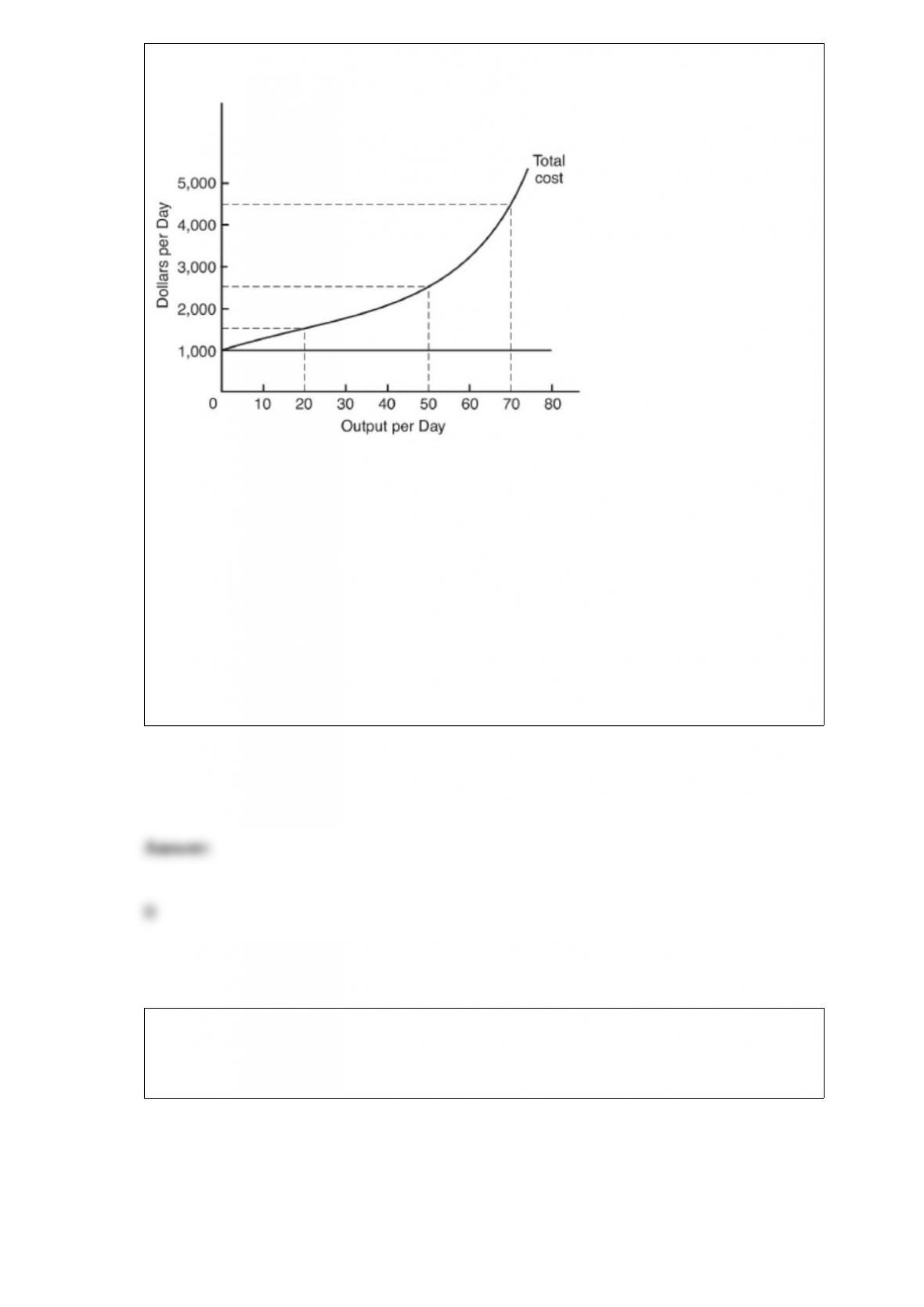
The following questions are based on the following graph:
Cost divided by output is ________ cost.
a. marginal
b. average
c. total
d. deflated
e. sunk
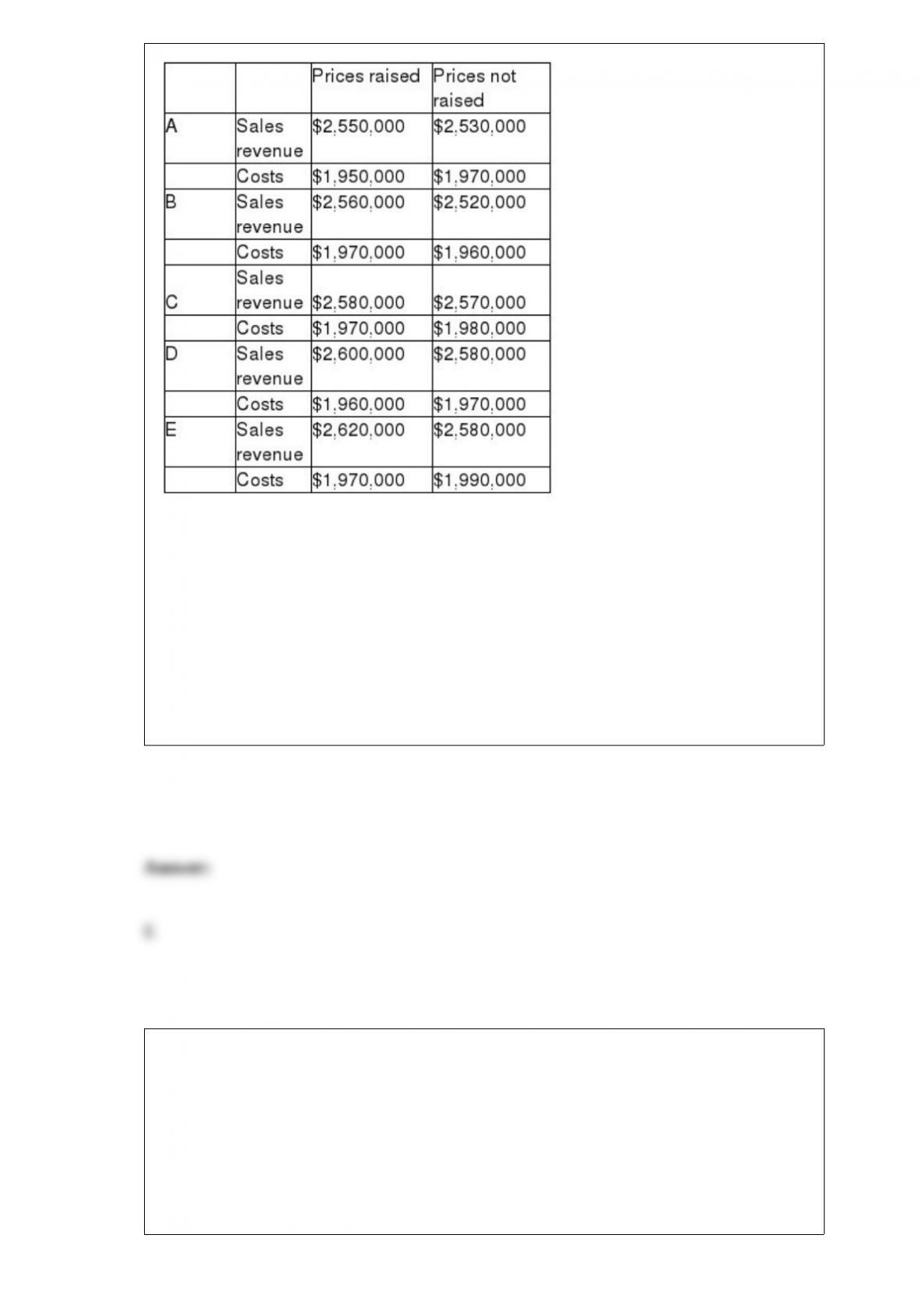
Ampere Electronics estimates that it costs $50,000 to change its catalogs, price lists,
and billing system when it changes prices. Under which of the following situations
would a price increase be clearly profitable?
a. A
b. B
c. C
d. D
e. E
During a period when total spending is too high relative to potential output, the
economy experiences
a. excessive unemployment.
b. falling average prices.
c. a glut.
d. a Great Crash.
e. inflation.

If, under the gold standard, the United States was importing more from Britain than it
was exporting to Britain, price levels in the United States and Britain would,
respectively
a. rise and rise.
b. remain unchanged and rise.
c. remain unchanged and fall.
d. fall and rise.
e. rise and fall.
New methods of producing existing products and new designs that make it possible to
create new products are best regarded as examples of
a. innovation.
b. investment.
c. technological change.
d. supply-side economics.
e. asymmetric information.

In general, financial institutions
a. exclude those businesses that lend to the public.
b. act as intermediaries between savers and investors.
c. number fewer than a thousand in the United States.
d. hold reserves equal to the value of checkable deposits.
e. operate as nonprofit institutions for the public good.
Public goods are generally financed by
a. user charges.
b. voluntary contributions.
c. the price system.
d. a tax system.
e. nothing; a public good is by definition costless.

When currency is deposited into a demand deposit account
a. it is a sign that a run on the bank has begun.
b. the money supply will fall.
c. the Federal Reserve System must borrow.
d. bank reserves increase.
e. it is no longer serving as a standard of value.
The main reason that Ford lost a large share of his market to General Motors is that
a. Ford misjudged the market and raised prices when he should not have.
b. General Motors’ product offered more quality for the money.
c. Ford resisted the trend toward mass production.
d. General Motors offered product diversity.
e. Ford spent excessive amounts of money on advertising.

Increases in the rate of interest
a. make it more profitable for firms to invest in new projects.
b. raise the expected rates of return on existing projects.
c. cause net investment to exceed gross investment.
d. raise the equilibrium levels of GDP.
e. tend to reduce the amount of investment.
The major source of revenue for state governments is ________ taxes.
a. personal income
b. sales
c. property
d. inheritance
e. import
A firm dumping pollutants into a stream, thereby rendering the water unfit for use by
those downstream, would be an example of a(n)

a. unfair distribution of income.
b. positive externality.
c. external diseconomy.
d. public good.
e. transfer payment.
Under a system of fixed exchange rates, a balance-of-payments surplus means that a
country’s currency is
a. partially valued.
b. undervalued.
c. overvalued.
d. devalued.
e. revalued.
The following questions are based on the following diagram illustrating the results of a
study of food expenditures and income for a group of families:
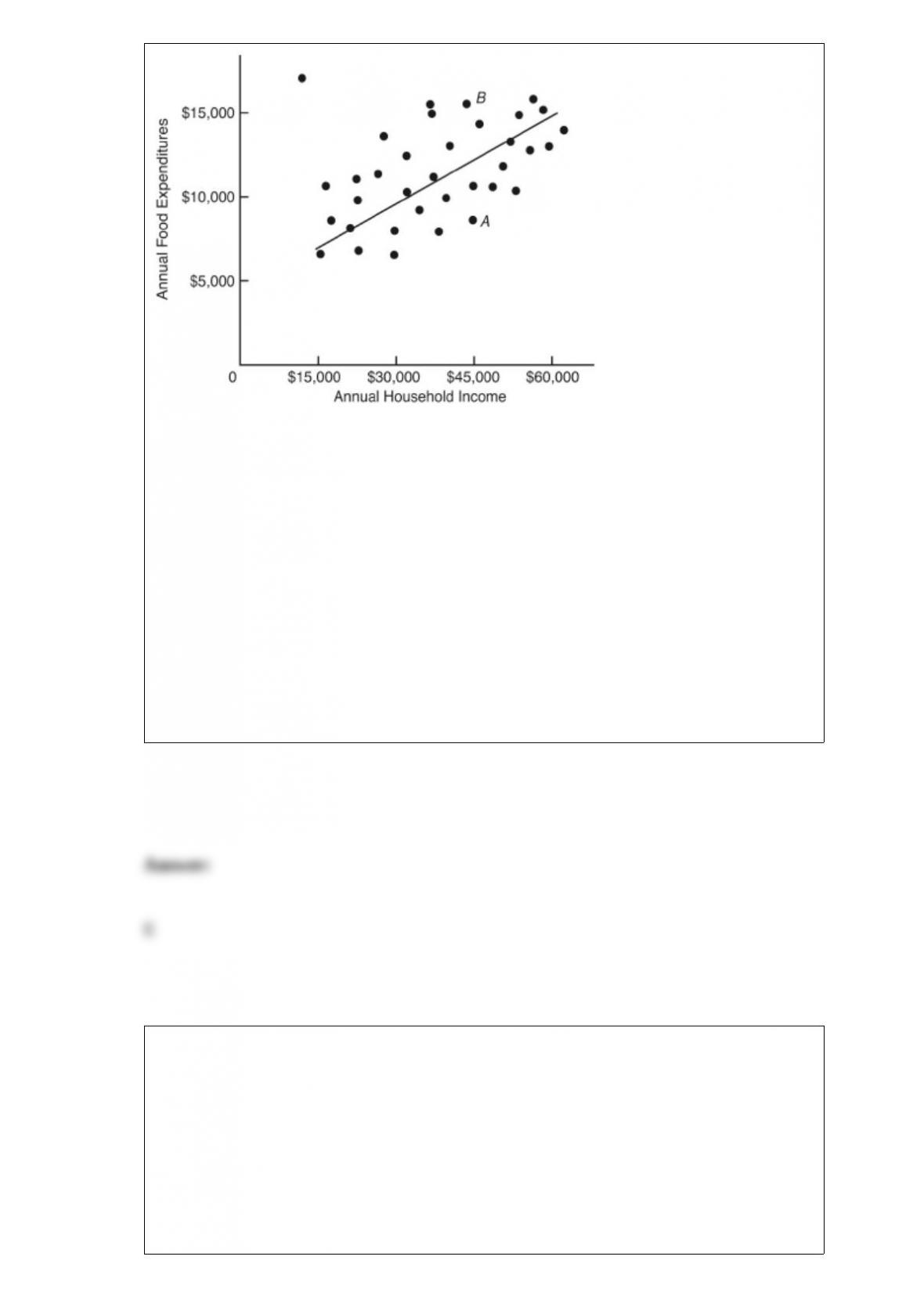
The evidence presented in
the graph indicates that
a. all families at a given income level spend the same amount on food.
b. the amount of household income depends on the amount of household food
expenditures.
c. an inverse relationship exists between the two variables.
d. for the families included in the study, no relationship exists between food
expenditures and income.
e. if income falls an average of $15,000, annual food expenditures will fall an average
of $2,500.
If overall labor productivity is increasing at an average rate of 3 percent per year but by
only
1 percent per year in the shoe manufacturing industry, then under the Kennedy-Johnson
guidelines, wages of shoe workers should increase by ________ percent per year; prices
of
shoes should ________.

a. 1; not change
b. 1; increase by 1 percent per year
c. 3; increase by 2 percent per year
d. 3; not change
e. 3; decrease by 2 percent per year
One explanation for why product prices adjust slowly is that
a. most markets are perfectly competitive.
b. businesses incur menu costs when they change prices.
c. markets clear continuously, making price adjustments difficult.
d. if wages adjust rapidly, prices take a while to catch up.
e. most markets are subject to government price control laws.
Significant changes in the price of major raw materials such as oil or agricultural goods
are often referred to as
a. price ceilings.
b. supply shocks.
c. menu costs.
d. barometric spirals.
e. externalities.
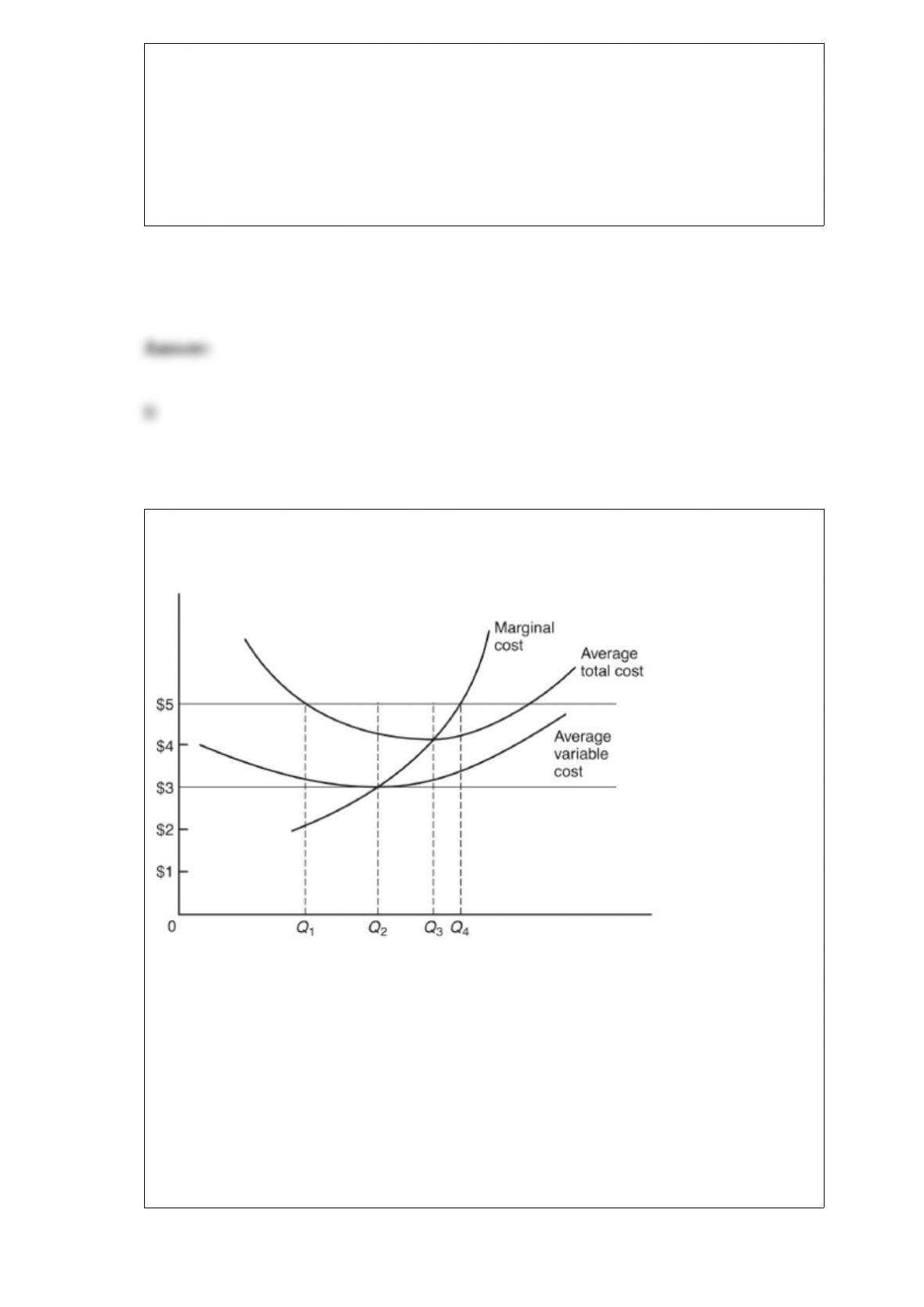
The following questions are based on the following diagram showing the short-run cost
curves for a perfectly competitive firm:
At what price per
unit would the firm find it no more profitable to operate than NOT to operate?
a. $1
b. $2
c. $3
d. $4
e. $5

In a simple Keynesian model, an increase in government spending, other things being
equal
a. increases the equilibrium GDP by a multiplier effect.
b. alters the composition of, but not the total amount of, intended spending.
c. shifts the C + I + G line downward.
d. pushes the aggregate demand curve to the left, causing price levels to fall.
e. changes the angle of the 45-degree line.
Which of the following government policies discourages technological innovation?
a. research and development tax credits
b. expansion of relevant work in government laboratories
c. grants and contracts from government agencies to support civilian technology
d. measures to reduce after-tax costs of plant and equipment
e. encouragement of higher rates of inflation to promote rising profits

A firm given exclusive rights by the government to do business in a particular area is
a(n) ________ monopoly.
a. patent
b. output
c. natural
d. franchise
e. input
If national output is fixed and there is a 10 percent increase in total spending, the price
level will
a. fall by 10 percent.
b. remain constant.
c. rise by 10 percent.
d. rise by 10 percent times the multiplier.
e. rise by 10 percent times the dollar value of output.
A business firm owned by a single individual is called a
a. monopoly.
b. closed shop.
c. proprietorship.
d. plant.
e. trust.
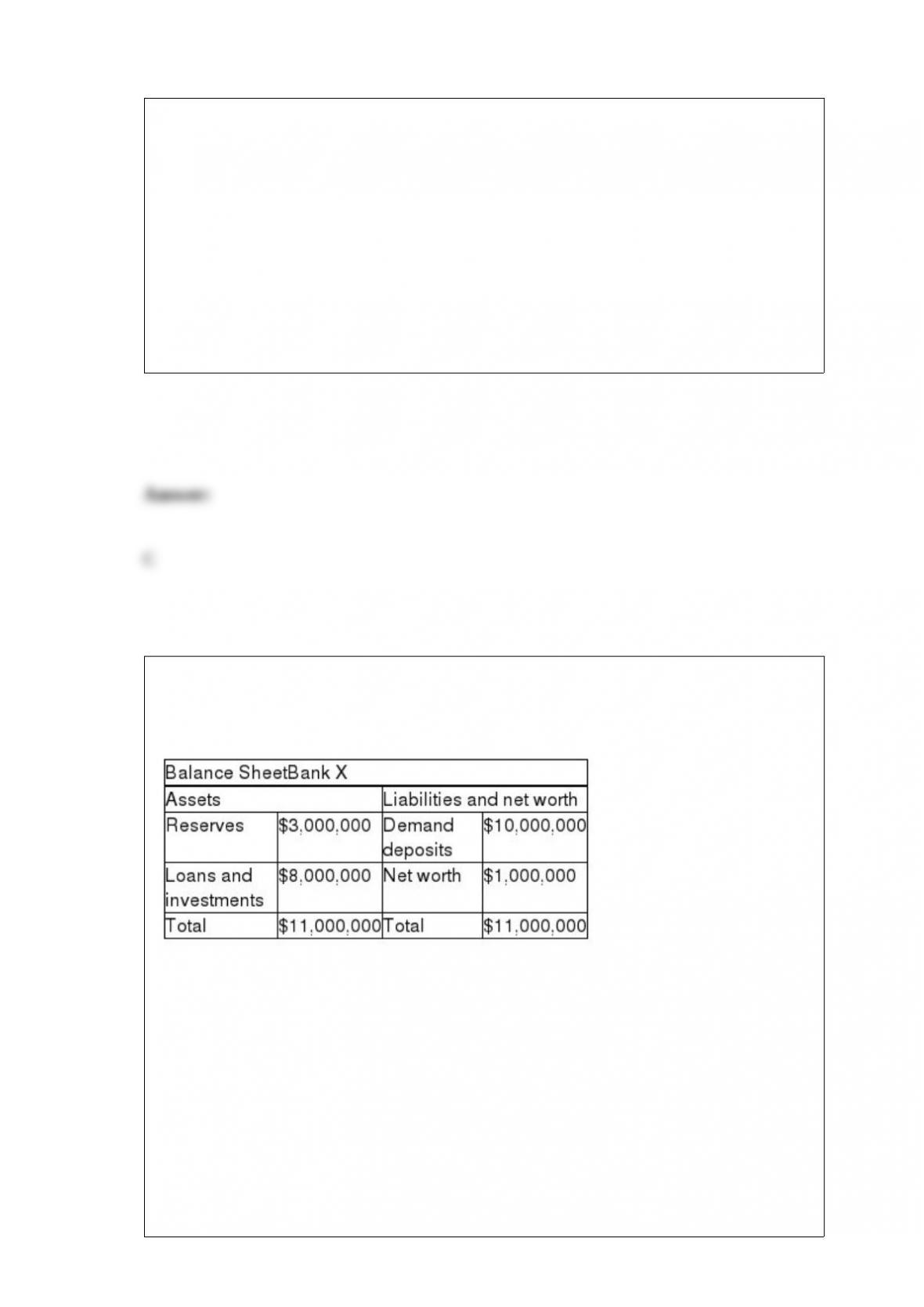
The following questions refer to the table that follows. Assume that there is a
fractional-reserve banking system, that the legal reserve requirements are 10 percent,
and that the balance sheet for Bank X is as follows:
Bank X has excess reserves of
a. $3,000,000.
b. $2,000,000.
c. $1,667,000.
d. $1,000,000.
e. $0.
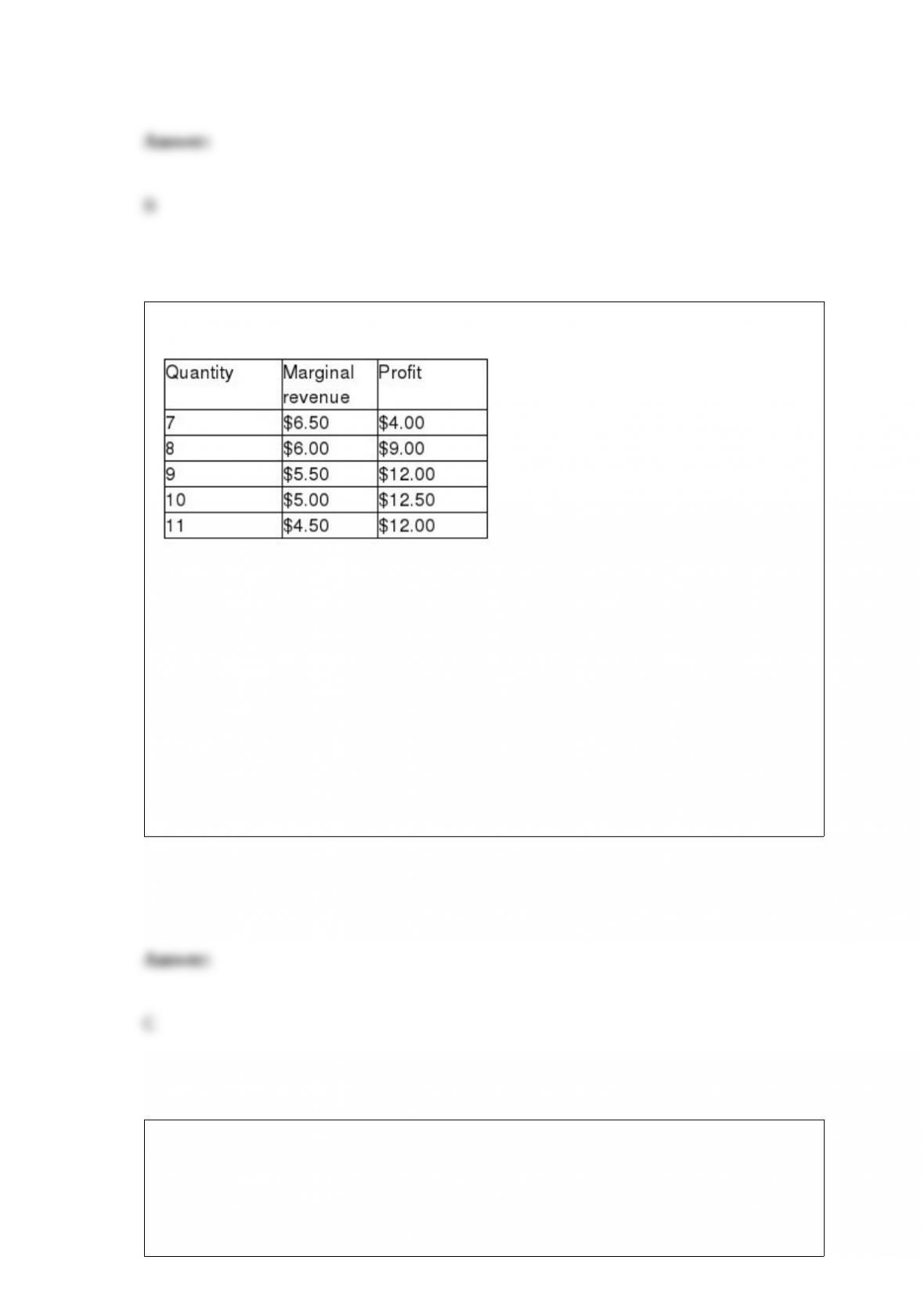
The following questions are based on the following data for a monopolist:
At the profit-maximizing output rate, marginal costs are
a. $12.50.
b. $7.50.
c. $5.00.
d. $0.50.
e. impossible to calculate from the information given.
The size of the structural deficit
a. can be used to evaluate the extent to which government fiscal policy is promoting
economic stability.

b. generally exceeds the actual budget surplus or deficit in a given fiscal year.
c. generally equals actual budgetary deficits and surpluses.
d. is greater during those years when a full-employment equilibrium GDP prevails.
e. automatically nets out to zero over the course of the business cycle.
Which of the following short-run cost curves generally declines, then rises as output is
increased?
a. average fixed cost and average variable cost
b. average variable cost and average total cost
c. average total cost and average fixed cost
d. average fixed cost only
e. average variable cost only
The perfectly competitive firm’s supply curve is exactly the same as
a. the supply curve of all other firms in the industry.
b. the average variable cost curve, since the firm will not produce if price is less than
average variable cost.

c. the firm’s marginal cost curve for all prices above the minimum value of average
variable cost.
d. its fully allocated costs.
e. the price faced by the firm.
In a capitalistic system, the signal for entry into and exit from an industry is provided
by
a. wages and salaries.
b. rent and interest.
c. spending and saving.
d. liquidity and rigidity.
e. profits and losses.
Under a gold exchange standard
a. all currencies are directly convertible into gold at fixed rates.
b. the monetary price of gold is allowed to fluctuate freely in response to supply and
demand.

c. balance-of-payments surpluses and deficits will not occur.
d. gold is directly convertible into special drawing rights called paper gold.
e. the dollar is convertible into gold at a fixed price, and thus other currencies via fixed
exchange rates are indirectly convertible into gold.
A full-time college student could drop out in his senior year and get a job paying
$19,500. By finishing school, he incurs an opportunity cost equal to
a. the college degree he gave up to take the job.
b. the college tuition he would otherwise pay.
c. the difference between the cost of tuition and $19,500.
d. $19,500.
e. zero.
The distinction between the pure rate of interest and the actual interest rate is primarily
a reflection of
a. surplus value.
b. rent.

c. innovation.
d. riskiness.
e. intensity.
Which of the following is an accurate statement about tax incidence?
a. Questions about tax incidence are purely problems of normative economics, that is,
questions involving, “Who should pay the tax?”
b. The incidence of the personal income tax is not generally agreed on.
c. The property tax is borne entirely by the landlord.
d. The incidence of the sales tax depends on the price sensitivity of the supply and
demand curves for the taxed commodity.
e. Economists agree that most, if not all, corporate income taxes are incidental.
The basic argument for government grants and contracts in support of civilian
technology is that they
a. make it easier to predict the social costs and benefits of a proposed project.
b. are both direct and selective.

c. provide better investment qualities than market incentives.
d. enable the government to earn money on the patents it acquires as a result of these
grants.
e. decrease the market rate of interest on investment funds since banks need to be
responsible for funding high-risk R&D activities.