
If net exports are negative,
A) net foreign investment is also negative.
B) capital inflows must be less than capital outflows.
C) net foreign investment is positive.
D) Both A and B are correct.
If actual inflation is greater than expected inflation, what is the relationship between the
actual real wage and the expected real wage?
A) The actual real wage will be lower than the expected real wage.
B) The actual real wage will be higher than the expected real wage.
C) The actual real wage will be equal to the expected real wage.
D) The relationship between the actual real wage and the expected real wage cannot be
predicted.
Figure 12-2
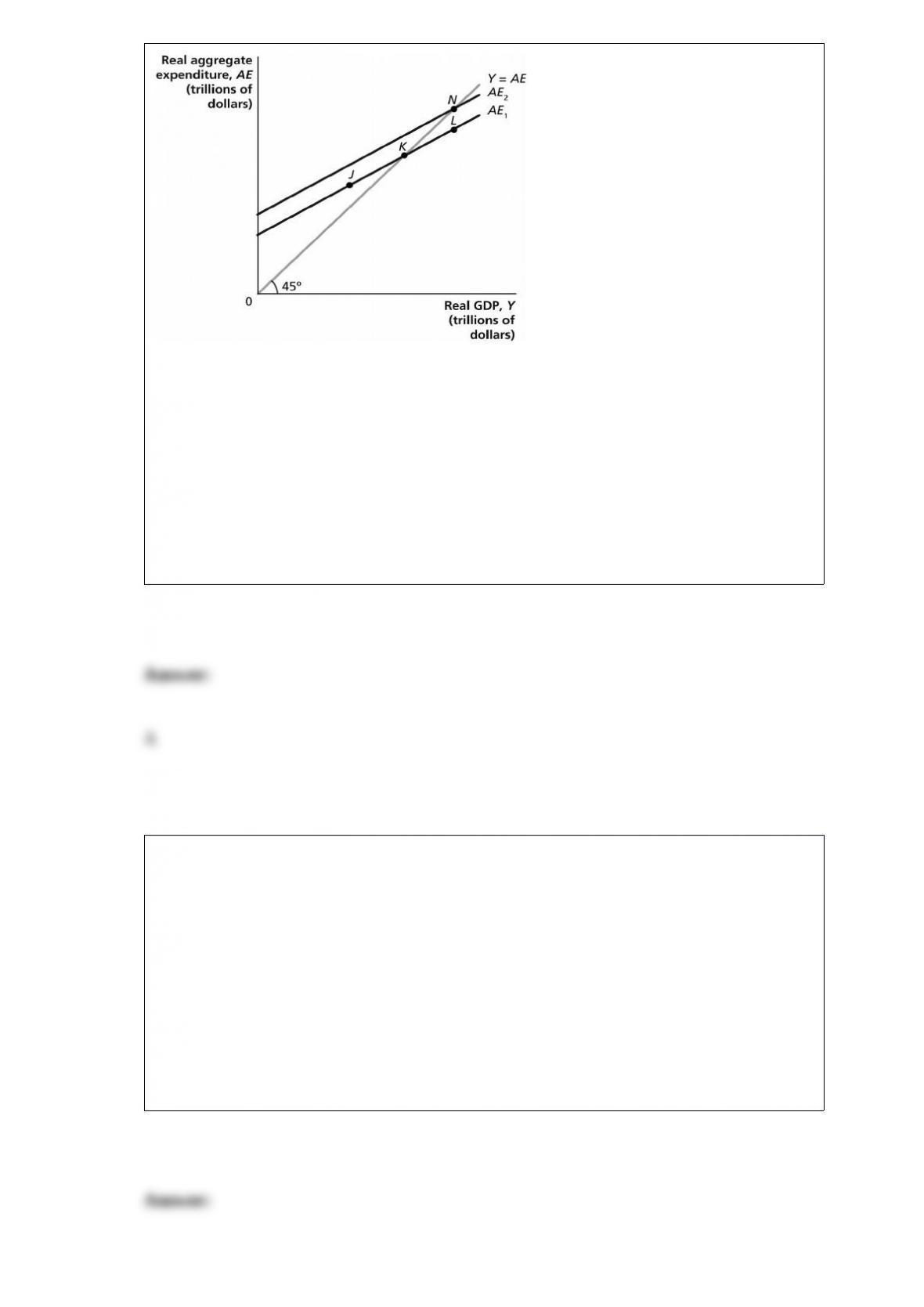
Refer to Figure 12-2. If the U.S. economy is currently at point N, which of the
following could cause it to move to point K?
A) Households expect future income to decline.
B) Household wealth rises.
C) The firm’s cash flow rises as profits rise.
D) Government expenditures increase.
Workers and firms both expect that prices will be 2.5% higher next year than they are
this year. As a result,
A) workers will be willing to take lower wages next year, but not lower than a 2.5
percent decrease.
B) the purchasing power of wages will rise if wages increase by 2.5%.
C) the short-run aggregate supply curve will shift to the left as wages increase.
D) aggregate demand will increase by 2.5%.
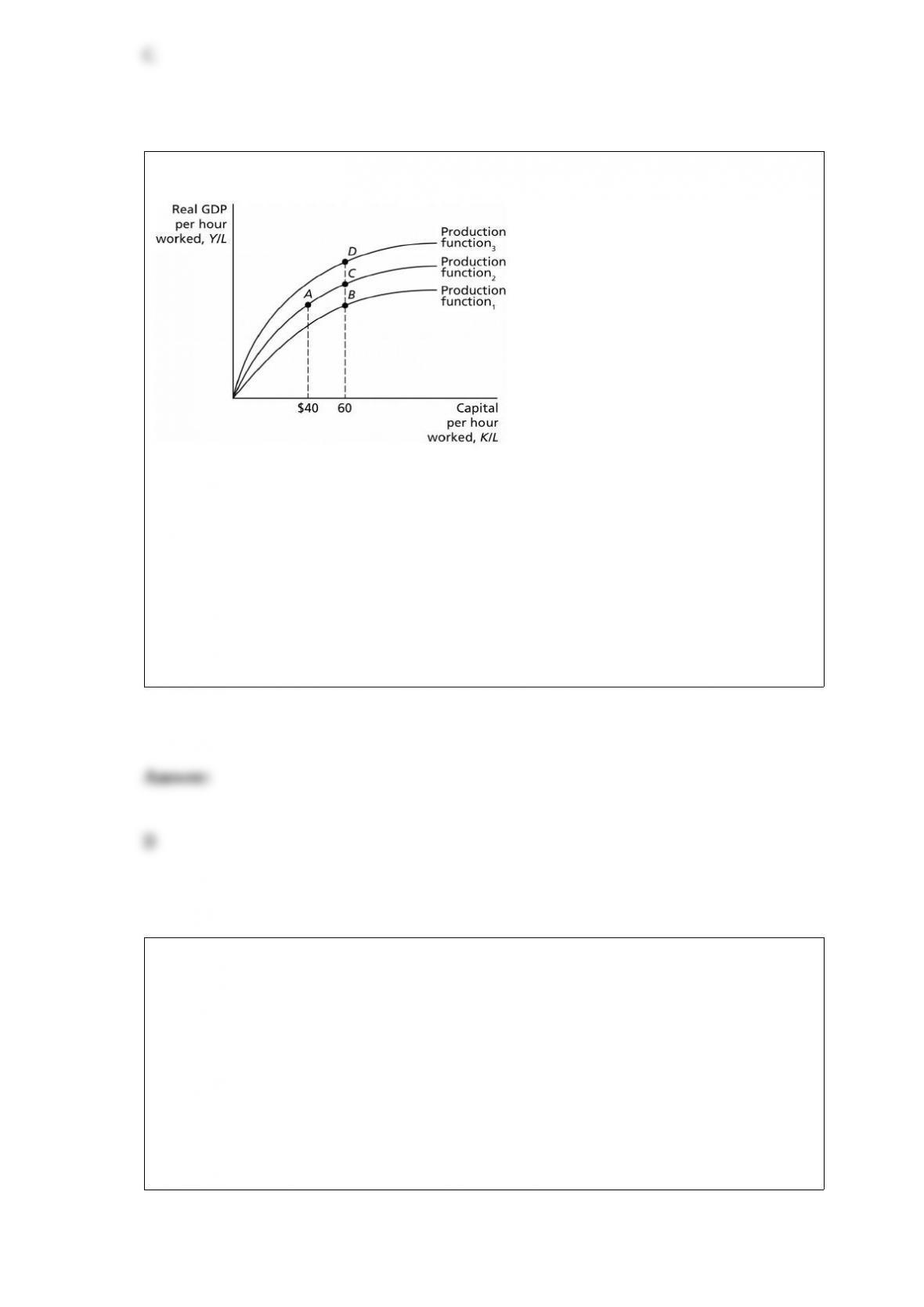
Figure 11-1
Refer to Figure 11-1. Technological change is illustrated in the per-worker production
function in the figure above by a movement from
A) A to B.
B) B to C.
C) B to A.
D) D to C.
The key idea of the aggregate expenditure model is that in any particular year, the level
of GDP is determined mainly by
A) investment spending.
B) export spending.
C) government spending.
D) the level of aggregate expenditure.

An increase in real GDP can shift
A) money demand to the right and decrease the equilibrium interest rate.
B) money demand to the right and increase the equilibrium interest rate.
C) money demand to the left and decrease the equilibrium interest rate.
D) money demand to the left and increase the equilibrium interest rate.
During World War II, prisoners of war used ________ as money.
A) bullets
B) cowrie shells
C) chocolate
D) cigarettes
The recession of 2007-2009 made many consumers pessimistic about their future
incomes. How does this increased pessimism affect the aggregate demand curve?

A) This will move the economy up along a stationary aggregate demand curve.
B) This will move the economy down along a stationary aggregate demand curve.
C) This will shift the aggregate demand curve to the left.
D) This will shift the aggregate demand curve to the right.
Because of diminishing returns, an economy can continue to increase real GDP per hour
worked only if
A) there are decreases in human capital.
B) the per-worker production function shifts downward.
C) there continue to be decreases in capital per hour worked.
D) there is technological change.
Table 8-13
Consider the data shown above for Vicuna, a country that produces only two products:
oranges and shirts.

Refer to Table 8-13. Nominal GDP for Vicuna for 2009 equals
A) $4,920.
B) $5,100.
C) $5,300.
D) $5,850.
Adam Smith’s ________ refers to the process by which individuals acting in their own
self-interest bring about a market outcome that benefits society as a whole.
A) Utopian society
B) comparative advantage model
C) invisible hand
D) survival of the fittest theory
In the United States in 2012, the percentage of firms that employed between 3 and 199
workers and did not offer health insurance as a fringe benefit to the workers was about
A) 2%.
B) 39%.
C) 61%.

D) 98%.
Which of the following is not a flow in the circular flow model?
A) the flow of goods and services and the flow of resources to produce goods and
services
B) the flow of profit and the flow of revenue
C) the flow of income earned by households and the flow of expenditures incurred by
households
D) the flow of revenue received by producers and the flow of payments to resource
owners