
If, through collective bargaining, a union is able to raise the wage above the existing
competitive equilibrium wage,
a. fewer workers will be employed than before the wage increase.
b. more workers will be employed than before the wage increase.
c. the same number of workers will be employed as before the wage increase.
d. the number of workers that will be employed is not related to the wage increase.
Economic profit is
a. total revenue minus total cost (including both explicit and implicit costs).
b. the same as accounting profit.
c. accounting profit plus implicit costs.
d. accounting profit minus implicit costs.
e. a and d
Which of the following statements is false?
a. At equilibrium in a market, scarcity does not exist.
b. If there is a shortage of 100 units at a price of $2 per unit, the shortage will be greater
than 100 units at a price of $1 per unit.

c. If there is a surplus of 30 units at a price of $3, the surplus will be less than 30 units
(or even nonexistent) at a price of $2.
d. If there is a surplus, suppliers will not be able to sell all they had hoped to sell at a
particular price.
Constitutional economists
a. assert that within a given set of institutions, constraints, laws and rules, outcomes
might be the same no matter who is elected to office.
b. study the type of constraints that individuals might seek to place upon themselves in
order to achieve some objective that doesn’t seem achievable in a non-constrainable
environment.
c. assert that better outcomes arise from changing the political party in power at any
given point in time than from changing institutions and constraints.
d. b and c
e. a and b
Good X is a normal good. If the average income of those who buy good X rises, the
_____________ curve for good X will shift ____________ resulting in a(n)
_____________ in the equilibrium price of X and a(n) ____________ in the
equilibrium quantity of X.
a. supply; rightward; decrease; increase.
b. demand; leftward; decrease; decrease
c. demand; rightward; increase; increase
d. supply; leftward; increase; decrease
e. supply; leftward; increase; increase
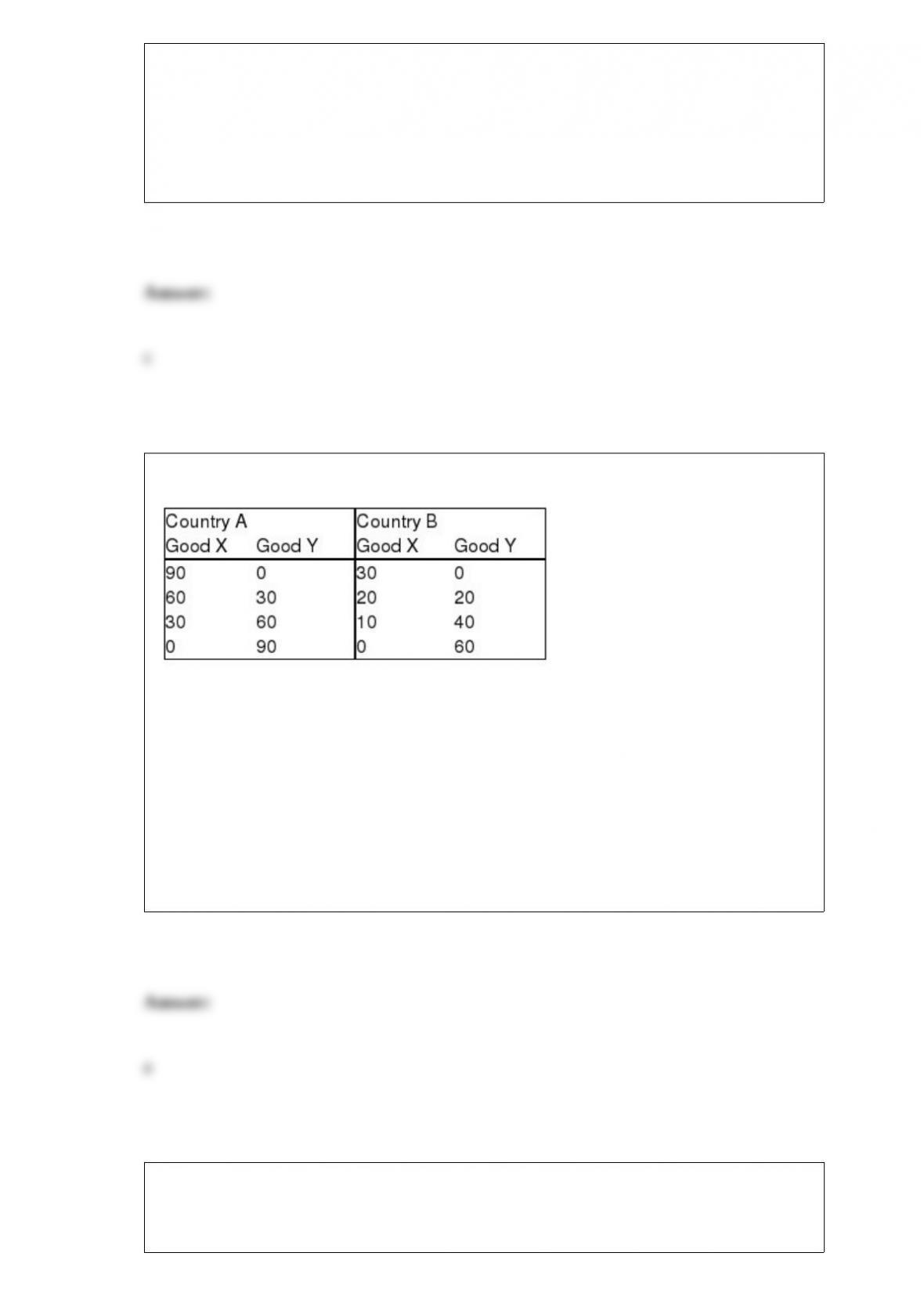
Exhibit 34-1
The opportunity cost of one unit of X in country A is
a. 1 unit of Y.
b. 2 units of Y.
c. 10 units of Y.
d. 0.50 units of Y.
From the sellers’ perspective, it is most desirable for a product to be perfectly elastic in
demand.

a. True
b. False
What is the approximate present value of $8,000 received four years from today if the
interest rate is 12 percent?
a. $12,588
b. $4,882
c. $10,837
d. $5,084
e. $6,908
A single-price monopolist sets its price for good X at $75 and is selling more than one
unit of good X. Which of the following must be true?
a. The average cost of that unit must be $75.
b. The marginal cost of that unit must be $75.
c. The marginal revenue of that unit must be $75.
d. The marginal revenue of that unit must be less than $75.

The law of supply states that price and quantity supplied are
a. inversely related, ceteris paribus.
b. directly related, ceteris paribus.
c. not related.
d. fixed.
Situation 4-1
During the winter of 1973-74, a general system of wage and price controls (including a
price ceiling on gasoline) was in force in the United States. At the beginning of 1974,
some oil-producing countries imposed an oil embargo (a legal prohibition on
commerce) on the West. In the spring of 1974, price controls were] abolished.
An economist would have most likely predicted that the oil embargo imposed in 1974
would result in a
a. leftward shift in the supply (curve) of gasoline.
b. rightward shift in the supply (curve) of gasoline.
c. leftward shift in the demand (curve) for gasoline.
d. rightward shift in the demand (curve) for gasoline.
e. both a and d
Suppose you live in New York City and the government has imposed price ceilings on
apartment rental rates. You want to rent an apartment from Smith, who says that unless
you buy the furniture in the apartment for $4,000, he cannot rent the apartment to you.
The condition of buying the furniture could be considered
a. a price ceiling.
b. a price floor.
c. a tie-in sale.
d. to be something no renter would agree to.
e. c and d
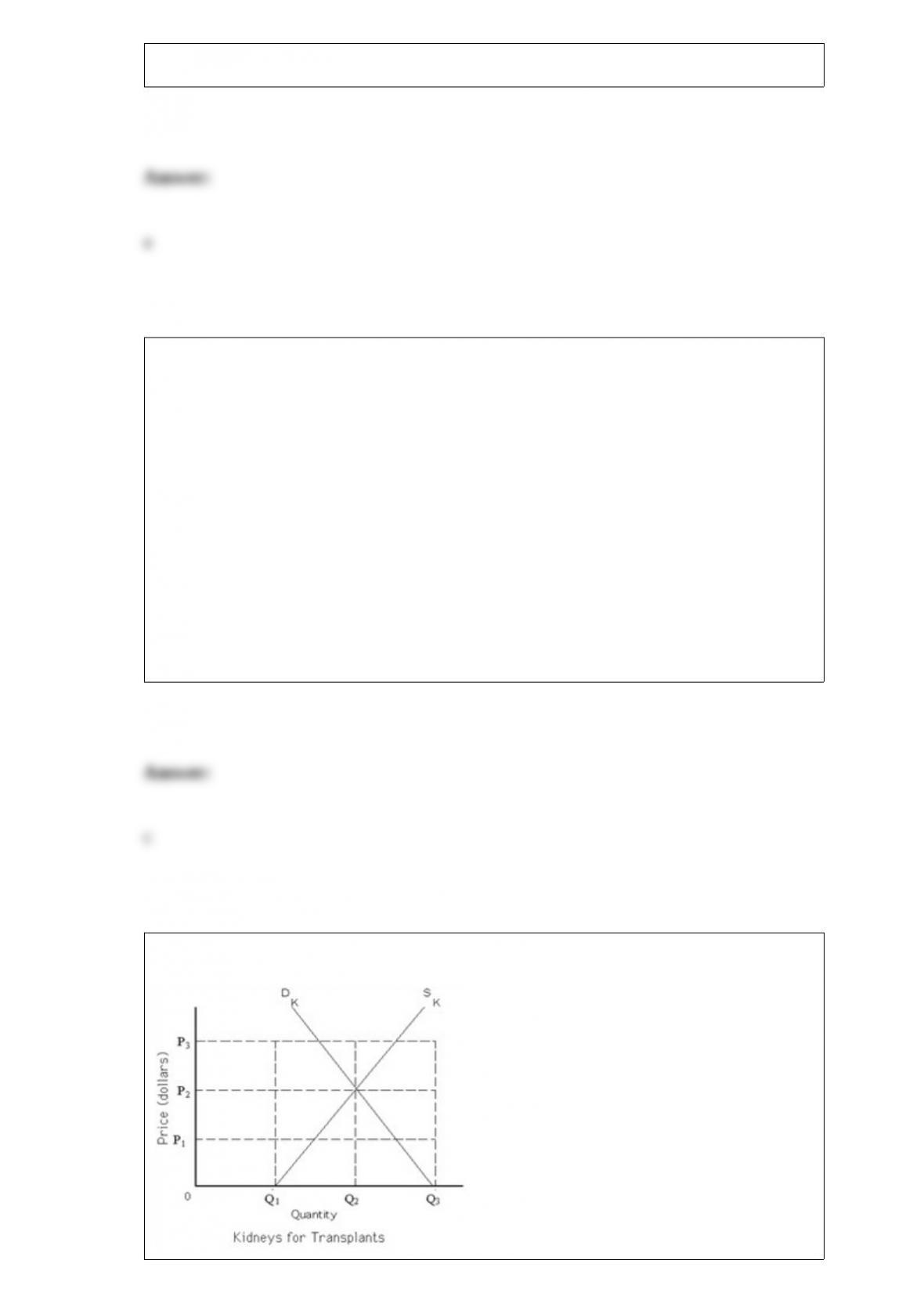
Exhibit 4-5

If a free market were allowed in the transplanted kidney market, then the equilibrium
price would be P2. The number of kidneys transplanted would increase by _________
compared to the number transplanted at a price ceiling of P= $0.
a. (Q3 – Q1)
b. (Q3 – Q2)
c. (Q2 – Q1)
d. Q2
An American good with a price tag of $89 costs 809 pesos. The exchange rate must be
approximately
a. $11.00 = 1 peso
b. $0.11 = 1 peso
c. $0.89 = 1 peso
d. $0.09 = 1 peso
e. none of the above
In long run equilibrium, a monopolistic competitive firm€s price will most likely be

a. equal to average total cost, but higher than marginal cost.
b. greater than both average total cost and marginal cost.
c. less than both average total cost and marginal cost.
d. equal to marginal cost, but higher than average total cost.
Suppose the price elasticity of demand of for soy beans is 0.85.When the price of
soybeans rises by 20 percent, the quantity demanded of soybeans falls by approximately
_____________ percent.
a. 0.024
b. 26.67
c. 23.53
d. 17.00
One consequence of a negative externality is that
a. social costs are greater than private costs.
b. private costs are greater than social costs.
c. the marginal private cost curve slopes upward.
d. the market output is less than the socially optimal output.

e. a and c
Which statement uses the term ceteris paribus correctly?
a. If you exercise regularly, you will be healthier, ceteris paribus.
b. Blue is to green, ceteris paribus, as red is to purple.
c. Most people consider Sunday to be the first day of the week, ceteris paribus.
d. Interest rates usually rise in October, ceteris paribus.
e. a and d
When the government implements an agricultural price support (above the equilibrium
price), a surplus results and the government buys the surplus at the support price.
a. True
b. False
A new delivery van will cost a catering firm $40,000 (including all associated taxes and
fees).The catering firm plans to pay cash for this van and the van will generate $8,000
(net of any costs associated with maintaining the van) worth of services each year for
five years. At the end of the fifth year, the van can be sold for an estimated value of
$10,000. If the interest rate is 6 percent, should the catering firm buy the new delivery
van?If the interest rate were to suddenly rise to 8 percent, would this change the firm’s
decision?Explain your answer, using present value calculations to support your
conclusions.
Describe how profit serves as both an incentive for individuals to produce and as a
signal.
Describe at least three of the key concepts in economics introduced in Chapter 1 of the
textbook that define how an economist views the world.
Compare and contrast the following market structures: oligopoly and monopolistic
competition.