
The economy’s money supply curve is vertical.
When negative spending shocks occur, transfer payments automatically fall.
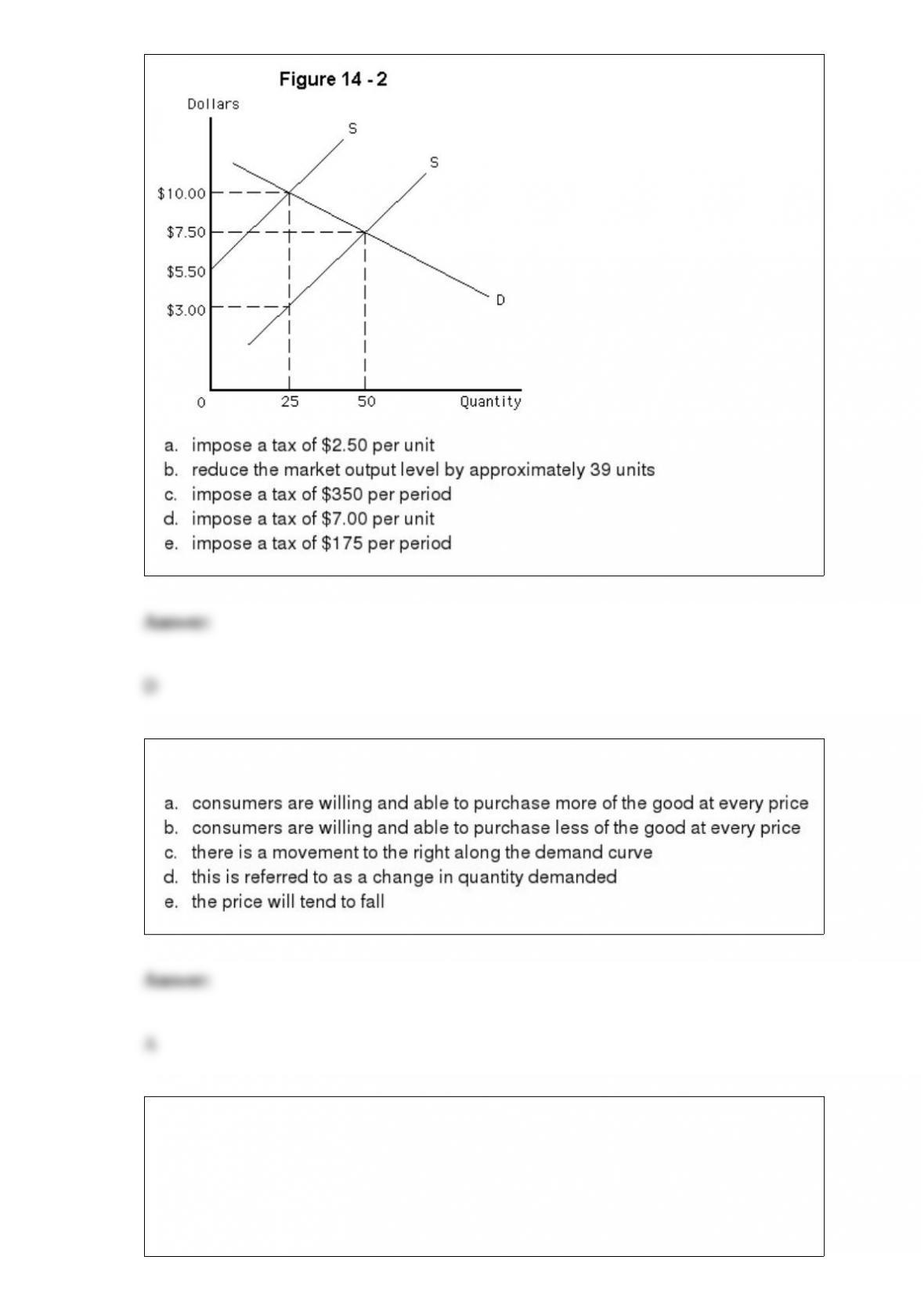
Suppose that production of the product in Figure 14-2 imposes a cost on society of
$7.00 per unit. If the free market equilibrium is at the intersection of demand curve D
and supply curve S, what should the government do to internalize the externality?
When demand increases,
If British real GDP rose relative to U.S. real GDP, there would be
a. a rightward movement along the supply of British pounds curve in the dollar-pound
market
b. a leftward movement along the supply of British pounds curve in the dollar-pound
market
c. a rightward shift of the supply of British pounds curve in the dollar-pound market

d. a leftward shift of the supply of British pounds curve in the dollar-pound market
e. the tendency for the supply of British pounds curve to become flatter in the
dollar-pound market
The vertical distance between a firm’s average total cost curve and its average variable
cost curve is its
Which of the following describes the relationship among income, disposable income,
taxes, and transfer payments?
a. Taxes plus transfers equal income plus disposable income
b. Disposable income equals income divided by the sum of taxes and transfers
c. Disposable income equals income minus taxes plus transfers
d. Disposable income equals income plus taxes plus transfers
e. Taxes plus transfers equal disposable income minus income
A rise in U.S. real GDP would cause
a. leftward shifts of the demand curves for foreign currencies
b. rightward shifts of the demand curves for foreign currencies
c. rightward movements along the demand curves for foreign currencies
d. no change in the demand curves for foreign currencies
e. initial rightward movements along the demand curves for foreign currencies,
followed by leftward shifts of those curves.

The amount of wealth in American hands has been decreasing as a result of the growing
trade deficit.
In order to maximize profits, a firm should decrease output whenever total cost exceeds
total revenue.
One difficulty with any explanation of economic fluctuations based on a shift in labor
supply is that
a. workers’ preferences tend to change very quickly
b. labor supply shifts all the time without causing recessions or expansions
c. labor supply is difficult to measure
d. workers’ preferences tend to change very slowly
e. the unemployment rate changes during economic fluctuations

Use the table below to find the real wage in 2008 (in 2007 dollars).
a. $13.00
b. $11.82
c. $14.30
d. $11.78
e. $11.48
Assume the required reserve ratio (RRR) is 10 percent. If the Fed purchases a $5,000
bond from a bond dealer who then deposits the $5,000 in a HSBC Bank account, what
has happened to the money supply?
a. It has decreased by $5,000.
b. It has increased by $5,000.
c. It has decreased by $4,500.
d. It has increased by $4,500.
e. There has been no change in the money supply.
Samantha has been working for a law firm and earning an annual salary of $90,000. She
decides to open her own practice. Her annual expenses will include $15,000 for office
rent, $3,000 for equipment rental, $1,000 for supplies, $1,200 for utilities, and a
$35,000 salary for a secretary/bookkeeper. Samantha will cover her start-up expenses
by cashing in a $20,000 certificate of deposit on which she was earning annual interest
of $1,000. Assuming that there are no additional expenses, Samantha’s annual implicit
costs will equal

Which of the following disciplines is not a social science?
Say’s Law
a. is valid only in a simple economy without financial markets
b. led economists during the 1920s to encourage the government to adopt flawed
economic policies that led to the Great Depression
c. assures us that in the aggregate, firms are able to sell their output so that full
employment can be sustained
d. tells us that in the long run, markets clear
e. tell us that firms must carefully monitor consumer spending and saving in order not
to produce more than consumers are willing to purchase
In the classical model, when an open economy has balanced trade, Say’s law does not
hold.
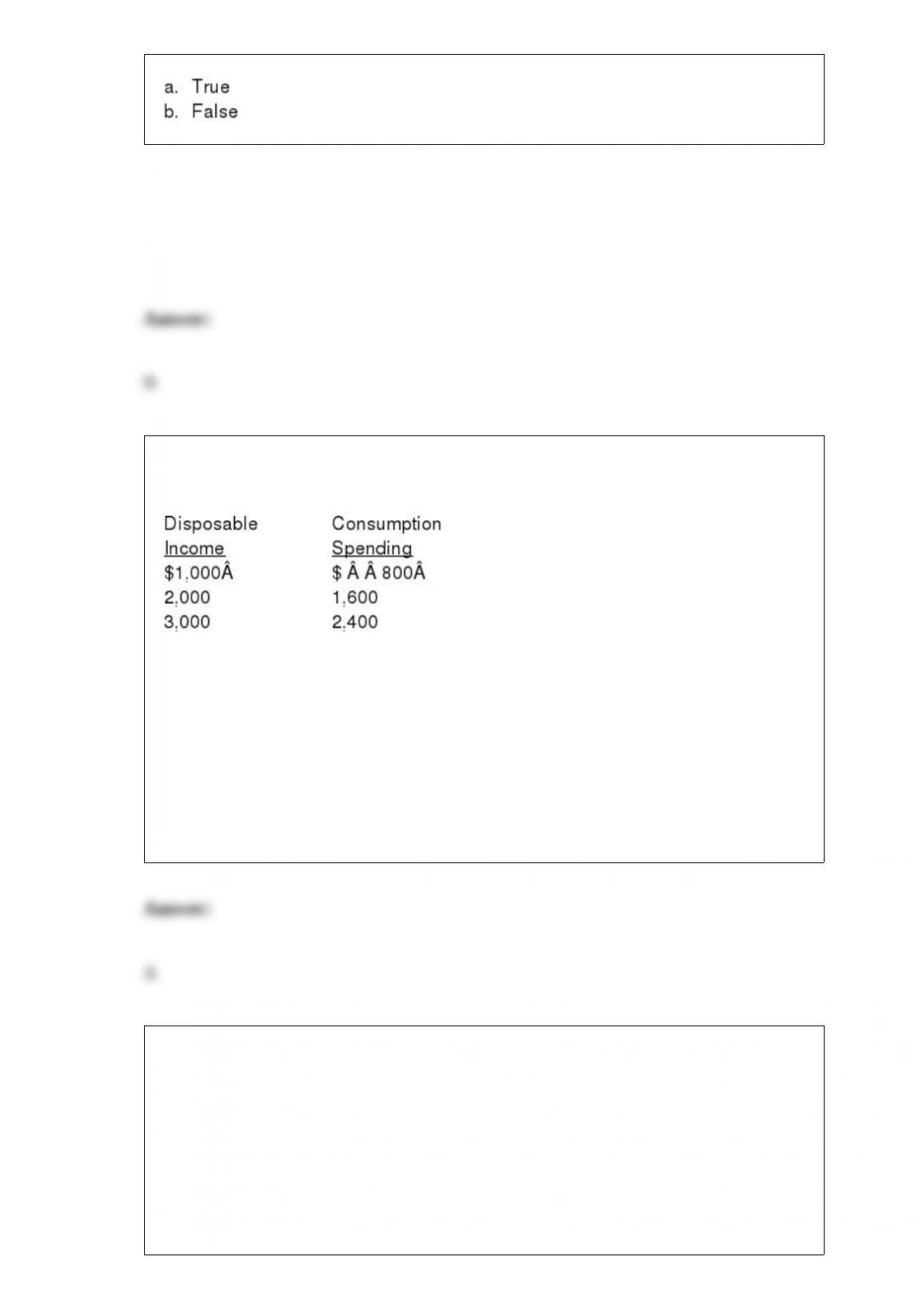
Use the table below to determine the impact on consumption spending of a $100
increase in net taxes.
a. Consumption will decrease by $80.
b. Consumption will increase by $80.
c. The marginal propensity to consume will increase to .91.
d. The marginal propensity to consume will decrease to .73.
e. The change in net taxes will not change consumption.
A decrease in the price level leads to which of the following sequences?
a. The money demand curve shifts leftward, the interest rate drops, the aggregate
expenditure line shifts upward, and there is movement downward along the aggregate
demand curve.
b. The money demand curve shifts rightward, the interest rate increases, the aggregate
expenditure line shifts downward, and there is movement upward along the aggregate
demand curve.
c. The money demand curve shifts leftward, the interest rate drops, the aggregate
expenditure line shifts downward, and there is movement upward along the aggregate

demand curve.
d. The money demand curve shifts rightward, the interest rate increases, the aggregate
expenditure line shifts upward, and there is movement downward along the aggregate
demand curve.
e. The money demand curve shifts leftward, the interest rate drops, the aggregate
expenditure line shifts upward, and there is movement upward along the aggregate
demand curve.
Under a market system of resource allocation