
As the interest rate (price for loanable funds) decreases, businesses will
a. find it less profitable to invest in capital goods, because the lower interest rate means
that they will earn a lower return on their investments.
b. find it less profitable to invest in capital goods, because their costs of production will
be higher.
c. increase their borrowings of loanable funds, because the cost of borrowing has
declined relative to the benefits of borrowing.
d. decrease their borrowings of loanable funds, because there will now be cheaper ways
to produce goods than to employ roundabout methods of production.
e. b and c
Firm X is a single seller of good X. There are, however, two substitutes for good X.
Given this,
a. firm X cannot be a monopolist because the theory of monopoly assumes there are no
substitutes for the good the single seller sells.
b. firm X may be a monopolist because the two substitutes may be close substitutes.
c. firm X cannot be a monopolist because if substitutes exist for the good it produces,
its demand curve is horizontal but monopolists face downward-sloping demand curves.
d. none of the above

Airlines that try to lower fares in order to increase revenue must believe that the
demand for airline service is
a. price inelastic.
b. income elastic.
c. income inelastic.
d. price elastic.
e. cross-price elastic.
When the government imposes a tariff on imported goods, it _____________ prices for
domestic consumers, ________________ consumers’ surplus and _________________
the producers’ surplus for domestic producers.
a. raises; lowers; raises
b. lowers; raises; raises
c. lowers; raises; lowers
d. raises; lowers; lowers
e. none of the above
Economists are nearly unanimous in their belief that small firms in highly competitive

markets with many rivals are more likely to innovate than are firms with larger market
shares.
a. True
b. False
Special interest groups are subsets of __________ that hold (usually) intense
preferences for or against a particular government service, activity, or policy.
a. the general population
b. bureaucrats
c. elected officials
d. candidates for political office
e. all of the above
If, through collective bargaining, a union is able to raise the wage above the existing
competitive equilibrium wage,
a. fewer workers will be employed than before the wage increase.
b. more workers will be employed than before the wage increase.
c. the same number of workers will be employed as before the wage increase.
d. the number of workers that will be employed is not related to the wage increase.
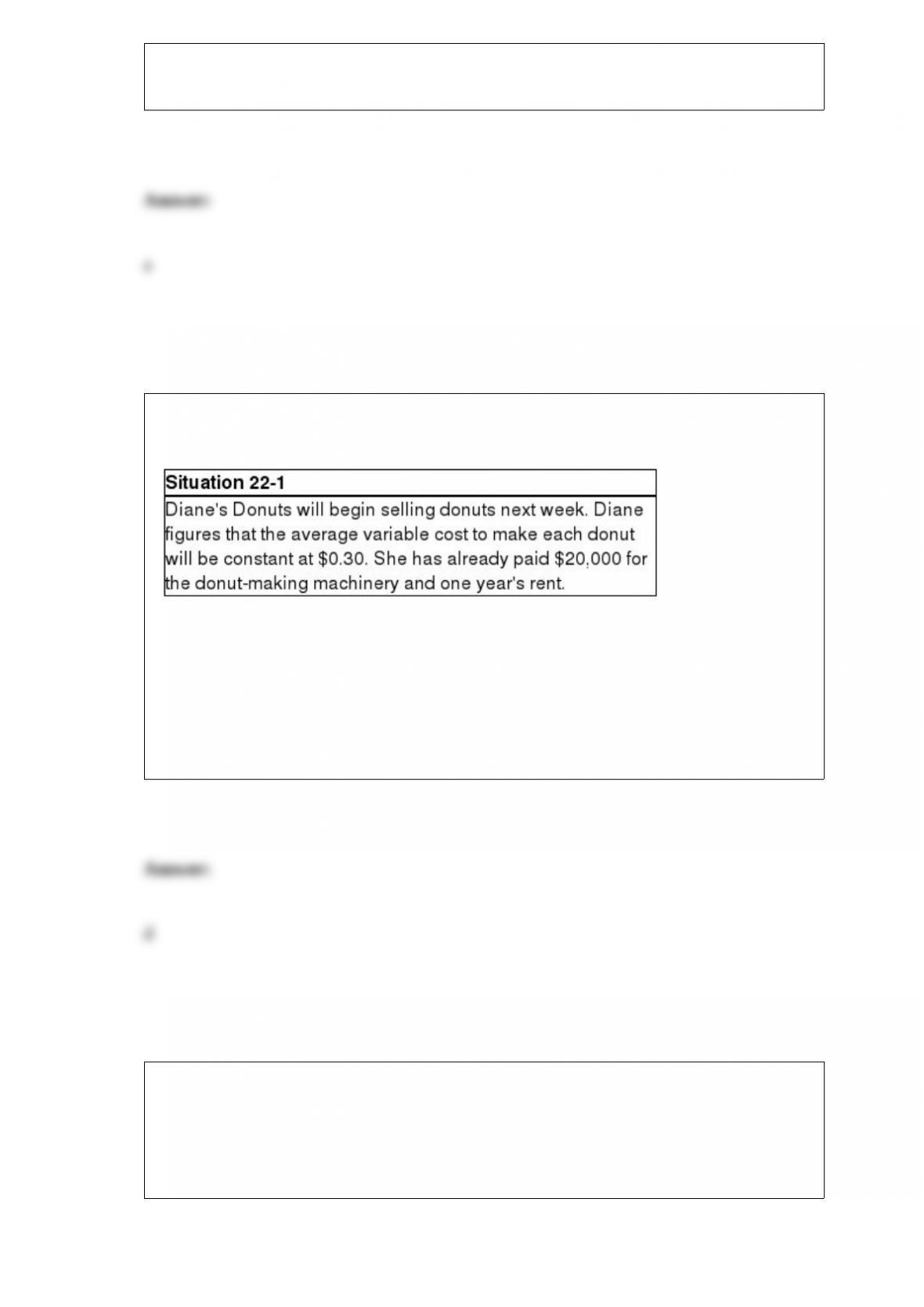
Refer to Situation 22-l. What will Diane’s approximate average fixed costs be if she
sells 36,500 donuts in one year?
a. $0.30
b. $0.088
c. $0.138
d. $0.55
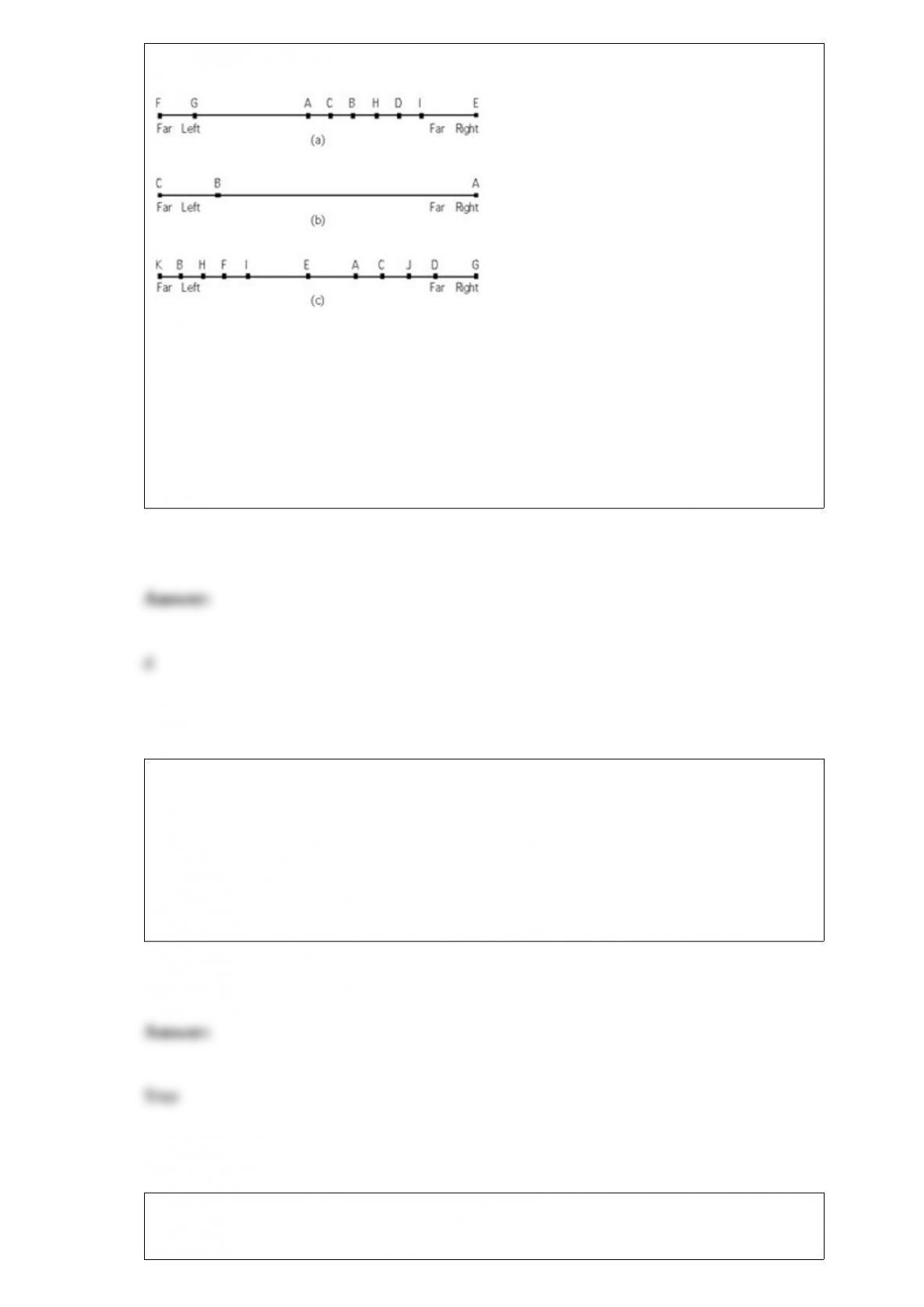
Refer to Exhibit 32-2-(a). Two candidates are competing for an electorate consisting of
9 voters labeled A-I shown positioned with respect to their ideological stands on issues.
The median voter theory would predict that candidates will assume the ideological
position(s)
Exhibit 32-2
a. of voter A.
b. halfway between that of voter G and that of voter A.
c. of voter C.
d. of voter B.
e. of voter G and voter I, respectively.
Under a target price system, the government can adjust the deficiency payment paid to a
farmer by deciding to pay some percentage of the difference between the target price
and the market price.
a. True
b. False
Refer to Exhibit 25-8. Average total cost at the profit-maximizing level of output equals
Exhibit 25-8

a. $32.50.
b. $36.67.
c. $33.33.
d. $50.00.
e. There is not enough information given to answer this question.
What is the approximate present value of $8,000 received four years from today if the
interest rate is 12 percent?
a. $12,588
b. $4,882
c. $10,837
d. $5,084
e. $6,908

Which of the following predictions is consistent with public choice theory?
a. Voters will sometimes cast votes based on whether they like a candidate’s personality,
not on hard facts.
b. Many voters will be uninformed on political and government issues.
c. Much legislation will be special interest legislation.
d. b and c
e. a, b, and c
In the United States, there are _______________ people in the average household in the
top quintile (of total money income) than in the bottom quintile.This situationtends to
skew the Census’s measure of the income distribution so that the income distribution
appears to be __________________ than it would be if a correction were made so that
each quintile actually contained 20% of the population.
a. more; less equal
b. less; less equal
c. more; more equal
d. less; more equal

If, as the price of good Y rises from $5.00 to $5.75, the quantity demanded of good Y
falls from 54 units to 48 units, price elasticity of demand for good Y in this price range
is
a. 1.05.
b. 1.19.
c. 0.37.
d. 4.77.
e. 0.84.
Consider a setting in which there is a positive externality, but no negative
externality.The market outcome is __________________; government can bring about
the ___________________ outcome if it sets a subsidy equal to the
__________________.
a. inefficient; efficient; MEB
b. inefficient; efficient; MEC
c. efficient; inefficient; MPC
d. inefficient; efficient; MPB
e. inefficient; efficient; MSB

The theory of contestable markets concludes that
a. a small number of firms in an industry is strong evidence that they will perform in a
noncompetitive way.
b. even if the number of sellers in an industry is small, profits can be zero in the
industry.
c. inefficient producers can survive in a contestable market.
d. a firm in a contestable market will sell at a price above marginal cost.
e. all of the above
Which of the following is a determinant of price elasticity of demand for good Z?
a. the number of substitutes for good Z
b. the percentage of one’s budget spent on good Z
c. the amount of time that has passed since the price of good Z has changed
d. b and c
e. all of the above
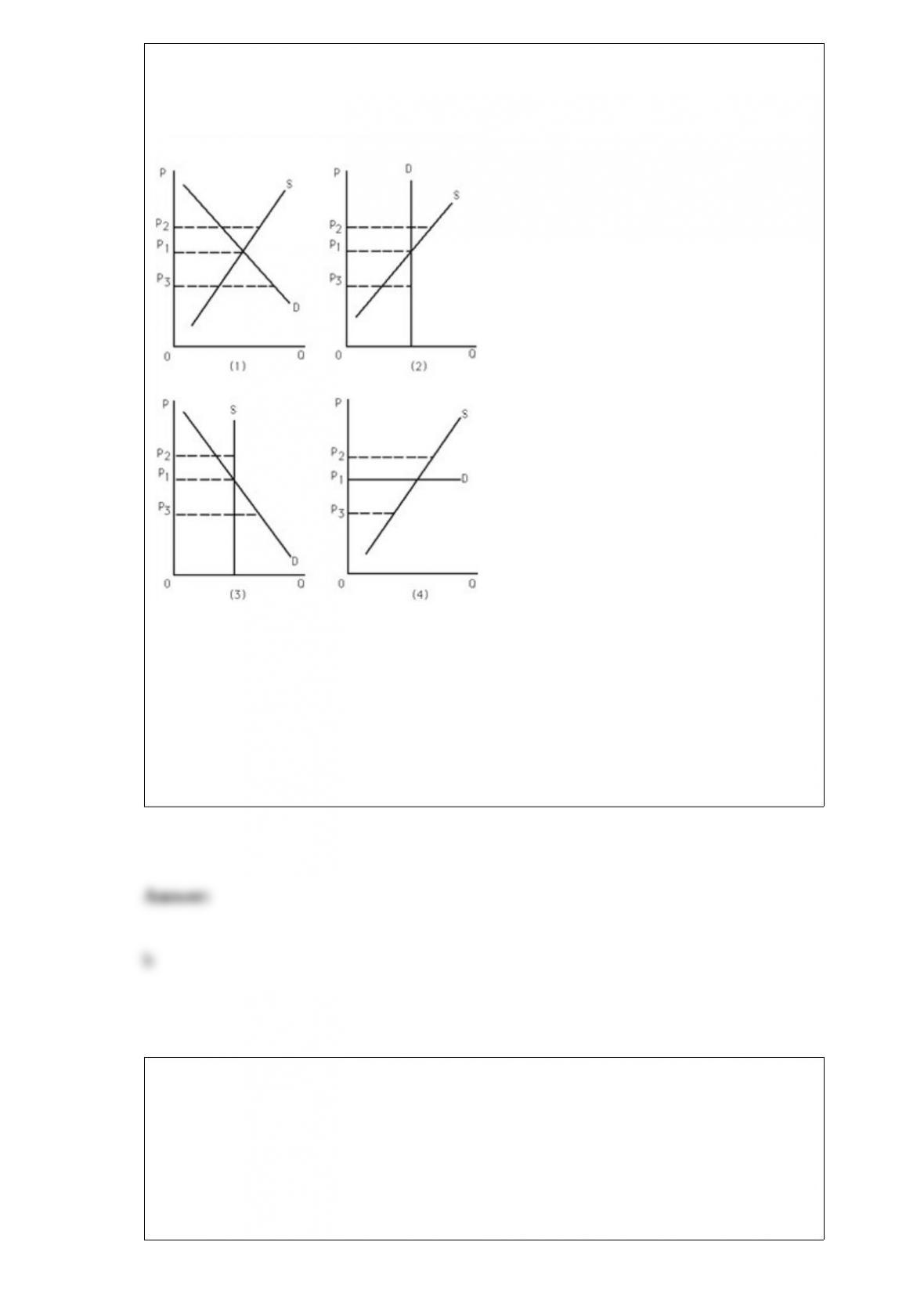
Refer to Exhibit 4-4. Which of the following statements is false?
Exhibit 4-4
a. Graph (1): A price ceiling set at P2 would not have an impact on the market.
b. Graph (2): As supply increases, equilibrium price remains constant.
c. Graph (3): As demand increases, equilibrium quantity remains constant.
d. Graph (4): As supply increases, equilibrium quantity increases.
The answer is: “The price of one currency in terms of another currency.” What is the
question?
a. What is a foreign currency?
b. What is an exchange rate?

c. What is a flexible exchange rate system?
d. What is a fixed exchange rate system?
The Gini coefficient measures the degree of
a. racial discrimination.
b. age discrimination.
c. income inequality.
d. sex discrimination.
e. wage discrimination.
If total revenue does not change as a result of a rise in the price of a given good, it
follows that demand is
a. perfectly elastic.
b. perfectly inelastic.
c. unit elastic.
d. inelastic.
e. elastic.
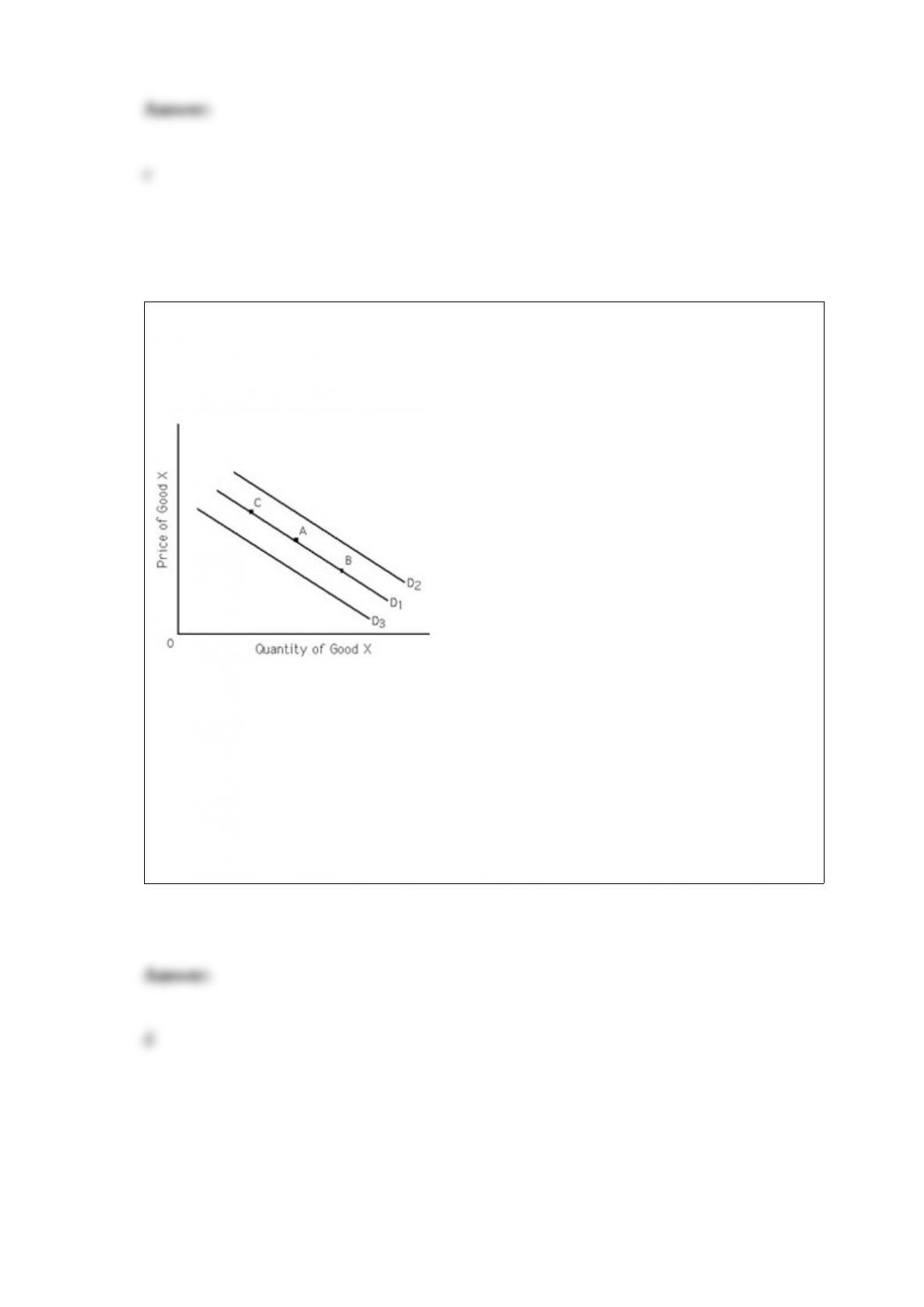
Refer to Exhibit 3-6. If D1 is the relevant demand curve, an increase in the price of
good X may cause
Exhibit 3-6
a. demand to shift from D1 to D2.
b. demand to shift from D1 to D3.
c. a movement along D1 from point A to point B.
d. a movement along D1 from point A to point C.