
1) Assume, for Japan, that the domestic price of automobiles without international trade
is lower than the world price of automobiles. This suggests that, in the production of
automobiles,
a.Japan has a comparative advantage over other countries and Japan will import
automobiles.
b.Japan has a comparative advantage over other countries and Japan will export
automobiles.
c.other countries have a comparative advantage over Japan and Japan will import
automobiles.
d.other countries have a comparative advantage over Japan and Japan will export
automobiles.
2) Which of the following should be held constant when calculating an income
elasticity of demand?
a.the price of the good
b.prices of related goods
c.tastes
d.All of the above should be held constant.
3) Suppose society consists of four individuals: Andy, Bill, Carl, and David. Andy has
$20,000 of income, Bill has $40,000 of income, Carl has $60,000 of income, and David
has $80,000 of income. A utilitarian would argue that
a.taking $1 from Bill and giving it to Carl would increase society’s total utility.
b.taking $1 from Carl and giving it to Andy would increase society’s total utility.
c.taking $1 from Carl and giving it to David would increase society’s total utility.
d.taking $1 from Bill and giving it to David would increase society’s total utility.
4) When economists describe preferences, they often use the concept of
a.markets.
b.income.
c.utility.
d.prices.
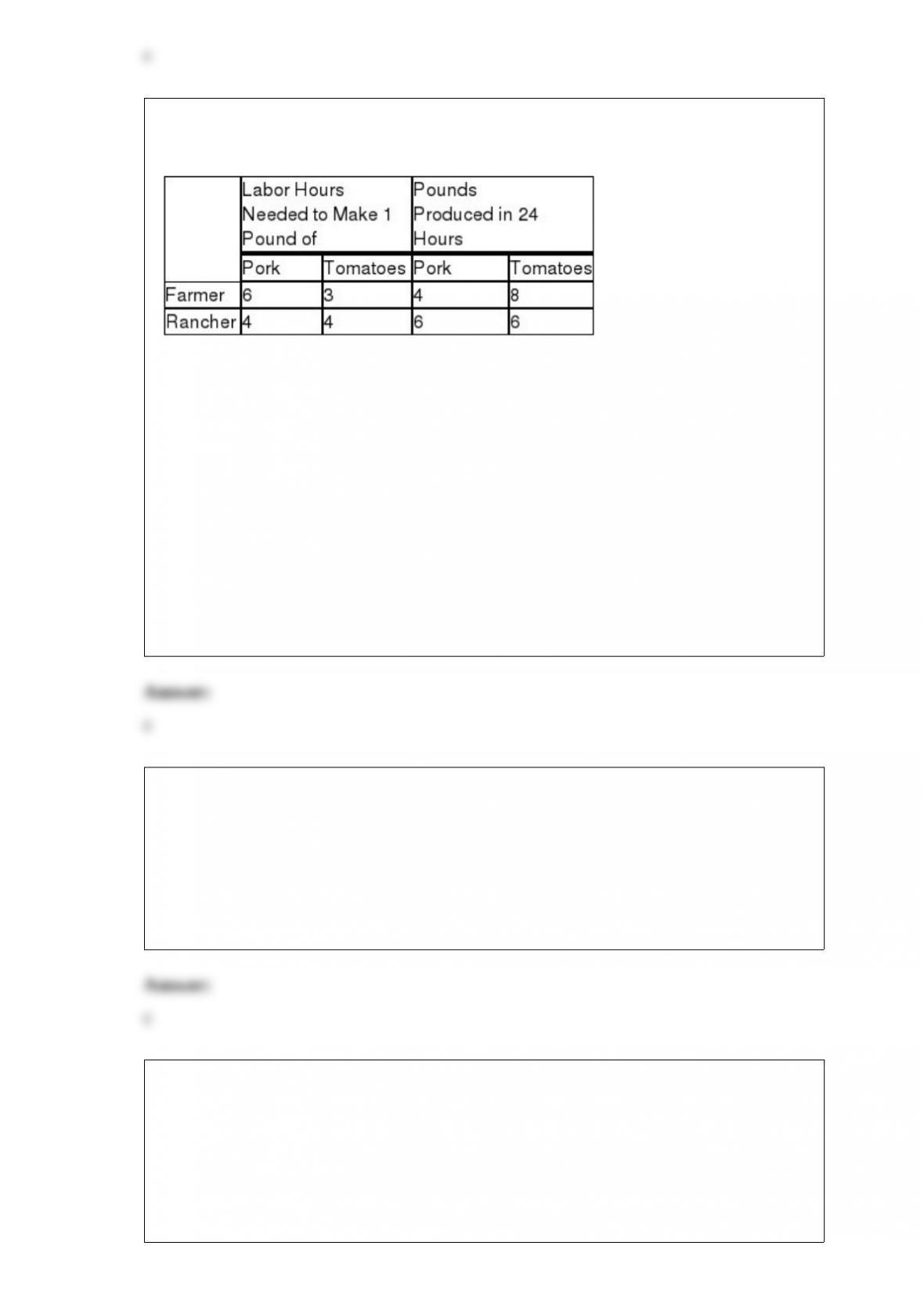
5) Assume that the farmer and the rancher can switch between producing pork and
producing tomatoes at a constant rate.
Without trade, the farmer produced and consumed 2 pounds of pork and 4 pounds of
tomatoes and the rancher produced and consumed 4 pounds of pork and 2 pounds of
tomatoes. Then, each person agreed to specialize in the production of the good in which
he has a comparative advantage and trade 4 pounds of pork for 6 pounds of tomatoes.
As a result,
a.the farmer gained 3 hours worth of production and the rancher gained 4 hours worth
of production.
b.the farmer gained 4 hours worth of production and the rancher gained 6 hours worth
of production.
c.the farmer gained 6 hours worth of production and the rancher gained 8 hours worth
of production.
d.the farmer gained 8 hours worth of production and the rancher gained 10 hours worth
of production.
6) In the long run a company that produces and sells covers for cell phones incurs total
costs of $2,500 when output is 1,250 covers and $4,000 when output is 1,500 covers.
For this range of output, the cell phone cover company exhibits
a.economies of scale.
b.constant returns to scale.
c.diseconomies of scale.
d.efficient scale.
7) Assume for the United States that the opportunity cost of each airplane is 50 cars.
Which of these pairs of points could be on the United States’ production possibilities
frontier?
a.(200 airplanes, 5,000 cars) and (150 airplanes, 4,000 cars)
b.(200 airplanes, 12,500 cars) and (150 airplanes, 15,000 cars)
c.(300 airplanes, 15,000 cars) and (200 airplanes, 25,000 cars)
d.(300 airplanes, 25,000 cars) and (200 airplanes, 40,000 cars)

8) At the equilibrium price of a good, the good will be sold by those sellers
a.whose cost is more than price.
b.whose cost is less than price.
c.that can produce the good.
d.enter the market first.
9) Suppose the socially-optimal quantity of good x is 2,500 units and the
market-equilibrium quantity of good x is 3,000 units. When 2,500 units of good x are
produced, the
a.external cost of good x exceeds the private value of good x.
b.external cost of good x equals the private value of good x.
c.social cost of good x exceeds the private value of good x.
d.social cost of good x equals the private value of good x.
10) Suppose that the government taxes income in the following fashion: 20 percent of
the first $50,000, 40 percent of the next $50,000, and 60 percent of all income over
$100,000. Marshall earns $200,000, and Lily earns $600,000. Which of the following
statements is correct?
a.Marshall’s marginal tax rate is higher than Lily’s marginal tax rate.
b.Marshall’s average tax rate is higher than his marginal tax rate.
c.Lily’s average tax rate is higher than her marginal tax rate.
d.Lily’s average tax rate is higher than Marshall’s average tax rate.
11) Which of the following expressions is correct?
a.accounting profit = total revenue – explicit costs
b.economic profit = total revenue – implicit costs
c.economic profit = total revenue – explicit costs
d.Both a and b are correct.
12) Compare and contrast the “life cycle” hypothesis and the “permanent income”
hypothesis. What are their respective implications for inequality in the income
distribution?
13) Explain the theory that education acts as a signaling device. How does this contrast
with the theory of education as an investment in human capital?
14) Describe the difference between a diminishing marginal product of labor and a
negative marginal product of labor. Why would a profit-maximizing firm always choose
to operate where the marginal product of labor is decreasing (but not negative)?

15) In the circular flow diagram, when Daphne purchases a new mobile phone, she
participates in the markets for
16) With regard to elasticity, as a firm nears its production capacity, supply becomes
more
17) OPEC (Organization of Petroleum Exporting Countries) is an example of a cartel in
the output market for petroleum. Major League Baseball could be considered a cartel in
the ________ market for baseball players.
18) In some situations, private economic actors cannot solve the problem of
externalities among themselves because of substantial costs.