1) exchange rate determination in the short run is underlied by which of the following
assumptions:
a.tariffs and quotas affect trade patterns only in the short run
b.prices of goods and services affect trade patterns only in the short run
c.expected returns on financial assets affect investment flows in the short run
d.preferences for goods and services affect trade flows only in the short run
2) for a “large” country, a tariff on an imported product may be partially absorbed by
the domestic consumer via a higher purchase price and partially absorbed by the foreign
producer via a lower export price.
a.true
b.false
3) the time period that it takes for companies to form new business connections and
place new orders in response to currency depreciation is known as the:
a.recognition lag
b.replacement lag
c.decision lag
d.production lag
4) the distribution of an import quota’s revenue effect depends on the relative
concentration of bargaining power between foreign exporters and domestic importers.
a.true
b.false
5) under managed floating exchange rates, the federal reserve could offset an
appreciation of the dollar against the yen by:
a.increasing the money supply which promotes falling interest rates and net investment
outflows
b.increasing the money supply which promotes rising interest rates and net investment
inflows
c.decreasing the money supply which promotes falling interest rates and net investment
outflows
d.decreasing the money supply which promotes rising interest rates and net investment
inflows
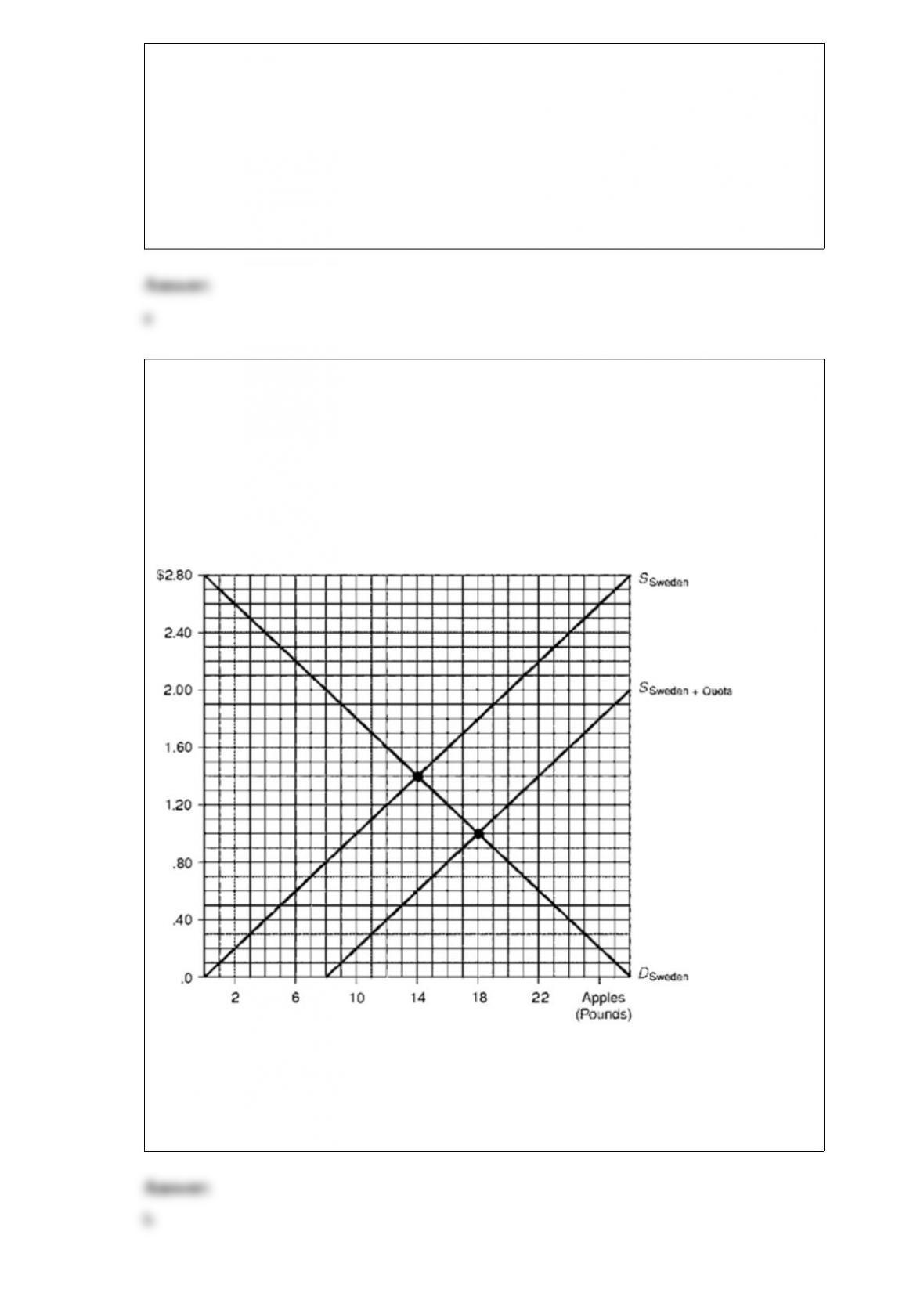
6) figure 5.3 illustrates the apple market for sweden, assumed to be a ‘small” country
that is unable to affect the world price. ssweden is the domestic supply and dsweden is
the domestic demand. ssweden+quota is sweden’s supply schedule with an import
quota.
figure 5.3. sweden’s apple market
consider figure 5.3. after the quota is levied, the price of apples in sweden will equal:
a.$0.60 per pound
b.$1.00 per pound
c.$1.40 per pound
d.$1.80 per pound
7) when the dollar depreciates
a.u.s. exporters tend to sell more goods in foreign markets
b.u.s. consumers travel abroad more cheaply
c.more foreign tourists can afford to visit the united states
d.both a and c
8) swap agreements are generally conducted by the:
a.federal reserve with foreign central banks
b.federal reserve with foreign commercial banks
c.u.s. treasury with foreign central banks
d.u.s. treasury with foreign commercial banks
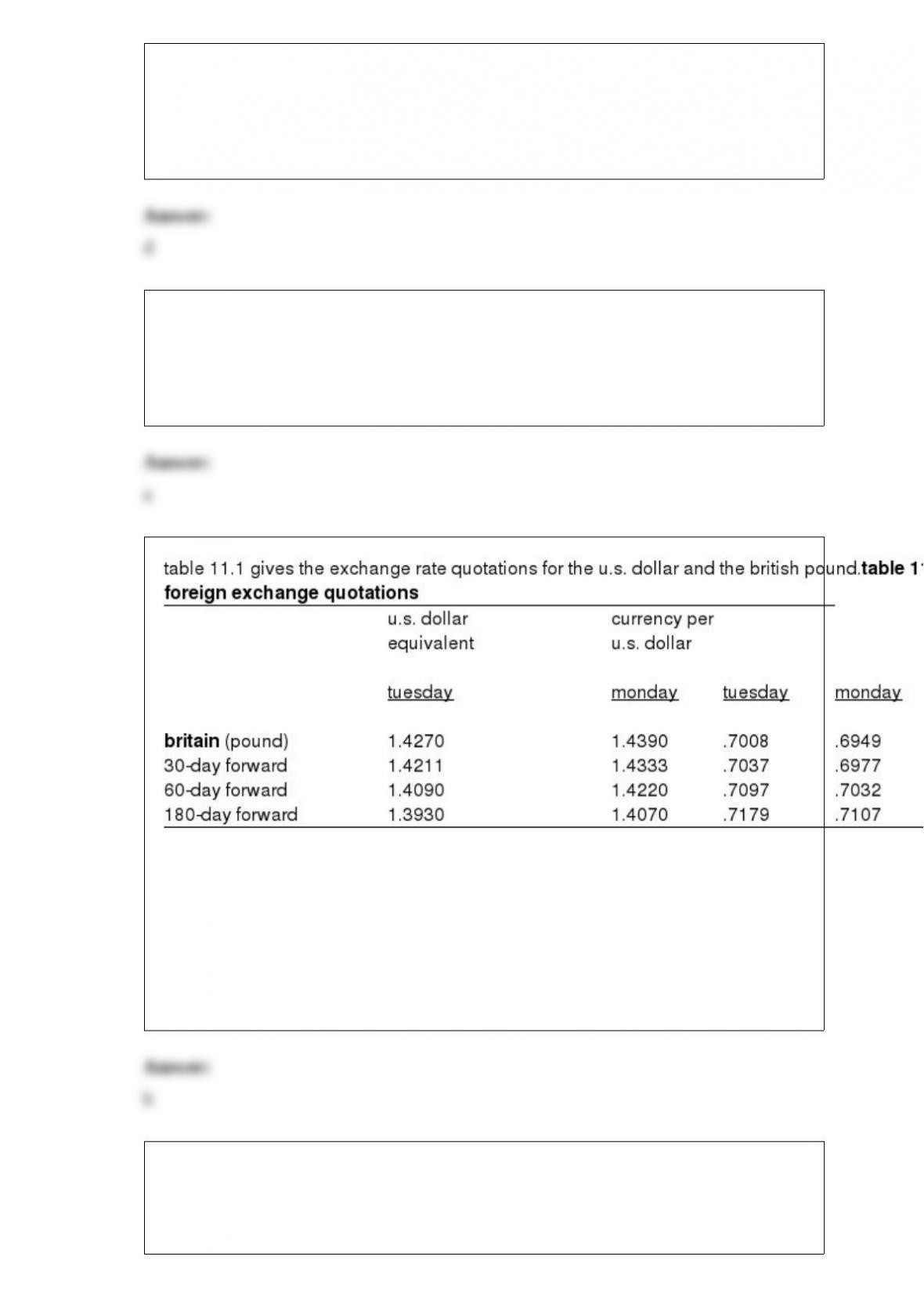
9) consider table 11.1. comparing tuesday to the previous monday, by tuesday the dollar
had:
a.depreciated against the pound
b.appreciated against the pound
c.not changed against the pound
d.none of the above
10) luxembourg is a member of:
a.a free trade area
b.a monetary union
c.benelux
d.both a and c
11) according to exchange-rate overshooting, an appreciation of the australian dollar is
likely to be greater over a long time period than over a short time period.
a.true
b.false
12) a primary reason why nations conduct international trade is because:
a.some nations prefer to produce one thing while others produce other things
b.resources are not equally distributed among all trading nations
c.trade enhances opportunities to accumulate profits
d.interest rates are not identical in all trading nations
13) international trade forces domestic firms to become more competitive in terms of:
a.the introduction of new products
b.product design and quality
c.product price
d.all of the above
14) in 1995 the ____ was established to administer the new global trade rules agreed in
the uruguay round of multilateral trade negotiations.
a.world trade organization
b.organization for economic cooperation and development
c.general agreement on tariffs and trade
d.united nations
15) the most vocal political pressure for tariffs is generally made by:
a.consumers lobbying for export tariffs
b.consumers lobbying for import tariffs
c.producers lobbying for export tariffs
d.producers lobbying for import tariffs
16) a terms-of-trade index that equals 150 indicates that compared to the base year:
a.it requires a greater output of domestic goods to obtain the same amount of foreign
goods
b.it requires a lesser amount of domestic goods to obtain the same amount of foreign
goods
c.the price of exports has risen from $100 to $150
d.the price of imports has risen from $100 to $150
17) swap arrangements
a.are agreements between governments
b.require repayment within a stipulated period
c.are usually multilateral agreements
d.are never initiated by telephone
18) how can currency boards and dollarization prevent currency crises?
19) can import duties have unintended side effects?
20) are economic downturns helpful to cartels?
21) explain how immigration and trade may worsen wage inequality, and how college
education may mitigate against that.
22) what is the focus of the product life cycle theory, and where is it applicable?
23) compared to classical economists, how did keynesian economics change the
discussion of trade adjustment?
24) are there any differences between the theory of multinational enterprises and
conventional trade theory?
25) describe the flying-geese pattern of economic growth? what countries have pursued
this strategy?
26) what does a current account deficit mean?