
In a simple majority vote on a public project,
a. the project will never be undertaken if the costs exceed the benefits.
b. the project may be undertaken even though the total costs exceed the total benefits.
c. the intensity of individual preferences is taken into account.
d. the project will always be undertaken if the total benefits exceed the total costs.
Switching costs make it less likely that the consumer of a network good will shift to a
different company’s product. This is called the __________ effect.
a. lock-in
b. system
c. Internet
d. compression
X-inefficiency occurs when a monopolist produces output at a cost that is greater than
the lowest possible cost.

a. True
b. False
The Gini coefficient would be
a. 1 if there were perfect income equality.
b. zero if there were perfect income equality.
c. -l if there were complete income inequality.
d. zero if there were complete income inequality.
e. a and d
The productivity of the agriculture sector (of the economy) increases dramatically. A
likely consequence is:
a. increased resources flowing into the agriculture sector.
b. an increase in the supply of foodstuffs and lower prices for foodstuffs.
c. an increase in the total revenue (farmers’ receive) from selling foodstuffs, assuming
the demand for their products is elastic.
d. a decrease in the total revenue (farmers’ receive) from selling foodstuffs, assuming
the demand for their products is inelastic.
e. none of the above
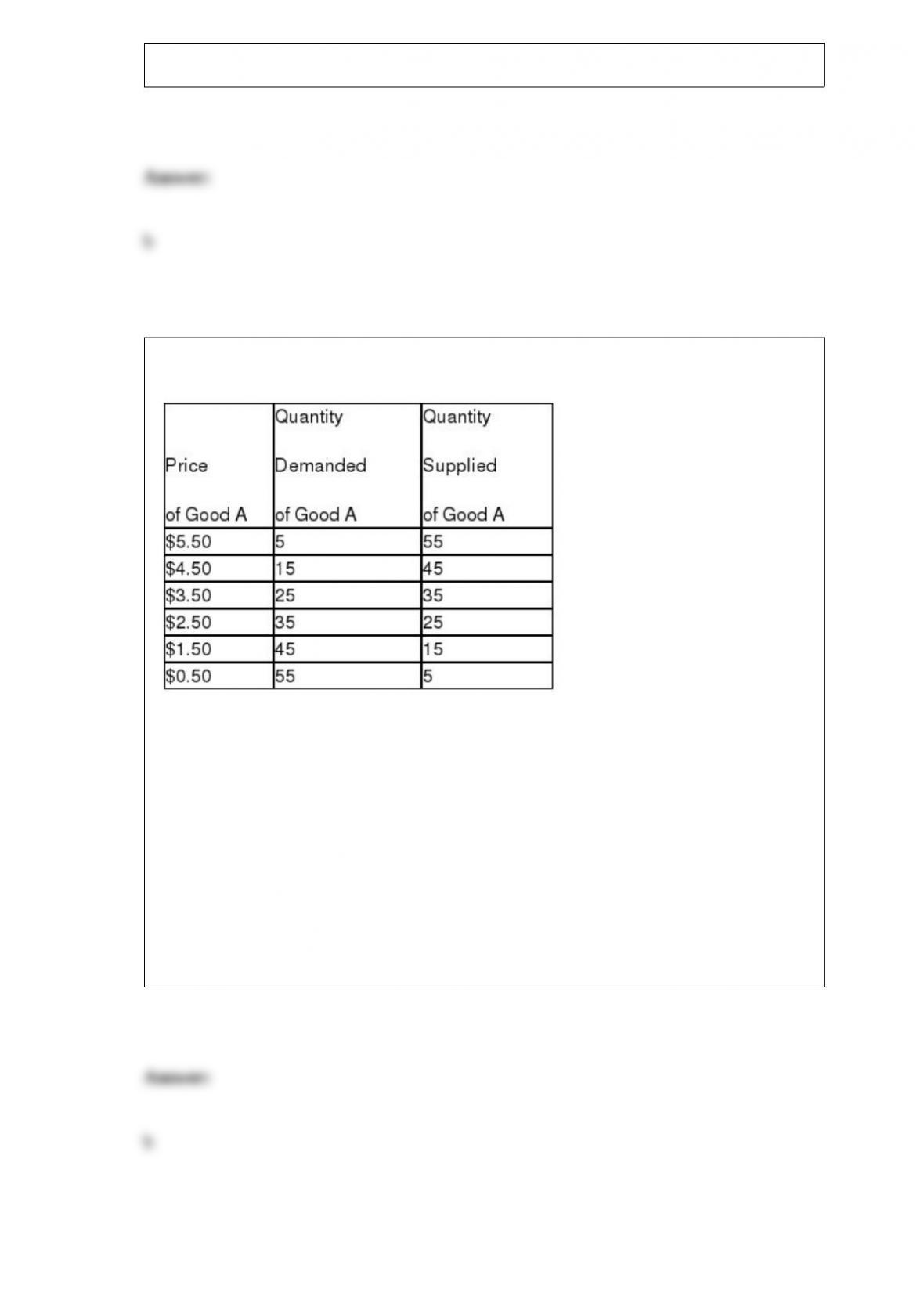
Exhibit 20-3
When price decreases from $1.50 to $0.50, the price elasticity of supply is
a. 0.
b. 1.0.
c. 5.0.
d. 0.1.
e. 0.5.

A change in the expected rate of inflation from 5 percent to 3 percent will
a. decrease the real interest rate by 2 percentage points.
b. decrease the real interest rate by 3 percentage points.
c. increase the nominal interest rate by 2 percentage points.
d. decrease the nominal interest rate by 2 percentage points.
Suppose that for a given good demand increases and supply increases at the same time.
If demand increases by a lesser amount than supply increases, then equilibrium price
__________ and equilibrium quantity __________ for that good.
a. rises; falls
b. falls; falls
c. rises; rises
d. falls; rises
Rent seeking occurs when the seller charges
a. different prices for the product it sells, and the price differences do not reflect cost
differences.
b. the highest price each consumer would be willing to pay for the product rather than
go without it.

c. a uniform price per unit for one specific quantity, a lower price for an additional
quantity, and so on.
d. a and c
e. none of the above
Transfer payments are payments that are
a. made in return for goods and services currently supplied.
b. made in return for goods and services to be supplied in the future.
c. made in return for goods and services that were supplied in the past.
d. not made in return for goods and services currently supplied.
Increased productivity in the agricultural sector in conjunction with an inelastic demand
curve for agricultural goods has caused a(n) __________ in output, a(n) __________ in
price, and __________ revenues for farmers.
a. increase; decrease; higher
b. increase; decrease; lower
c. decrease; increase; higher
d. decrease; increase; lower
e. increase; increase; higher

Which of the following statements is true?
a. There are more farms today than at the beginning of the 20th century.
b. An individual farmer prefers good weather to bad weather, but farmers as a group
may prefer bad weather to good weather, especially if the demand for their products is
inelastic.
c. Income elasticity of demand measures the responsiveness of a change in quantity
supplied to changes in income.
d. a and b
e. b and c
In recent years, which of the following industries has had high four- and eight-firm
concentration ratios?
a. tires
b. soap
c. retail clothing
d. a and b
e. all of the above

One major reason for the law of demand is that
a. one price changing requires at least one other price to change in the opposite
direction.
b. people substitute relatively lower-priced goods for relatively higher-priced goods.
c. a higher price never reduces quantity demanded by enough to lower total revenue.
d. people are willing to produce more units at a higher price.
Which of the following statements is true?
a. A monopolist can charge whatever price it wants without losing any customers, by
virtue of its monopoly position.
b. A monopolist can always increase its profits by increasing its price.
c. In the monopoly market structure, there are low barriers to entry.
d. A monopolist is assured of positive economic profits.
e. none of the above
If more people join carpools and travel to work together
a. the demand curve for freeway space shifts leftward.
b. the supply curve for freeway space shifts rightward.
c. the supply curve for freeway space shifts leftward.
d. a and b
e. none of the above
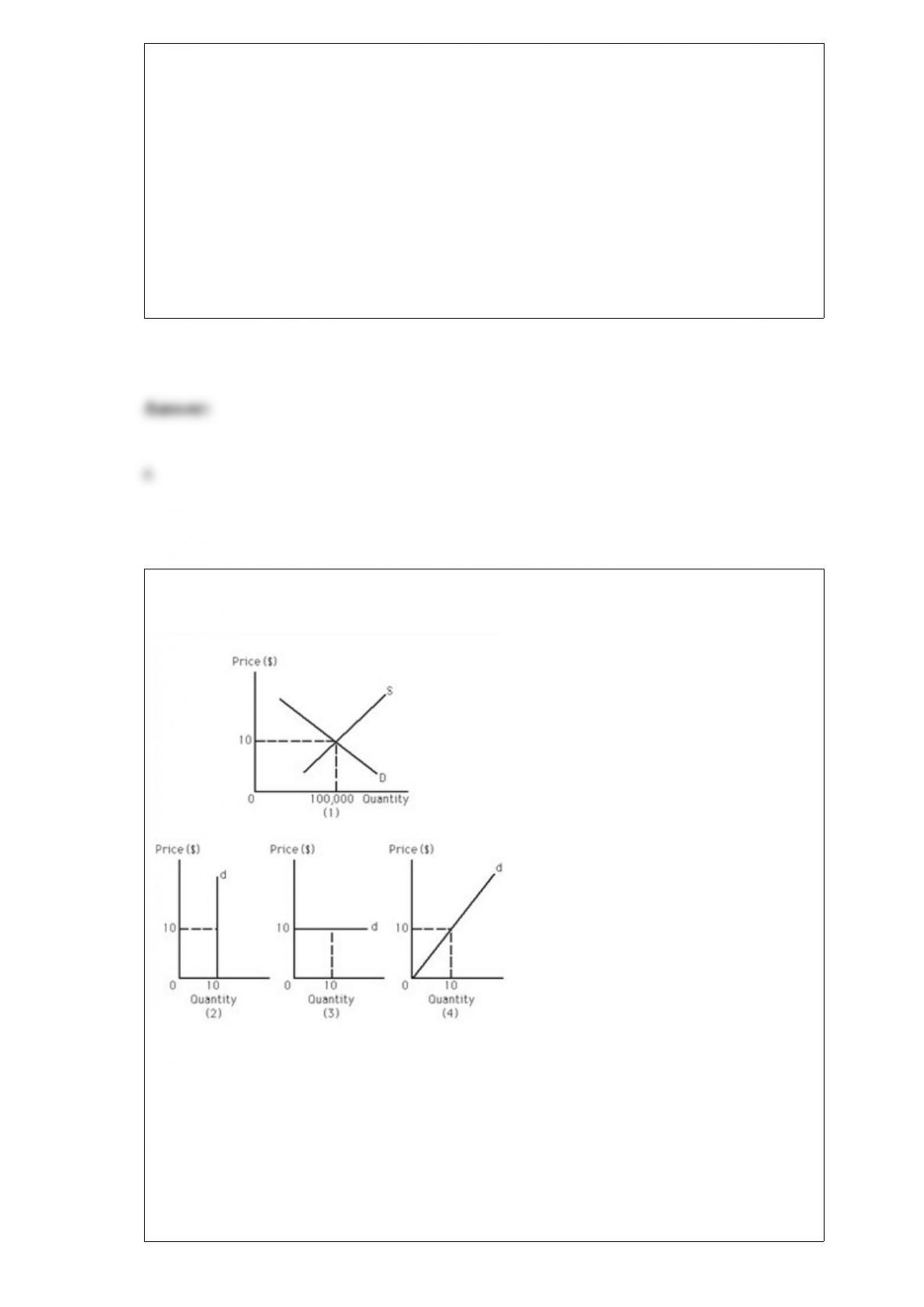
Exhibit 23-6
A perfectly competitive firm operating in the market depicted in graph (1) faces the
demand curve depicted in
a. graph (1)-the same as the market demand curve.
b. graph (2).
c. graph (3).

d. graph (4).
The act that made exclusive dealing illegal was the
a. Sherman Act.
b. Federal Trade Commission Act.
c. Robinson-Patman Act.
d. Clayton Act.
e. none of the above
The current real interest rate is 6 percent. It follows the nominal interest rate is
__________ percent if the expected inflation rate is __________ percent.
a. 8; 14
b. 10; 2
c. -2; 4
d. 9; 3
e. There is not enough information to answer the question.