
1) it is possible for a consumer’s indifference curves to intersect.
2) The capricious universe view is the idea that the IACs are exploiting the DVCs.
3) wages and salaries are the largest source of household income.
4) TANF stands for Temporary Assistance for Needy Families.
5) When commercial banks retire outstanding loans, the supply of money is increased.
6) macroeconomics explains the behavior of individual households and business firms;
microeconomics is concerned with the behavior of aggregates or the economy as a
whole.
7) third-party (insurance) payment of health care costs causes health care to be
overconsumed.
8) The real-balances effect indicates that inflation makes the public feel wealthier and
they therefore spend more out of their current incomes.

9) The recessionary expenditure gap is the amount by which the equilibrium GDP and
the full-employment GDP differ.
10) pure monopolists always earn economic profits.
11) generally speaking, the demand for luxury goods is more price elastic than is the
demand for necessities.
12) Marginal resource (labor) cost will exceed the wage rate when there is imperfect
competition in the hire of labor.
13) Property rights over fish in the open ocean exist once the fish are caught.
14) ndp can be determined by adding taxes on production and imports to gdp.
15) The crowding-out effect of expansionary fiscal policy suggests that:
A.government spending is increasing at the expense of private investment.
B.imports are replacing domestic production.
C.private investment is increasing at the expense of government spending.
D.saving is increasing at the expense of investment.
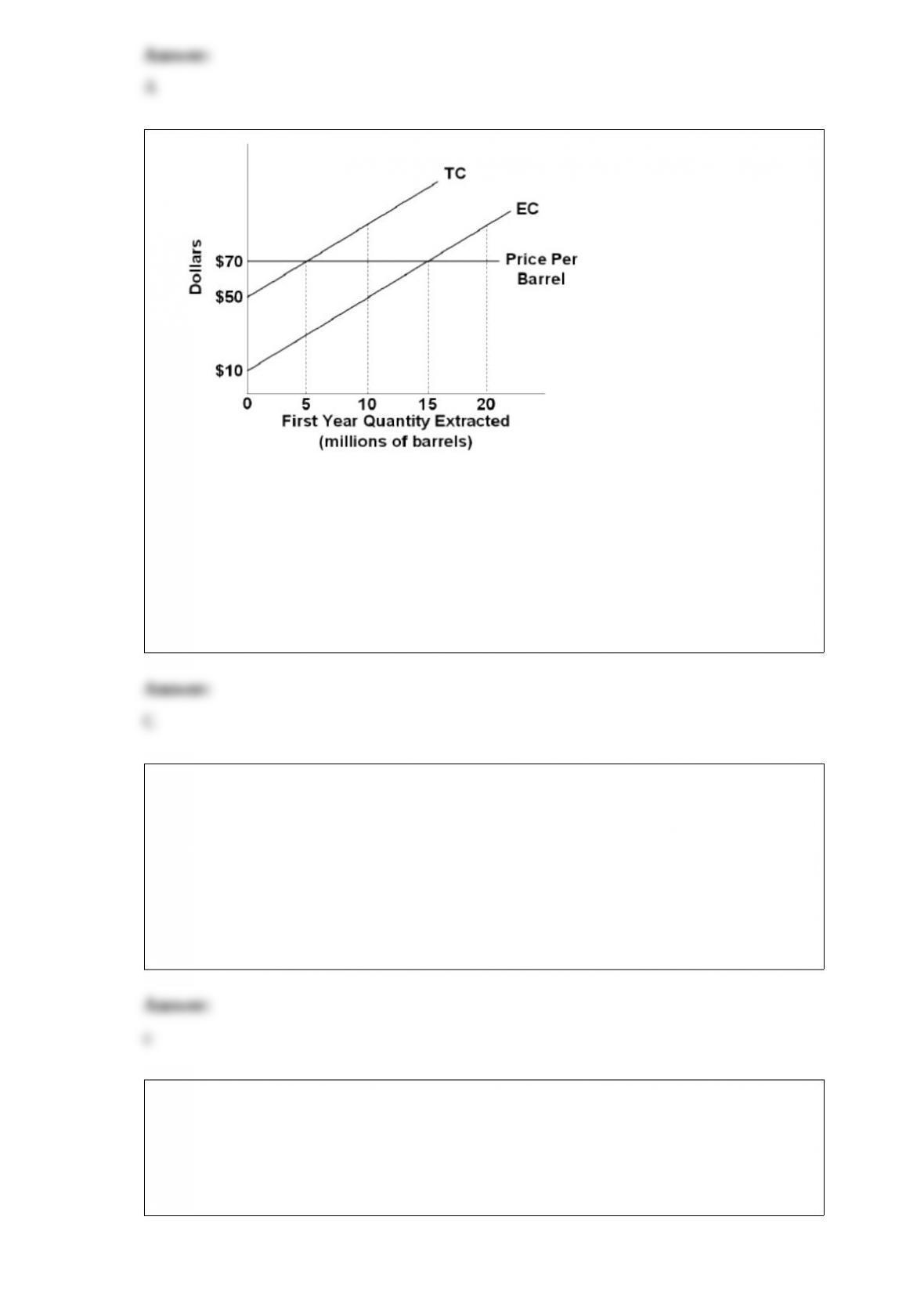
16)
Refer to the diagram above, representing Slippery Slope Oil Company. A $10 increase
in the user cost would shift:
A.up the extraction cost curve only, and reduce the amount of oil extracted in the
present.
B.up both the extraction cost and total cost curves, and reduce the amount of oil
extracted in the present.
C.up the total cost curve only, and reduce the amount of oil extracted in the present.
D.down the total cost curve, and increase the amount of oil extracted in the future.
17) determine, other things equal, the effects of a given change in a determinant of
demand or supply for product x upon (1) the demand (d) for, or supply (s) of, x, (2) the
equilibrium price (p) of x and (3) the equilibrium quantity (q) of x.
refer to the above. an improvement in the technology used to produce x will:
a.decrease s, increase p, and decrease q.
b.decrease s, increase p, and increase q.
c.increase s, decrease p, and increase q.
d.decrease d, decrease p, and decrease q.
18)
Forestry companies typically harvest and replant an area when trees are:
A.very young and growing slowly.
B.middle aged and growing rapidly.
C.near the end of their rapid growth period.
D.extremely old and about to die anyway.
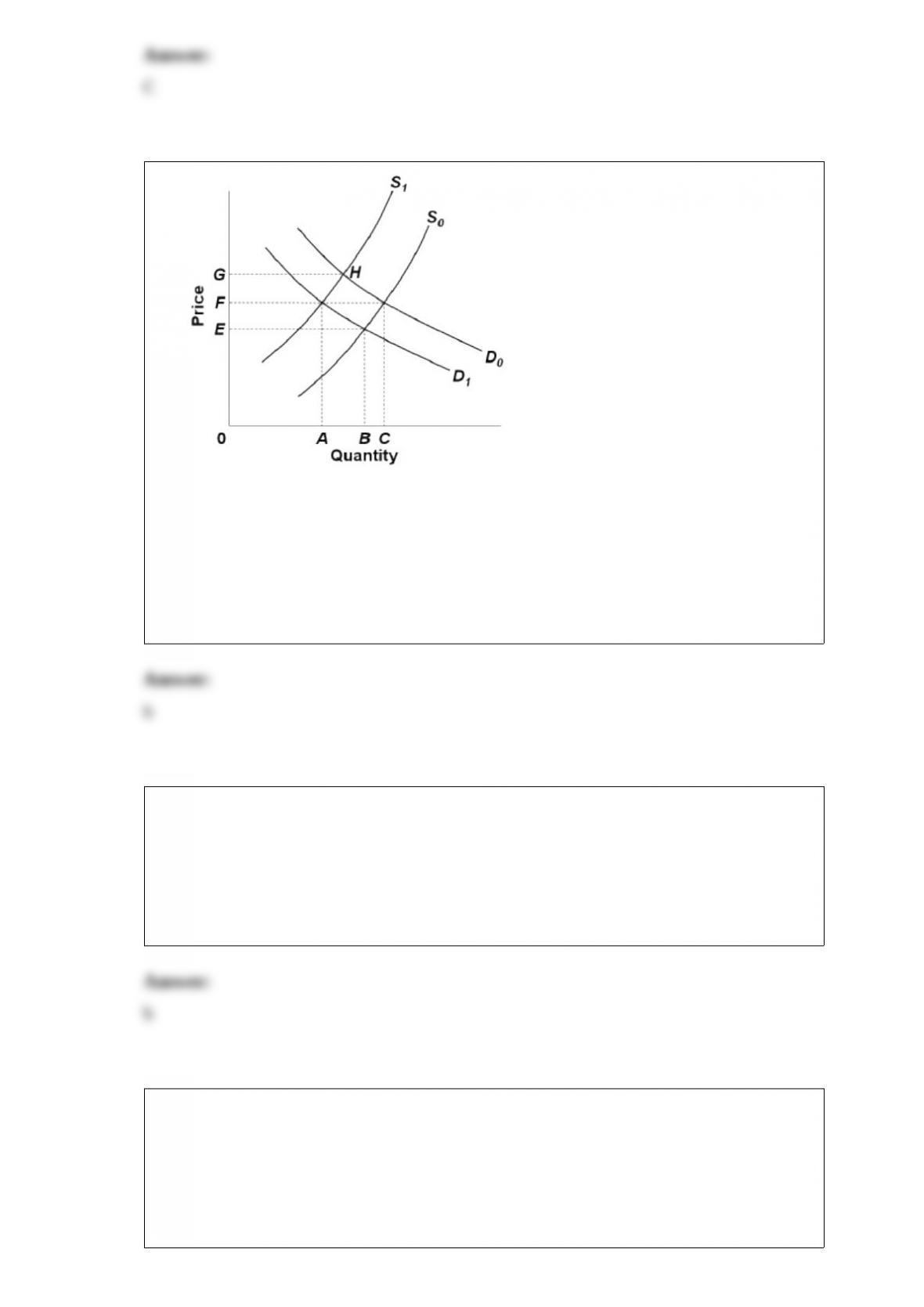
19)
refer to the above diagram, which shows demand and supply conditions in the
competitive market for product x. a shift in the demand curve from d0 to d1 might be
caused by a(n):
a.decrease in income if x is an inferior good.
b.increase in the price of complementary good y.
c.increase in money incomes if x is a normal good.
d.increase in the price of substitute product y.
20) if a firm increases all of its inputs by 10 percent and its output increases by 15
percent, then:
a.it is encountering diseconomies of scale.
b.it is encountering economies of scale.
c.the law of diminishing returns is taking hold.
d.the firm’s long-run atc curve will be rising.
21) eclectic enterprises is a single firm that sells goods and services in the markets for
health food, furniture, electric energy, and toys. eclectic enterprises is best described as
a(n):
a.conglomerate.
b.horizontally integrated firm.
c.vertically integrated firm.
d.industry.
22) in which phase of the business cycle will the economy most likely experience rising
real output and falling unemployment rates?
a.expansion
b.recession
c.peak
d.trough
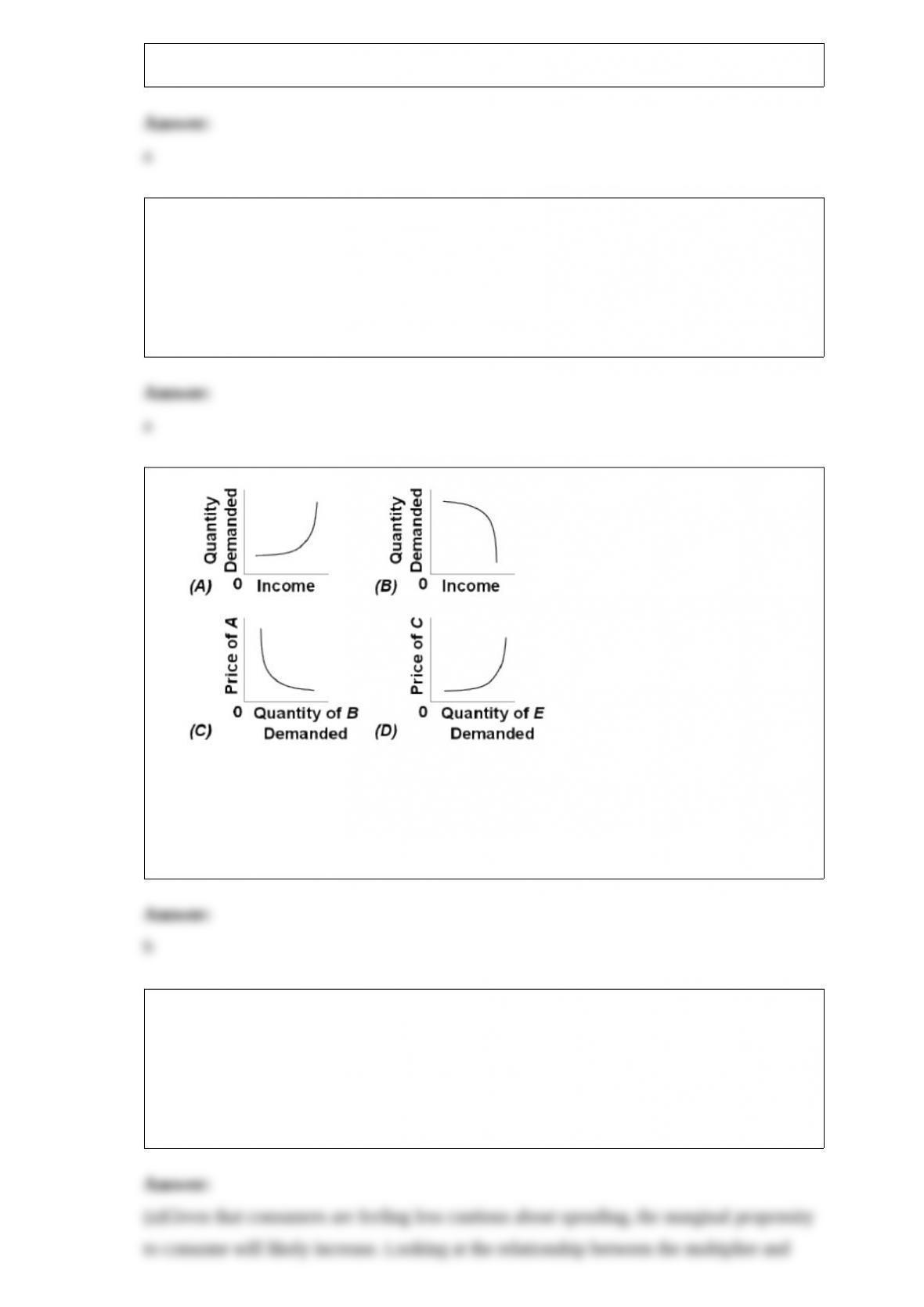
23)
refer to the above diagrams. the case of an inferior good is represented by figure(s):
a.a only.
b.b only.
c.c.
d.d.
24) Consider the effect of the following on the multiplier.
(a)As a recession ends and recovery begins consumers are feeling less cautious about
spending.
(b)As the economy moves into an expansion, spending increases.
(c)Uncertainty about national security and political relations abroad causes the public to
adjust by saving more to use in case of an economic downturn worldwide.
25) Which of the following is not a component of the demand for loanable funds?
A.household purchases of housing and durable consumer goods
B.business purchases of capital goods
C.government financing of the public debt
D.household saving
26) which of the following statements is true about productive and allocative
efficiency?
a.realizing allocative efficiency implies that productive efficiency has been realized.
b.productive efficiency can only occur if there is also allocative efficiency.
c.society can achieve either productive efficiency or allocative efficiency, but not both
simultaneously.
d.productive efficiency and allocative efficiency can only occur together; neither can
occur without the other.
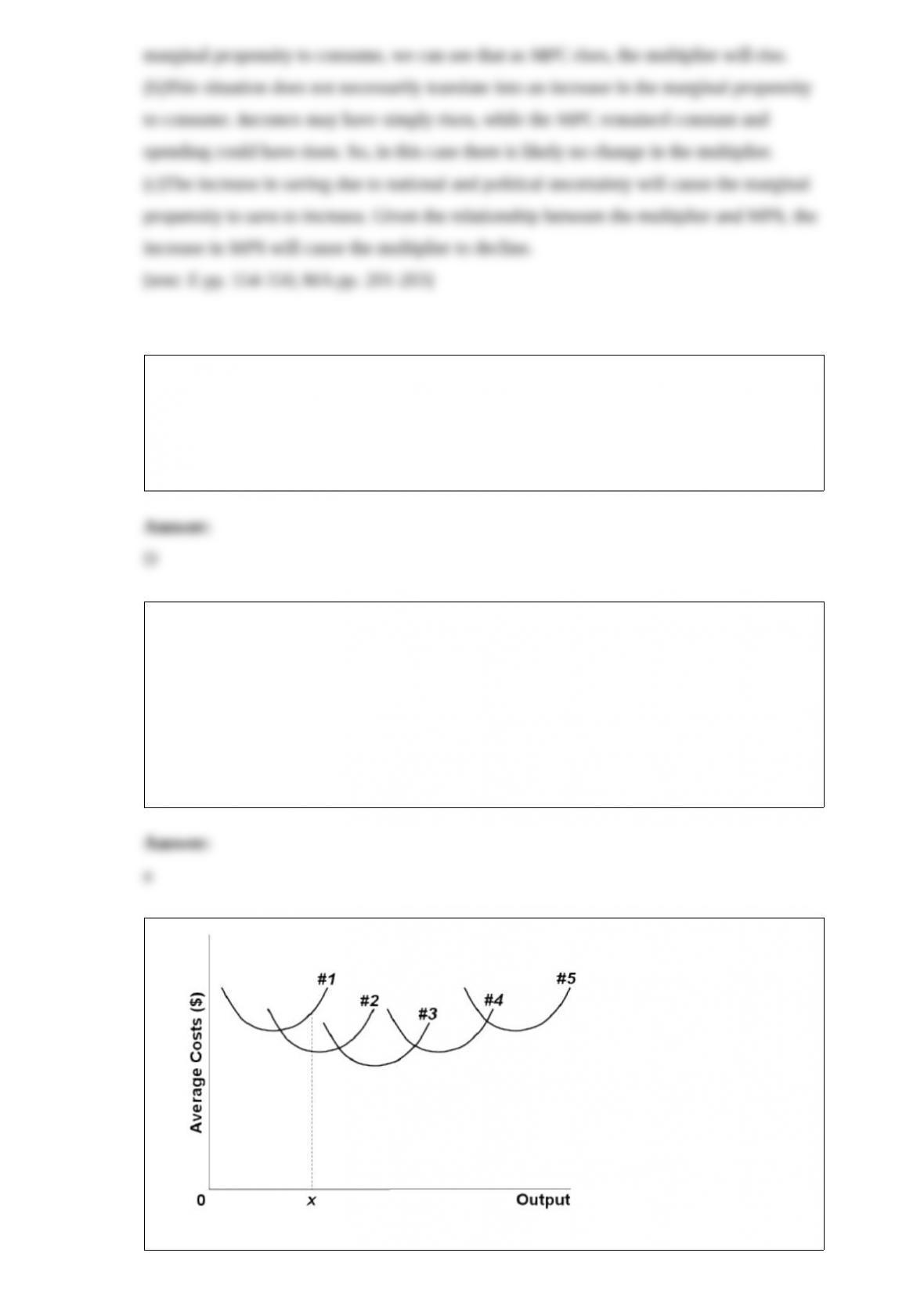
27)
the above diagram shows the short-run average total cost curves for five different plant
sizes of a firm. the position of these five curves in relation to one another reflects:
a.economies and diseconomies of scale.
b.the effect of fixed costs on atc as output increases.
c.the law of constant costs.
d.the law of diminishing returns.
28) one of the main differences between ppos and hmos is that:
a.hmo physicians charge on a traditional fee-for-service basis, while ppo physicians do
not.
b.hmos are usually for-profit organizations, whereas ppos are not.
c.ppos employ their own doctors, whereas hmos do not.
d.ppo physicians charge on a traditional fee-for service basis, while hmos do not.
29) Suppose Gigantic Health Cooperative doesn’t hire Mandy Morrison solely because
she is a graduate of a particular foreign medical school, which is not known for the high
quality of its graduates. Yet, Mandy is actually more qualified than the average graduate
of American medical schools. This is an example of:
A.monopsony exploitation.
B.human-capital discrimination.
C.statistical discrimination.
D.irrational behavior.
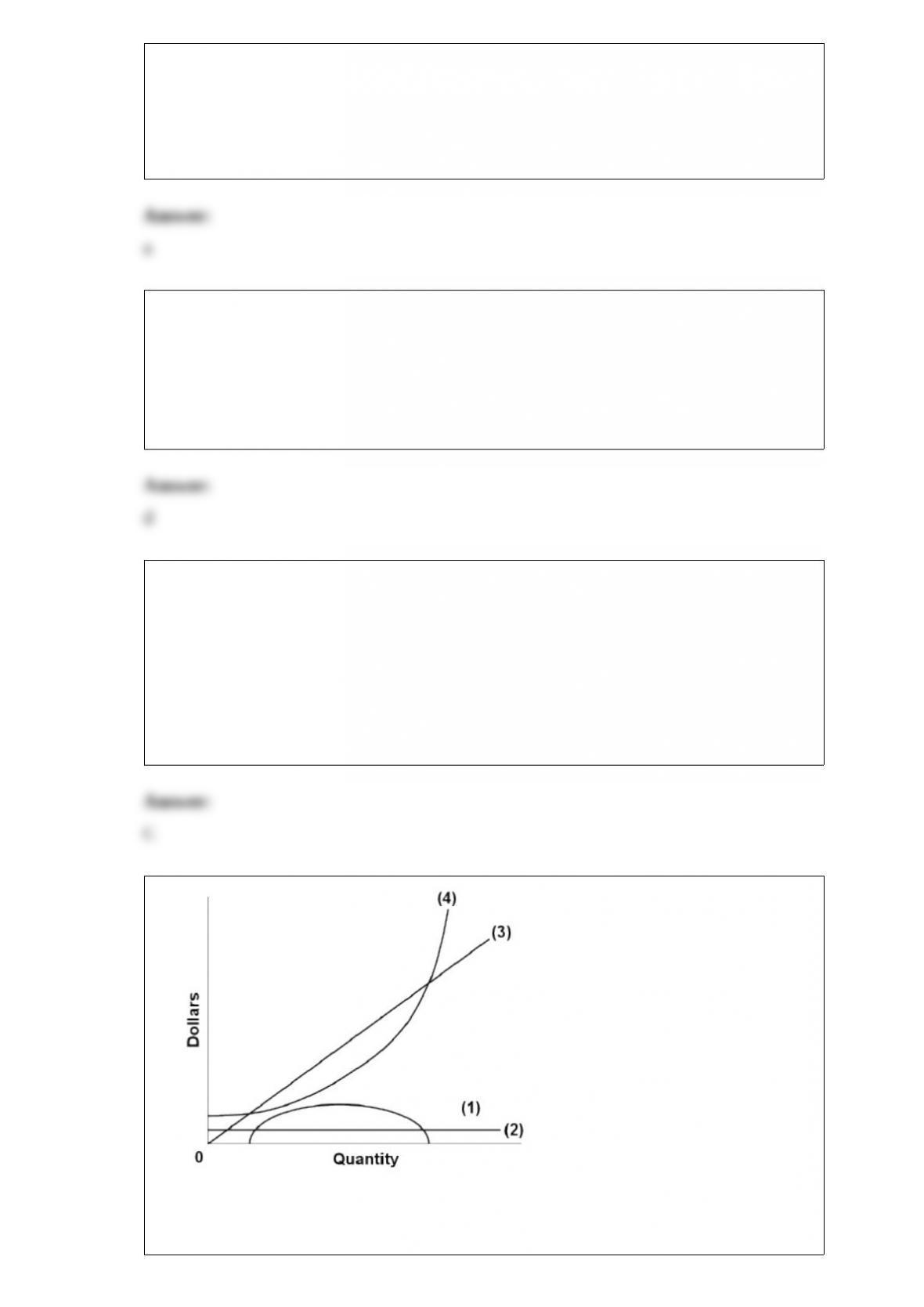
30)
curve (2) in the above diagram is a purely competitive firm’s:
a.total cost curve.
b.total revenue curve.
c.marginal revenue curve.
d.total economic profit curve.
31) if in some year gross investment was $120 billion and net investment was $65
billion, then in that year the country’s capital stock:
a.may have either increased or decreased.
b.increased by $65 billion.
c.increased by $55 billion.
d.decreased by $55 billion.
32) What is a bilateral monopoly? What is the economic outcome from a bilateral
monopoly? Is a bilateral monopoly a bad situation for society?
33) What are the two types of demand that make up total demand for money?
34) Should all pollution be banned? Why might some level of pollution be
economically efficient?
35) How will the market demand curve for a public good differ from the market
demand curve for a private good?
36) What is meant by human capital and how can it be used to promote economic
growth?
37) Is the public debt a burden on future generations? Explain.
38) Differentiate between the average propensity to consume and the marginal
propensity to consume.
39) Define the multiplier. How is it related to real GDP and the initial change in
spending? How can the multiplier have a negative effect?
40) Some economists believe that creeping (moderate) inflation cannot be accepted
because a gradual increase in prices leads to an ever-rising rate of inflation. Other
economists argue that in order to achieve rapid economic growth, some moderate price
increases are necessary and that rigid price stability would cause considerable
unemployment. Contrast and evaluate these two points of view.