
Under an emissions tax program, the government sets ____; under an emissions permits
program, the government sets ____.
a. the price of the right to pollute; the price of the right to pollute
b. the price of the right to pollute; the permitted total quantity of pollution
c. the permitted total quantity of pollution; the price of the right to pollute
d. the permitted total quantity of pollution; the permitted total quantity of pollution
Part of the controversy about Fed independence include(s)
a. the goal to bring all macroeconomic policy under the direct control of the president.
b. the appropriate role of the Fed in policy making.
c. how to make the Fed more powerful than other central banks.
d. All of the above are correct.
Variability in exchange rates of currencies used in international trade
a. causes a complete breakdown of trade.
b. renders the theory of gains from trade null in practice.

c. brings with it a host of complications in trade policy.
d. has no impact on trade.
All four market forms discussed in the text maximize profit where
a. P = MC.
b. AR = AC.
c. MR = MC.
d. MC = AR.
Which of the following is the correct statement of the marginal rule for optimal input
proportions? The input proportion is optimal when
a. PA = PB.
b. MPPA = MPPB.
c. PA MPPA = PB MPPB.
d. PA/PB = MPPA/MPPB.

The principal effect of unemployment insurance on the entire U.S. economy is
a. that it spreads the costs of unemployment.
b. that it eliminates the social costs of unemployment.
c. that it reduces the social costs of unemployment.
d. the reduction in the federal debt.
The Securities and Exchange Commission (SEC) oversees the regulation of the
securities market.
a. True
b. False
Because of recent corporate downsizing, Chuck loses his job. The most likely effect on
his consumption function is a(n)
a. movement downward along the function.
b. shift upward of the function.
c. shift downward of the function.
d. increase in consumption expenditures.
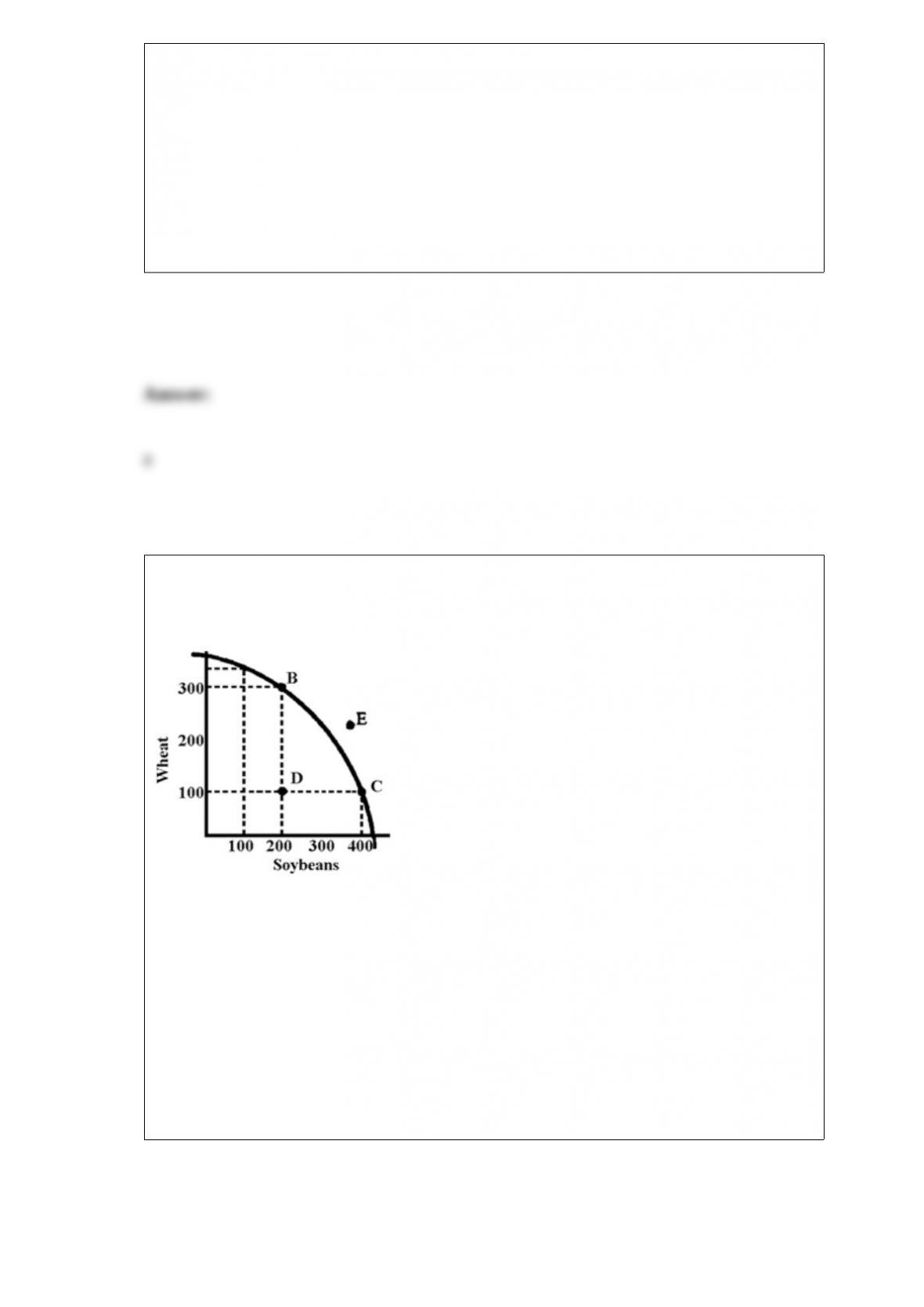
Figure 3-6
In Figure 3-6 assume this economy is currently operating at point D. What is the
opportunity cost of moving to B?
a. about 200 bushels of wheat
b. 200 bushels of soybeans
c. Infinite, B cannot be produced at any cost.
d. 0

An inflationary gap will eliminate itself through a process of price increases.
a. True
b. False
An important assumption that is made when constructing a demand schedule is that
a. only price and quantity matter in determining demand.
b. people always want a certain amount of a product.
c. demand is too important to be left to the economists.
d. all other determinants of demand are held constant.
e. demand has a positive slope.
Economists study perfect competition

a. because many markets are perfectly competitive.
b. for its descriptive realism.
c. to establish a benchmark by which to measure the performance of the economy.
d. All of the above are correct.
Total fixed cost falls as output expands.
a. True
b. False
During the Revolutionary War, the Pennsylvania legislature attempted to help the
Continental Army by enacting
a. wage floors for soldiers in the army.
b. bonuses for soldiers who re-enlisted.
c. laws to buy food for the soldiers stationed in Pennsylvania.
d. price controls on essential commodities.
e. All of the above are correct.

Stock prices can be described as “random walks” if there is no relationship between one
day’s prices and the following day’s prices.
a. True
b. False
For legal purposes, a corporation is treated as
a. an individual.
b. a nonprofit organization.
c. a partnership.
d. a limited partner in a partnership.
In the 19th century, Russian peasants noticed that during cholera epidemics there were
lots of doctors around; in an attempt to eliminate cholera, they killed all the doctors.
This is an example of
a. mistaking correlation with causation.
b. the fallacy of opportunism.
c. excessive abstraction.
d. rationality.
e. marginal analysis.
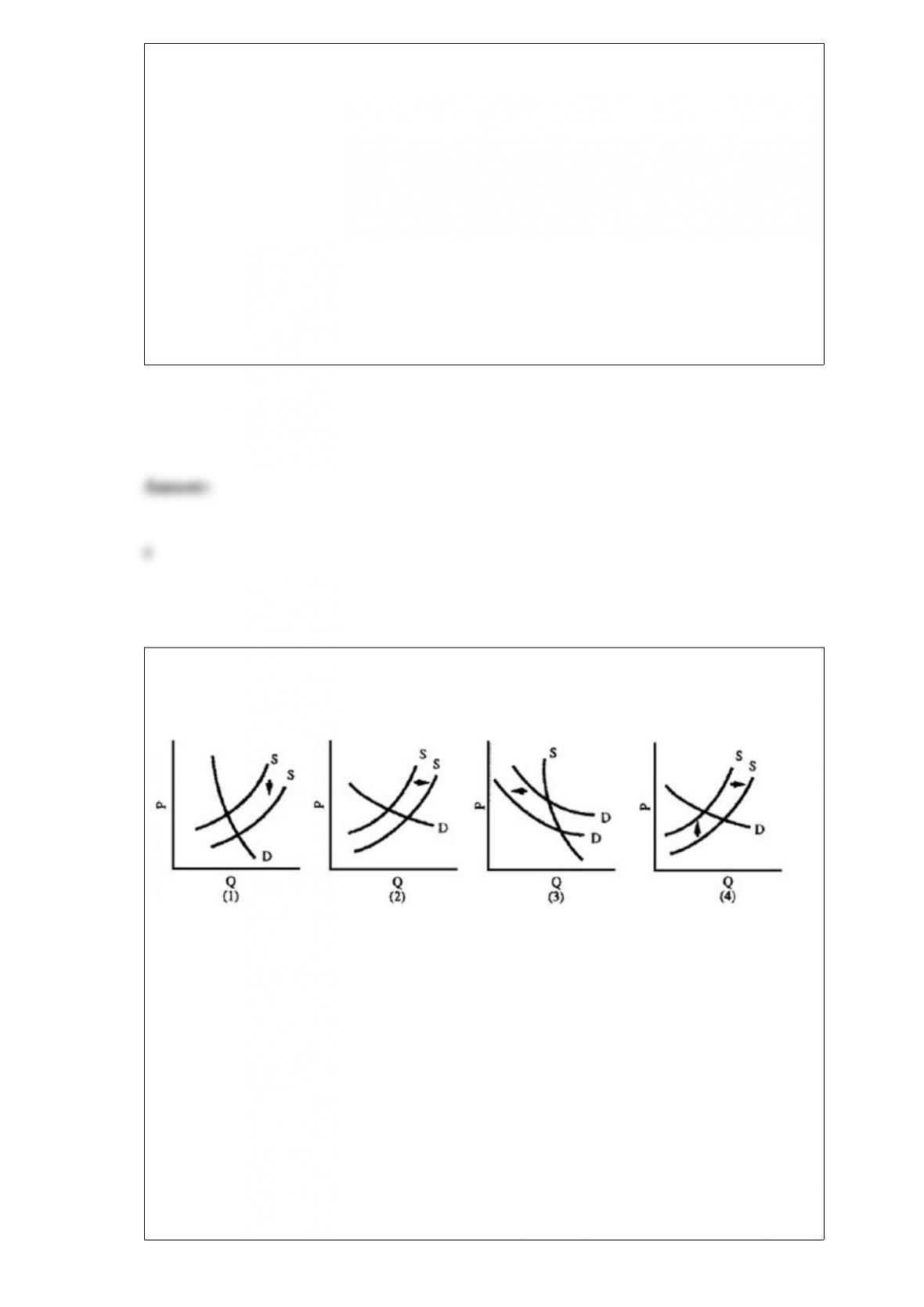
Figure 4-15
Recycling of newspapers has been undermined by its success. The supply of old papers,
gathered diligently by those concerned with the environment, has increased
dramatically, as has the number of firms that convert the material into recycled
newsprint. The quantity demanded has remained relatively stable despite falling prices
because newspapers consider recycled newsprint an inferior substitute for regular
newsprint. Consequently, the price of recycled newsprint has fallen below the cost of
production; recycling firms are going out of business; mountains of old newspapers are
left behind. Which graph in Figure 4-15 best illustrates this situation?
a. 1
b. 2

c. 3
d. 4
Why does an increase in the price level cause a decrease in real GDP demanded?
a. Consumer wealth increases.
b. Net exports will increase.
c. Interest rates decrease and cause higher investment.
d. Net exports will decrease.
If nominal GDP is 8,100 billion florins and the money supply is 900 billion florins, the
velocity of circulation is
a. 900.0.
b. 90.0.
c. 81.0.
d. 9.0.
e. 8.1.

The major difference between the Keynesian approach and the monetarist approach is
that
a. Keynesian analysis explains an equilibrium condition and monetarism does not.
b. in Keynesian analysis, money affects the economy by first affecting interest rates;
monetarist analysis is not limited to working through interest rates.
c. monetarism explains an equilibrium condition and Keynesian analysis does not.
d. there are no differences.
Deviations from the perfectly competitive market can lead to
a. inefficiently high production costs.
b. higher prices and smaller outputs.
c. less efficient resource allocation.
d. All of the above are correct.

In what way do policy makers have to face a trade-off between inflation and
unemployment?
a. The cost of reducing inflation by restrictive fiscal and monetary policies is a
temporary increase in unemployment.
b. The cost of reducing inflation by restrictive fiscal and monetary policies is a
permanent increase in unemployment.
c. The cost of reducing unemployment by expansionary fiscal and monetary policies is
virtually nonexistent.
d. The cost of reducing unemployment by expansionary fiscal and monetary policies
involves higher inflation during recessions.
Two goods with a low cross elasticity of demand are competing in the same market.
a. True
b. False
The reason why inflation reduces the value of the multiplier is that part of the change in

demand is
a. absorbed by price changes.
b. saved rather than spent.
c. matched by changes in supply.
d. matched by changes in income.
The concept that describes the situation where the economy has used every available
opportunity to make someone better off without making someone else worse off is
a. economic efficiency.
b. the benefits principle.
c. horizontal equity.
d. vertical equity.
Teenagers generally have high marginal revenue products because they have not
completed their educations and have little job experience.
a. True
b. False

If the Fed decides to buy T-bills, it increases the demand for T-bills. How will this affect
the price of T-bills and the interest rate?
a. T-bill prices fall and interest rates fall.
b. T-bill prices rise and interest rates rise.
c. T-bill prices rise and interest rates fall.
d. T-bill prices fall and interest rates rise.
In a competitive economy, the questions of what, how, and for whom to produce tend to
be regulated by
a. the government.
b. businessmen.
c. the price system.
d. workers.

If policy makers do nothing in a recessionary gap, the most likely outcome is a
a. drop in the inflation rate and a rise in the unemployment rate.
b. drop in the inflation rate and a drop in the unemployment rate.
c. rise in the inflation rate and a drop in the unemployment rate.
d. rise in the inflation rate and a rise in the unemployment rate.
If the dollar depreciates, both the aggregate demand curve and the aggregate supply
curve shift inward.
a. True
b. False
The optimal level of resource use comes when
a. MRP exceeds input price.
b. MRP is less than input price.

c. MRP equals input price.
d. use of the resource exhausts the producer’s funds.