
If the demand for a particular farm product is inelastic between price P1 and P2 (where
P2 > P1), farmers as a group would want to sell their product at the
a. higher price, but an individual farmer would rather sell his product at the lower price.
b. higher price, and an individual farmer would rather sell his product at the higher
price, too.
c. lower price, but an individual farmer would rather sell his product at the higher price.
d. lower price, and an individual farmer would rather sell his product at the lower price,
too.
When income distribution data for the United States is adjusted for taxes and in-kind
transfer payments the distribution is more equal than before such an adjustment is
made.
a. True
b. False
The monopolistic competitive firm faces a(n) __________ demand curve.
a. horizontal
b. vertical
c. downward-sloping

d. upward-sloping
A side effect of an action that adversely affects the well-being of others is called a
a. complement.
b. supplement.
c. negative externality.
d. marginal cost.
If Maria and Maya each specialize in the good in which she has a comparative
advantage and then engage in trade, ____________________ can consume a
combination of goods that lies beyond her PPF.
a. Maria, but not Maya,

b. Maya, but not Maria,
c. both Maria and Maya
d. neither Maria nor Maya
The seller of good X sells 1,000 units of the good.Each unit is being sold for the highest
price each consumer is willing to pay for the good. The seller practices
a. second-degree price discrimination.
b. third-degree price discrimination.
c. perfect price discrimination.
d. marginal revenue pricing.
e. rent seeking.
Exhibit 34-4

Country 1 has a comparative advantage in the production of __________, and country 2
has a comparative advantage in the production of __________.
a. good A; good B
b. good B; good A
c. both goods; neither good
d. neither good; both goods
e. neither good; neither good
Given two goods, X and Y, their prices, PX and PY, a consumer is in equilibrium when
the last dollar spent on X yields
a. zero marginal utility for Y.
b. the same marginal utility as if all the money were spent on Y.
c. a smaller marginal utility than the last dollar spent on Y.
d. the same marginal utility as the last dollar spent on Y.
e. none of the above
Which of the following statements represents a correct sequence of events?
a. Productivity rises in the agriculture sector, the supply curve of foodstuffs shifts to the

left, price rises, and total revenue rises assuming demand is inelastic.
b. Productivity rises in the agriculture sector, the supply curve of foodstuffs shifts to the
right, price rises, and total revenue rises assuming demand is inelastic.
c. Productivity rises in the agriculture sector, the supply curve of foodstuffs shifts to the
right, price falls, and total revenue falls assuming demand is elastic.
d. Productivity rises in the agriculture sector, the supply curve of foodstuffs shifts to the
left, price falls, and total revenue rises assuming demand is elastic.
e. none of the above
Which of the following statements is true?
a. Government cannot remove individuals from a prisoner€s dilemma setting and
make them better off.
b. As long as government charges each individual a tax that is more than the gain
received by being removed from a prisoner’s dilemma setting, then government makes
that individual better off.
c. Government can remove individuals from a prisoner€s dilemma setting by
changing the payoff matrix.
d. a and c
e. all of the above
What is the most prominent rationing device you will likely find at your campus

bookstore?
a. dollar price
b. brute force
c. anti-theft tags on the high-priced items
d. none of the above
The Taft-Hartley Act allowed states the right to
a. check into the past of prospective employees before they were hired.
b. prosecute labor union bosses who did not obey the labor practices deemed reasonable
by state authorities.
c. pass right-to-work laws.
d. b and c
e. none of the above
Suppose a sailboat factory and a fishing boat factory exist in the same town. Employees
at both factories have the same skills and are initially paid the same wage rate. If the
sailboat manufacturer increases the hourly wage paid to his employees, then the
a. demand for sailboats will increase, and the supply will decrease.
b. quantity supplied of labor at the sailboat factory will increase.

c. supply of labor at the fishing boat factory will increase.
d. b and c
e. a and c
What does it mean if a person makes a “decision at the margin”?
a. The person compares additional benefits and additional costs when deciding what to
do.
b. The person weighs the good against the bad and then decides what to do.
c. The person is more likely to say yes than to say no.
d. The person compares marginal benefits and total costs and then decides what to do.
e. The person makes a decision based on a condition.
Which of the following statements is false?
a. The perfectly competitive firm and the perfectly price-discriminating monopolist
both exhibit resource-allocative efficiency.
b. The perfectly competitive firm, unlike the single-price monopolist, exhibits
resource-allocative efficiency.
c. The perfectly competitive firm charges the same price for each unit of the good it
sells.

d. The perfectly price-discriminating monopolist charges the same price for each unit of
the good it sells.
A positive externality exists and government wants to apply a per-unit subsidy in order
to bring about an efficient outcome. Under what condition will the solution (the
subsidy) be worse than the problem (the market failure)?
a. Under the condition that the subsidy is greater than the marginal external benefit
(associated with the positive externality).
b. Under the condition that the post-subsidy output is not farther away from the efficient
level of output than the pre-subsidy output is from the efficient level of output.
c. Under the condition that the post-subsidy output is farther away from the efficient
level of output than the pre-subsidy output is from the efficient level of output.
d. Under the condition that the subsidy is less than the marginal external benefit
(associated with the positive externality).
e. none of the above
Exhibit 28-8

If the profit-maximizing monopsonist were to pay its workers what the marginal
worker’s services are worth to it, the wage rate would be
a. W1.
b. W2.
c. W3.
d. W4.
e. W5.
If a contestable market does not satisfy all of the conditions of a perfectly competitive
market, that contestable market _______________ achieve resource allocative
efficiency.
a. will not
b. will definitely
c. could possibly
d. This is a trick question since only monopolies achieve resource allocative efficiency.
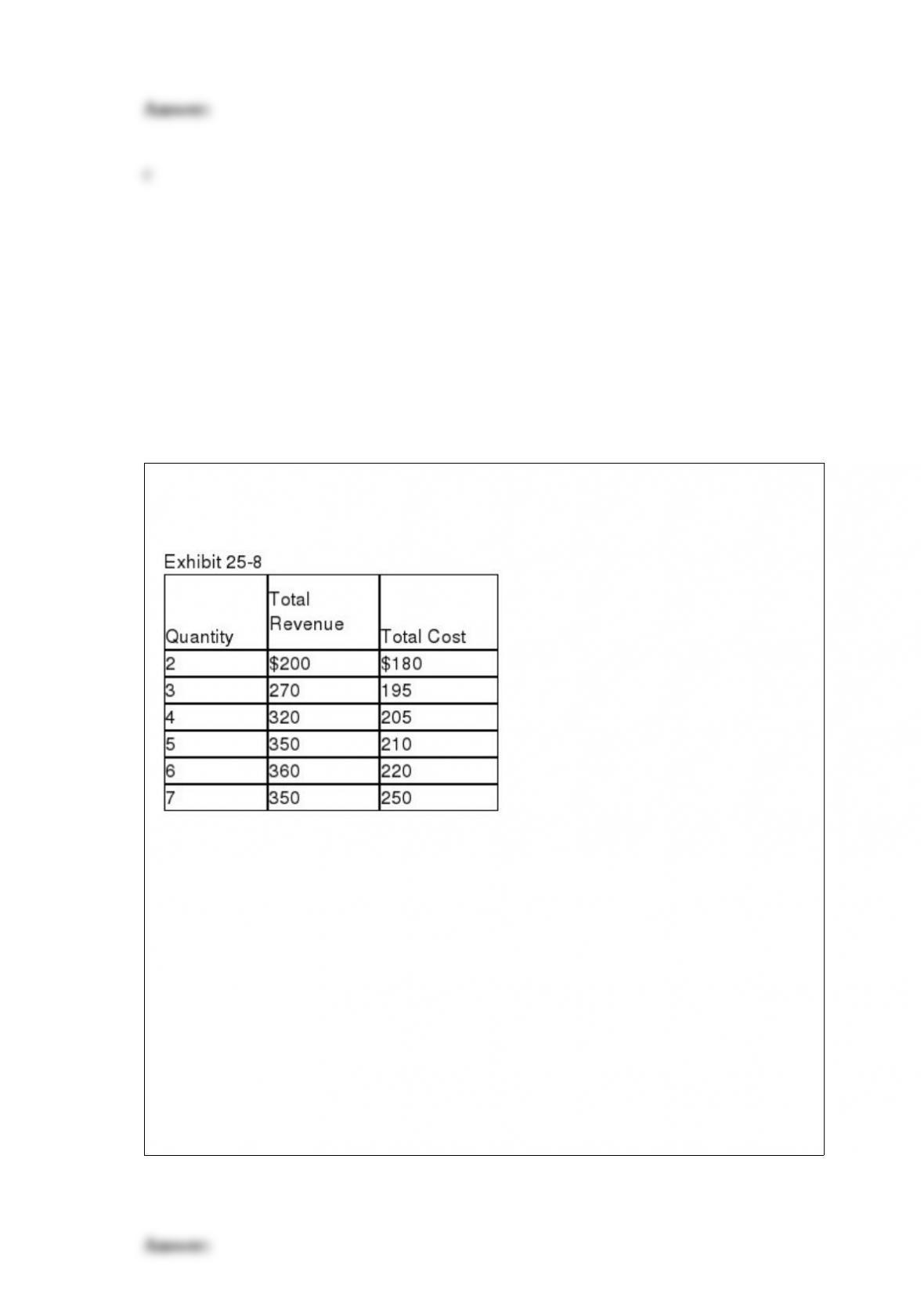
A profit-maximizing monopolistic competitive firm that produces the level of output
where MR = MC will produce ______________ units of output and charge a price of
______________.
a. 3; $90
b. 4; $80
c. 5; $42
d. 6; $60
e. 7; $50

If you thought the share price of a stock was going to rise, would you be more likely to
buy a call option or a put option?
a. a call option
b. a put option
c. a call option and a put option
d. There is not enough information given to answer this question.