
In an increasing-cost industry the long-run supply curve is upward sloping.
If aggregate expenditure is less than GDP, then inventories rise and GDP falls.
A country which incurs a current account deficit will most likely have a financial or
capital account surplus.
An externality is an example of a market failure.
Compared to the previous 20 years, productivity growth in the United States increased
between 1996 and 2012.
If the Fed wishes to decrease the supply of money and credit, it may sell government
securities, raise the discount rate, or lower required reserve ratios.
When voluntary exchange takes place, both parties gain from the exchange.
A doctor pursuing his own interests rather than the interests of his patients is an
example of the principal-agent problem.

Contractionary monetary policy refers to the Fed’s decreasing the money supply and
decreasing interest rates to decrease real GDP.
It is ________ difficult to effectively time fiscal policy than monetary policy because
________.
A) more; fiscal policy can be quickly decided and changed
B) more; fiscal policy takes longer to implement
C) less; monetary policy takes longer to decide and change
D) less; monetary policy takes longer to implement
The long-run average cost curve shows
A) the lowest average cost of producing every level of output in the long run.
B) where the most profitable level of output occurs.
C) the average cost of producing where diminishing returns are not present.
D) the plant size or scale that the firm should build.

What impact does a decrease in the price level in the United States have on net exports
and why?
A) A decrease in the price level increases net exports because lower prices increase the
value of the dollar.
B) A decrease in the price level increases net exports by reducing the relative cost of
American goods.
C) A decrease in the price level reduces net exports because lower prices raise the value
of the dollar.
D) A decrease in the price level reduces net exports because lower prices increase
American spending on imports.
In the principal-agent relationship, the agent is
A) the owner of a resource that has hired another party to act on his behalf.
B) the person who is placed in control over resources that are not his own, with a
contractual obligation to use these resources in the interests of some other party.
C) the person who is placed in control over resources that are not his own and agrees to
compensate the resource owner in the event of outcomes that do not satisfy the resource
owner.
D) the person who places his resources in professional hands in exchange for the
professional’s promise to act on the resource owner’s behalf.

Monetary policy has a ________ effect on aggregate demand in a(n) ________
economy, and fiscal policy has a ________ effect on aggregate demand in a(n)
________ economy.
A) weaker; open; weaker; open
B) weaker; closed; weaker; closed
C) stronger; open; weaker; open
D) stronger; closed; weaker; open
In preparing their estimates of the stimulus package’s effect on GDP, Obama
administration economists estimated a government purchases multiplier of 1.57. This
indicates that a $1 billion increase in government purchases would increase equilibrium
real GDP by
A) $1 billion.
B) $1.57 billion.
C) $15.7 billion.
D) $157 billion.
A decrease in real GDP can
A) shift money demand to the right and decrease the interest rate.
B) shift money demand to the right and increase the interest rate.

C) shift money demand to the left and decrease the interest rate.
D) shift money demand to the left and increase the interest rate.
Vineyards can grow either red wine grapes or white wine grapes on their land. Which of
the following would cause the supply of red wine grapes to decrease?
A) an increase in the price of white wine grapes
B) a decrease in the price of white wine grapes
C) an increase in the demand for red wine grapes
D) an increase in the price of red wine
Writing in the New York Times on the technology boom of the late 1990s, Michael
Lewis argues, “The sad truth, for investors, seems to be that most of the benefits of new
technologies are passed right through to consumers free of charge.” What does Lewis
means by the benefits of new technology being “passed right through to consumers free
of charge”?
A) Firms in perfect competition are price takers. Since they cannot influence price, they
cannot dictate who benefits from new technologies, even if the benefits of new
technology are being “passed right through to consumers free of charge.”
B) In perfect competition, price equals marginal cost of production. In this sense,
consumers receive the new technology “free of charge.”
C) In the long run, price equals the lowest possible average cost of production. In this

sense, consumers receive the new technology “free of charge.”
D) In perfect competition, consumers place a value on the good equal to its marginal
cost of production and since they are willing to pay the marginal valuation of the good,
they are essentially receiving the new technology “free of charge.”
Your roommate Hansen argues that American producers cannot compete with foreign
producers because wages are lower in foreign countries than in the United States.
Hansen
A) is incorrect. Free trade raises living standards by increasing economic efficiency.
B) is right in asserting the need to protect high wages if the United States wishes to
maintain its high standard of living.
C) is correct in arguing that the high wages of U.S. workers make it impossible to
compete with workers in low-wage countries.
D) is advancing the anti-dumping argument for protectionism.
How does expansionary monetary policy affect net exports?
A) Expansionary monetary policy increases exports and reduces imports.
B) Expansionary monetary policy reduces exports and increases imports.
C) Expansionary monetary policy increases exports and increases imports.
D) Expansionary monetary policy reduces exports and reduces imports.

Unemployment arising from a persistent mismatch between the skills and
characteristics of workers and the requirements of jobs is called
A) frictional unemployment.
B) structural unemployment.
C) cyclical unemployment.
D) seasonal unemployment.
E) unnatural unemployment.
A persistent surplus of pounds at a given fixed exchange rate (in dollars per pound) is
evidence that the pound is ________ versus the dollar. This surplus can be reduced or
eliminated through a ________ of the pound.
A) undervalued; devaluation
B) undervalued; revaluation
C) overvalued; revaluation
D) overvalued; devaluation

The study of the problems due to asymmetric information was begun when economists
analyzed which type of market?
A) the market for citrus fruit
B) the market for insurance
C) farmers’ markets
D) the market for automobiles
Money is
A) an asset that people are willing to accept in exchange for goods and services.
B) a liability that people are willing to accept in exchange for goods and services.
C) the income one earns over a period of time.
D) one’s assets net of one’s liabilities at any point in time.
Suppose at the current price, the demand for copper is estimated at -3.14. What happens
to sales revenue if the government imposes a price ceiling below the free market
equilibrium price in the copper market?
A) Sales revenue falls.

B) Sales revenue rises.
C) Sales revenue remains unchanged because copper is a necessity for most industries.
D) It cannot be determined without information on prices.
In recent years the cost of producing wines in the U.S. has increased largely due to
rising rents for vineyards. At the same time, more and more Americans prefer wine over
beer. Which of the following best explains the effect of these events in the wine market?
A) The supply curve has shifted to the left and the demand curve has shifted to the
right. As a result there has been an increase in the equilibrium quantity and an uncertain
effect on the equilibrium price.
B) Both the supply and demand curves have shifted to the right. As a result, there has
been an increase in the equilibrium price and an uncertain effect on the equilibrium
quantity.
C) Both the supply and demand curves have shifted to the right. As a result, there has
been an increase in both the equilibrium price and the equilibrium quantity.
D) The supply curve has shifted to the left and the demand curve has shifted to the
right. As a result, there has been an increase in the equilibrium price and an uncertain
effect on the equilibrium quantity.
Which of the following describes the national security argument for protectionism?
A) Nearly all industries can make some claim to strategic importance so such trade
restrictions can get out of hand.
B) Increases in economic surplus outweigh the decreases in consumer surplus that
result from protectionism.
C) Some goods should be insulated from foreign competition to ensure an adequate
supply of these goods in the event of an international conflict.
D) Private companies (for example, Coca-Cola) should not be forced to reveal their
trade secrets to foreign companies.
Real interest rates at times have been negative. Why would anyone lending money
agree to a negative real interest rate?
Suppose that Hawaii legalizes casino gambling. By imposing a tax on casino revenues,
the state government is able to eliminate the state income tax on wages. What is likely
to be the effect on the labor supply curve in Hawaii?
What is adverse selection?
In a simple circular flow diagram, who supplies factors of production in markets and
who buys these factors of production? Who supplies goods and services in markets and
who buys these goods and services?
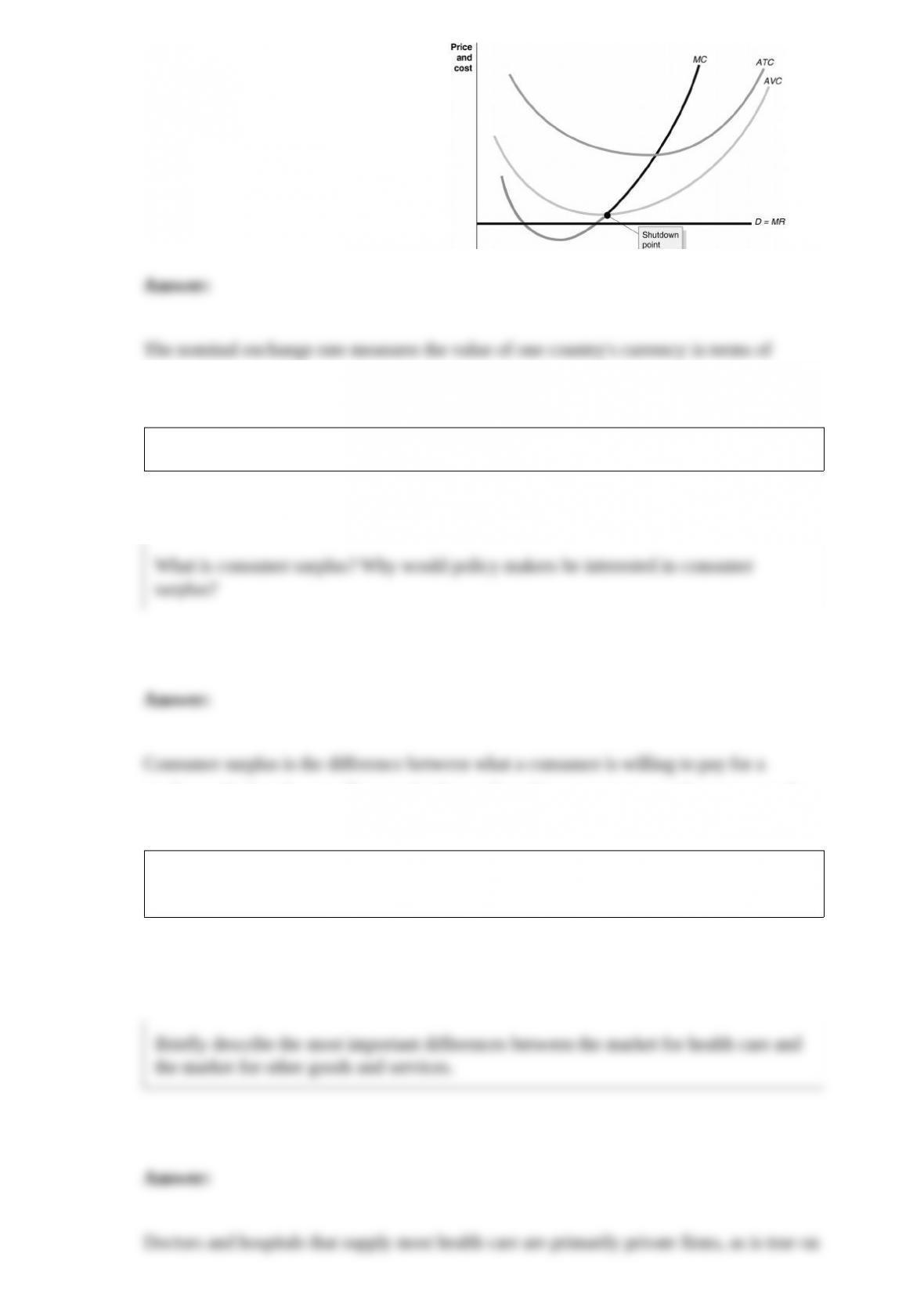
Use a graph to show the demand, AVC, ATC, MC, and MR curves of a firm that should
temporarily shut down in the short run. Identify the shutdown point on the graph.
What’s the difference between the nominal exchange rate and the real exchange rate?
What is consumer surplus? Why would policy makers be interested in consumer
surplus?
Briefly describe the most important differences between the market for health care and
the market for other goods and services.
What is a production possibilities frontier? What do points along the frontier represent?
What do points inside and outside the frontier represent?
Explain how the static aggregate demand and aggregate supply model gives us
misleading results about the price level, particularly with respect to decreases in
aggregate demand. Describe how the aggregate demand curve is different in the
dynamic model as compared to the static model. Describe how potential GDP is
different in the dynamic model as compared to the static model.