
Chapter 21 ■ SPELLING QUIZ 585
Chapter Twenty-One
SPELLING QUIZ
Name: ______________________________
A. Circle the term that is spelled correctly and write its meaning in the space provided.
1. areolsol aerosol ____________________________________________________
2. antacid antiacid ___________________________________________________
3. antedote antidote ___________________________________________________
4. antipyretic antepyretic _________________________________________________
5. cartharic cathartic __________________________________________________
6. hypnotic hipnotic ___________________________________________________
7. iatrogenic iatragenic __________________________________________________
8. caffiene caffeine ___________________________________________________
9. syringe syrinje ____________________________________________________
10. tolerence tolerance __________________________________________________
B. Circle the term that is spelled correctly. The meaning of each term is given.
11. Agent that excites and
promotes activity ………………………………… stimulent stimulant stimolent
12. Drug that promotes vomiting ………………. emetic enemetic emetik
13. Drug that relieves chest pain ……………….. anteanginal anteanjinal antianginal
14. Hypersensitivity reaction …………………….. anaphilaxis anaphylaxis antiphylaxis
15. Drug that is given by injection …………….. parenteral parinteral parentarol
16. Legal, noncommercial name
for a drug …………………………………………… genareic generic jeneric
17. Harmful effects of a drug …………………….. toxcitity toxicity toxicitiy
18. Drug that relieves pain ………………………… analjesic anesthetic analgesic
19. Drugs that are applied locally
on the skin …………………………………………. topical typoical typical
20. Drug that restores heart
to a regular cycle ………………………………… antirhhytmic antiarrhythmic antiarryhthmic

586 Chapter 21 ■ PRONUNCIATION QUIZ
Chapter Twenty-One
PRONUNCIATION QUIZ
Name: ______________________________
A. Underline the accented syllable in the following words:
1. antiarrhythmic 4. synergistic 7. cathartic 10. generic name
2. anaphylaxis 5. pharmacokinetics 8. antidote
3. idiosyncrasy 6. antihistamine 9. intrathecal
B. Match the term in Column I with its meaning in Column II:
Column I Column II
1. amphetamine _______ A. The combination of two similar drugs is equal
to the sum of the effects of each
2. antiemetic _______ B. An agent that lowers blood pressure by increasing
the release of urine
3. diuretic _______ C. A habit-forming drug that produces sleep and stupor
4. narcotic _______ D. A central nervous system stimulant
5. hypodermic _______ E. A drug that relieves pain
6. erythromycin _______ F. Pertaining to under the skin
7. laxative _______ G. A drug that relieves constipation
8. analgesic _______ H. An agent that acts against vomiting
9. toxicity _______ I. Harmful effects of a drug
10. additive action _______ J. An antibiotic
C. Complete the following medical terms from their definitions:
1. anti ____________________________ Pertaining to an agent that reduces fever
2. anti ____________________________ An agent that prevents or delays blood clotting
3. par ____________________________ Administration of drugs other than through the
intestinal tract, such as into the skin, muscles, or
veins
4. gluco __________________________ Hormone from the adrenal cortex that raises blood
sugar
5. anti ____________________________ Agent that lowers blood pressure
6. ___________________________ ology Study of poisonous effects of drugs
7. intra ___________________________ Pertaining to within a sheath or within the
membranes surrounding the spinal cord

Chapter 21 ■ REVIEW SHEET QUIZ 587
Chapter Twenty-One
REVIEW SHEET QUIZ
Name: ______________________________
A. Give meanings for the following combining forms:
1. aer/o __________________________ 6. cutane/o ________________________________
2. alges/o ________________________ 7. derm/o __________________________________
3. bronch/o ______________________ 8. enter/o __________________________________
4. chem./o _______________________ 9. erg/o ___________________________________
5. cras/o _________________________ 10. esthesi/o ________________________________
B. Give meanings for the following combining forms:
1. hist/o _________________________ 7. or/o ____________________________________
2. hypn/o ________________________ 8. pharmac/o _______________________________
3. iatr/o _________________________ 9. prurit/o _________________________________
4. lingu/o ________________________ 10. pyret/o __________________________________
5. myc/o _________________________ 11. thec/o __________________________________
6. narc/o _________________________
C. Give meanings for the following combining forms, suffixes and prefixes:
1. tox/o __________________________ 8. -phylaxis ________________________________
2. vas/o __________________________ 9. ana- ____________________________________
3. ven/o _________________________ 10. anti- ____________________________________
4. vit/o __________________________ 11. contra- _________________________________
5. -dote __________________________ 12. syn- ____________________________________
6. -genic _________________________ 13. par– ____________________________________
7. -in ___________________________

588 Chapter 21 ■ MEDICAL SCRAMBLE
Chapter Twenty-One
MEDICAL SCRAMBLE
Name: ______________________________
Unscramble the letters to form pharmacology terms from the clues. Use the letters in the squares
to complete the bonus term.
1. Clue: Drug that acts against viruses such as the herpesvirus and HIV.
____ ____ ____ ____ ____ ____ ____ R A T V A L I N I
2. Clue: Movement of a drug across a cell membrane into body cells.
____ ____ ____ ____ ____ ____ ____ ____ P O N R R T T A S
3. Clue: Pertaining to under the skin.
____ ____ ____ ____ ____ ____ ____ ____ M Y O P R I C H E D
4. Clue: Pertaining to a condition that is produced by a physician or treatment.
____ ____ ____ ____ ____ ____ ____ ____ C A N I E T O R I G
5. Clue: Pertaining to under the tongue.
____ ____ ____ ____ ____ ___ ____ ____ B U G I N L L U S A
BONUS TERM: Clue: Drug that relieves pain

Chapter 21 ■ CROSSWORD PUZZLE 589
Chapter Twenty-One
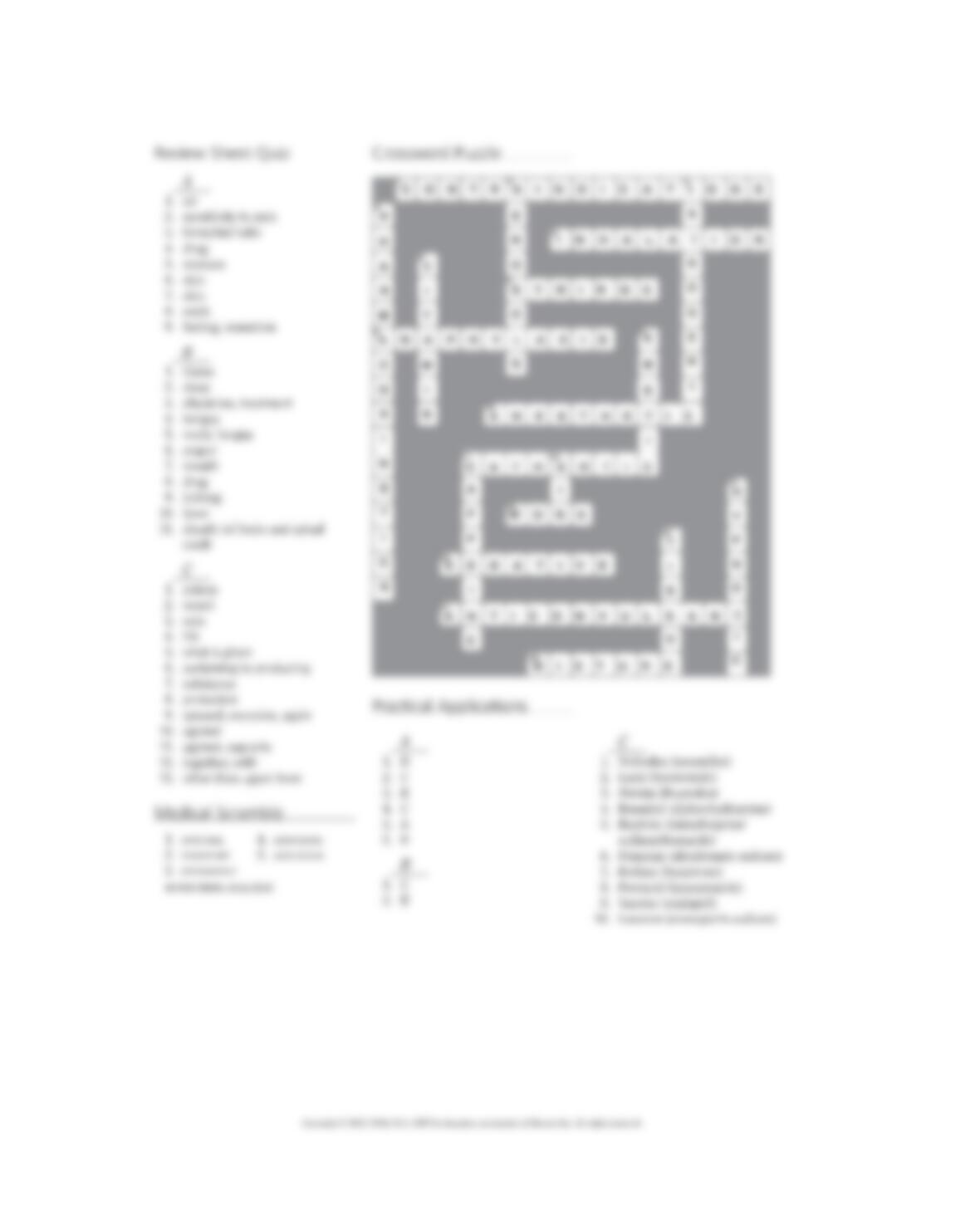
CROSSWORD PUZZLE
Name: ______________________________
Fill in the crossword puzzle below using the clues listed below it.
4
5
6
7
89
10
11 12
13
14
15
16
17
18
21 3
Across Clues Down Clues
1. Factors in the patient’s condition that prevent the
use of a particular drug or treatment.
5. Administration of drugs in gaseous or vapor form
through the nose or mouth.
7. Instrument for introducing or withdrawing fluids
from the body.
8. Hypersensitive reaction of the body to a drug or
foreign organism.
10. Drug that reduces or eliminates sensation.
11. Drug that relieves constipation.
14. Erg/o means _____; as in synergism.
16. Mildly hypnotic drug that relaxes without
necessarily producing sleep.
17. Type of drug that prevents convulsions.
18. Cras/o means _____; as in blood dyscrasia.
2. Particles of drug suspended in the air.
3. Any adverse condition in a patient resulting from
treatment by a physician.
4. Study of drug absorption, distribution, metabolism,
and excretion over a period of time.
6. Substance found in foods and essential in small
quantities for growth and good health.
9. Drug that promotes vomiting.
11. Central nervous system stimulant; found in coffee.
12. Aer/o means _____.
13. An agent that produces sleep; from the Greek
hypnos meaning sleep.
15. Hist/o means _____; as in antihistamine.

590 Chapter 21 ■ PRACTICAL APPLICATIONS
Chapter Twenty-One
PRACTICAL APPLICATIONS
Name: ______________________________
A. The following questions are based on the prescription information given below:
Fluoxetine (Prozac) 20 mg p.o. b.i.d.
Dimenhydrinate (Dramamine) 10 mg 2 tab q 4-6h
Ondansetron (Zofran) 4 mg 1 tab/caps t.i.d. p.r.n. for nausea
Ranitidine (Zantac) 300 mg 1 tab p.c. daily
Pseudoephedrine (Sudafed) 60 mg 1 caps q.i.d. for 15 days
Acetaminophen (300 mg) & codeine (30 mg) 1 tab q.i.d. p.r.n. for pain
1. Which drug is given after meals to
relieve the pain of ulcers? ……………..
A. Fluoxetine
B. Dimenhydrinate
C. Acetaminophen
D. Ranitidine
2. Which drug is an antiemetic and
prescribed three times a day as
necessary? ………………………………….
A. Ranitidine
B. Pseudoephedrine
C. Ondansetron
D. Dimenhydrinate
3. Which drug is an analgesic and
prescribed four times a day as
needed? ……………………………………..
A. Fluoxetine
B. Acetaminophen and codeine
C. Dimenhydrinate
D. Ranitidine
4. Which drug is used to treat
depression and prescribed
twice a day orally? …………………………..
A. Ondansetron
B. Pseudoephedrine
C. Fluoxetine
D. Acetaminophen
5. Which drug is an antihistamine,
bronchodilator, and decongestant
and prescribed four times a day for
an extended period? ………………………..
A. Pseudoephedrine
B. Dimenhydrinate
C. Fluoxetine
D. Acetaminophen
6. Which drug is an antihistamine and
antinauseant, used to prevent motion
sickness, and prescribed every few
hours (up to six times a day)? …………..
A. Ranitidine
B. Dimenhydrinate
C. Pseudoephedrine
D. Ondansetron
B. FYI
Drugs taken by a mother during pregnancy may have harmful effects on the fetus or newborn.
Some examples are analgesics (heroin, morphine) that produce respiratory depression, addiction,
and neonatal mortality; anesthetics that produce fetal bradycardia; anticoagulants that lead to
hemorrhage and fetal death; hormones (androgens and estrogens) that produce masculinization
or clitoromegaly.
1. What drug can produce slow
heartbeat in the fetus? ………………….
A. Testosterone
B. Morphine
C. Anesthetic
D. Anticoagulant
2. What drug, taken by the mother, puts
the fetus at risk for bleeding? …………..
A. Estrogen
B. Anticoagulant
C. Heroin
D. Anesthetic

Chapter 21 ■ PRACTICAL APPLICATIONS 591
C. Drug Identifications
Match the following drugs with a description that fits it below. Write the name of the drug in
the space provided.
Bactrim (trimethoprim/sulfamethoxazole) Lovenox (enoxaparin sodium)
Benadryl (diphenhydramine) Motrin (ibuprofen)
BuSpar (buspirone) Nolvadex (tamoxifen)
Fosamax (alendronate sodium) Prevacid (lansoprazole)
Lasix (furosemide) Vasotec (enalapril)
1. This is a nonsteroidal antiestrogen medication indicated for the treatment of breast cancer in
postmenopausal women. It is used when tumor cells are estrogen-receptor positive. It can be used
to prevent breast cancer in women at high risk. _________________________________________
2. This is a potent diuretic to treat edema associated with congestive
heart failure. _____________________________________________________________________
3. This is a nonsteroidal anti-inflammatory drug (NSAID) used to relieve the pain and inflammation
of arthritis. It is also indicated for use to treat fever, dysmenorrhea, and mild to
moderate pain. ____________________________________________________________________
4. This is a nonprescription antihistamine often used for severe allergic reactions (bee stings or
poison ivy) and nasal allergy symptoms. It may also be used as an antipruritic (cream or lotion),
sleep aid, or cough suppressant. ______________________________________________________
5. This antibiotic medication is prescribed to treat urinary tract infections, acute otitis media, and
respiratory infections. ______________________________________________________________
6. This medication is indicated for the treatment and prevention of osteoporosis in postmenopausal
women. It increases bone mass to help reduce the incidence of fractures, such as in the wrist and
spine. ___________________________________________________________________________
7. This tranquilizer is prescribed for a patient with diagnosed general
anxiety disorder. ___________________________________________________________________
8. This medication is commonly prescribed to treat duodenal and
gastric ulcers. ____________________________________________________________________
9. This angiotensin-converting enzyme (ACE) inhibitor is indicated for the treatment of hypertension,
heart failure, and in patients after MI, when the function of the left ventricle of the heart has been
affected. _________________________________________________________________________
10. This is a low-molecular-weight heparin, indicated for the prevention of deep vein thrombosis,
which may lead to pulmonary embolism in patients undergoing surgery (e.g., hip or knee
replacement). It is usually administered by injection. _____________________________________
592 Chapter 21 ■ ANSWERS TO THE QUIZZES
Chapter Twenty-One
ANSWERS TO THE QUIZZES
Chapter 21 ■ ANSWERS TO THE QUIZZES 593
594 Chapter 21 ■ ANSWERS TO THE QUIZZES
Chapter 21 ■ ANSWERS TO TERMINOLOGY SECTION 595