
536 Chapter 19 ■ DICTATION AND COMPREHENSION QUIZ
Chapter Nineteen
DICTATION AND
COMPREHENSION QUIZ
Name: ______________________________
A. Dictation of Terms
1. ____________________________________ 11. ______________________________________
2. ____________________________________ 12. ______________________________________
3. ____________________________________ 13. ______________________________________
4. ____________________________________ 14. ______________________________________
5. ____________________________________ 15. ______________________________________
6. ____________________________________ 16. ______________________________________
7. ____________________________________ 17. ______________________________________
8. ____________________________________ 18. ______________________________________
9. ____________________________________ 19. ______________________________________
10. ____________________________________ 20. ______________________________________
B. Comprehension of Terms: Match number of the above term with its meaning below.
______ Programmed cell death
______ Specialization of cells
______ Giving radiation therapy in small, repeated doses
______ Spread of a malignant tumor to a secondary site
______ Condition of being diseased
______ Drug that increases the sensitivity of tumors to radiation therapy
______ Loss of specialization of cells; reversion to a more primitive type
______ Malignant tumor of connective tissue
______ Possessing a stem or stalk; characteristic of some polypoid tumors
______ Formation of blood vessels
______ Region of DNA found in tumor cells; examples are abl, ras, src
______ Synthetic chemicals containing groups that interfere with DNA synthesis
______ Visual examination of the abdomen using small incisions and an endoscope
______ Removal of tumor along with a large area of surrounding tissue and lymph nodes
______ Microscopic description of tumors possessing a variety of cells
______ Localized cancer; confined to the site of origin
______ Malnutrition associated with chronic disease (such as malignancy) and ill health
______ Malignant tumor of epithelial tissue (glandular cells)
______ Cells are scraped from an area of suspected disease and examined microscopically
______ Pertaining to producing change in cells

Chapter 19 ■ SPELLING QUIZ 537
Chapter Nineteen
SPELLING QUIZ
Name: ______________________________
A. Circle the term that is spelled correctly and write its meaning in the space provided.
1. retinoblastoma retinoblasoma ______________________________________________
2. metastasis matestasis _________________________________________________
3. bengine benign ____________________________________________________
4. chemotherapy chemotheraphy _____________________________________________
5. oncology onkocology ________________________________________________
6. malignent malignant _________________________________________________
7. carsinoma in situ carcinoma in situ ___________________________________________
8. hyperplasia hyperplayzea _______________________________________________
9. displastic dysplastic __________________________________________________
10. polypoid polipoid ___________________________________________________
B. Circle the term that is spelled correctly. The meaning of each term is given.
11. Malignant tumor of fibrous
tissue ………………………………………………fibrosacroma fibrosarcoma fibrosarkoma
12. Additional treatment ………………………..adjuvant therapy adjivent theraphy adjuvent therapy
13. Replication of cells …………………………..miteosis mitosis meiosis
14. Specialization of cells ……………………….differentiation differantiation differentsheation
15. Return of disease symptoms ……………..relaspe relapse relapze
16. Plan for treatment ……………………………protocal protokol protocol
17. Densely packed tumors …………………….scirrhous skirrus scirrhus
18. Spread over a wide area …………………….diffuse difuse difusse
19. Pertaining to tumors filled
with mucus ……………………………………..mucinous mucanous musinous
20. Condition of being diseased ………………morbitity morbidity morbitidy

538 Chapter 19 ■ PRONUNCIATION QUIZ
Chapter Nineteen
PRONUNCIATION QUIZ
Name: ______________________________
A. Underline the accented syllable in the following terms:
1. papillary tumor 4. laparoscopy 7. adjuvant 10. mucinous
2. exenteration 5. anaplasia 8. neurofibromatosis
3. cauterization 6. alkylating 9. antimetabolites
B. Match the term in Column I with its meaning in Column II:
Column I Column II
1. benign _______ A. In glass; an experiment performed in a laboratory with chemicals
2. neoplasm ______ B. Harmless; not cancerous
3. morbidity ______ C. Production of two identical cells from a parent cell
4. protocol ______ D. Plan for treatment
5. in vitro ______ E. To remove substances from a cavity using suction
6. in vivo ______ F. In life; an experiment performed in a living animal
7. lethal ______ G. The condition of being diseased
8. mitosis ______ H. A new growth; tumor
9. carcinogen ______ I. A substance that produces cancer
10. aspiration ______ J. Pertaining to producing death
C. Complete the following medical terms from their definitions:
1. cach ___________________________ Malnutrition associated with cancer
2. _____________________________ oma Cancerous tumor of a gland
3. _____________________________ oma Tumor of embryonic retinal cells
4. meta ___________________________ Beyond control; spreading of a cancer tumor to
secondary origin
5. __________________________ therapy Cancer treatment using immune cells and
antibodies to kill tumor cells.
6. in _____________________________ Extending beyond normal boundaries; local
invasion of tissue
7. chemo __________________________ Treatment using drugs
8. ped _____________________________ Possessing a stem or stalk
9. dif _____________________________ Specialization of cells

Chapter 19 ■ REVIEW SHEET QUIZ 539
Chapter Nineteen
REVIEW SHEET QUIZ
Name: ______________________________
A. Give meanings for the following combining forms:
1. aden/o _________________________ 6. cry/o ___________________________________
2. cac/o _____ ______________________ 7. cyst/o ___________________________________
3. carcin/o ________________________ 8. fibr/o ___________________________________
4. cauter/o ________________________ 9. follicul/o ________________________________
5. chem./o ________________________ 10. fung/i ___________________________________
B. Give meanings for the following combining forms:
1. medull/o _______________________ 9. plas/o ___________________________________
2. mucos/o ________________________ 10. ple/o ___________________________________
3. mut/a __________________________ 11. polyp/o _________________________________
4. necr/o _____ _____________________ 12. radi/o ___________________________________
5. neur/o __________ _______________ 13. sarc/o ___________________________________
6. onc/o __________________________ 14. scirrh/o _________________________________
7. papill/o _________________________ 15. xer/o ___________________________________
8. pharmac/o ______________________

540 Chapter 19 ■ REVIEW SHEET QUIZ
C. Give meanings for the following suffixes and prefixes:
1. -blastoma _______________________ 10. -therapy _________________________________
2. -oid ____________________________ 11. ana- ____________________________________
3. -oma ___________________________ 12. anti- ____________________________________
4. -plasia _________________________ 13. apo- ____________________________________
5. -plasm _________________________ 14. brachy- _________________________________
6. -ptosis _________________________ 15. dys- ____________________________________
7. -stasis __________________________ 16. meta- ___________________________________
8. -genesis ________________________ 17. tele- ____________________________________
9. -suppression ____________________ 18. epi- ____________________________________

Chapter 19 ■ MEDICAL SCRAMBLE 541
Chapter Nineteen
MEDICAL SCRAMBLE
Name: ______________________________
Unscramble the letters to form cancer-related terms from the clues. Use the letters in the squares
to complete the bonus term.
1. Clue: Partial or complete disappearance of symptoms of disease
____ ____ ____ ____ ____ ____ S N E M I I R S O
2. Clue: Spread of a cancerous tumor to another site or secondary location
____ ____ ____ ____ ____ ____ ____ T T A E A I S S S M
3. Clue: Pertaining to abnormal formation or development of cells; not clearly malignant
____ ____ ____ ____ ____ ____ ____ ____ C L Y A S S P T I D
4. Clue: Increased growth in numbers of normal cells
____ ____ ____ ____ ____ ____ ____ ____ S P E R I A Y P H A L
BONUS TERM: Clue: Pertaining to embryonic connective tissue from which connective tissue tumors
(sarcomas) arise

542 Chapter 19 ■ CROSSWORD PUZZLE
Chapter Nineteen
CROSSWORD PUZZLE
Name: ______________________________
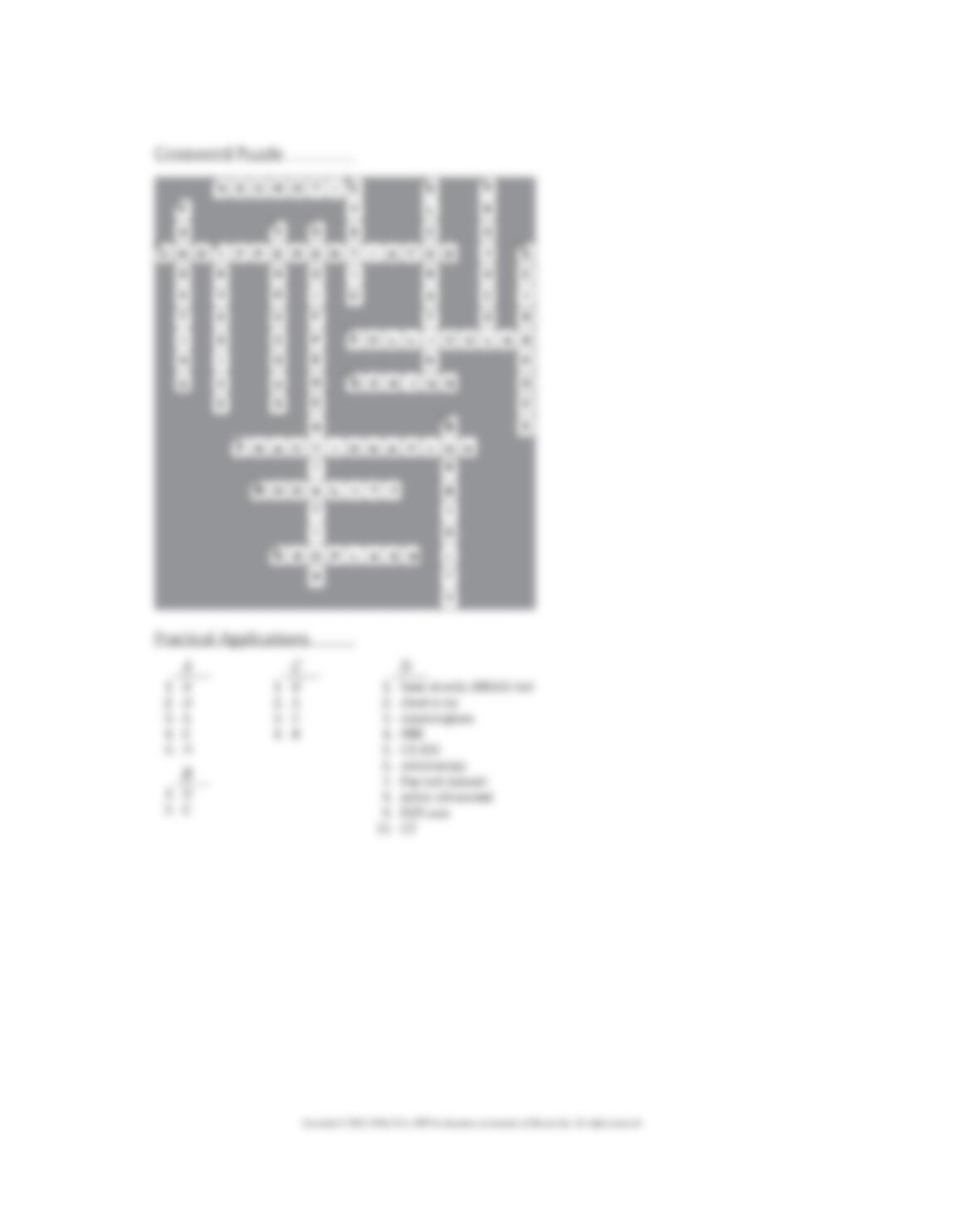
Fill in the crossword puzzle below using the clues listed underneath it.
1
6
8
5
9 10
11
12
13
14
15
16
7
234
Across Clues Down Clues
1. Containing dead tissue.
8. Lacking microscopic structures typical of normal,
fully matured cells.
11. Forming microscopic gland-type sacs.
12. Noncancerous, not harmful.
14. Giving radiation in small, repeated doses.
15. Method of treatment, such as surgery,
chemotherapy, or radiation.
16. New growth.
2. Forming large open sacs filled with fluid.
3. Characterizing an open, exposed surface resulting from
death of overlying tissue.
4. An explicit detailed plan for treatment.
5. Mushrooming pattern of growth.
6. Resembling a wart-like growth.
7. Loss of differentiation cells.
9. Having the ability to enter and destroy surrounding
tissue.
10. Hard, densely packed tumors, overgrown with fibrous
tissue.
13. Damage to normal tissue; state of being diseased.

Chapter 19 ■ PRACTICAL APPLICATIONS 543
Chapter Nineteen
PRACTICAL APPLICATIONS
Name: ______________________________
A. Case Study
The patient is a 63-year-old woman with a history (10 years ago) of squamous cell carcinoma
in situ of the cervix, which was treated with a total abdominal hysterectomy. Three years ago a
pelvic mass was palpated, and exploratory laparotomy revealed a multinodular solid cystic mass
of 10 to 12 cm. The mass arose from the right ovary and was adherent to the right pelvic wall.
The patient underwent resection of the mass, and the pathology revealed squamous cell carcinoma
of the ovary. She subsequently had combined modality treatment with chemotherapy (cisplatin and
5-fluorouracil) and radiation therapy to the pelvis. The latest CT scan of the abdomen revealed a new
right retroperitoneal lymph node. CT-guided fine needle aspiration was consistent with metastatic
ovarian squamous cell carcinoma.
1. What best describes the patient’s
original diagnosis? …………………………
A. Endometrial and cervical carcinoma
B. Localized cancer of the lower portion of
the uterus
C. Cervical cancer that spread to the
abdomen
D. Ovarian cancer
2. What was the initial primary
treatment? ……………………………………
A. Drug treatment
B. Radiation treatment
C. Drug and radiation treatment
D. Surgical removal of the entire uterus
3. What procedure identified the new
pelvic mass? …………………………………
A. Incision of the abdomen
B. Radiation therapy
C. Total abdominal hysterectomy
D. CT scan of the abdomen
4. Which treatment modalities were
used for the patient’s ovarian
carcinoma? …………………………………..
A. Computed tomography of the abdomen
B. Fine-needle aspiration of the ovary
C. Drug and radiation therapy in addition to
surgical removal
D. Surgical resection of the mass
5. How would you characterize the
disease in the patient’s retroperitoneal
lymph node? …………………………………
A. Cancer of the lymphatic system
B. Cervical cancer that had spread
C. Primary ovarian cancer
D. Ovarian cancer that had spread
B. Research Report
In a recent trial comparing the antiemetics ondansetron (Zofran) and metoclopramide (Reglan),
ondansetron was more effective and produced less severe side effects. The trial involved 24 medical
centers and 307 cancer patients receiving high doses of cisplatin.
1. What type of drug is
ondansetron? ………………………………..
A. Chemotherapeutic
B. Antipsychotic medication
C. Antibiotic
D. Antinauseant
2. When is ondansetron
prescribed? …………………………………..
A. After cancer surgery
B. In conjunction with metoclopramide
C. When patients are receiving high-dose
chemotherapy for cancer
D. Before cancer surgery

544 Chapter 19 ■ PRACTICAL APPLICATIONS
C. Chart Note
Pt with metastatic squamous cell carcinoma of the tongue. Toward the end of XRT, the pt complained
of some intermittent costal and low vertebral pain. The pt presented to the ER when pain control
was no longer achieved using Percocet. CT scan and MRI were performed, revealing a number of
vertebral bodies involved with tumor in the upper lumbar and lower thoracic regions. Preliminary
reading suggests no evidence of cord compression, yet there is evidence of disk protrusion at T6-T7.
We are consulted for palliative XRT of the spine lesions for purpose of pain control.
1. What was probably causing the
patient’s pain? ………………………………
A. Tuberculosis of the spine
B. Pressure on the spinal cord
C. Tumor of the oral cavity
D. Metastatic tumor in the backbones
2. What does costal
mean? …………………………………………
A. Pertaining to ribs
B. Pertaining to spinal cord
C. Pertaining to the back
D. Pertaining to the breast bone
3. What is palliative
XRT? …………………………………………..
A. Diagnostic workup for malignancy
B. Chemotherapy for painful cancer treatment
C. Radiotherapy to relieve symptoms but not
to cure
D. Surgery to relieve pain
4. What type of doctor wrote
this report? ………………………………….
A. Radiologist
B. Radiation oncologist
C. Nuclear medicine specialist
D. Orthopedist
D. Tests and Their Uses in Oncology
Match the following tests with their uses:
Bone density (DEXA) test Mammogram
CA-125 MRI
Chest x-ray Pap test (smear)
Colonoscopy PET scan
CT Pelvic ultrasound
1. This test would reveal osteoporosis _______________________________________________________
2. Test that shows thoracic viscera in PA or LAT views _________________________________________
3. A test used to specifically diagnose abnormalities in breast tissue ______________________________
4. This test uses magnetic waves to show soft tissue lesions _____________________________________
5. Blood test that reveals levels of protein marker associated with ovarian cancer ___________________
6. Test to identify lesions in the large bowel __________________________________________________
7. In this test, tissue is removed and examined to detect vaginal and
cervical cancer _______________________________________________________________________
8. Sound waves can show areas of abnormality in region of the hip _______________________________
9. Radiopharmaceutical is injected and traced to organs to detect tumors _________________________
10. X-rays primarily in axial plane show bony and organ tissue abnormalities _______________________
Chapter 19 ■ ANSWERS TO THE QUIZZES 545
Chapter Nineteen
ANSWERS TO THE QUIZZES
546 Chapter 19 ■ ANSWERS TO THE QUIZZES
Chapter 19 ■ ANSWERS TO THE QUIZZES 547
548 Chapter 19 ■ ANSWERS TO THE QUIZZES
Chapter 19 ■ ANSWERS TO TERMINOLOGY SECTION 549
Chapter Nineteen

550 Chapter 19 ■ ANSWERS TO TERMINOLOGY SECTION