Chapter 15 ■ CROSSWORD PUZZLE 411
Chapter Fifteen
CROSSWORD PUZZLE
Name: ______________________________
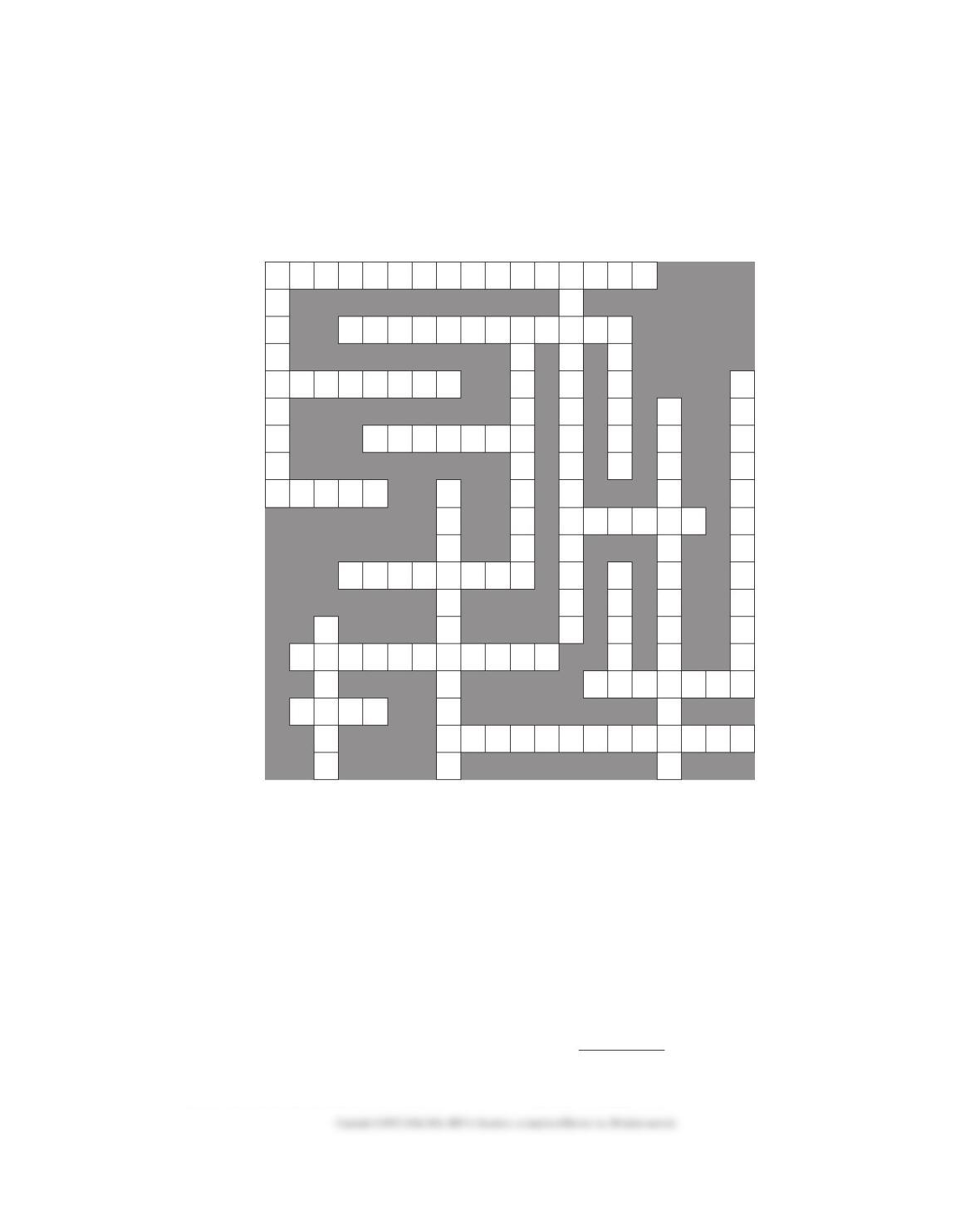
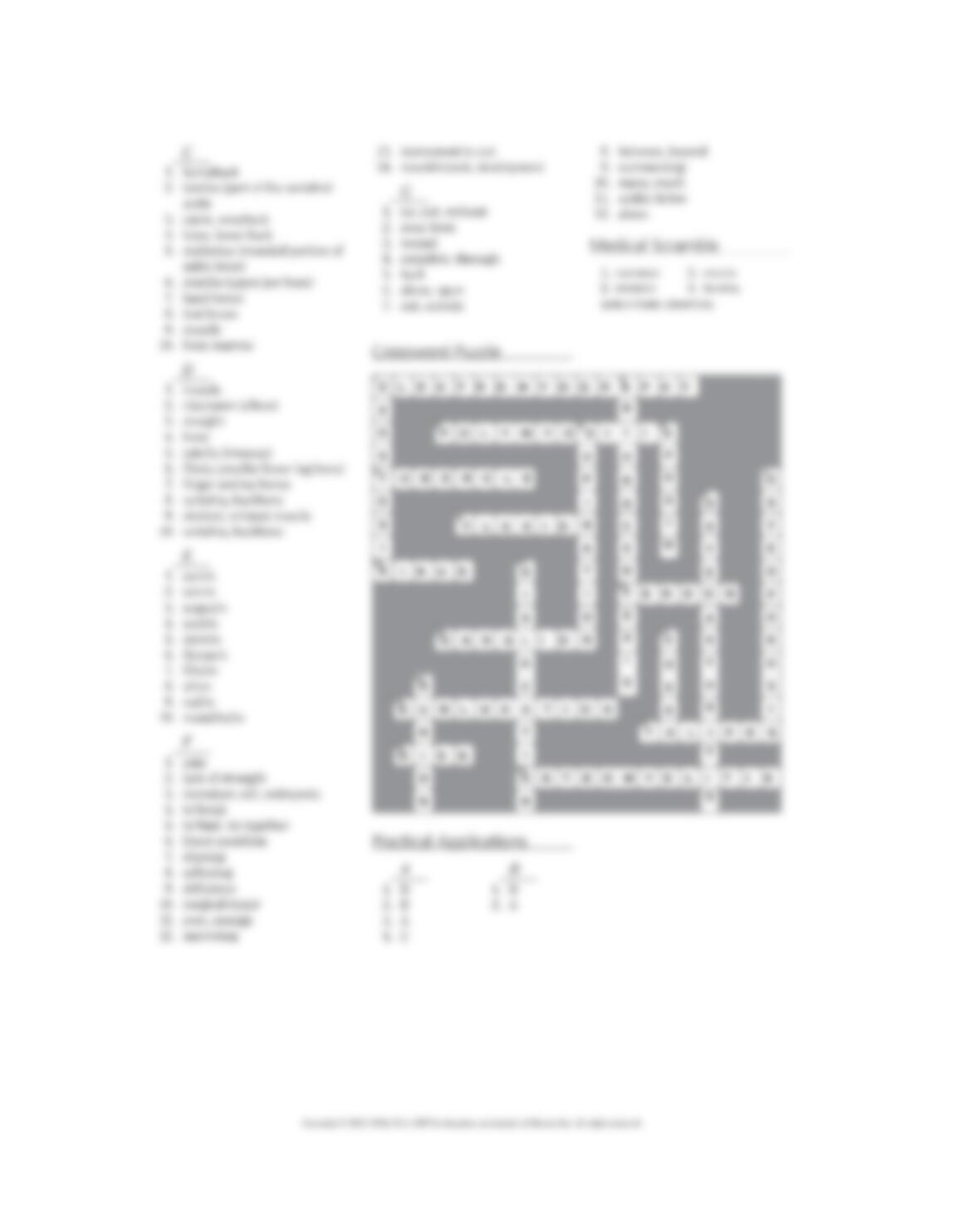
Fill in the crossword puzzle below using the clues listed underneath it.
Across Clues Down Clues
1. The process of recording the strength of muscle
contraction.
3. Chronic inflammatory myopathy of uncertain
etiology (inflammation of many muscles).
6. Rounded process on a bone; attachment for
muscles and tendons.
9. Decreasing the angle between two bones; bending
of the bone.
10. Cavity within a bone (cranial and facial bones).
12. Connective tissue that binds muscles to bones.
13. A cystic mass arising from a tendon in the wrist.
16. A partial or incomplete dislocation.
17. Clubfoot.
18. Flat, round, plate-like cartilaginous structure
between vertebrae.
19. Inflammation of the bone and bone marrow.
1. Bony growth arising from the surface of bone.
2. Surgical puncture of the joint space with a needle.
4. As applied to the hand, the act of turning the palm
upward.
5. Trauma to a joint with pain, swelling, and injury to
ligaments.
7. Decrease in bone density; thinning and weakening a
limb.
8. Progressive, degenerative joint disease characterized
by loss of articular cartilage; literally, inflammation of
bone and joint.
11. Displacement of a bone from its joint. For example, a
shoulder .
14. Shallow cavity in a bone.
15. Abnormal swelling of the joint between the big toe and
the first metatarsal bone.
19
12
345
6
10
7
8
9
11
12
13 14
15
16
17
18

412 Chapter 15 ■ PRACTICAL APPLICATIONS
1. Effusion in a joint means: ……………….
A. The bones at the joint are broken
B. The meniscus is torn
C. The patella is fractured
D. There is fluid in the joint space
2. Where is the femoral condyle? ………….
A. At the ankle joint
B. At the knee joint
C. At the distal end of the tibia
D. At the distal end of the fibula
3. An exostosis is: ……………………………..
A. A bony growth
B. A fluid-filled cyst
C. A healed fracture
D. Type of tendon
4. Where is the medial meniscus? …………
A. Near the big toe
B. At the hip socket
C. In the middle of the knee
D. At the base of the nail of the big toe
Chapter Fifteen
PRACTICAL APPLICATIONS
Name: ______________________________
A. Chart Note
The patient is having pain around the medial aspect of his left knee. About 12 years ago he had a
tear of his medial meniscus (crescent-shaped fibrocartilage), which was removed. On examination,
he has a well-healed medial scar to his left knee; there was no effusion; full range of motion; and it
is stable. X-rays show very slight scarring of the medial femoral condyle and a small accessory bone
medially, but nothing in the interior of the joint. The great toe shows a healed fracture. There was
no obvious exostosis impinging on the base of the nail.

Chapter 15 ■ PRACTICAL APPLICATIONS 413
B. Chart Note
Follow-up for the complications of osteoporosis as they affect the spine. Mrs. Smith had a 6-month
history of progressive disabling back pain visibly associated with progressive kyphotic deformity of
the thoracolumbar spine, with an attendant cervical lordosis. X-rays of the thoracic spine reveal a
compression fracture of T11 and L1. I advised the patient that such fractures even without trauma
may be complications of underlying osteoporosis as severe as hers.
1. Which term best describes
Mrs. Smith’s condition? …………………..
A. Osteoarthritis
B. Gouty arthritis
C. Osteomalacia
D. Osteopenia
2. What type of spinal deformity is
present? ……………………………………….
A. Posterior curvature of the chest and
anterior curvature of the neck
B. Lateral curvature of the chest
C. Cervical fracture
D. Anterior curvature of the thorax
414 Chapter 15 ■ ANSWERS TO THE QUIZZES
Chapter Fifteen
ANSWERS TO THE QUIZZES
Chapter 15 ■ ANSWERS TO THE QUIZZES 415
416 Chapter 15 ■ ANSWERS TO THE QUIZZES
Chapter 15 ■ ANSWERS TO THE QUIZZES 417
418 Chapter 15 ■ ANSWERS TO THE QUIZZES
Chapter 15 ■ ANSWERS TO TERMINOLOGY SECTION 419
Chapter Fifteen
Answers to Terminology Section
420 Chapter 15 ■ ANSWERS TO TERMINOLOGY SECTION
Chapter 15 ■ ANSWERS TO TERMINOLOGY SECTION 421