
332 Chapter 13 ■ DICTATION AND COMPREHENSION QUIZ: VOCABULARY
Chapter Thirteen
DICTATION AND COMPREHENSION QUIZ:
VOCABULARY
Name: ______________________________
A. Dictation of Terms
1. ____________________________________ 11. ______________________________________
2. ____________________________________ 12. ______________________________________
3. ____________________________________ 13. ______________________________________
4. ____________________________________ 14. ______________________________________
5. ____________________________________ 15. ______________________________________
6. ____________________________________ 16. ______________________________________
7. ____________________________________ 17. ______________________________________
8. ____________________________________ 18. ______________________________________
9. ____________________________________ 19. ______________________________________
10. ____________________________________ 20. ______________________________________
B. Comprehension of Terms: Match number of the above term with its meaning below.
______ Abnormal condition of blood clotting
______ Change in structure and function of a cell as it matures; specialization
______ Platelet precursor found in bone marrow
______ Protein found in blood; maintains the proper amount of water in blood
______ Deficiency of iron
______ Immature bone marrow cell that develops into a white blood cell
______ Deficiency of a type of white blood cell
______ Protein threads that form the basis of a blood clot
______ White blood cell with dense, reddish granules (associated with allergic reactions)
______ A large cell that engulfs and destroys foreign material
______ Separation of white blood cells from the rest of the blood (using a centrifuge)
______ Plasma protein that contains antibodies
______ Blood protein found in red blood cells
______ Plasma minus clotting proteins and cells
______ Condition of irregularly shaped cells fired blood cells)
______ Condition of cells of unequal size fired blood cells)
______ A substance that prevents clotting of blood
______ Breakdown of recipient’s red blood cells when incompatible bloods are mixed
______ Separation of clotting cells from the rest of the blood (using a centrifuge)
______ Formation of red blood cells

Chapter 13 ■ DICTATION AND COMPREHENSION QUIZ: PATHOLOGY AND TESTS 333
Chapter Thirteen
DICTATION AND COMPREHENSION QUIZ:
PATHOLOGY AND TESTS
Name: ______________________________
A. Dictation of Terms
1. ____________________________________ 11. ______________________________________
2. ____________________________________ 12. ______________________________________
3. ____________________________________ 13. ______________________________________
4. ____________________________________ 14. ______________________________________
5. ____________________________________ 15. ______________________________________
6. ____________________________________ 16. ______________________________________
7. ____________________________________ 17. ______________________________________
8. ____________________________________ 18. ______________________________________
9. ____________________________________ 19. ______________________________________
10. ____________________________________ 20. ______________________________________
B. Comprehension of Terms: Match number of the above term with its meaning below.
______ Determines the numbers of different types of leukocytes
______ Determines the shape or form of erythrocytes
______ Percentage of erythrocytes in a volume of blood
______ Any abnormal or pathologic condition of the blood
______ Inherited defect in the ability to produce hemoglobin
______ Multiple pinpoint hemorrhages; thrombocytopenia
______ Erythremia
______ Excessive bleeding caused by lack of factor VIII or IX
______ Lymphoblasts predominate in the blood; most often seen in children
______ Malignant tumor of bone marrow
______ Separation of blood into its parts
______ Time required for venous blood to clot in a test tube
______ Small amount of bone marrow is aspirated and examined under a microscope
______ Relieving pain, but not curing an illness
______ Lack of mature erythrocytes owing to inability to absorb vitamin B12
______ Both mature and immature granulocytes are present in bone marrow and blood
______ Total amount of a blood protein is measured in a sample of blood
______ Symptoms of disease return
______ Symptoms of disease disappear
______ Speed at which red cells settle out of plasma

334 Chapter 13 ■ SPELLING QUIZ
Chapter Thirteen
SPELLING QUIZ
Name: ______________________________
A. Circle the term that is spelled correctly, and write its meaning in the space provided:
1. myeloma myleoma __________________________________________________
2. erythropoeisis erythropoiesis ______________________________________________
3. billirubin bilirubin ___________________________________________________
4. fibrinogen fibrinogin __________________________________________________
5. platlet platelet ____________________________________________________
6. poykilocytosis poikilocytosis _______________________________________________
7. leukopheresis leukapheresis _______________________________________________
8. heparin heparine ___________________________________________________
9. electropheresis electrophoresis _____________________________________________
10. thallassemia thalassemia ________________________________________________
B. Circle the term that is spelled correctly. The meaning of each term is given.
11. Deficiency of clotting cells …………….thrombocitopenia thrombositopenea thrombocytopenia
12. Process of clotting ………………………..coagulation coagglulation coaglulation
13. Large cell that engulfs foreign
material and worn-out red cells ……..macrophage macropage makrophage
14. White blood cell that destroys
foreign material by phagocytosis ……neutrophil neutrophill nuetrophil
15. Blood protein ……………………………….allbumen albumen albumin
16. Lack of mature red cells owing to
inability to absorb vitamin B12 ……….pernicious anemia perniscious anemia panescius anemia
17. Relieving symptoms but not
curing ………………………………………….palliative pallitive paliative
18. Improper formation of bone
marrow cells ………………………………..myeleodysplasia myleodisplasia myelodysplasia
19. A protein with antibody activity ……..immunoglobulen immunoglobulin inmunoglobulen
20. Increase in red blood cells ……………..polycythemia vera polycytemia vera polysithemia vera

Chapter 13 ■ PRONUNCIATION QUIZ 335
Chapter Thirteen
PRONUNCIATION QUIZ
Name: ______________________________
A. Underline the accented syllable in the following terms:
1. hemolysis 4. purpura 7. albumin 10. leukocytopenia
2. anisocytosis 5. anticoagulant 8. differentiation
3. erythropoietin 6. eosinophil 9. myelodysplasia
B. Match the term in Column I with its meaning in Column II:
Column I Column II
1. megakaryocyte _______ A. Orange-yellow pigment formed from destruction of
hemoglobin
2. reticulocyte _______ B. Separation of clotting cells from rest of the blood
3. myeloid _______ C. Plasma minus clotting proteins and cells
4. fibrin _______ D. Derived from bone marrow
5. electrophoresis _______ E. An anticoagulant substance
6. plateletpheresis _______ F. An immature red blood cell
7. bilirubin _______ G. Percentage of red blood cells in a volume of blood
8. heparin _______ H. Separation of plasma proteins using electricity
9. hematocrit _______ I. An immature clotting cell
10. serum _______ J. Protein threads that form the essence of a blood clot
C. Complete the following terms using the definitions given:
1. hemo ____________________________ Stoppage or control of blood flow
2. dys ______________________________ Any blood disorder
3. re ______________________________ Symptoms of disease return
4. ____________________________ ology Study of the shape of cells
5. anti _____________________________ A foreign substance that stimulates the formation
of antibodies
6. anti _____________________________ Protein substances formed in the blood to destroy
foreign substances
7. _____________________________ cyte A cell that engulfs another cell
8. ____________________________ emia A type of inherited anemia marked by defective
type of hemoglobin in people of Mediterranean
background
336 Chapter 13 ■ DIAGRAM QUIZ
Chapter Thirteen
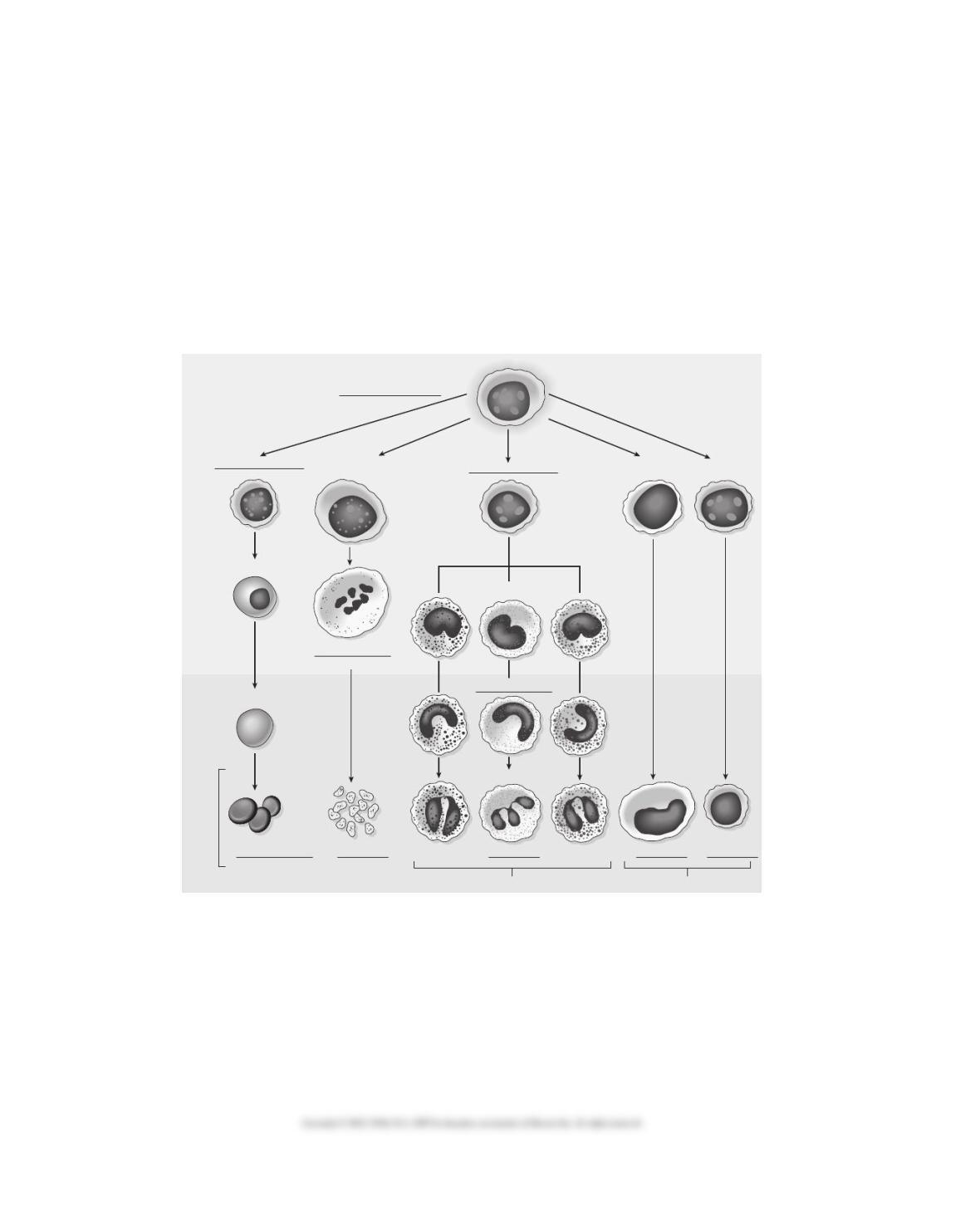
DIAGRAM QUIZ
Name: ______________________________
Label the diagram below using the terms listed below:
Band cell Hematopoietic stem cell Monocyte Platelets
Erythroblast Lymphocyte Myeloblast
Erythrocytes Megakaryocyte Neutrophil
Bone marrowCirculating in bloodstream
Mature cells
Basophil
Segmented
Myelocytes
Normoblast
Reticulocyte
Eosinophil
Granulocytes
2.______________
3.____________
4.____________
7.____________
5.________ 8.________ 9.________ 10.________
Mononuclear cells
6.______________
1.________________
Monoblast Lymphoblast
Mega-
karyoblast

Chapter 13 ■ REVIEW SHEET QUIZ 337
Chapter Thirteen
REVIEW SHEET QUIZ
Name: ______________________________
A. Give meanings for the following combining forms:
1. coagul/o ________________________ 7. myel/o __________________________________
2. cyt/o ___________________________ 8. morph/o ________________________________
3. erythr/o ________________________ 9. neutr/o _________________________________
4. hem/o __________________________ 10. sider/o __________________________________
5. kary/o __________________________ 11. phag/o __________________________________
6. leuk/o __________________________ 12. thromb/o ________________________________
B. Give meanings for the following suffixes:
1. -apheresis ______________________ 7. -penia __________________________________
2. -blast __________________________ 8. -phage __________________________________
3. -cytosis _________________________ 9. -phoresis ________________________________
4. -emia __________________________ 10. -poiesis _________________________________
5. -globin _________________________ 11. -stasis __________________________________
6. -lytic ___________________________ 12. -oid ____________________________________

338 Chapter 13 ■ REVIEW SHEET QUIZ
C. Give meanings for the following prefixes:
1. anti- _____ ______________________ 5. micro- __________________________________
2. hypo- _____ _____________________ 6. mono- __________________________________
3. macro- _____ ____________________ 7. pan- ____________________________________
4. mega- _____ _____________________ 8. poly- ___________________________________

Chapter 13 ■ MEDICAL SCRAMBLE 339
Chapter Thirteen
MEDICAL SCRAMBLE
Name: ______________________________
Unscramble the letters to form blood system terms from the clues. Use the letters in the squares to
complete the bonus term.
1. Clue: Blood protein
____ ____ ____ ____ M L U I N A B
2. Clue: Percentage of red blood cells in a volume of blood
____ ____ ____ ____ ____ ____ C A H O T R E T M I
3. Clue: Blood protein in erythrocytes
____ ____ ____ ____ ____ ____ ____ G I M O H O N E B L
4. Clue: Threads of a clot
____ ____ ____ ____ ____ B I F N I R
BONUS TERM: Clue: Process of blood clotting
340 Chapter 13 ■ CROSSWORD PUZZLE
Chapter Thirteen
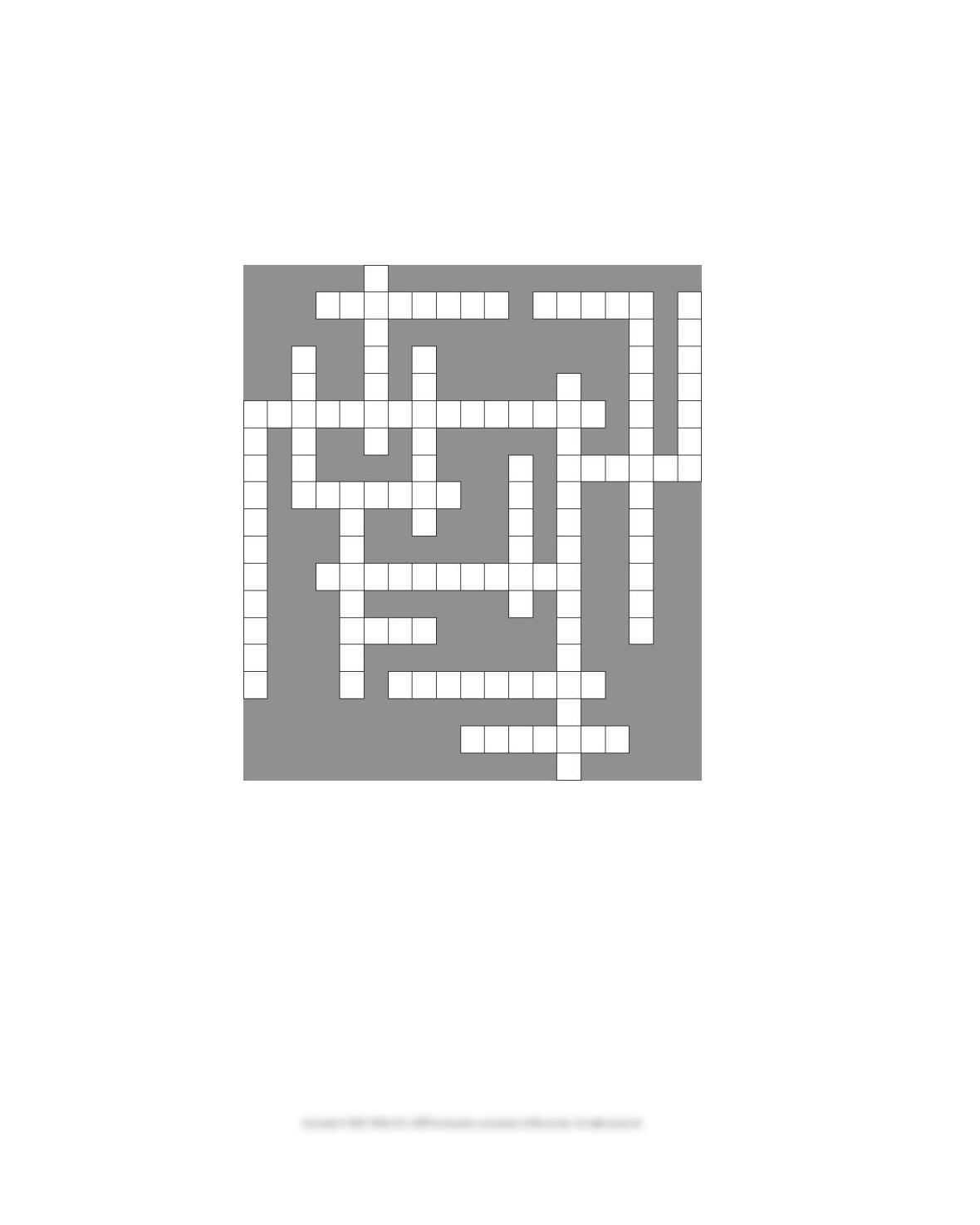
CROSSWORD PUZZLE
Name: ______________________________
Fill in the crossword puzzle below using the clues listed underneath it.
1
2
6
9
10
12 13
14
15
16
17
11
7
8
345
Across Clues Down Clues
2. Excessive increase in white blood cells with
immature forms.
1. Multiple pinpoint hemorrhages and accumulation of
blood under the skin.
4. Platelet precursor formed in the bone marrow.
5. -globulin means_____.
6. Deficiency in erythrocytes or hemoglobin.
7. An anticoagulant produced by liver cells and found in
blood and tissues.
8. Change in structure and function of a cell as it matures
9. Red blood cell.
10. The protein part of hemoglobin.
13. White blood cell with large dark-staining granules.
3. Plasma minus clotting proteins and blood cells.
9. Method of separating plasma proteins by electrical
charge.
11. Protein threads that form the base of a clot.
12. Protein found in blood.
14. Process of blood clotting.
15. Iron-containing nonprotein portion of the
hemoglobin molecule.
16. White blood cell.
17. Derived from bone marrow.

Chapter 13 ■ PRACTICAL APPLICATIONS 341
Chapter Thirteen
PRACTICAL APPLICATIONS
Name: ______________________________
A. Research Report
Colony-stimulating factors are hormones that regulate hematopoiesis. Erythropoietin (Epogen),
secreted by the kidney, increases bone marrow erythropoiesis. Granulocyte colony-stimulating
factor (G-CSF) stimulates bone marrow leukopoiesis. The most recent colony-stimulating factor
is thrombopoietin (TPO), which acts on bone marrow to promote the growth of platelets. These
hormones are now produced biosynthetically by recombinant DNA techniques and have shown some
impact in the prevention of chemotherapy-induced neutropenia, treatment of cytopenias associated
with myelodysplasias, and aplastic anemia.
1. What is erythropoietin? …………………..
A. A drug that causes bone marrow
suppression
B. A chemical that promotes white cell
production
C. A recombinant product that stimulates
platelet growth
D. A renal hormone that stimulates growth
of RBCs
2. G-CSF is helpful in: ……………………….
A. Preventing decrease in WBCs during drug
treatment for cancer
B. Replacing red cells after hemorrhage
C. Stimulating formation of thrombocytes
D. Stimulating lymphocytes
3. Myelodysplasia means: ……………………
A. The spleen is not functioning
B. Liver formation is impaired
C. Blood cells are not made
D. The bone marrow is not forming
blood cells properly
4. TPO is: ……………………………………….
A. A neutrophil growth factor
B. An erythrocyte growth factor
C. A clotting cell growth factor useful in the
treatment of thrombocytopenia
D. Useful in the treatment of hemophilia

342 Chapter 13 ■ PRACTICAL APPLICATIONS
B. Case Report
A 17-year-old white female was admitted to the ER for melena. A CBC showed the hemoglobin to
be 9.0%, hematocrit 27%, WBC 32,000/mm3 with 21% polys, 7% bands, 70% lymphocytes, and 2%
monocytes. Platelet count was 20,000/ mm3. Bone marrow aspiration and smear shows evidence of
lymphoblasts.
1. What was the patient’s admitting
symptom? ……………………………………
A. Diarrhea
B. Blood in her stool
C. Vomiting blood
D. Spitting up blood
2. What do the lab data tell about
RBCs? …………………………………………
A. None of the tests reflect information
about RBCs
B. RBCs are normal
C. RBCs are elevated
D. RBCs are decreased as evidenced by low
hematocrit and hemoglobin
3. What is a likely diagnosis for the
patient? ……………………………………….
A. Sickle cell anemia
B. Hemophilia
C. Acute lymphoblastic leukemia
D. Chronic myelocytic leukemia
4. The bone marrow was filled with: ……..
A. Immature white blood cells
B. Mature neutrophils
C. Platelets
D. Immature red blood cells
Chapter 13 ■ ANSWERS TO THE QUIZZES 343
Chapter Thirteen
ANSWERS TO THE QUIZZES
344 Chapter 13 ■ ANSWERS TO THE QUIZZES
Chapter 13 ■ ANSWERS TO THE QUIZZES 345
346 Chapter 13 ■ ANSWERS TO THE QUIZZES
Chapter 13 ■ ANSWERS TO TERMINOLOGY SECTION 347
Chapter Thirteen
Answers to Terminology Section
(textbook pages 514–516)
348 Chapter 13 ■ ANSWERS TO TERMINOLOGY SECTION