
224 Chapter 10 ■ DICTATION AND COMPREHENSION QUIZ: VOCABULARY
Chapter Ten
DICTATION AND COMPREHENSION QUIZ:
VOCABULARY AND TERMINOLOGY
Name: _________________
A. Dictation of Terms
1. ____________________________________ 11. ______________________________________
2. ____________________________________ 12. ______________________________________
3. ____________________________________ 13. ______________________________________
4. ____________________________________ 14. ______________________________________
5. ____________________________________ 15. ______________________________________
6. ____________________________________ 16. ______________________________________
7. ____________________________________ 17. ______________________________________
8. ____________________________________ 18. ______________________________________
9. ____________________________________ 19. ______________________________________
10. ____________________________________ 20. ______________________________________
B. Comprehension of Terms: Match number of the above term with its meaning below.
______ The connective and framework tissue of any organ
______ Fatty tissue that surrounds and protects the axon of a nerve cell
______ Largest part of the brain
______ Posterior part of the brain; responsible for maintaining balance
______ A type of glial cell
______ Neurotransmitter chemical released at the ends of nerve cells
______ The space through which a nerve impulse passes from one nerve cell to another
______ Inflammation of membranes around the brain and spinal cord
______ Malignant brain tumor
______ Slow movement
______ Lack of muscle coordination
______ Condition of absence of a brain (congenital anomaly)
______ Pertaining to fainting
______ Benign tumor of the membranes around brain
______ Part of the brain that controls the secretions of the pituitary gland
______ Nervous exhaustion; “lack of nerve strength”
______ Movements and behavior are not purposeful
______ Paralysis of the lower part of the body
______ State of unconsciousness from which a patient cannot be aroused
______ Elevations on the surface of the cerebral cortex

Chapter 10 ■ DICTATION AND COMPREHENSION QUIZ: PATHOLOGY 225
Chapter Ten
DICTATION AND COMPREHENSION QUIZ:
PATHOLOGY
Name: ________________
A. Dictation of Terms
1. ____________________________________ 11. ______________________________________
2. ____________________________________ 12. ______________________________________
3. ____________________________________ 13. ______________________________________
4. ____________________________________ 14. ______________________________________
5. ____________________________________ 15. ______________________________________
6. ____________________________________ 16. ______________________________________
7. ____________________________________ 17. ______________________________________
8. ____________________________________ 18. ______________________________________
9. ____________________________________ 19. ______________________________________
10. ____________________________________ 20. ______________________________________
B. Comprehension of Terms: Match number of the above term with its meaning below.
______ A floating clot; mass of material suddenly blocks a blood vessel
______ Relieving symptoms, but not curing
______ Mini-stroke
______ X-ray record of blood vessels within the brain
______ Mental decline and deterioration
______ Breakage of a blood vessel within the brain
______ Demyelination of tissue around the axons of CNS neurons
______ Paralysis and loss of muscular coordination caused by brain damage in the perinatal period
______ Congenital defect of spinal column with herniation of the spinal cord and meninges
______ Major convulsive epileptic seizure
______ Malignant brain tumor
______ Relapsing weakness of skeletal muscles (“no muscle strength”); autoimmune condition
______ Collection of fluid in the ventricles of the brain
______ Degeneration of nerves in the brain; occurring in later life and leading to tremors, bradykinesia
______ Manner of walking
______ Type of neurotransmitter
______ Peculiar sensation appearing before more definite symptoms
______ Involuntary, spasmodic twitching movements; uncontrollable utterances

226 Chapter 10 ■ SPELLING QUIZ
Chapter Ten
SPELLING QUIZ
Name: ______________________________
A. Circle the term that is spelled correctly and write its meaning in the space provided:
1. hypothalamus hypothalmus _______________________________________________
2. neurorrhapy neurorrhaphy ______________________________________________
3. motor nerve moter nerve ________________________________________________
4. myelin sheath mylein sheath ______________________________________________
5. acetylcholene acetylcholine _______________________________________________
6. meningoma meningioma _______________________________________________
7. hyperkinesis hyperkenesis _______________________________________________
8. neurasthenia neurastenea ________________________________________________
9. pareasis paresis ____________________________________________________
10. demyleination demyelination ______________________________________________
B. Circle the term that is spelled correctly. The meaning of each term is given.
11. Pertaining to fainting ………………………….. sincopal syncopal sinkaple
12. Abnormal sensation …………………………….. paresthesia parasthesia parasthezia
13. Relieving, but not curing …………………….. pailiative paliative palliative
14. Peculiar symptoms appearing
before more definite symptoms ……………. aura aurra hora
15. Loss of mental capacity ……………………….. demenshea dementia dementsha
16. Within the meninges …………………………… intrathecal interthecal intrathekal
17. Essential cells of an organ ……………………. parenchymal parenchymel parencyhmal
18. Space between nerve cells ……………………. sinapse synnapse synapse
19. Part of the brain that controls
muscular coordination ………………………… cerebellum serabellum serebellum
20. Manner of walking ………………………………. gate gaite gait

Chapter 10 ■ PRONUNCIATION QUIZ 227
Chapter Ten
PRONUNCIATION QUIZ
Name: ______________________________
A. Underline the accented syllable in the following terms:
1. angiography 4. myelomeningocele 7. myelopathy 10. narcolepsy
2. encephalopathy 5. syncope 8. glioma
3. occlusion 6. dendrite 9. hyperesthesia
B. Match the term in Column I with its meaning in Column II:
Column I Column II
1. axon _______ A. Pertaining to supportive cells of the nervous system
2. meninges _______ B. Substance that helps transmit a nervous impulse
3. embolism _______ C. Part of a nerve cell
4. cauda equina _______ D. Obstruction of a blood vessel by a clot or foreign substance
5. glial _______ E. Network of nerve fibers.
6. thalamus _______ F. Tail end of the spinal cord
7. synapse _______ G. Three membranes surrounding the brain and spinal cord
8. plexus _______ H. Space between nerve cells
9. acetylcholine _______ I. A part of the brain that serves as a relay station for impulses
10. neurasthenia _______ J. Lack of strength in nerves; sense of weakness and exhaustion
C. Complete the following terms from their definitions:
1. dys ______________________________ Difficult speech
2. an _______________________________ A condition of insensitivity to pain
3. hemi ____________________________ Slight paralysis of right or left side of the body
4. _____________________________ itis Inflammation of a spinal nerve root
5. neuro ____________________________ Disease of a nerve
6. vago _____________________________ Incision of the vagus nerve
7. a _______________________________ Lack of coordination
8. dys _____________________________ Condition of painful nervous sensations
9. glio _____________________________ Tumor of immature brain cells (glia)
10. electro __________________________ Electrical record of the brain
228 Chapter 10 ■ DIAGRAM QUIZ
Chapter Ten
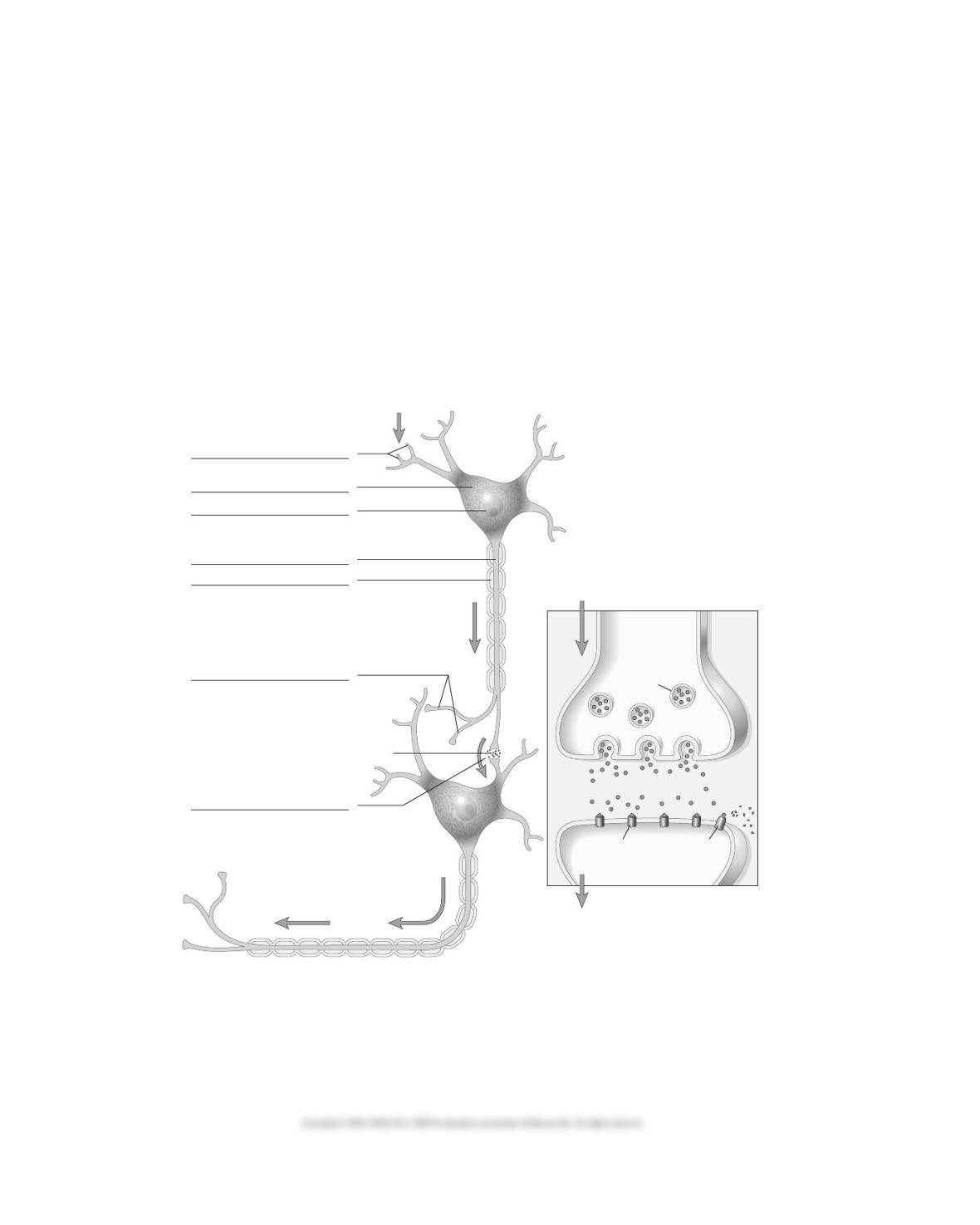
DIAGRAM QUIZ
Name: ______________________________
Label the diagram using the terms listed below:
Axon
Cell body
Cell nucleus
Dendrites
Myelin sheath
Synapse
Terminal end fibers
STIMULUS
AXON
Terminal end
fiber
DENDRITE
Neurotransmitters
Nerve
impulse
Nerve
impulse
Vesicle
Receptor Inactivator
1
2
3
4
5
6
7
Neurotransmitters

Chapter 10 ■ REVIEW SHEET QUIZ 229
Chapter Ten
REVIEW SHEET QUIZ
Name: ______________________________
A. Give meanings for the following combining forms:
1. encephal/o ____________________________________________
2. kines/o _______________________________________________
3. mening/o ____________________________________________
4. neur/o _______________________________________________
5. my/o ________________________________________________
6. vag/o- ________________________________________________
7. radicul/o _____________________________________________
8. tax/o _________________________________________________
9. myel/o _______________________________________________
10. esthesi/o ______________________________________________
B. Give meanings for the following prefixes:
1. quadri- _______________________________________________
2. hypo- ________________________________________________
3. hemi-________________________________________________
4. poly- _________________________________________________
5. sub- _________________________________________________
6. micro- _______________________________________________
7. hyper– ________________________________________________
8. dys- _________________________________________________
9. epi- _________________________________________________
10. para- _________________________________________________

230 Chapter 10 ■ REVIEW SHEET QUIZ
C. Give meanings for the following suffixes:
1. -algesia ______________________________________________
2. -paresis ______________________________________________
3. -phasia ______________________________________________
4. -ptosis ______________________________________________
5. -sclerosis ____________________________________________
6. -plegia ______________________________________________
7. -sthenia ____________________________________________
8. -praxia ______________________________________________
9. -blast _______________________________________________
10. -cele ________________________________________________

Chapter 10 ■ MEDICAL SCRAMBLE 231
Chapter Ten
MEDICAL SCRAMBLE
Name: ______________________________
Unscramble the letters to form suffixes related to nervous system conditions from the clues. Use the
letters in the squares to complete the bonus term.
1. Clue: Abnormal electrical activity in the brain
____ ____ ____ ____ ____ ____ E Y P I P E S L
2. Clue: Inflammation of membranes surrounding the brain and spinal cord
____ ____ ____ ____ ____ ____ ____ ____ ____ S I E T M I N G N I
3. Clue: Paralysis
____ ____ ____ S A Y L P
4. Clue: Mental decline and deterioration
____ ____ ____ ____ ____ ____ E N E T I D A M
BONUS TERM: Clue: Space between nerve cells
232 Chapter 10 ■ CROSSWORD PUZZLE
Across Clues Down Clues
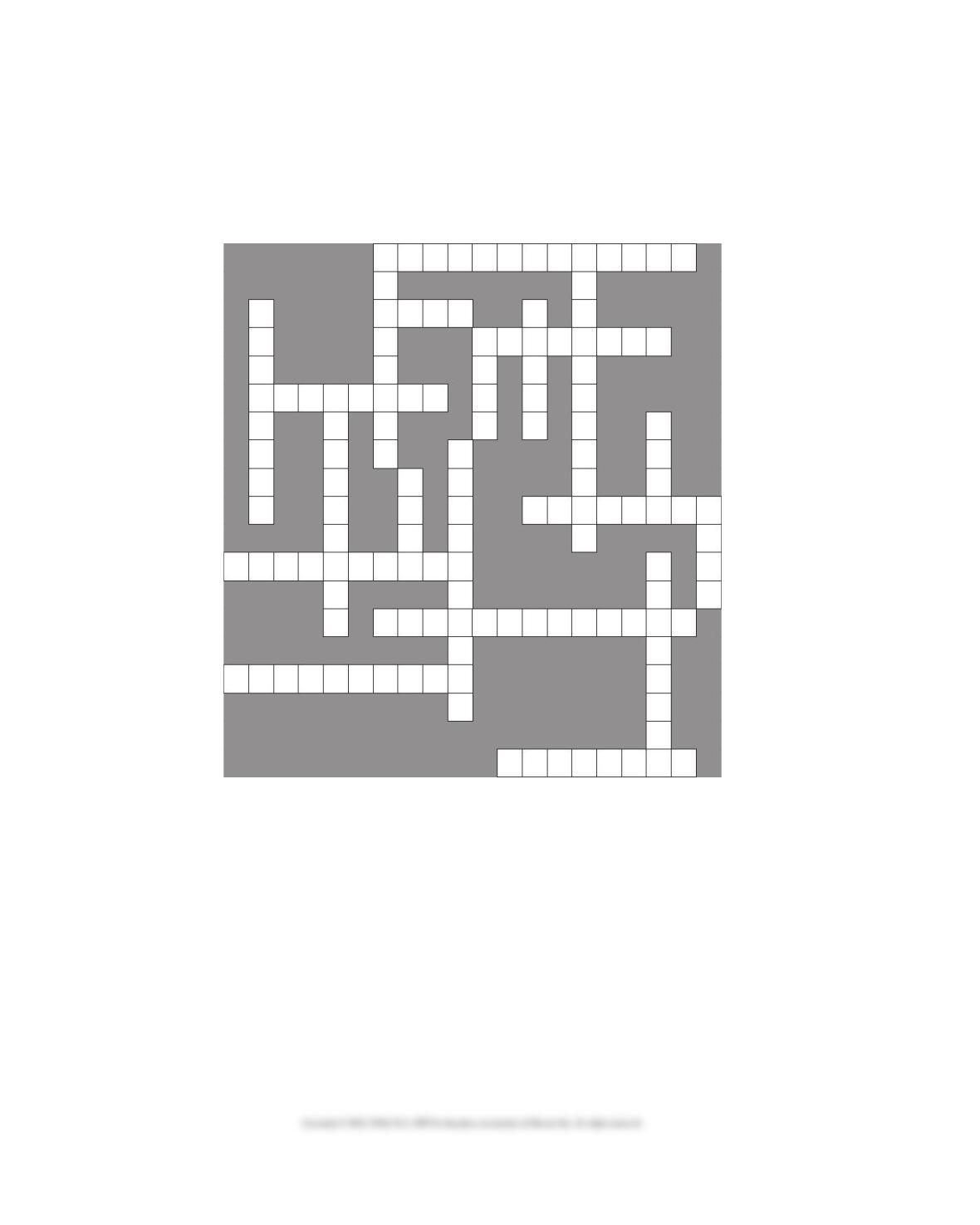
1. Destruction of myelin on the axons of nerves. 1. Neurotransmitter that is deficient in Parkinson disease.
4. Part of the brain; means “bridge”. 2. Malignant tumor of glial cells (astrocytes) in the brain.
6. Abnormal widening of a blood vessel. 3. Largest part of the brain.
7. Mass of material travels through the bloodstream
and suddenly blocks a vessel.
5. Macroscopic structure consisting of axons and
dendrites in bundle-like strands.
12. Mental decline and deterioration.
14. Relieving symptoms, but not curing.
16. Neurotransmitter released at the ends of some
nerve cells.
17. Posterior part of the brain.
18. Three protective membranes that surround the
brain and spinal cord.
6. Peculiar sensation appearing before more definite
symptoms.
8. Blockage.
9. Manner of walking.
10. Removal of the thymus gland; treatment for
myasthenia gravis.
11. Sheets of nerve cells that produce elevation in the
cerebral cortex, convolution.
13. Microscopic fiber that carries the nervous impulse
along a nerve cell.
15. Microscopic branching fiber of a nerve cell that is the
first part to receive the nervous impulse.
Chapter Ten
CROSSWORD PUZZLE
Name: ______________________________
Fill in the crossword puzzle below using the clues listed underneath it.
12
5
6
9
43
78
10
11
14
16
18
15
1312
17

Chapter 10 ■ PRACTICAL APPLICATIONS 233
Chapter Ten
PRACTICAL APPLICATIONS
Name: ______________________________
MRI Report
MRI was performed through the brain, cervical spine, and upper thoracic region. Scans were
generated in the transaxial, sagittal, and coronal (frontal) planes.
Evaluation of the brain parenchyma demonstrates the presence of multiple areas of abnormal
increased signal intensity scattered through the white matter of both cerebral hemispheres. These
areas are periventricular in location. The pattern is most compatible with a demyelinative process.
Scans through the cervical spine and spinal cord demonstrate no definite areas of abnormal increased
or decreased signal within the cord. The disks are intact. Evaluation of the upper thoracic region
demonstrates an appearance similar to that of the cervical region.
1. What is MRI? ………………………………..
A. Ultrasound images that show the
structure of organs and tissues
B. X-rays on a transverse plane
C. Magnetic and radio waves are used to
create images
D. Radioactive materials are injected and
images are recorded of their uptake in
tissues
2. What combining forms indicate the
regions of the body imaged? ……………..
A. Myel/o and my/o
B. Encephal/o and myel/o
C. My/o and encephal/o
D. Encephal/o
3. What is the brain parenchyma? …………
A. Neuronal tissue of the brain
B. Glial tissue of the brain
C. Ventricles of the brain
D. Connective tissue of the brain
4. From the report, what is a likely
diagnosis? …………………………………….
A. Alzheimer disease
B. Parkinson disease
C. Amyotrophic lateral sclerosis
D. Multiple sclerosis
234 Chapter 10 ■ ANSWERS TO THE QUIZZES
Chapter Ten
ANSWERS TO THE QUIZZES
Chapter 10 ■ ANSWERS TO THE QUIZZES 235
236 Chapter 10 ■ ANSWERS TO THE QUIZZES
Chapter 10 ■ ANSWERS TO THE QUIZZES 237
238 Chapter 10 ■ ANSWERS TO TERMINOLOGY SECTION
Chapter Ten
Answers to Terminology Section
(textbook pages 357–362)
Chapter 10 ■ ANSWERS TO TERMINOLOGY SECTION 239