Walker & Hemmens, Legal Guide for Police (10th Ed.)
Test Bank—Chapter 6
Multiple-Choice Questions
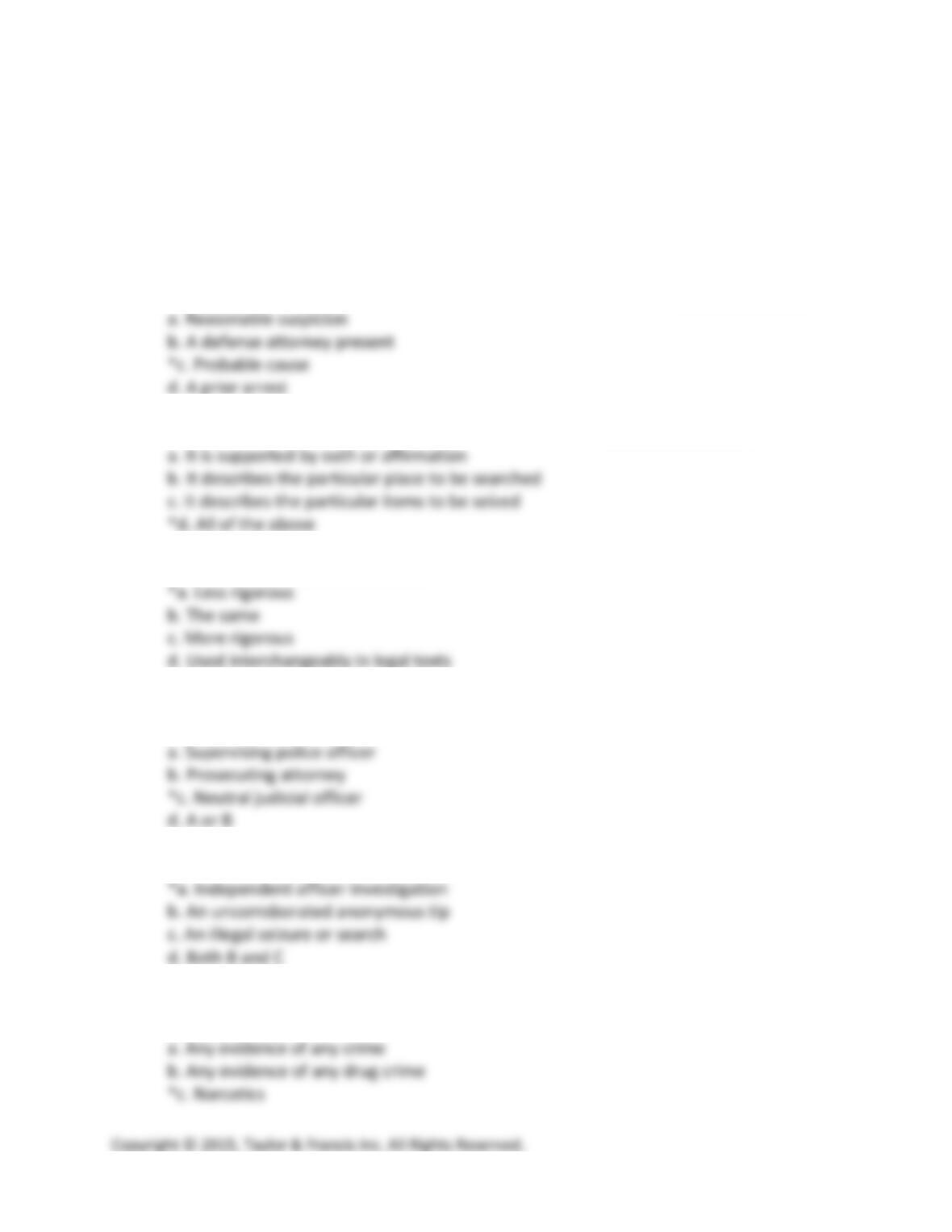
1. The Fourth Amendment states that no warrants shall be issued without ______________.
2. The Fourth Amendment states that a warrant is invalid unless ________________.
3. Probable cause is __________________ than the standard of beyond a reasonable doubt.
4. When securing a search warrant, a _________________ determines whether probable cause
has been satisfied.
5. Probable cause can be satisfied by _______________.
6. An officer wants to search a residence for narcotics. A search warrant must specifically
identify ____________ as the target of the search.
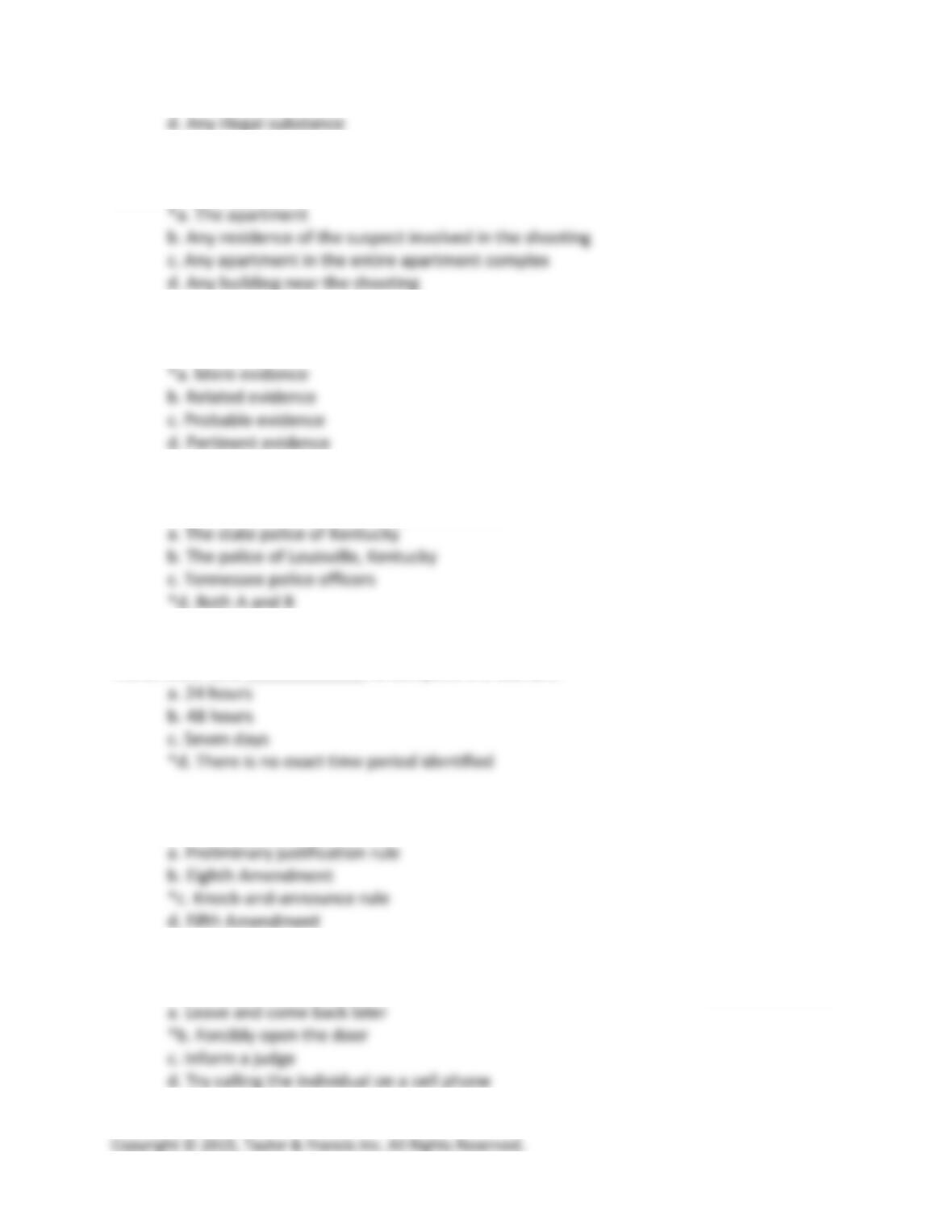
7. An officer wants to search an apartment for evidence of a shooting. A search must identify
__________________ as the target of the search.
8. _______________ is something that is related to the case but is not by itself the object of a
crime.
9. A search warrant identifies all officers of the state of Kentucky as the officers that must
execute the warrant. Therefore, ________________ can execute the warrant.
10. A warrant states that the officer must execute the warrant in a reasonable amount of time.
The officers have _____________ to complete the warrant.
11. The ______________ states that police cannot automatically use force to execute a search
warrant.
12. An officer is executing a search warrant. The officer announces his presence and intent to
execute the warrant. The individual will not open the door. The officer should ______________.
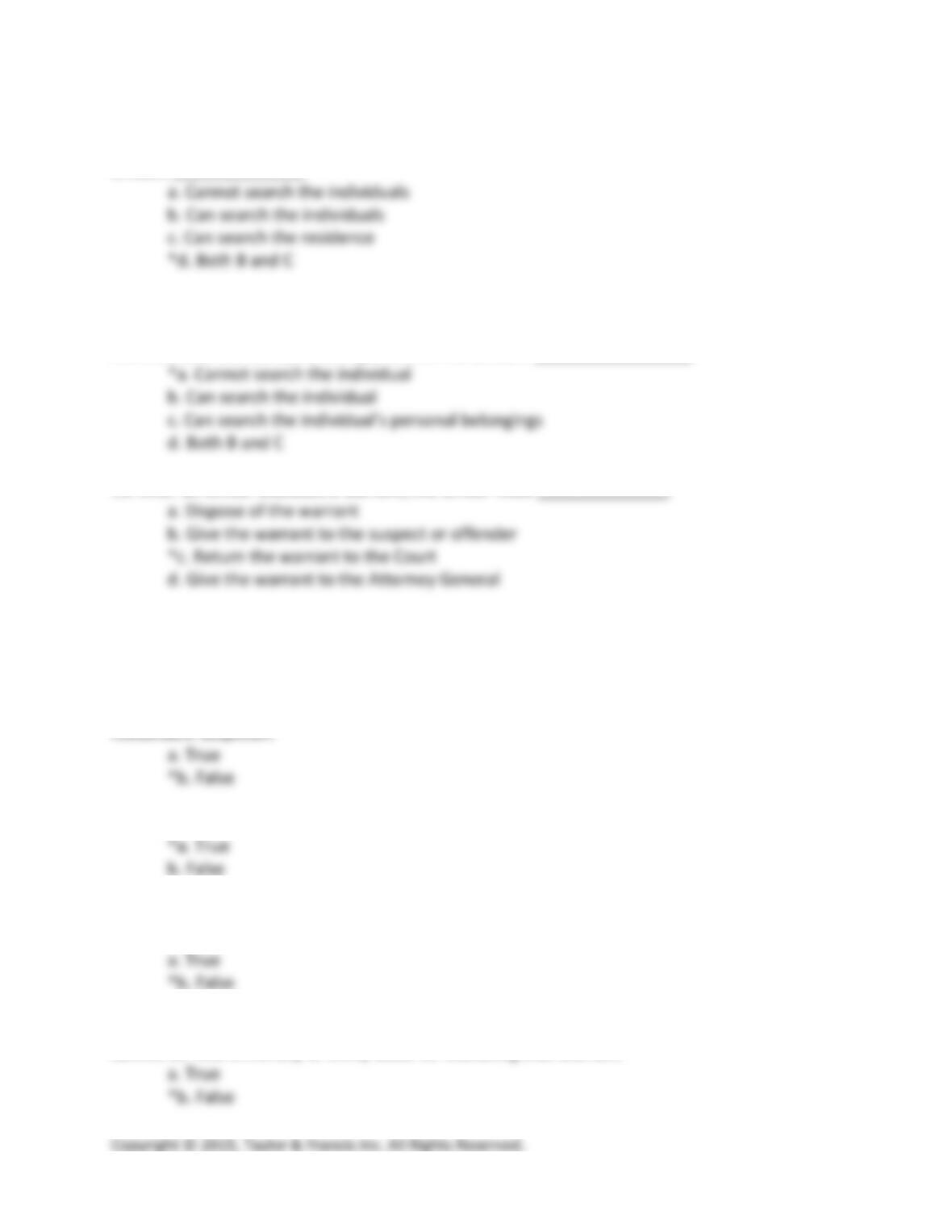
13. Officers are executing a search warrant to find an illegal handgun. The officers gain entry to
the identified residence. During the search, they find two individuals in the residence. The
officers ______________.
14. Officers are executing a search warrant on an apartment. The officers spot an individual
walking one block away from the apartment. The individual is not named in the warrant, and
the individual did not leave the apartment. The officers _________________.
15. After an officer executes a warrant, the officer must ______________.
True/False Questions
1. The Fourth Amendment states that a search warrant shall only be issued upon the grounds of
2. Probable cause cannot be satisfied by an uncorroborated anonymous tip.
3. The United States Supreme Court has stated that search warrants must be justified beyond a
reasonable doubt.
4. An officer lies or provides false evidence in order to secure an arrest warrant. That officer
cannot be held criminally or civilly liable for executing that warrant.

5. An officer illegally discovers evidence, but another officer then discovers that evidence at a
later time through legal means. That evidence will be allowed at trial under the “independent
source” doctrine.
6. The Courts have stated that police officers can utilize any technology to secure evidence to
satisfy probable cause.
7. A prosecuting attorney can issue a search warrant.
8. Any officer can execute any search warrant, regardless of jurisdictional considerations.
9. Search warrants must be executed in a reasonable amount of time.
10. An officer is limited in the amount of force that he or she can use while executing a search
warrant.
11. An officer is executing a search warrant. That officer must knock on the door to the
residence and announce his or her presence before entering the residence (unless there are
specific exigent circumstances).
12. The United States Supreme Court has stated that an officer must announce his or her intent
to execute an arrest warrant. The Court further held that an officer must wait 10 minutes for an
individual to respond before using force to gain access to an area.
13. While executing a search warrant, an officer can search any person that is around the area
being searched, regardless of the proximity of that person to the area.

14. An officer enters into a house to execute a search warrant. Three individuals are in the
house. The officer searches the three individuals to ensure that they are unarmed. The officer
finds a handgun. That evidence will be admitted at trial.
15. A search warrant identifies the individual to be targeted. The search warrant then permits
the officers to search for any item that they wish to find. Further, the warrant allows the
officers to search any building that the officers wish to search. This warrant is constitutional,
valid, and legal.