Version 1 1
Student name:__________
1) While evaluating a case, what risk factors must an investigator consider in deciding
whether to make an arrest and when to make it?
Question Details
Accessibility : Keyboard Navigation
2) In the context of the rules of evidence, discuss the importance of admissibility and the
rules governing it.
Question Details
Accessibility : Keyboard Navigation
3) Differentiate between the terms “burden of proof” and “burden of going forward with
evidence.”
Question Details
Accessibility : Keyboard Navigation
Version 1 2
4) Describe the manner in which circumstantial evidence is used in a criminal prosecution.
Question Details
Accessibility : Keyboard Navigation
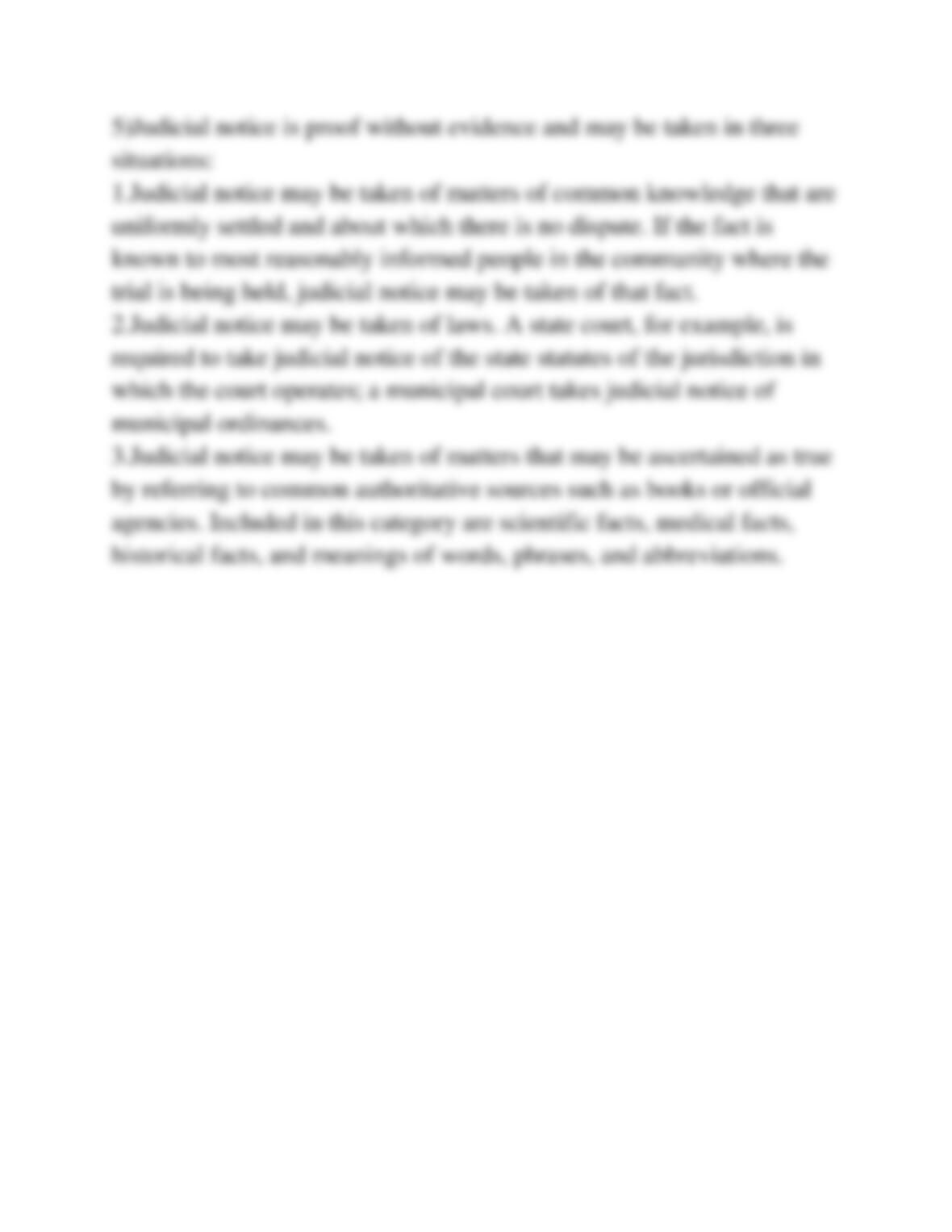
5) In the context of the rules of evidence, what are the situations in which judicial notice
may be taken?
Question Details
Accessibility : Keyboard Navigation
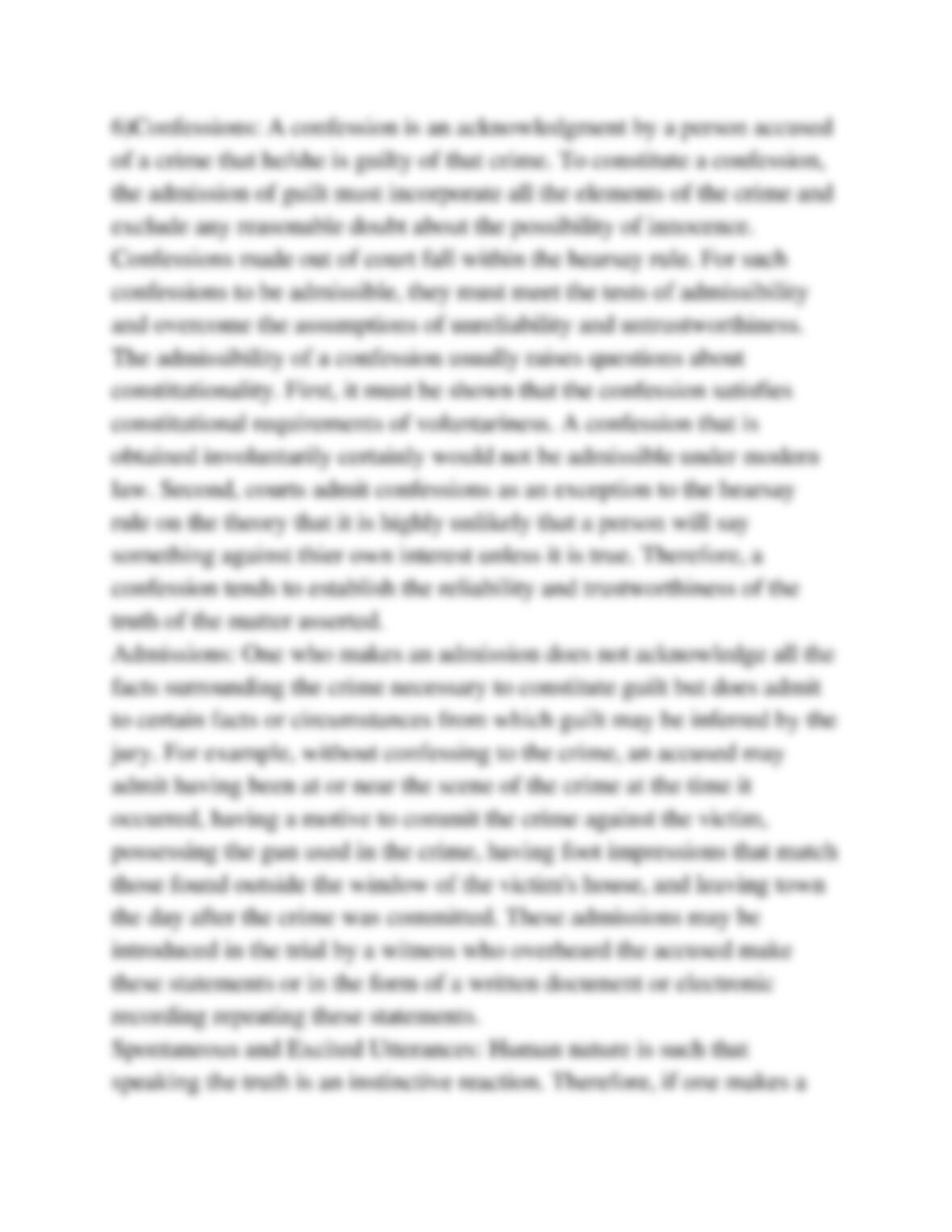
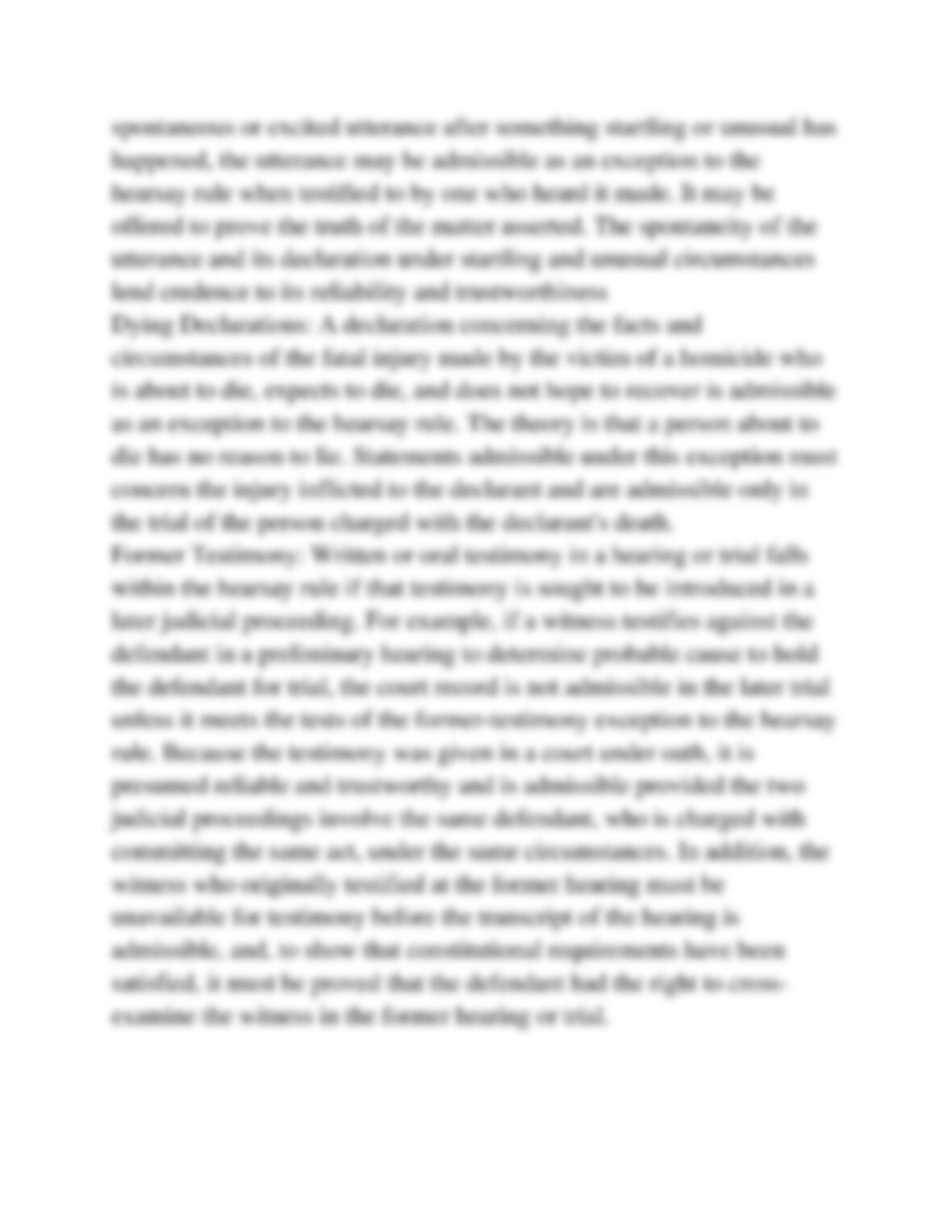
6) Discuss the exceptions to the hearsay rule: confessions, admissions, spontaneous and
excited utterance, dying declaration, and former testimony.
Question Details
Accessibility : Keyboard Navigation
Version 1 3
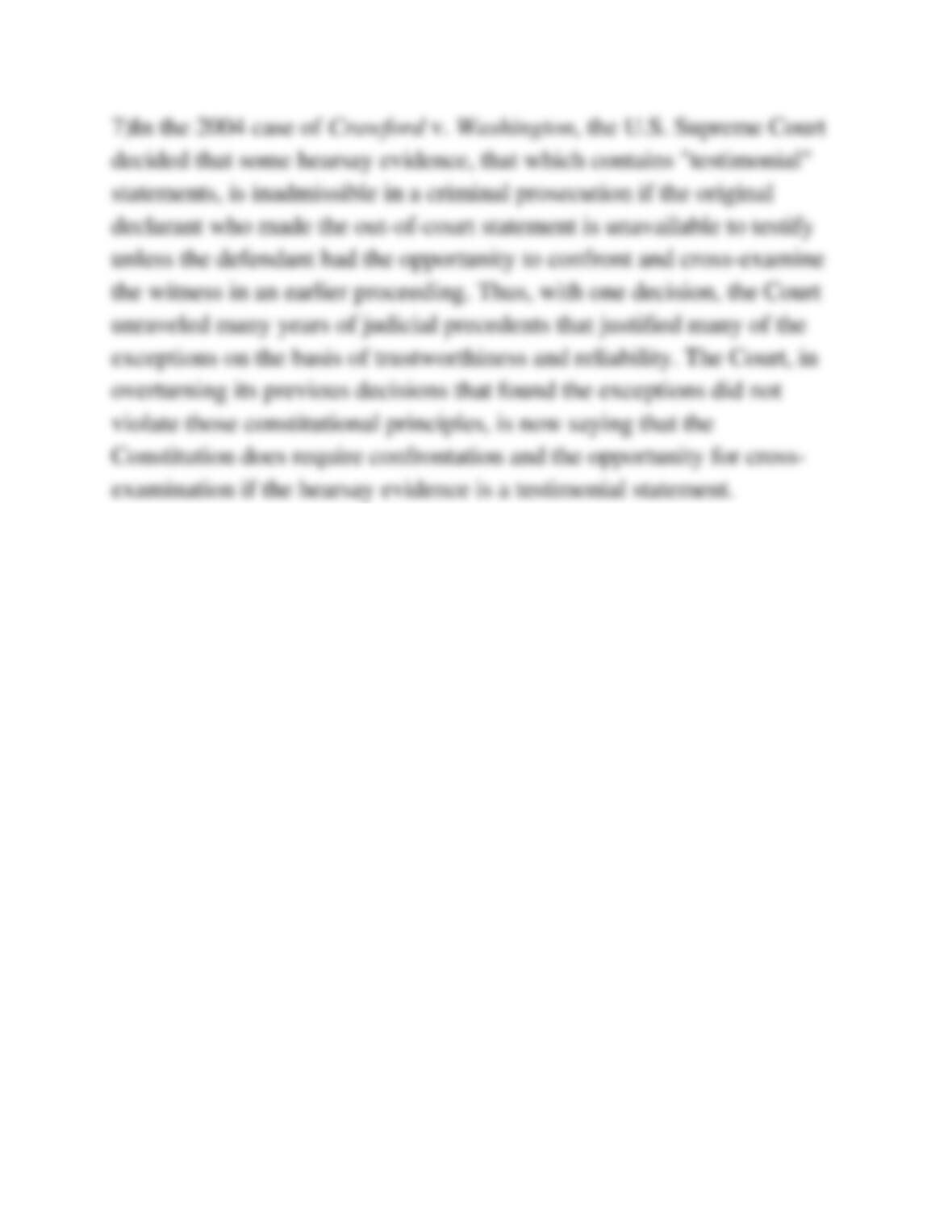
7) For what proposition does the U.S. Supreme Court case ofCrawford v.Washington stand?
Question Details
Accessibility : Keyboard Navigation
8) What factors affect the credibility of the investigator as a witness?
Question Details
Accessibility : Keyboard Navigation
9) How important are a witness’s appearance and demeanor to credibility?
Question Details
Accessibility : Keyboard Navigation
10) When and how may a witness use notes on the witness stand?
Version 1 4
Question Details
Accessibility : Keyboard Navigation
11) The jury panel from whom the jurors in a trial are eventually picked is called
a(n)_________blank.
11) ______
Question Details
Accessibility : Keyboard Navigation
12) In a civil case, the party allegedly wronged is called the_________blank.
12) ______
Question Details
Accessibility : Keyboard Navigation
13) The_________blank is the combination of all the elements of a crime.
13) ______
Question Details
Accessibility : Keyboard Navigation
14) Sometimes referred to as physical evidence,_________blank evidence is connected with
the commission of a crime and can be produced in court.
Version 1 5
14) ______
Question Details
Accessibility : Keyboard Navigation
15) _________blank is derived from “heard say” and is inadmissible in court because of its
inaccuracy, unreliability, and untrustworthiness.
15) ______
Question Details
Accessibility : Keyboard Navigation
16) One who makes a(n)_________blank does not acknowledge all the facts surrounding the
crime necessary to constitute guilt but does admit to certain facts or circumstances from which
guilt may be inferred by the jury.
16) ______
Question Details
Accessibility : Keyboard Navigation
17) _________blank refer to certain matters of communication that defendants and other
witnesses can rightfully have barred from disclosure in court.
17) ______
Question Details
Accessibility : Keyboard Navigation
18) A(n)_________blank concerning the facts and circumstances of the fatal injury made by
the victim of a homicide who is about to die, expects to die, and does not hope to recover is
admissible as an exception to the hearsay rule.
Version 1 6
18) ______
Question Details
Accessibility : Keyboard Navigation
19) Some of the more common evidentiary privileges fall into four categories.
The_________blank privileges include those that exist between attorney and client, physician
and patient, priest and penitent, and journalist and informant.
19) ______
Question Details
Accessibility : Keyboard Navigation
20) The type of evidentiary privilege that involves communication between an attorney and
their client is referred to as_________blank.
20) ______
Question Details
Accessibility : Keyboard Navigation
21) _________blank is the process used before testimony by individuals who for personal
reasons refuse to take an oath.
21) ______
Question Details
Accessibility : Keyboard Navigation
22) _________blank is the process of discrediting or contradicting the testimony of a witness
to show that the witness is unworthy of belief.
Version 1 7
22) ______
Question Details
Accessibility : Keyboard Navigation
23) In the rules of evidence, using notes and reports simply to refresh the memory is referred
to as_________blank.
23) ______
Question Details
Accessibility : Keyboard Navigation
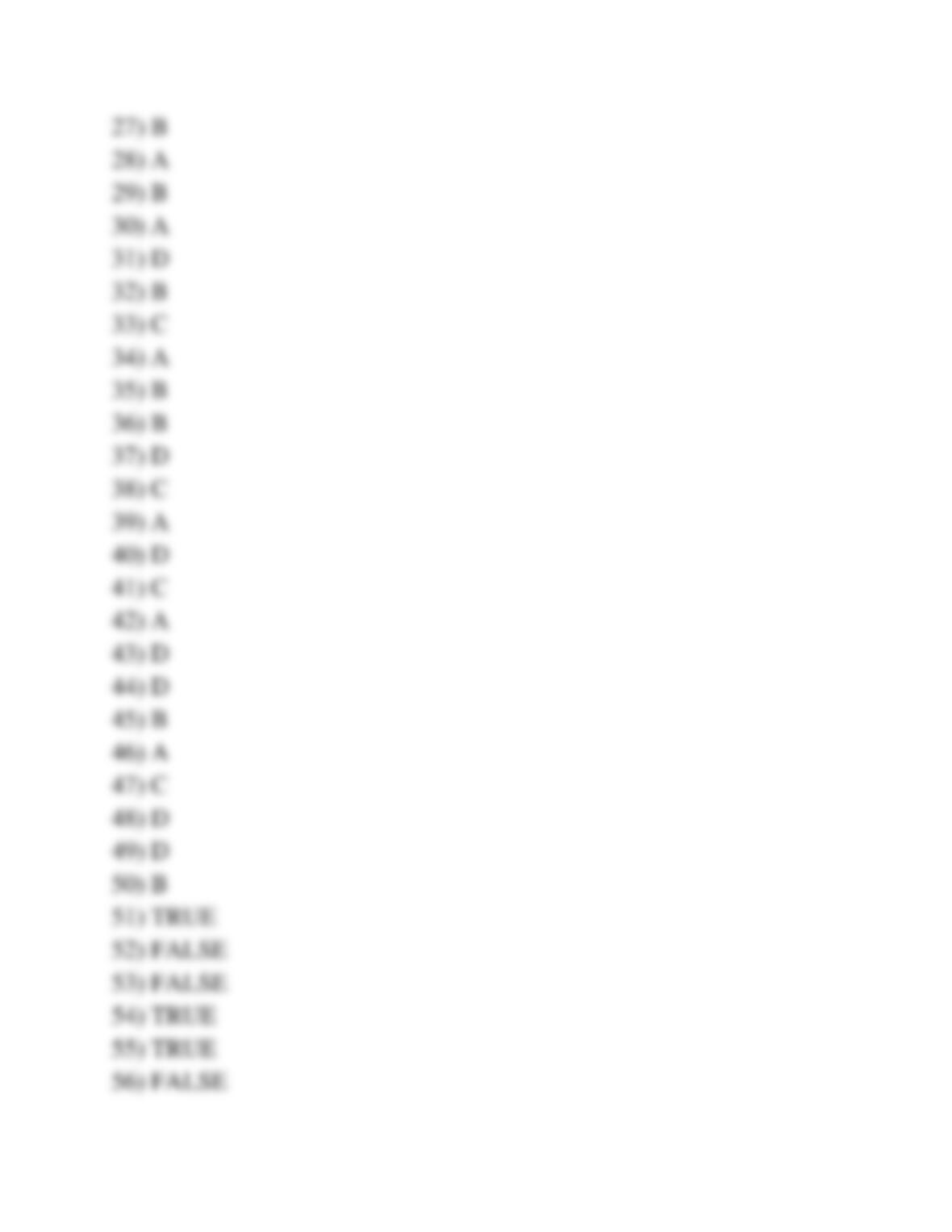
24) Which of the following statements is true about probable cause?
24) ______
A) Once probable cause has been established, an arrest is mandatory.
B) Once probable cause has been established, the investigation is complete.
C) The fact that probable cause exists does not require an arrest to be made at the
moment.
D) If the suspect is likely to flee if allowed to remain free, an arrest should be made even
if the probable cause is not established.
Question Details
Accessibility : Keyboard Navigation
25) Which of the following should an investigator ponder prior to making an arrest?
25) ______
Version 1 8
A) Is the suspect likely to flee if left in the community?
B) What is the potential danger to others if the suspect is allowed to remain free?
C) What hardships will be imposed on the suspect by early incarceration?
D) All of these answers are correct.
Question Details
Accessibility : Keyboard Navigation
26) Once questioning of potential jurors has been completed, what is the challenge that may
be used for any reason, as long as the reason is race and gender neutral and is not a pretext for
racial or gender motivation, to excuse a prospective juror?
26) ______
A) challenge for cause
B) challenge for bias
C) peremptory challenge
D) executive challenge
Question Details
Accessibility : Keyboard Navigation
27) While the prosecution is presenting its case, the questioning of witnesses it calls to testify
on behalf of the prosecution is called
27) ______
A) examination.
B) direct examination.
C) cross-examination.
D) rebuttal examination.
Version 1 9
Question Details
Accessibility : Keyboard Navigation
28) In the context of a trial, which of the following terms is defined as the questioning of a
witness who was initially called by the opposing party?
28) ______
A) cross-examination
B) redirect examination
C) rebuttal
D) surrebuttal
Question Details
Accessibility : Keyboard Navigation
29) In the context of a trial, which of the following terms is defined as the re-questioning of a
witness initially called by the opposing party?
29) ______
A) redirect examination
B) re-cross-examination
C) rebuttal
D) surrebuttal
Question Details
Accessibility : Keyboard Navigation
30) After the defense rests its case, the prosecution has an opportunity for_________blank.
30) ______
Version 1 10
A) rebuttal
B) surrebuttal
C) cross-examination
D) re-cross-examination
Question Details
Accessibility : Keyboard Navigation
31) At what point in the trial process does the judge have the responsibility of instructing the
jury on the law applicable to the case and of advising the jury of its responsibilities?
31) ______
A) after the jurors have been sworn in but before opening statements
B) after the prosecution and defense have presented their case
C) before closing statements
D) after closing statements
Question Details
Accessibility : Keyboard Navigation
32) What is the first rule of evidence?
32) ______
A) Proof is not evidence, but the combination of individual facts is proof.
B) Anything is admissible as evidence unless there is some rule that prohibits its
admissibility.
C) Evidence must be relevant to the case at hand.
D) Determine the importance of the evidence.
Version 1 11
Question Details
Accessibility : Keyboard Navigation
33) _________blank is the essence of the rules of evidence.
33) ______
A) Disclosure
B) Testimony
C) Admissibility
D) Confession
Question Details
Accessibility : Keyboard Navigation
34) In a criminal trial, the requirement that the prosecution establish the defendant’s guilt
beyond, and to the exclusion of, every reasonable doubt is referred to as
34) ______
A) burden of proof.
B) burden of going forward with evidence.
C) preponderance of evidence.
D) order of proof.
Question Details
Accessibility : Keyboard Navigation
35) Who carries the burden of going forward with evidence in a trial?
35) ______
Version 1 12
A) prosecution
B) defense
C) judge
D) court officials
Question Details
Accessibility : Keyboard Navigation
36) In a civil suit, the party wronged is the plaintiff. What is the burden of proof necessary to
win a civil case?
36) ______
A) proof beyond a reasonable doubt
B) preponderance of evidence
C) probable cause
D) reasonable suspicion
Question Details
Accessibility : Keyboard Navigation
37) Which of the following terms refers to an evidentiary shortcut whereby the necessity of
formally proving the truth of a particular matter is eliminated when that truth is not in dispute?
37) ______
A) evidentiary privilege
B) preponderance of evidence
C) peremptory challenge
D) judicial notice
Version 1 13
Question Details
Accessibility : Keyboard Navigation
38) A combination of all the elements of a crime is referred to as
38) ______
A) judicial notice.
B) order of proof.
C) corpus delicti.
D) direct evidence.
Question Details
Accessibility : Keyboard Navigation
39) Which of the following statements is true about direct evidence?
39) ______
A) It is based on the firsthand knowledge of a witness regarding the guilt of the
defendant.
B) It consists of maps, diagrams, sketches, photographs, tape recordings, videotapes, X-
rays, and visual tests and demonstrations produced to assist witnesses in explaining their
testimony.
C) It is used in a criminal case by inferring from a series of known facts the existence of
an unknown fact.
D) It includes items of physical evidence found at a crime scene, such as a weapon used
to commit a homicide, a crowbar used to pry open a window, and fingerprints.
Question Details
Accessibility : Keyboard Navigation
Version 1 14
40) There are five types of evidence identified in the textbook. Which type introduces
tangible objects even though they are not identical to real evidence?
40) ______
A) direct evidence
B) real evidence
C) circumstantial evidence
D) demonstrative evidence
Question Details
Accessibility : Keyboard Navigation
41) An individual who testifies in court and who possesses special skills or knowledge not
ordinarily possessed by others, acquired through experience, study, observation, or education and
who is permitted to interpret such information for the jury, give opinions, and draw conclusions
is called
41) ______
A) a lay witness.
B) a police officer.
C) an expert witness.
D) a forensic scientist.
Question Details
Accessibility : Keyboard Navigation
42) Which of the following is a reason why hearsay evidence is inadmissible?
42) ______
Version 1 15
A) It is unreliable and untrustworthy.
B) It violates two provisions of the Eighth Amendment to the U.S. Constitution.
C) There is a tendency of information to be fabricated as it becomes secondhand
information.
D) It carries little weight with juries.
Question Details
Accessibility : Keyboard Navigation
43) Which of the following statements is true about theCrawford v. Washington case in
2004?
43) ______
A) The U.S. Supreme Court decided that some hearsay evidence, that which contains
“testimonial” statements, is inadmissible in a criminal prosecution if the original declarant who
made the out-of-court statement is unavailable to testify.
B) With this decision, the Court unraveled many years of judicial precedents that justified
many of the exceptions on the basis of trustworthiness and reliability.
C) Since theCrawford decision, many thousands of federal and state cases have been
decided interpreting the application of the decision to differing factual scenarios and many of the
decisions conflicted with each other.
D) All of these answers are correct.
Question Details
Accessibility : Keyboard Navigation
44) A(n)_________blank is an acknowledgment by a person accused of a crime that he/she is
guilty of that crime.
44) ______
Version 1 16
A) disclosure
B) admissibility
C) admission
D) confession
Question Details
Accessibility : Keyboard Navigation
45) A command to an individual to appear in court and to bring certain records or documents
in their possession is called a
45) ______
A) subpoena.
B) subpoena duces tecum.
C) summons.
D) complaint.
Question Details
Accessibility : Keyboard Navigation
46) Which of the following terms is defined as a formal attestation in which a witness swears
to tell the truth on the basis of their belief in a supreme being?
46) ______
A) oath
B) affirmation
C) declaration
D) None of these answers is correct.
Version 1 17
Question Details
Accessibility : Keyboard Navigation
47) The most important characteristic of a good witness is to
47) ______
A) not show nervousness.
B) adequately investigate the case.
C) be prepared.
D) anticipate the kind of tactics the defense attorney will use in cross-examination.
Question Details
Accessibility : Keyboard Navigation
48) According to the textbook, for a law enforcement witness, what is the first step in
preparation for testifying in court?
48) ______
A) Ensure that a complete investigation was conducted.
B) Ensure that all investigative leads were followed and all avenues explored.
C) Review all notes, reports, electronic recordings, and physical evidence prior to
testifying.
D) All of these answers are correct.
Question Details
Accessibility : Keyboard Navigation
49) Regarding the proper clothing to wear while testifying in court, all authorities agree that
49) ______
Version 1 18
A) a uniform should always be worn while testifying.
B) civilian clothes should always be worn while testifying.
C) an investigator should wear what they were wearing at the time of the arrest.
D) regardless of what is worn it should be neat and clean.
Question Details
Accessibility : Keyboard Navigation
50) In the event that a witness cannot remember the facts of the case but uses notes or reports
as the sole basis of testimony without any independent recall, the term applied is
50) ______
A) report reading.
B) past recollection recorded.
C) past recollection read.
D) past recollection refreshed.
Question Details
Accessibility : Keyboard Navigation
51) The courtroom process begins with the selection and swearing in of a jury.
51) ______
⊚ true
⊚ false
Question Details
Accessibility : Keyboard Navigation
Version 1 19
52) There is no limit on the number of peremptory challenges, but each side has a specific
number of challenges for cause.
52) ______
⊚ true
⊚ false
Question Details
Accessibility : Keyboard Navigation
53) A language barrier is never a basis for a challenge for cause.
53) ______
⊚ true
⊚ false
Question Details
Accessibility : Keyboard Navigation
54) While the prosecution is presenting its case, the questioning of witnesses the prosecution
calls to testify on behalf of the prosecution is called direct examination.
54) ______
⊚ true
⊚ false
Question Details
Accessibility : Keyboard Navigation
55) The prosecution has the opportunity to conduct a redirect examination of the defendant
after completion of cross-examination.
55) ______
⊚ true
⊚ false
Version 1 20
Question Details
Accessibility : Keyboard Navigation
56) Proof can be defined as anything that tends logically to prove or disprove a fact at issue
in a judicial case or controversy.
56) ______
⊚ true
⊚ false
Question Details
Accessibility : Keyboard Navigation
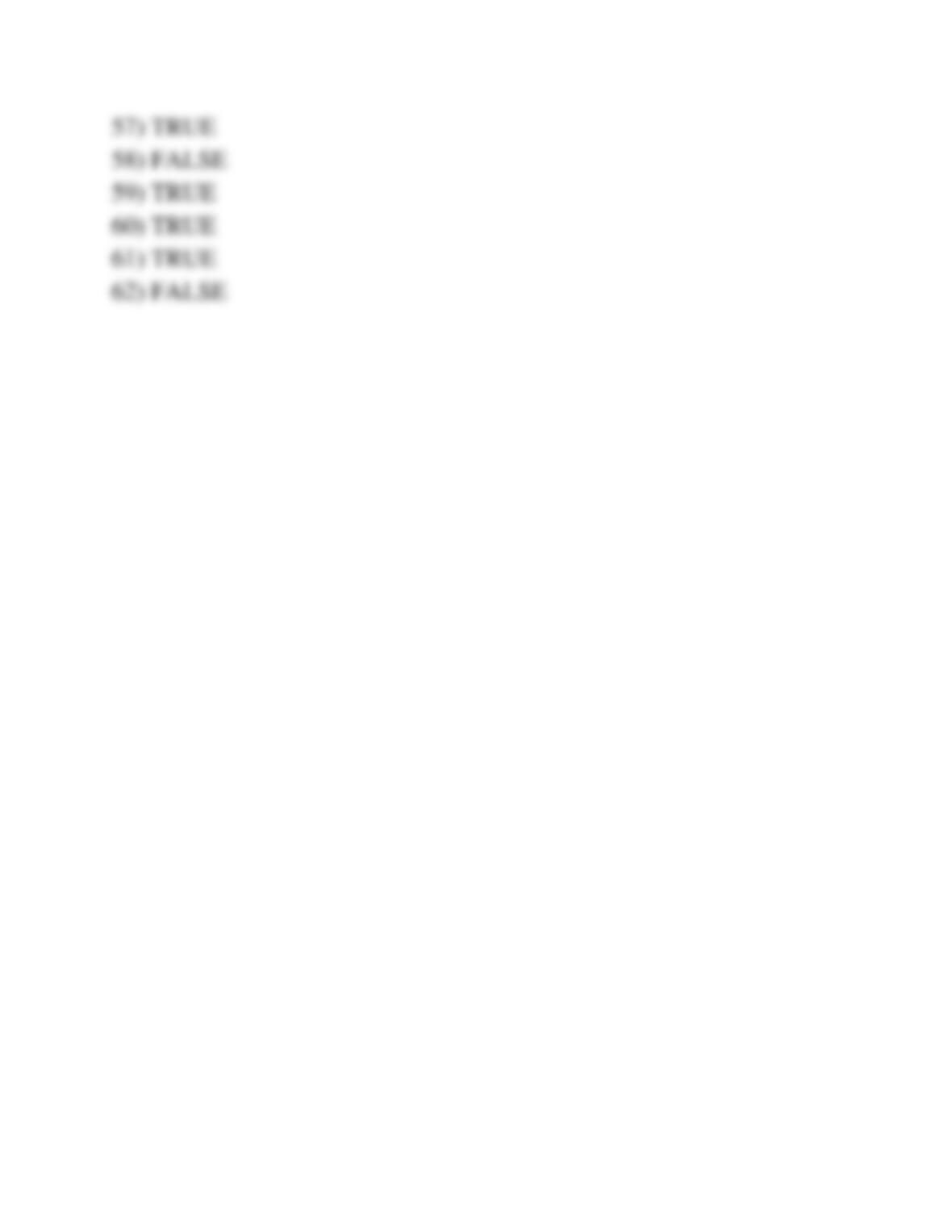
57) The rules of admissibility protect the trier of fact, generally a jury, from hearing improper
evidence that may be unreliable or untrustworthy and that may prejudice a case unjustifiably
against the defendant.
57) ______
⊚ true
⊚ false
Question Details
Accessibility : Keyboard Navigation
58) One of the rules governing the admissibility of evidence allows evidence that is not
relevant to a case to be admitted if the defense does not object to it.
58) ______
⊚ true
⊚ false
Question Details
Accessibility : Keyboard Navigation
Version 1 21
59) Weight of evidence deals with the elements of persuasion and believability.
59) ______
⊚ true
⊚ false
Question Details
Accessibility : Keyboard Navigation
60) An inference is similar to a presumption but differs in that the jury has more latitude in
accepting or rejecting an inference.
60) ______
⊚ true
⊚ false
Question Details
Accessibility : Keyboard Navigation
61) It is a myth that one cannot be convicted of a crime based solely on circumstantial
evidence.
61) ______
⊚ true
⊚ false
Question Details
Accessibility : Keyboard Navigation
62) Judicial confessions fall within the hearsay rule.
62) ______
Version 1 22
⊚ true
⊚ false
Question Details
Accessibility : Keyboard Navigation
Version 1 23
Answer Key
Test name: chapter 22
Version 1 24
Version 1 25
Version 1 26
Version 1 27
Version 1 28
Version 1 29
Version 1 30
Version 1 31
Version 1 32
Version 1 33
Version 1 34
Version 1 35
Version 1 36
Version 1 37