CHAPTER 4 – SIX MODEL NATIONS
Multiple Choice
1. Which of the following is not a part of England’s parliament?
A. The Monarch
B. The House of Lords
C. The House of Commons
D. The House of Councilors
2. The major component of Parliament in England, which has 650 fixed elected members is:
A. House of Lords
B. House of Commons
C. House of Councilors
D. The Cabinet
3. France has a:
A. Unitary Civil Law legal system
B. Unitary Common Law legal system
C. Federal Civil Law legal system
D. Federal Common Law legal system
4. The basic principles of the Criminal Law in France come from:
A. The Criminal Law Act
B. Criminal Justice Act
C. The Declaration of the Rights of Man and of the Citizen
D. The Magna Carta
5. Which of the following is not a comparison between France and the United States?
A. Both were developed after a revolution
B. Both are republican in style
C. Most power in both countries remains embedded in a centralized form of government
D. Both are rooted in a written constitution
6. Power in Germany is:
A. Centralized in the federal government
B. Decentralized in the state governments
C. Centralized in the executive branch of the government
D. Distributed between the federal and state governments
7. Germany is divided into 16 states, called:
A. Bundestag
B. Lander
C. Landegesetz
D. Vergehen
8. Which of the following is not one of the three most important contemporary influences
on the criminal justice system in Germany?
A. Problem of drugs and crime
B. Extensive immigration from bordering countries
C. Constant threat of terrorism
D. Ethnic violence and hate crimes
9. The primary organs of governmental power in China include all of the following, except:
A. National People’s Congress
B. The presidency
C. The State Council
D. The Supreme Court of China
10. In Confucian ethics, the main force behind motivating people to avoid illegal or
immoral activities is:
A. Retribution
B. Group consciousness
C. Rehabilitation
D. Harsh punishment
11. Which of the following is not a part of China’s centrally monitored criminal justice
system?
A. The procuratorate
B. Police
C. Corrections
D. Preffectorate
12. Japan’s constitution is modeled after:
A. The German constitution and Chinese culture
B. The American and British constitutions
C. The Chinese constitution and American Bill of Rights
D. The American constitution and the British Parliamentary system
13. The primary crime problem in Japan is:
A. Juvenile crime
B. Domestic violence
C. Organized crime
D. Economic crime
14. The two issues of concern related to crime in Saudi Arabia are:
A. Terrorism and human trafficking
B. Human trafficking and drug trafficking
C. Terrorism and drug trafficking
D. Drug trafficking and hate crimes
15. Who is the chief of state and head of government in Saudi Arabia?
A. The president
B. The king
C. The chancellor
D. The prime minister
Sentence Completion
1. ________________ is the mixing of more than one system of law in a country or section
of a country.
2. The name of crime data in England that is akin to the NCVS in the United States is called
the ____________________.
3. A ___________ is a person who is the sole and absolute ruler of a country, such as a
king, queen or emperor.
4. Keeping order in England is a shared responsibility between the _____________ and
___________ government.
5. The French Republic, with a population of over 65 million is divided into _______
administrative regions.
6. France maintains a strong ______________ government style, in which a president heads
the government but the main power remains in the hands of the citizens, who vote for
representatives who are then responsible for the electorate.
7. The police in France are generally divided into two bodies: the ________________and
the ____________.
8. German criminal code distinguishes between ___________ and _______________.
9. Due to the increase in immigration a major crime problem facing Germany is currently
___________.
10. ________________ is one of the world’s most populous nations and one of the world’s
oldest civilizations with thousands of years of continuous history.
11. In reality, all levels of the Chinese government are subordinate to the
_______________________ , meaning the real role of government is to implement party
policy.
12. In response to crime increases, the Chinese government initiated different anticrime
crackdowns or “strike hard” campaigns, called __________.
13. Organized crime, or __________________ in Japanese, is known to be a crime problem
in Japan and was a main reason for crime increases in recent years.
role in the protection and promotion of the economic and social well-being of its citizens.
15. The two nations that do not have a formal written constitution are _____________
and____________________.
True/False
1. In England the influence of the Monarch has eroded and today it serves a ceremonial
rather than an executive function.
2. Organic laws are those laws of Parliament that describe the machinery of government; an
example of which being, The Human Rights Act of 1998.
3. Since 1967, all crimes in England and Wales are either “arrestable or “unarrestable”
offenses.
4. The police in France are divided into two bodies with responsibilities determined by the
geographical size of the territory.
5. Due to economic stability, France is less concerned about terrorism than other European
nations.
6. Germany’s government contains executive, legislative and judicial branches, similar to
the United States.
7. One of the most important changes in German law in modern times was the German Civil
Code, developed under Bismarck.
8. One American influence in the German criminal justice system is the use of previous
court decisions as a source of law.
9. China is a multinational socialist country with 23 provinces, 5 autonomous regions and 4
municipalities under the authority of the central government.
10. The goal of Communist law is to promote economic classes and destroy a social order
based on the rule of people rather than the rule of law.
11. In China the Ministry of Public Security is responsible for the police, while the
correctional system is under the direct supervision of the Ministry of Justice.
12. Japan is one of the most homogenous countries in the world with over 99% of the people
being native Japanese.
13. Japan has had some increase in crime during the 20th century, making its crime rate
almost even with that of the United States.
14. Saudi Arabia is not a democracy and there is no system of election and representation, so
there is no legislative branch.
human trafficking.
Short Answers
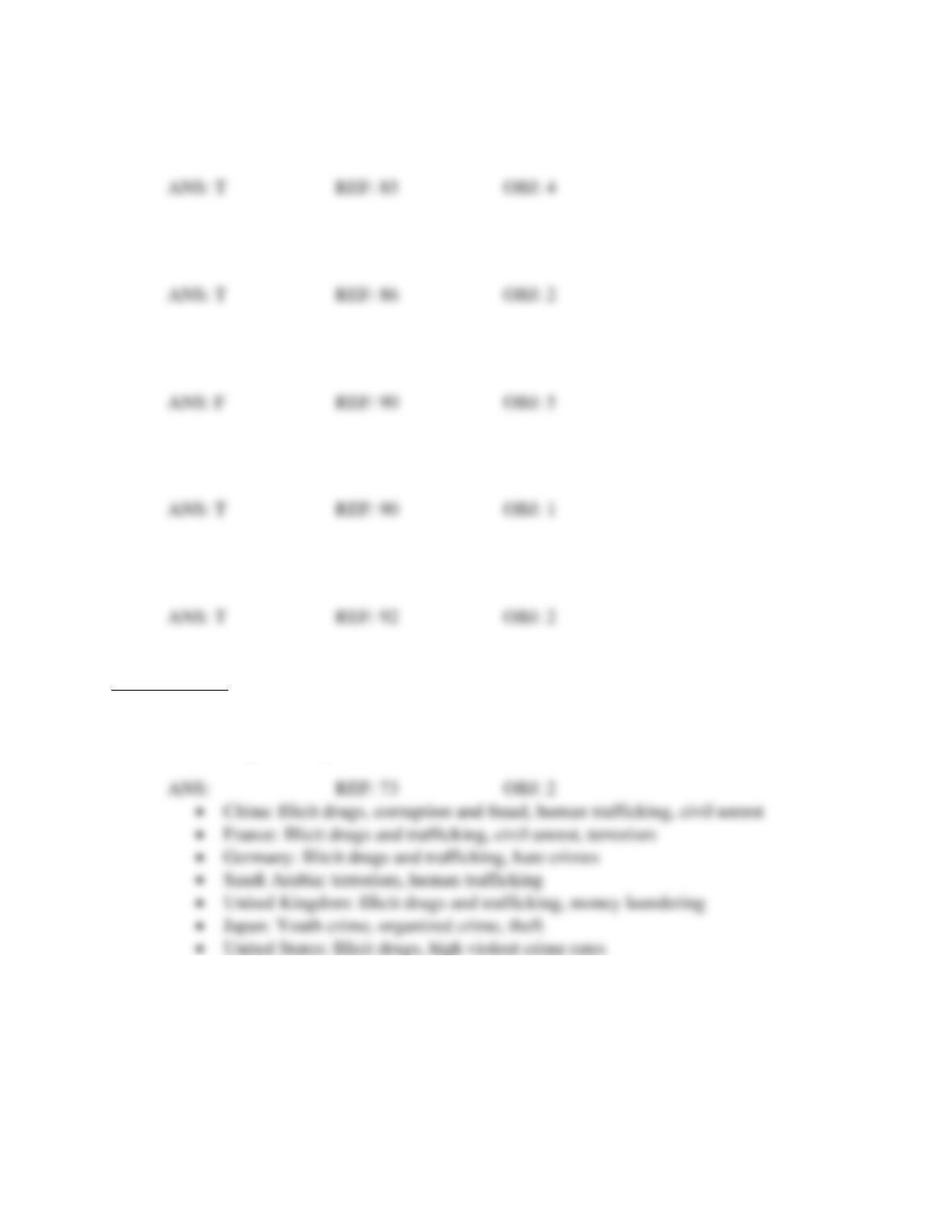
1. List the major crime problems in each of our model countries and the United States.
2. Identify difficulties in comparing crime statistics for Saudi Arabia with those of other
countries.
3. The French penal code is divided into five books. Discuss what each book entails.
4. In Japan, discuss how the Penal code is divided into two books, and how crimes are
divided into 3 categories.
Essays
1. Discuss the three characteristics of the Saudi Arabian criminal justice system that
Americans would find peculiar.
2. How would you compare the crime situation in the model countries to that of the United
States?
3. Within each of the six model nations, which particular historical developments may have
had a major effect on their formation of criminal law and criminal justice administration?
Pick two of the model countries and discuss these historical developments in depth.