Chapter Three Test Bank Questions
1. People, in general, develop ideas regarding the way other people’s traits and behavioral
tendencies fit together. Bruner and Tagiuri (1954) referred to these as:
a. stereotypes
b. implicit personality theories
c. worldviews
d. self-schema
2. Cognitive structures, derived from past experience, that organize and guide the processing
of ongoing, self-related information are known as:
a. self-schema
b. worldviews
c. unconscious processes
d. psychic determinants
3. The operation of self-schema lies within the person’s range of conscious experience.
a. true
b. false
4. Which of the following ways is the processing of information influenced by the operation
of self-schema?
a. heightens sensitivity to self-relevant stimuli
b. enhances recall of information that is self-congruent
c. processing of information that is incongruent with one’s self-schema is resisted
d. all of the above
e. (a) and (b) only
5. “The sum total of one’s beliefs about the nature of the world and how one relates to it”
defines:
a. the ecological self
b. worldview
c. self-schema
d. social interest
6. In the selection and application of counseling theories, extroverts tend to gravitate toward
those theories that:
a. are action oriented
b. require cognitive reframing
c. encourage thoughtful introspection
d. do not require clinical judgment
7. Which of the following is highly recommended when it comes to the relationship between
theory selection and personal characteristics of the counselor?
a. Successful therapists tend to select theories that run counter to their natural
tendencies.
b. Successful counselors adopt theories and methods that are congruent with his or
her own personality.
c. Because so many variables operate at any given time, it is best to not consider how
one’s personality traits interact with the selection and application of theory.
d. Only extroverts should enter into the counseling professions since the intensity of
interpersonal contact is so great.
8. Which of the following theorists have developed the Transtheoretical Model of behavioral
change?
a. Miller
b. Prochaska and DiClementi
c. Bem and Bem
d. Bronfenbrenner
9. Which stage of change is the client unaware of their need to make behavioral changes?
a. precontemplation
b. contemplation
c. action
d. maintenance
10. Which of the following is a highly recommended approach when working with clients in
the preparation stage of behavioral change?
a. development of an action or treatment plan
b. conducting a benefits/cost analysis of their current behavior
c. pushing the client toward goal attainment
d. developing relapse prevention skills
11. In which stage is the client aware of the problem and considering making changes while
also struggling with the ambivalence of giving up familiar patterns of behavior?
a. action
b. maintenance
c. precontemplation
d. contemplation
12. Which of the following theoretical perspectives was developed by Urie Bronfenbrenner?
a. reciprocal determinism
b. ecological perspective
c. psychosocial perspective
d. the medical model
13. Which of the following levels of the ecological system involves the “linkages and
processes taking place between two or more settings containing the developing person?”
a. microsystem
b. mesosystem
c. macrosystem
d. megasystem
14. Which of the following levels of the ecological system includes one’s culture, language,
and economic system?
a. microsystem
b. mesosystem
c. macrosystem
d. exosystem
15. As a teenager, Marie’s father spent a night in jail for a petty crime that he did not commit.
When 15-year-old Marie is brought home by the cops for shoplifting, her father yells at
them and tells them he is going to get a lawyer. Which of the following levels of the
ecological system is affecting Marie right now?
a. microsystem
b. mesosystem
c. exosystem
d. macrosystem
16. According to mental health and community counselors, mental health is much more than
the mere absence of mental illness.
a. true
b. false
17. Which of the following dimensions are represented in the comprehensive mental health
counseling model?
a. mental health
b. mental illness
c. ecological context
d. all of the above
e. (a) and (b) only
18. A university holds a Mental Health day and screens students for emotional/mental
disorders. Students who are detected as having an emotional/mental disorder are offered
counseling resources. This is an example of
a. primary prevention
b. secondary prevention1
c. tertiary prevention
d. relapse prevention
19. Drug Abuse Resistance Education (DARE) programs are an example of which model of
prevention?
a. primary prevention
b. secondary prevention
c. tertiary prevention
d. relapse prevention
20. Which model of prevention reduces the long-term impact on people recovering from a
disorder?
a. primary prevention
b. secondary prevention
c. tertiary prevention
d. relapse prevention
Essay Questions
1. Identify and describe the four basic roles played by a good counseling theory.
2. Identify and describe four criteria that are applied to evaluate the adequacy of a
counseling theory.
3. Briefly describe the foundational components of the clinical mental health counseling
paradigm. What do you see as its primary strengths?
4. Discuss your understanding of the interactions between the dimensions of wellness and
pathology within one’s unique ecological context in the mental health counseling
paradigm. Identify specific ways in which your understanding of these interactions might
influence your professional practice?
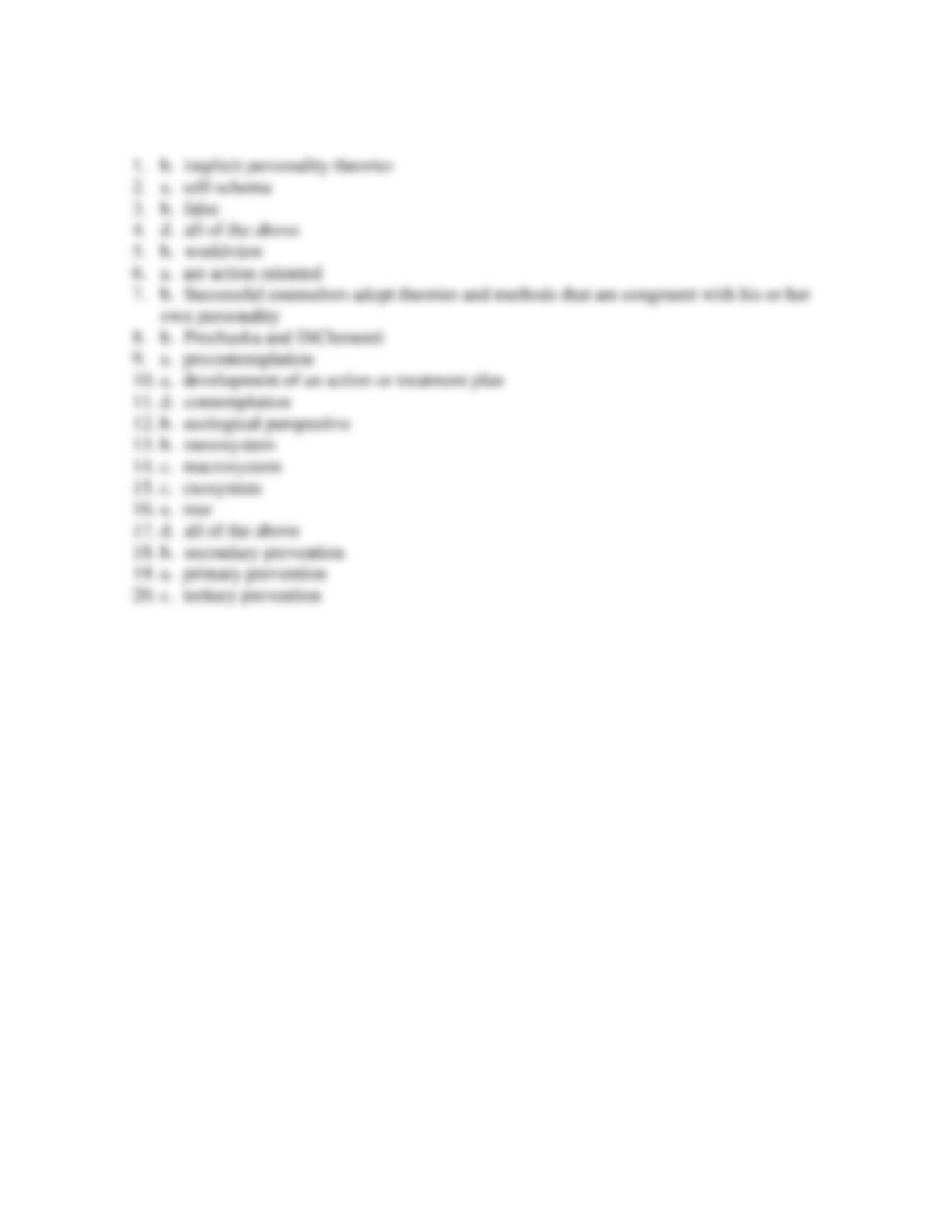
Test Bank Multiple Choice Answer Key