
Name:
Class:
Date:
chapter 11
Copyright Cengage Learning. Powered by Cognero.
Page 1
Indicate whether the statement is true or false.
1. Men are the most common victims of domestic violence.
a.
True
b.
False
2. The DARE program has received mixed reviews, and some departments have cut their programs, especially in these
tight budget years.
a.
True
b.
False
3. The Police Explorer program is aimed at senior citizens.
a.
True
b.
False
4. Triad programs are focused on senior citizens.
a.
True
b.
False
5. Police chaplain volunteers serve as liaisons with various religious institutions in the community.
a.
True
b.
False
6. Federal law requires police officers to investigate the immigration status of suspects on all calls and to report persons
who are in this country illegally.
a.
True
b.
False
7. One of the most significant problems facing the police over the past three decades has been the tension, and often
outright hostility, between the police and minority group citizens.
a.
True
b.
False
8. The terms racial profiling and driving while black have become commonplace.
a.
True
b.
False
9. According to the author, the police–community relations (PCR) movement had a tremendous effect on the philosophy
and culture of most police departments.
a.
True
b.
False
10. Given the difficult job the police have, it is easier for them to perform their duties if they have the support of the
public.
a.
True
b.
False

Name:
Class:
Date:
chapter 11
Copyright Cengage Learning. Powered by Cognero.
Page 2
11. Community Emergency Response Teams (CERT) help police act in the event of an emergency or disaster.
a.
True
b.
False
12. Public opinion polls have revealed that most citizens have a very poor image of the police.
a.
True
b.
False
13. None of the cities in the United States have made any special efforts to recruit members of the gay community for
police jobs.
a.
True
b.
False
14. Social media played a significant part in the Boston Marathon bombings investigation.
a.
True
b.
False
15. One of the community crime prevention programs includes Crime Stoppers.
a.
True
b.
False
16. Studies involving DARE programs have established that they are totally effective in preventing young people from
experimenting with drugs and alcohol.
a.
True
b.
False
Indicate the answer choice that best completes the statement or answers the question.
17. Typically, Police Explorers are required to work approximately _____ hours a month to maintain their
eligibility, but they may work more hours if they wish.
a.
8
b.
12
c.
20
d.
40
18. A well-rounded chaplain program will attempt to have representatives from _____ religious groups.
a.
all local
b.
Christian
c.
two main
d.
nondenominational
19. Another name for Neighborhood Watch programs is __________.
a.
Crime Watch
b.
Block Watch

Name:
Class:
Date:
chapter 11
Copyright Cengage Learning. Powered by Cognero.
Page 3
c.
Community Alert
d.
All of these choices.
20. Crime Stoppers is a program in which police typically _____________.
a.
operate decoy programs where they dress like possible crime victims
b.
open up storefronts and pose as criminals who buy stolen property
c.
ask television and radio stations to publicize a “crime of the week” so citizens can call tips into a
special police phone number
d.
All of these choices.
21. DARE is a program aimed at _____________.
a.
senior citizens
b.
children
c.
Americans with physical disabilities
d.
all Americans
22. Today, police departments have created numerous special programs to assist with the challenges faced by
the aging population. One such program is ____________.
a.
AARP
b.
Explorers
c.
DARE
d.
Triad
23. Which of the following people who live on the public streets can be described as street people?
a.
The homeless
b.
Alcoholics
c.
The mentally ill
d.
All of these choices.
24. The police–community relations movement (PCR) developed out of the __________.
a.
efforts at team policing in the 1970s
b.
efforts of police reform after the Wickersham Report
c.
riots and civil disorders of the 1960s
d.
the Rodney King incident of 199l
25. An annual event in which citizens are encouraged to turn on outside lighting and step outside their homes for
an hour in the evening to get to know their neighbors is called-:
a.
Neighborhood Watch
b.
Block Watch
c.
National Night Out
d.
Good Samaritans

Name:
Class:
Date:
chapter 11
Copyright Cengage Learning. Powered by Cognero.
Page 4
26. Non-police who volunteer to walk the streets or drive around in cars to alert police to possible crimes or area
criminals are participating in ______.?
a.
Operation Identification
b.
citizen patrols
c.
Neighborhood Night Out
d.
Volunteers in Police Service (VIPS)
27. National Night Out is in effect ____________.
a.
once a month
b.
twice a year
c.
once a year
d.
one week a year
28. Recently, social media has played a valuable role in the crime fight as well as _____ between the police
departments and their clients.
a.
catching criminals
b.
crime suppression programs
c.
government intrusion
d.
building relationships
29. McGruff, the crime dog, and the “Take a Bite Out of Crime” program is an example of
¬¬¬¬¬¬¬¬¬¬¬¬¬¬_______.
a.
a police ride-along program
b.
a police mass media campaign
c.
a police storefront or mini-station program
d.
a citizen volunteer program
30. James Q. Wilson said that the police “probably exaggerate the extent of citizen hostility” when
acknowledging the fact that police feel that the public does not like or support them, even when the 2016 Gallup
polls indicated that the attitudes of both white and non-white citizens toward the police were:
a.
apathetic
b.
negative
c.
positive
d.
ambivalent
31. The Police Explorer program is aimed at youths interested in __________.
a.
camping and sleeping out of doors
b.
police work
c.
traveling to foreign cities
d.
None of the above
32. According to the author, one of the best ways to improve relationships between the police and minority

Name:
Class:
Date:
chapter 11
Copyright Cengage Learning. Powered by Cognero.
Page 5
groups is to _____________.
a.
enforce the law differentially against minority group members
b.
appoint a minority member as police chief
c.
ensure that minority groups are adequately represented in a jurisdiction’s police department
d.
hold minority group members to a less strict standard of legal behavior
33. Most of the tension between police officers and members of minority groups has focused on police
relationships with ___________.
a.
Hispanics
b.
Asians
c.
African Americans
d.
women
34. What landmark 1954 Supreme Court case ended legal segregation of the races?
a.
Mapp v. Ohio
b.
Brown v. Mississippi
c.
Brown v. Board of Education of Topeka
d.
Board of Education v. Eisenhower
35. In a 2016 nationwide poll asking people how much respect they have in the police, 76 percent answered
___________.
a.
a great deal
b.
some
c.
very little
d.
none
36. Triad is a joint partnership between the police and ____________.
a.
senior citizens
b.
gays
c.
Asian Americans
d.
African Americans
37. The Police Explorer program is part of the _____ organization.
a.
Camp Fire
b.
Boy Scouts of America
c.
Police Athletic League
d.
YMCA
38. The human relations training program that is designed to provide participants an opportunity to learn more
about themselves and their impact on others is called __________.
a.
objectivity training
b.
sensitivity training

Name:
Class:
Date:
chapter 11
Copyright Cengage Learning. Powered by Cognero.
Page 6
c.
behavior enlightenment
d.
participation training
39. In jurisdictions with populations greater than 100,000, approximately 7 percent of police contacts involve
________________________, which can be some of the most dangerous calls that officers face.
a.
the elderly
b.
juveniles
c.
the mentally ill
d.
drug addicts
40. Everything done with each other as human beings in all kinds of relationships is the definition of
___________.
a.
community relations
b.
public relations
c.
human relations
d.
incarceration
41. As many as _____ million people are victims of violent or property crime in the United States annually.
a.
16
b.
31
c.
42
d.
20
42. Crime Stoppers originated in ____________.
a.
Albuquerque, New Mexico
b.
Boise, Idaho
c.
Miami, Florida
d.
Seattle, Washington
43. Which of the following describe Reserve Police Officers?
a.
They are volunteers.
b.
They are also called part-time, auxiliary, or special police.
c.
Many receive the same training as police officers.
d.
All of these choices.
44. What is the largest minority group in the United States?
a.
Native Americans
b.
German Americans
c.
African Americans
d.
Hispanics
45. The program in which the police engrave identifying numbers onto property such as bicycles, televisions,

Name:
Class:
Date:
chapter 11
Copyright Cengage Learning. Powered by Cognero.
Page 7
and stereos is called ________.
a.
Operation Engravement
b.
Operation Home Security
c.
Operation Crime Stop
d.
Operation Identification
46. The President’s Commission on Law Enforcement and Administration of Justice reported in 1967 that police
relations with minority groups had __________.
a.
sunk to explosively low levels
b.
improved somewhat over the years
c.
improved significantly over the years
d.
remained the same
47. Based on recent national polls, all of the following gave police high ratings except _________________.
a.
middle-age citizens
b.
older citizens.
c.
non-whites.
d.
young people.
48. According to the author, the police should be seen by the community as ____________.
a.
an army of occupation
b.
mercenaries
c.
part of the community
d.
impartial enforcers of the law
Enter the appropriate word(s) to complete the statement.
49. The relationships involved in both human relations and public relations between the police and the community are
called __________.
50. __________ is a program given by police officers in which the officers go into schools to teach students in their
classrooms about the dangers of drug abuse.
51. __________ programs are produced by radio and television stations that publicize an unsolved crime of the week;
cash rewards are given for information that results in the conviction of the offender.
52. According to the 2010 U.S. Census, _______percent of the total U.S. population is foreign born.
53. __________ are small police facilities in neighborhoods in which officers are stationed to engage in crime prevention
programs with members of the community.
54. Racial profiling or __________ is a form of discrimination that singles out people of racial or ethnic groups due to the
belief that these groups are more likely than others to commit certain types of crimes.
55. Activities performed by police agencies designed to create a favorable image of themselves are called police

Name:
Class:
Date:
chapter 11
Copyright Cengage Learning. Powered by Cognero.
Page 8
__________.
56. __________ is a name for crime prevention programs (also known as Crime Watch, Block Watch, or Community
Alert programs) in which neighbors are supposed to watch over their blocks and alert the police to any suspicious or
disorderly behavior.
57. Twenty-six percent of teens in romantic relationships report being intimidated and controlled with the assistance of
______________ and ____________________ sites.
58. __________ programs involve engraving identifying numbers onto property such as bicycles, televisions, and other
personal electronic items with the goal of returning the property to owners if and when it is stolen and then recovered by
the police.
59. Everything done with each other as human beings in all kinds of relationships is called __________.
60. An experiment, which began to change the police response in domestic violence cases, was conducted in __________
to determine the deterrent effect of various methods of handling domestic violence, including mandatory arrest.
61. Explain the role that social media is playing in crime investigations.
62. Explain why it is important for police departments to have a good working relationship with the press and media.
63. Discuss the role of individual police officers as ambassadors for their departments and explain why that role is
particularly important now.
64. Discuss why calls involving people with mental illness are dangerous for police officers and what police departments
are doing to minimize tragic outcomes.
65. Discuss some of the challenges people face as they age and how the Triad program is helping police departments and
senior citizens address problems seniors encounter with safety and quality-of-life issues.
66. What is National Night Out, and what are the program’s objectives?
67. Discuss the relationship between citizens’ concerns for the environment and their perception of the police, and give
examples of efforts police departments can make to create a favorable perception.
68. Are the terms human relations, police public relations, and police–community relations interchangeable? Why or why
not?
69. When budgets are tight, how can a police department justify the costs associated with implementing and running
citizen volunteer programs?
70. Explain why the relationship between a police department and businesses might be considered a slippery slope and
what can be done to avoid ethical concerns.
71. What are the key elements of the SPD SAFE PLACE program that have made it a success? How could this program
be replicated to improve police relations with other minority communities?

Name:
Class:
Date:
chapter 11
Copyright Cengage Learning. Powered by Cognero.
Page 9
Answer Key

Name:
Class:
Date:
chapter 11
Name:
Class:
Date:
chapter 11
Copyright Cengage Learning. Powered by Cognero.
Page 11
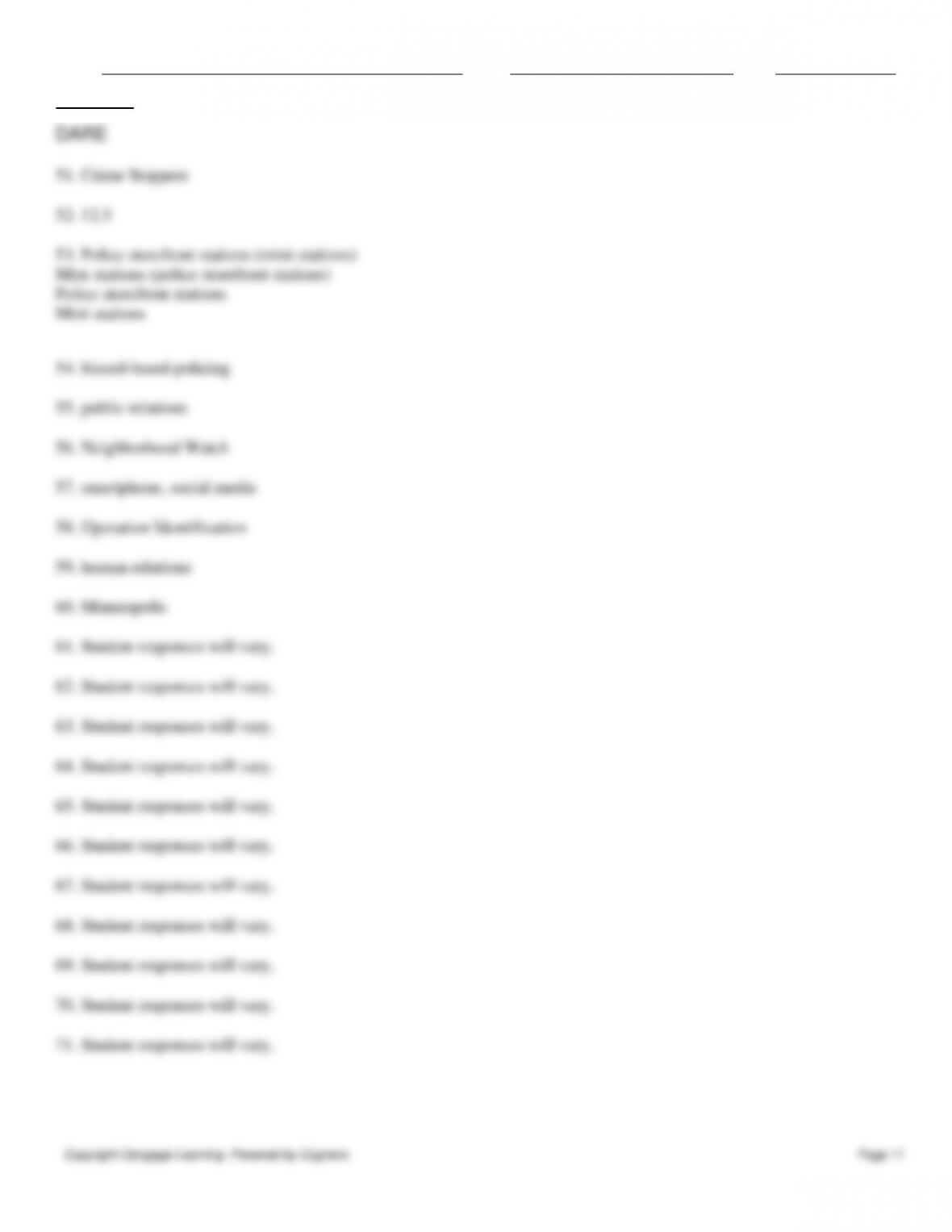
DARE
51. Crime Stoppers
52. 12.5
53. Police storefront stations (mini-stations)
Mini stations (police storefront stations)
Police storefront stations
Mini stations
54. biased-based policing
55. public relations
56. Neighborhood Watch
57. smartphone, social media
58. Operation Identification
59. human relations
60. Minneapolis
61. Student responses will vary.
62. Student responses will vary.
63. Student responses will vary.
64. Student responses will vary.
65. Student responses will vary.
66. Student responses will vary.
67. Student responses will vary.
68. Student responses will vary.
69. Student responses will vary.
70. Student responses will vary.
71. Student responses will vary.