CHAPTER 5 QUIZ
1. Production-cost cross-subsidization results from
a. allocating indirect costs to multiple products.
b. assigning traced costs to each product.
c. assigning costs to different products using varied costing systems within the same
organization.
d. assigning broadly averaged costs across multiple products without recognizing amounts
of resources used by which products.
2. In refining a cost system
a. total direct costs are unchanged because they can be traced in an economically feasible
way to the product and traced costs are more accurate.
b. the costs are grouped in homogeneous pools of the same or similar amounts.
c. the criterion of cause-and-effect is used to relate indirect costs to a factor that
systematically links to a cost object.
d. the organization looks for cost-allocation bases that will provide a uniform spreading of
indirect costs to each product.
Question 3 is based on the following data.
The average cost data are for In-Sync Fixtures Company’s (a retailer) only two product
lines, Marblette and Italian Marble.
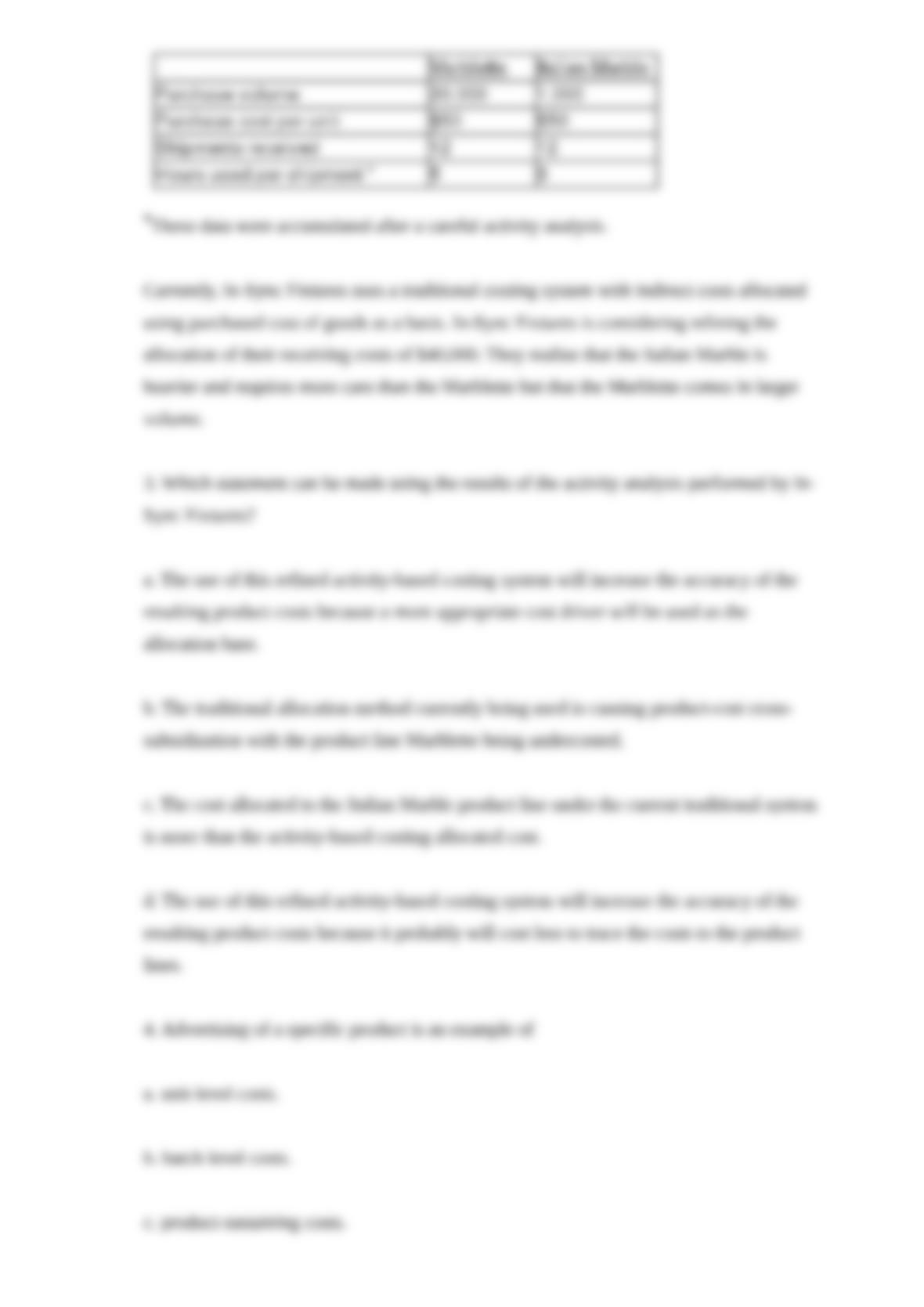
*These data were accumulated after a careful activity analysis.
Currently, In-Sync Fixtures uses a traditional costing system with indirect costs allocated
using purchased cost of goods as a basis. In-Sync Fixtures is considering refining the
allocation of their receiving costs of $40,000. They realize that the Italian Marble is
heavier and requires more care than the Marblette but that the Marblette comes in larger
volume.
3. Which statement can be made using the results of the activity analysis performed by
In-Sync Fixtures?
a. The use of this refined activity-based costing system will increase the accuracy of the
resulting product costs because a more appropriate cost driver will be used as the
allocation base.
b. The traditional allocation method currently being used is causing product-cost
cross-subsidization with the product line Marblette being undercosted.
c. The cost allocated to the Italian Marble product line under the current traditional system
is more than the activity-based costing allocated cost.
d. The use of this refined activity-based costing system will increase the accuracy of the
resulting product costs because it probably will cost less to trace the costs to the product
lines.
4. Advertising of a specific product is an example of
a. unit-level costs.
b. batch-level costs.
c. product-sustaining costs.
d. facility-sustaining costs.
5. The allocation of indirect costs in an activity-based costing system
a. may require other costs to be allocated to activities before the costs of the activities can
be allocated to the products.
b. is simplified because more costs are identified as direct costs.
c. requires the use of heterogeneous cost pools.
d. is simplified because a limited number of activities are identified as cost objects.
Information for questions 6 and 7 is given below.
Jackson Enterprises manufactures two products—a basic gizmo and an advanced model
gizmo. The company is using an activity-based costing system. They have identified three
activities for allocation of indirect costs.
Activity Cost Driver Cost-Allocation Rate
Materials receiving Number of parts $2.00 per part
Production setup Number of setups $500.00 per setup
Quality inspection Inspection time $90 per hour
A production run for the basic model is 250 units, for the advanced model, 100 units.
Each unit of product consumes the following activities:
Number of Parts Number of Setups Inspection Time
Basic Gizmo 10 50 10 minutes
Advanced Gizmo 15 25 20 minutes
Direct costs for the two products are as follows:
Direct Materials Direct Labor
Basic Gizmo $50.00 $ 75.00
Advanced Gizmo $95.00 $125.00
6. The amount of overhead allocated to one unit of the basic model would be
a. $592.
b. $37.
c. $162.
d. $65.
7. The total cost of an advanced model would be
a. $162.
b. $65.
c. $200.
d. $265.
8. A significant limitation of activity-based costing is the
a. attention given to indirect cost allocation.
b. many necessary calculations.
c. operations staff’s attitude toward the accounting staff.
d. use it makes of technology.

9. Evaluating customer reaction of the trade-off of giving up some features of a product for
a lower price would best fit which category of management decisions under activity-based
management?
a. Pricing and product-mix decisions
b. Cost reduction decisions
c. Design decisions
d. Discretionary decisions
10. Which of the following statements is more representative of activity-based costing in
comparison to a department costing system?
a. The use of multiple cost-allocation bases
b. The use of indirect-cost rates for significant resource use
c. The use of activities having a cause-and-effect relationship
d. The use of multiple cost pools
CHAPTER 5 QUIZ SOLUTIONS