CHAPTER 16 QUIZ
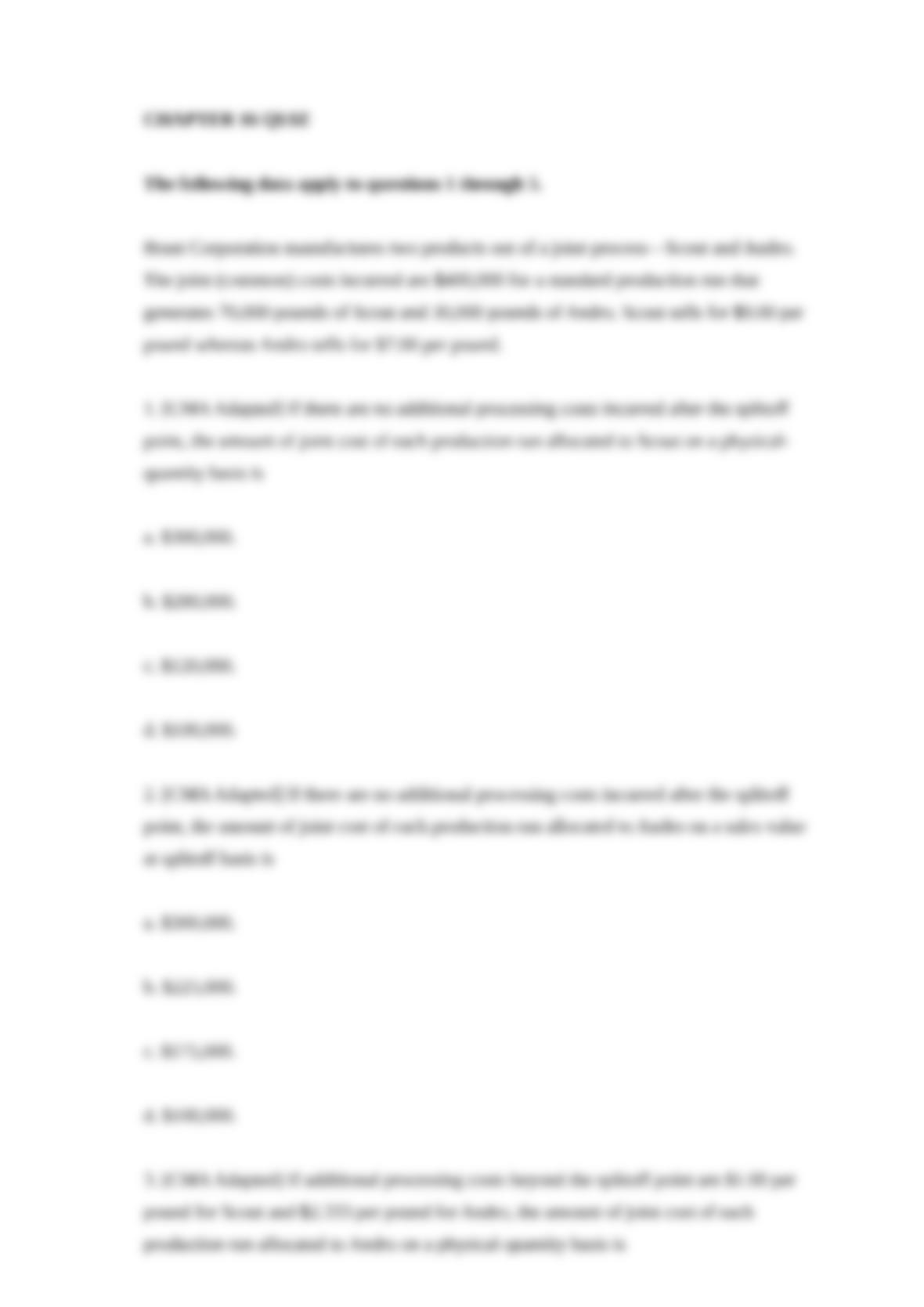
The following data apply to questions 1 through 5.
Brant Corporation manufactures two products out of a joint process—Scout and Andro.
The joint (common) costs incurred are $400,000 for a standard production run that
generates 70,000 pounds of Scout and 30,000 pounds of Andro. Scout sells for $9.00 per
pound whereas Andro sells for $7.00 per pound.
1. [CMA Adapted] If there are no additional processing costs incurred after the splitoff
point, the amount of joint cost of each production run allocated to Scout on a
physical-quantity basis is
a. $300,000.
b. $280,000.
c. $120,000.
d. $100,000.
2. [CMA Adapted] If there are no additional processing costs incurred after the splitoff
point, the amount of joint cost of each production run allocated to Andro on a sales value
at splitoff basis is
a. $300,000.
b. $225,000.
c. $175,000.
d. $100,000.
3. [CMA Adapted] If additional processing costs beyond the splitoff point are $1.00 per
pound for Scout and $2.333 per pound for Andro, the amount of joint cost of each
production run allocated to Andro on a physical-quantity basis is
a. $300,000.
b. $280,000.
c. $120,000.
d. $100,000.
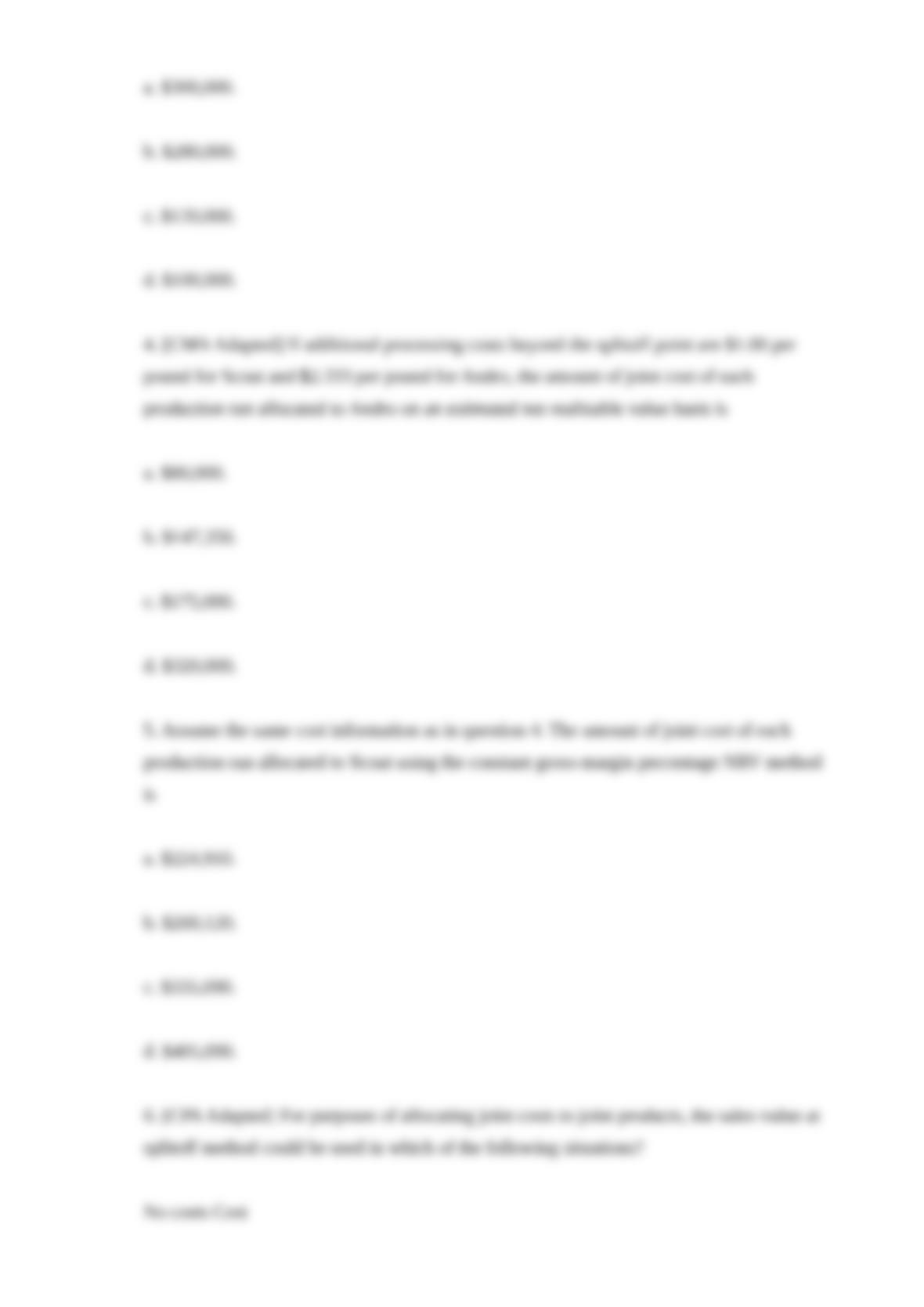
4. [CMA Adapted] If additional processing costs beyond the splitoff point are $1.00 per
pound for Scout and $2.333 per pound for Andro, the amount of joint cost of each
production run allocated to Andro on an estimated net-realizable value basis is
a. $80,000.
b. $147,350.
c. $175,000.
d. $320,000.
5. Assume the same cost information as in question 4. The amount of joint cost of each
production run allocated to Scout using the constant gross-margin percentage NRV method
is
a. $224,910.
b. $260,120.
c. $335,090.
d. $405,090.
6. [CPA Adapted] For purposes of allocating joint costs to joint products, the sales-value at
splitoff method could be used in which of the following situations?
No costs Cost
beyond beyond
splitoff splitoff
a. Yes No
b. Yes Yes
c. No Yes
d. No No
7. Products G and H are joint products developed from the same process with each being
processed further. Joint costs are incurred until splitoff, the separable costs are incurred in
further refining each product. Sales values of G and H at splitoff are used to allocate joint
costs. If the sales value of G at splitoff increases and all other costs and selling prices
remain unchanged, joint costs allocated to:
G H
a. increases increases
b. increases decreases
c. decreases decreases
d. decreases increases
8. [CPA Adapted] Tanner Company manufactures products Katran and Klare from a joint
process. Product Katran has been allocated $7,500 of total joint costs of $30,000 for the
1,500 units produced. Katran can be sold at the splitoff point for $4 per unit, or it can be
processed further with additional costs of $2,000 and sold for $7 per unit. If Katran is
processed further and sold, the result would be
a. a breakeven situation.
b. an overall loss of $1,500.

c. a gain of $2,500 from further processing.
d. a gain of $1,000 from further processing.
9. [CPA Adapted] In accounting for byproducts, the value of the byproduct may be
recognized at the time of
Production Sale
a. Yes No
b. Yes Yes
c. No No
d. No Yes
10. [CPA Adapted] Mohler Corporation manufactures a product that yields the byproduct
Jep. The only costs associated with Jep are selling costs of $0.10 for each unit sold. Mohler
accounts for sales of Jep by deducting Jep’s separable costs from Jep’s sales and then
deducting this net amount from the major product’s cost of goods sold. Jep’s sales were
200,000 units at $1.00 each. If Mohler changes its method of accounting for Jep’s sales by
showing the net amount as additional sales revenue, the Mohler’s gross margin would
a. increase by $180,000.
b. increase by $200,000.
c. increase by $220,000.
d. be unaffected.
CHAPTER 16 QUIZ SOLUTIONS