CHAPTER 12 QUIZ
1. Major influences of competitors, costs, and customers on pricing decisions are factors of
a. supply and demand.
b. activity-based costing and activity-based management.
c. key management themes that are important to managers attaining success in their
planning and control decisions.
d. the value-chain concept.
2. Short-run pricing decisions include
a. pricing a main product in a major market.
b. considering all costs in the value chain of business functions.
c. adjusting product mix and volume in a competitive market while maintaining a stable
price if demand fluctuates from strong to weak.
d. pricing for a special order with no long-term implications.
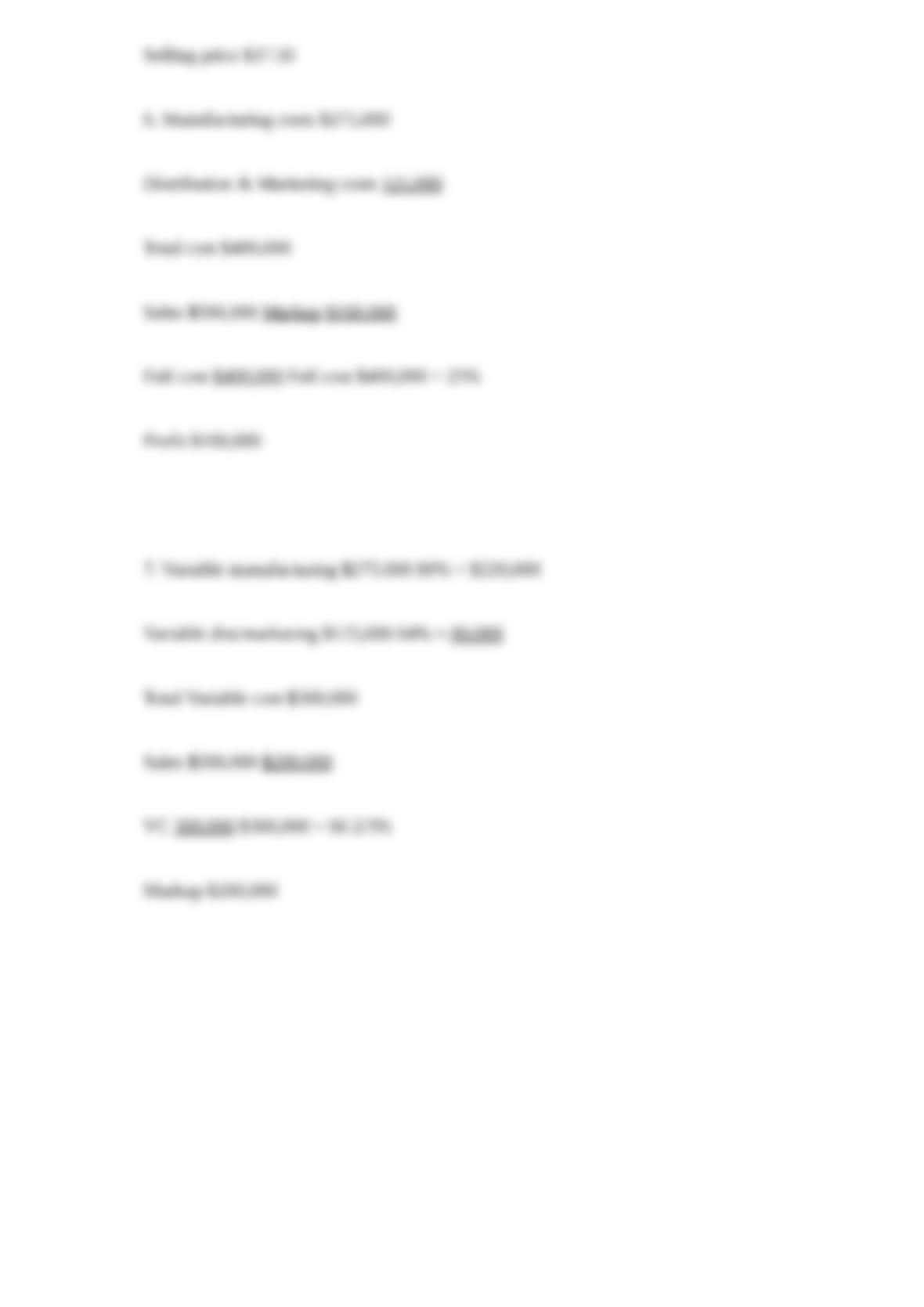
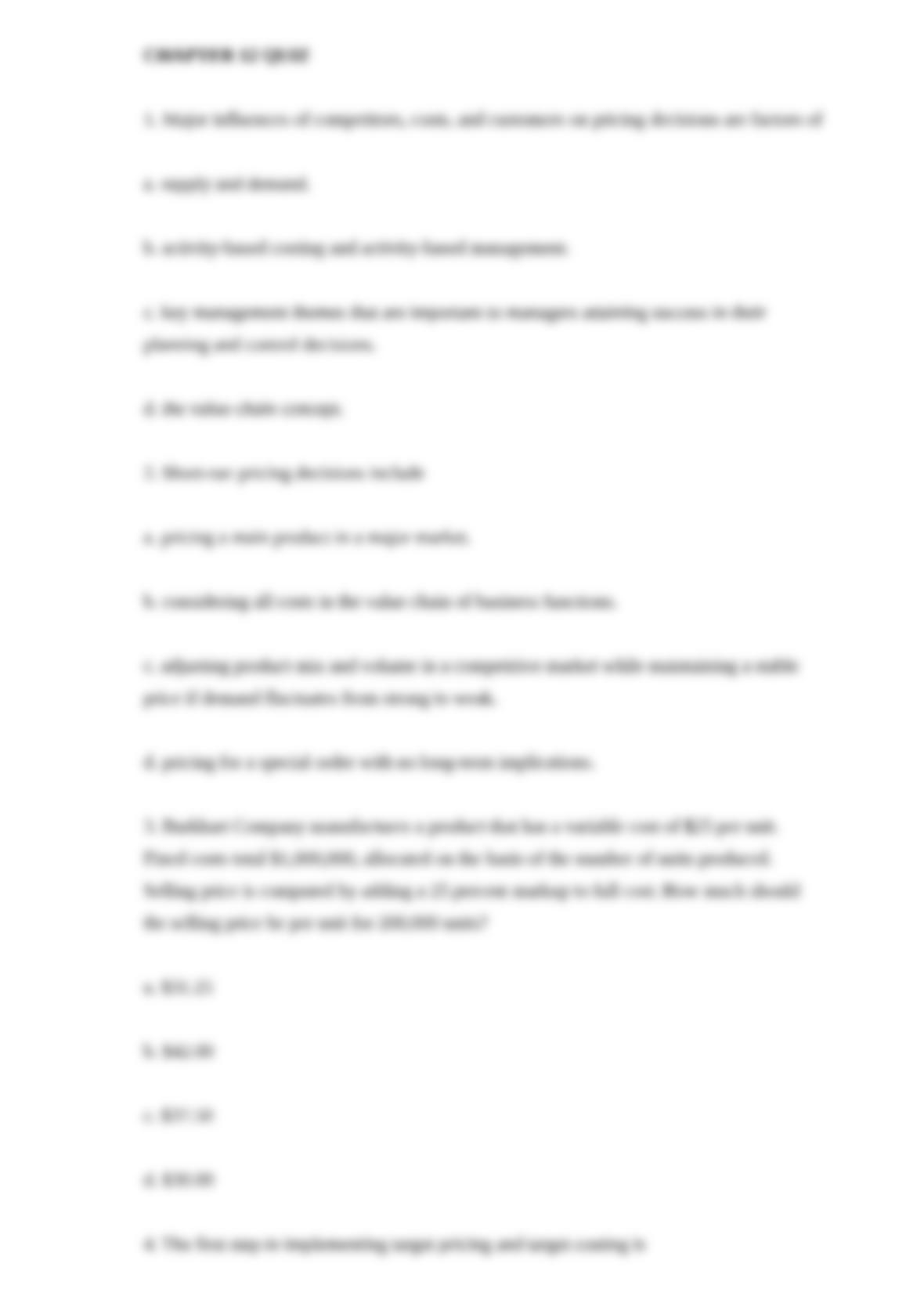
3. Burkhart Company manufactures a product that has a variable cost of $25 per unit.
Fixed costs total $1,000,000, allocated on the basis of the number of units produced.
Selling price is computed by adding a 25 percent markup to full cost. How much should
the selling price be per unit for 200,000 units?
a. $31.25
b. $42.00
c. $37.50
d. $30.00
4. The first step in implementing target pricing and target costing is
a. choosing a target price.
b. determining a target cost.
c. developing a product that satisfies needs of potential customers.
d. performing value engineering.
5. The best opportunity for cost reduction is
a. during the manufacturing phase of the value chain.
b. during the product or process design phase of the value chain.
c. during the marketing phase of the value chain.
d. during the distribution phase of the value chain.
The following data apply to questions 6 and 7.
Each month, Haddon Company has $275,000 total manufacturing costs (20 percent fixed)
and $125,000 distribution and marketing costs (36 percent fixed). Haddon’s monthly sales
are $500,000.
6. The markup percentage on full cost to arrive at the target (existing) selling price is
a. 25 percent.
b. 75 percent.
c. 80 percent.
d. 20 percent.
7. The markup percentage on variable costs to arrive at the existing (target) selling price is
a. 20 percent.
b. 40 percent.
c. 80 percent.
d. 66 percent.
8. The price of movie tickets for opening day and the few days following compared to the
price six months later is an example of
a. price gouging.
b. peak-load pricing.
c. dumping.
d. demand elasticity.
9. Price discrimination is
a. always illegal.
b. a type of peak-load pricing.
c. not regulated in the United States.
d. the practice of charging different prices to different customers for the same product or
service.
10. Which of these do antitrust laws on pricing not cover?
a. Collusive pricing
b. Dumping
c. Peak-load pricing
d. Predatory pricing
CHAPTER 12 QUIZ SOLUTIONS