COMPREHENSIVE EXAMINATION A
(Chapters 1 – 4)
Approximate
Problem Topic Points Minutes
A – I Multiple Choice …………………………………….. 20 20
A – II Cost of Goods Manufactured and Sold …….. 20 15
A – III Job Order Cost Accounting …………………….. 20 15
A – IV Process Cost Accounting ……………………….. 25 20
A – V Activity-Based Costing …………………………... 15 15
100 85
Checking Work ……………………………………. 5
90

Test Bank for Managerial Accounting, Sixth Edition
A – 2
Problem A – I — Multiple Choice (20 points)
Circle the one best answer.
1. Which one of the following is not a benefit of activity-based costing?
a. More accurate product costing
b. Fewer cost pools used to assign overhead costs to products
c. Enhanced control over overhead costs
d. Better management decisions
2. An example of a value-added activity in a manufacturing operation is
a. machine repair.
b. inventory control.
c. engineering design.
d. building maintenance.
3. Assigning manufacturing costs to work in process results in credits to all of the following
accounts except
a. Factory Labor.
b. Manufacturing Overhead.
c. Raw Materials Inventory.
d. Work in Process Inventory.
Use the following information for questions 4 and 5.
In the month of November, a department had 700 units in the beginning work in process inventory
that were 45% complete. These units had $42,000 of materials cost and $26,075 of conversion
costs. Materials are added at the beginning of the process and conversion costs are added
uniformly throughout the process. During November, 12,000 units were completed and
transferred to the finished goods inventory and there were 3,000 units that were 25% complete in
the ending work in process inventory on November 30. During November, manufacturing costs
charged to the department were: Materials $241,500; Conversion costs $184,300.
4. How much is the cost assigned to the units transferred to finished goods during
November?
a. $493,875
b. $283,500
c. $424,800
d. $69,075
5. How much is the cost assigned to the units in the ending work in process inventory on
November 30?
a. $69,075
b. $56,700
c. $106,200
d. $12,385
6. Cost of goods sold is equal to
a. total manufacturing costs plus beginning work in process less ending work in process.
b. cost of goods sold plus beginning work in process less ending work in process.
c. total manufacturing costs plus ending work in process less beginning work in process.
d. cost of goods manufactured plus beginning finished goods less ending finished goods.

Comprehensive Examination A
A – 3
7. Cost of goods manufactured during a period is obtained by taking the total manufacturing
costs incurred during the period and adding and subtracting the following inventories:
Adding Subtracting
a. Beginning finished goods inventory Ending finished goods inventory
b. Beginning work in process inventory Ending finished goods inventory
c. Beginning raw materials inventory Ending work in process inventory
d. Beginning work in process inventory Ending work in process inventory
8. Which of the following are inventory accounts for a manufacturer?
a. raw materials, work in process, and finished goods
b. direct labor, work in process, and finished goods
c. manufacturing overhead, raw materials, and direct labor
d. work in process, direct labor, and manufacturing overhead
9. In a process cost system, equivalent units of production are the
a. work done on physical units expressed in fully completed units.
b. units that are transferred to the next processing department.
c. units completed and transferred to finished goods.
d. units that are incomplete at the end of a period.
10. An appropriate cost driver for ordering and receiving materials cost is
a. direct labor hours.
b. machine hours.
c. number of parts.
d. number of purchase orders.

Test Bank for Managerial Accounting, Sixth Edition
A – 4
Problem A – II — Cost of Goods Manufactured and Sold (20 points)
Selected account balances of Santana Manufacturing Company appear below for 2014:
Beginning of Year End of Year
Finished Goods Inventory $15,000 $ 17,000
Work In Process Inventory 22,000 21,000
Raw Materials Inventory 13,000 19,000
Sales 380,000
Direct Labor 43,000
Factory Supervisory Salaries 17,000
Income Tax Expense 32,000
Factory Insurance 18,000
Raw Material Purchases 93,000
Administrative Expenses 12,000
Sales Returns and Allowances 3,000
Factory Depreciation 8,000
Indirect Labor 14,000
Selling Expenses 44,000
Instructions
Using the above information for Santana Manufacturing Company, answer the following
questions. Support your answers with clearly identified computations.
1. What was the amount of direct materials used in production?
2. What were the total manufacturing costs incurred?
3. What was the cost of goods manufactured?
4. What was the cost of goods sold?
5. What was the amount of net income?

Comprehensive Examination A
A – 5
Problem A – III — Job Order Cost Accounting (20 points)
Sandro Clean uses a job order cost accounting system. On October 1, the company has a
balance in Work in Process Inventory of $4,200 and two jobs in process: Job No. R92, $1,600
and Job No. R93, $2,600. During October, a summary of source documents reveals the
following:
For Materials Requisition Slips Labor Time Tickets
Job No. R92 $ 2,200 $ 7,100
Job No. R93 1,700 4,100
Job No. R94 4,700 3,300
Job No. R95 2,200 5,100
General Use 1,800 2,000
$12,600 $21,600
Sandro applies manufacturing overhead to jobs at an overhead rate of 90% of direct labor cost.
Job No. R92 was completed during the month.
Instructions
(a) Prepare summary journal entries to record the requisition slips, time tickets, the assignment
of manufacturing overhead to jobs, and the completion of Job No. R92. Show computations.
(b) Answer the following questions.
1. What is the balance in Work in Process Inventory at October 31?
2. If Sandro incurred $13,000 of manufacturing overhead in addition to indirect labor and
indirect materials, was overhead over- or underapplied in October and by how much?

Test Bank for Managerial Accounting, Sixth Edition
A – 6
Problem A – IV — Process Cost Accounting (25 points)
Choco Nibbles produces low calorie chocolate snacks. The Baking Department has the following
production and manufacturing cost data for January.
Production: Beginning inventory has 2,200 boxes of Nibbles that are 100% complete as to
materials and 30% complete as to conversion costs. A total of 38,000 boxes were started into
production. Ending inventory of 3,500 boxes are 40% complete as to conversion costs.
Manufacturing Costs: Beginning work in process inventory was $7,845, comprised of $3,160 of
materials and $4,685 of conversion costs. Materials added during the month were $29,000, with
labor and overhead applied during the month totaling $19,000 and $16,320, respectively.
Instructions
(a) Compute the equivalent units of production for materials and conversion costs for the month
of January.
(b) Compute the unit costs for materials and conversion costs.
(c) Determine the costs to be assigned to the units transferred out and ending work in process.
Problem A – V — Activity-Based Costing (15 points)
Cenatrac produces two products: hand soap and sanitizer. During June, 8,000 containers of hand
soap and 6,000 containers of sanitizer were produced. Total overhead costs of $34,000 were
incurred. The following information related to overhead costs was available:
Activity Cost Driver Total Cost
Materials handling Number of requisitions $7,000
Machine setups Number of setups 12,000
Quality inspections Number of inspections 15,000
The cost driver volume for each product was as follows:
Cost Driver Hand soap Sanitizer Total
Number of requisitions 25 15 40
Number of setups 12 13 25
Number of inspections 90 160 250
Instructions
(a) Compute the overhead rate for each activity.
(b) Assign the manufacturing overhead costs for June to the two products using activity-based
costing, and determine the overhead cost per unit.
Comprehensive Examination A
A – 7
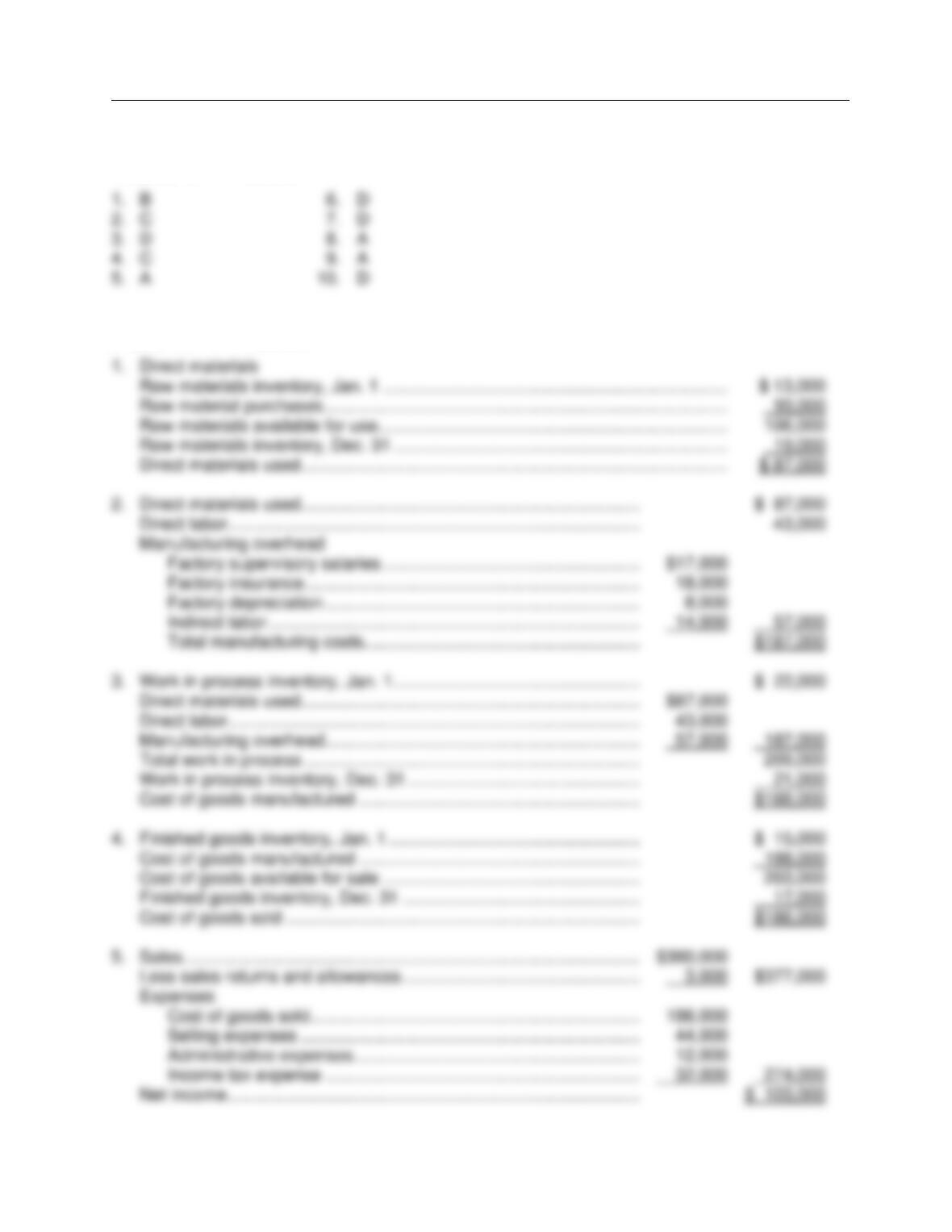
Solutions — Comprehensive Examination A
Problem A – I — Solution
Problem A – II — Solution
Test Bank for Managerial Accounting, Sixth Edition
A – 8
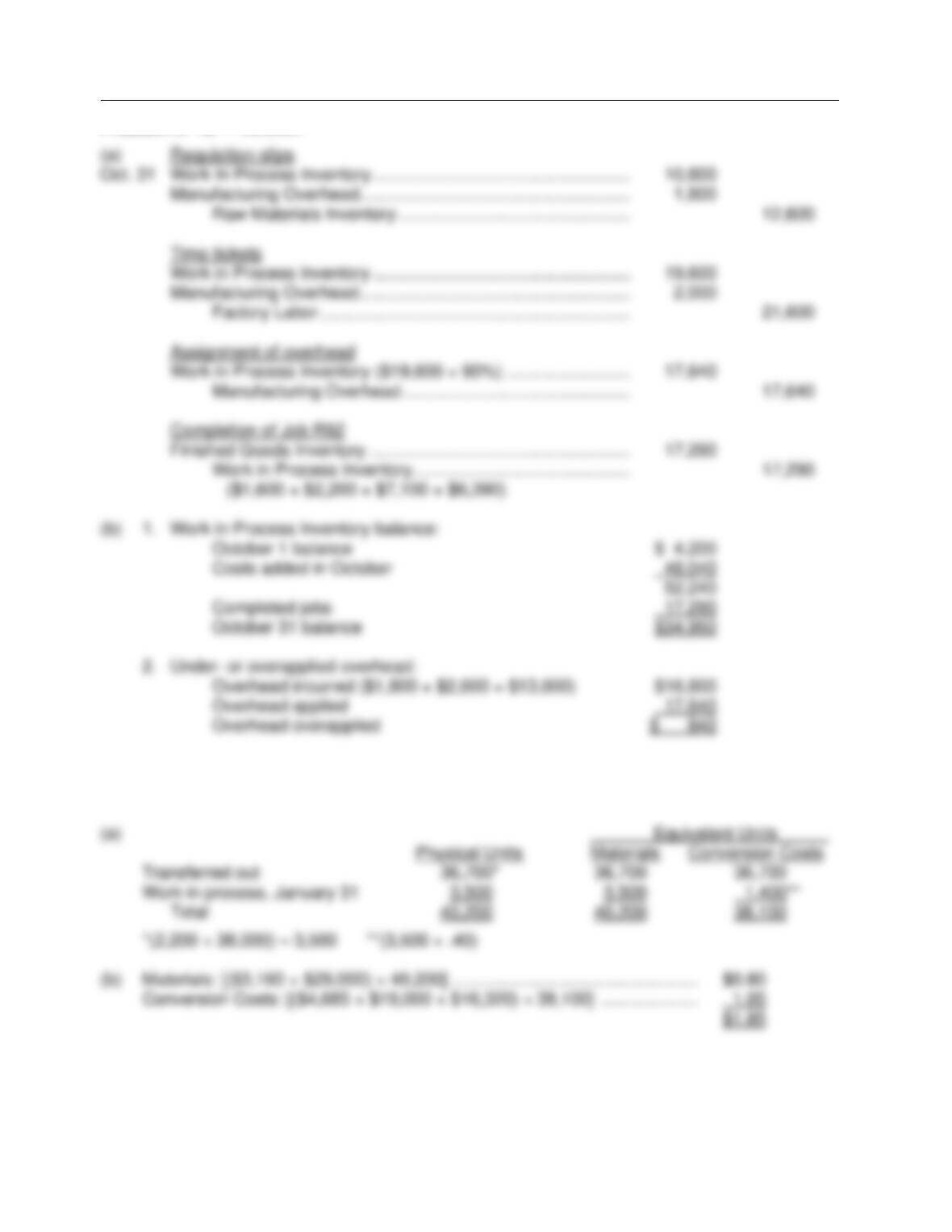
Problem A – III — Solution
Problem A – IV — Solution
Comprehensive Examination A
A – 9
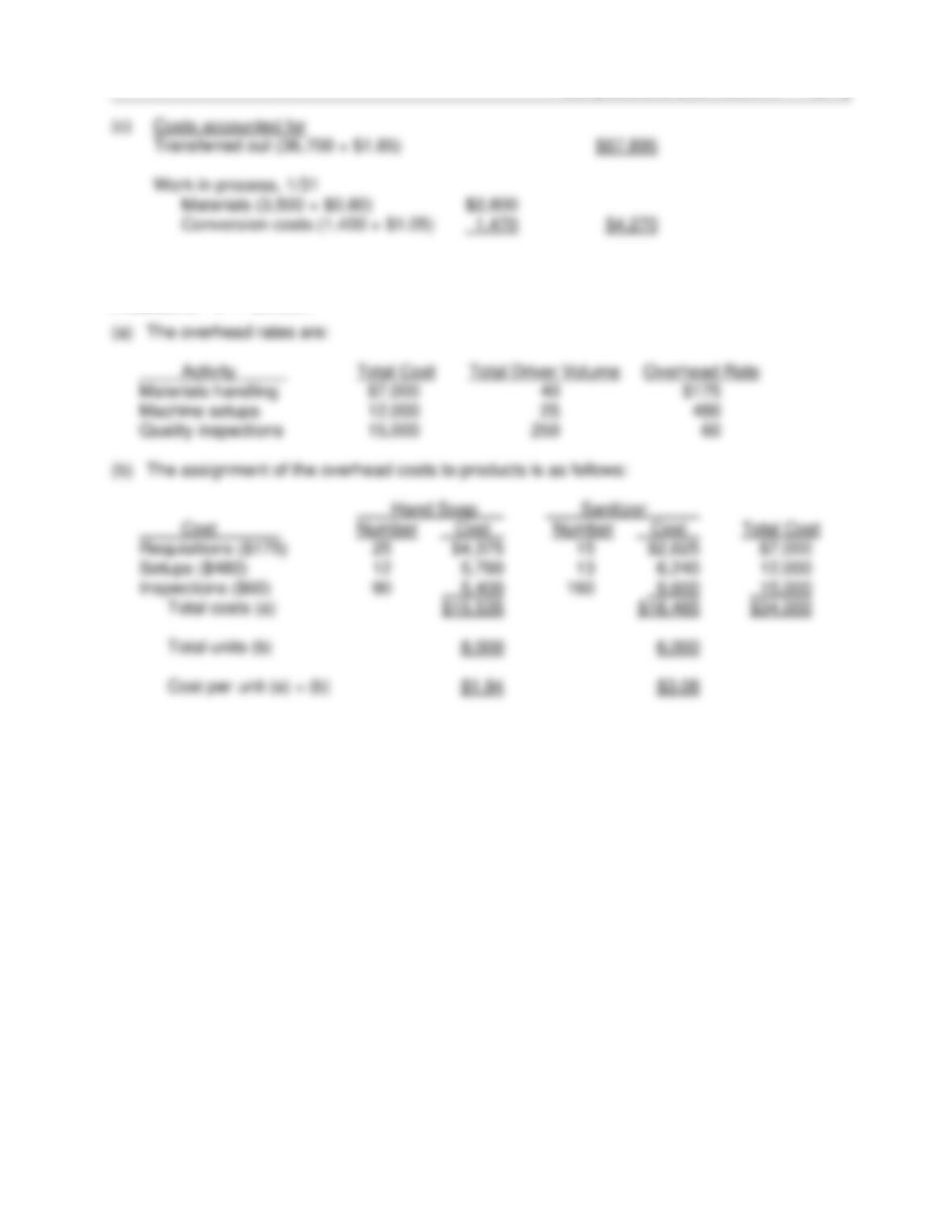
Problem A – V — Solution
COMPREHENSIVE EXAMINATION B
(Chapters 5 – 9)
Approximate
Problem Topic Points Minutes
B – I Multiple Choice …………………………………….. 22 22
B – II Cost-Volume-Profit ………………………………… 24 16
B – III Transfer Pricing ……………………………………. 12 12
B – IV Budgeting ……………………………………………. 18 15
B – V Contribution Margin ……………………………….. 14 10
B – VI Incremental Analysis …………………………..…. 10 10
100 85
Checking Work …………………………………….. 5
90

Test Bank for Managerial Accounting, Sixth Edition
B – 2
Problem B – I — Multiple Choice (22 points)
Circle the one best answer.
1. Halladorn, Inc. sells a single product with a contribution margin of $9 per unit, fixed costs
of $54,000, and sales for the current year of $82,800. How much is Juniper’s break-even
point?
a. 15,200 units
b. $6,000
c. 6,000 units
d. 9,200 units
Use the following information for questions 2 and 3.
At January 1, 2014, Top Surf, Inc. has beginning inventory of 2,100 surfboards. Top Surf
estimates it will sell 6,000 units during the first quarter of 2014 with a 10% increase in sales each
quarter. Top Surf’s policy is to maintain an ending inventory equal to 10% of the next quarter’s
sales. Each surfboard costs $80 and is sold for $120.
2. How many boards should Top Surf produce during the first quarter of 2014?
a. 6,660
b. 4,560
c. 5,940
d. 6,000
3. How much is budgeted sales revenue for Top Surf the third quarter of 2014?
a. $7,260
b. $720,000
c. $864,000
d. $871,200
4. Jayson Company’s variable costs are 40% of sales. The company is contemplating an
advertising campaign that will cost $34,000. If sales are expected to increase $50,000, by
how much will the company’s net income increase/(decrease)?
a. $30,000
b. $20,000
c. ($14,000)
d. ($4,000)
5. Finnegan’s Grill has total fixed costs of $96,000 and a contribution margin ratio of 40%.
How much are total variable costs incurred at the break-even level of activity?
a. $96,000
b. $240,000
c. $144,000
d. $160,000
6. A company desires to earn target net income of $42,000 from the sale of its product. If the
unit sales price is $12, unit variable cost is $7, and total fixed costs are $56,000, how
many units must the company sell to earn its target net income?
a. 19,600 units
b. 11,200 units
c. 2,800 units
d. 33,600 units

Comprehensive Examination B
B – 3
7. Advantage Production has a policy of having sufficient direct materials inventory on hand
at the end of each month equal to 25% of next month‘s budgeted production needs. The
company has budgeted production of 12,000 clipboards in June and 15,000 units in July.
It takes 1.5 pounds of resin to produce one clipboard and 4,500 pounds of resin were on
hand on May 31. How many pounds of resin should be purchased in the month of June?
a. 13,500 pounds
b. 17,250 pounds
c. 19,125 pounds
d. 11,250 pounds
8. Bates Boogie Boards has budgeted direct materials purchases of $120,000 in March and
$160,000 in April. Past experience indicates that the company pays for 40% of its
purchases in the month of purchase and the remaining 60% in the next month. During
April, the following items were budgeted:
Wages Expense $32,000
Purchase of office equipment 13,000
Selling and Administrative Expenses 25,000
Depreciation Expense 9,000
How much are budgeted cash disbursements for April?
a. $214,000
b. $223,000
c. $206,000
d. $127,000
9. Shan Stone manufactures a product with a unit variable cost of $26 and a unit sales price
of $38. Fixed manufacturing costs were $48,000 when 10,000 units were produced and
sold, equating to $4.80 per unit. The company has a one-time opportunity to sell an
additional 1,500 units at $29 each in an international market which would not affect its
present sales. The company has sufficient capacity to produce the additional units. How
much is the relevant income or loss effect of accepting the special order?
a. ($2,250)
b. $4,500
c. $43,500
d. ($16,500)
10. Hoover, Inc. is unsure of whether to sell its product assembled or unassembled. The unit
cost of the unassembled product is $9, while the added cost of assembling each unit is
estimated at $5. Unassembled units can be sold for $22, while assembled units could be
sold for $31 per unit. What decision should Hoover make?
a. Sell before assembly, the company will earn $4 per unit.
b. Sell before assembly, the company will save $5 per unit.
c. Process further, the company will earn $5 less per unit.
d. Process further, the company will earn $4 more per unit.

Test Bank for Managerial Accounting, Sixth Edition
B – 4
*11. Bourdon Enterprises sells its product for $30 per unit. During 2014, it produced 12,000
units and sold 10,000 units (there was no beginning inventory). Costs per unit are: direct
materials $6, direct labor $2, and variable overhead $1. Fixed costs are: $126,000
manufacturing overhead, and $32,000 selling and administrative expenses. How much is
the manufacturing cost per unit under absorption costing?
a. $9.00
b. $22.17
c. $21.60
d. $19.50
Problem B – II — Cost-Volume-Profit (24 points)
Temp Range Company prepared the following income statement for 2014:
TEMP RANGE COMPANY
Income Statement
For the Year Ended December 31, 2014
———————————————————————————————————————————
Sales (5,000 units) ……………………………………………………………………………. $200,000
Variable expenses ……………………………………………………………………………. 75,000
Contribution margin ………………………………………………………………………….. 125,000
Fixed expenses ……………………………………………………………………………….. 83,200
Net income ……………………………………………………………………………………… $ 41,800
Instructions
Answer the following independent questions and show computations to support your answers.
1. What is the company’s break-even point in units?
2. How many units would the company have had to sell to earn a target net income of $64,000
in 2014?
3. If the company expects a 25% increase in sales volume in 2015, what would be the expected
net income in 2015?
4. How much sales (in dollars) would the company have to generate in order to earn a target net
income of $68,000 in 2015?

Comprehensive Examination B
B – 5
Problem B – III — Transfer Pricing (12 points)
Winslow Company, a division of Lann Lawnmowers, produces rubber tires. Winslow sells the tires
to retail stores for $13 each. The variable cost per tire is $7, and fixed costs per tire are $4. Top
management of Lann Lawnmovers would like Winslow to transfer 12,000 tires to another division
within the company at a price of $9 each. Winslow has sufficient excess capacity to provide the
12,000 tires to the other division.
Instructions
(a) Compute the minimum transfer price that Winslow should accept.
(b) Assume Winslow is operating at full capacity. Compute the minimum transfer price that
Winslow should accept.
Problem B – IV — Budgeting (18 points)
Ratario Company has budgeted the following unit sales for the first quarter of 2014:
Units
January 12,000
February 17,000
March 15,000
It takes 3 pounds of direct materials, which cost $6 per pound, to manufacture one unit of
product. It is the company’s policy to have a finished goods inventory on hand at the end of each
month equal to 30% of next month’s sales and to maintain a direct materials inventory at the end
of the month equal to 20% of the next month’s production needs. The inventory levels at
December 31, 2013, were in accordance with company policy.
Instructions
Answer the following independent questions and show computations to support your answers.
1. Calculate the number of units that should be scheduled for production in the month of
February.
2. What was the number of units in ending finished goods inventory at December 31, 2013?
3. What was the number of pounds in ending direct materials inventory at December 31, 2013?
4. What was the number of pounds and the dollar amount of direct materials purchases
budgeted for the month of January?

Test Bank for Managerial Accounting, Sixth Edition
B – 6
Problem B – V — Contribution Margin (14 points)
Rudine Company makes two products, wallets and belts. Additional information follows:
Wallets Belts
Units 1,500 2,500
Sales $33,000 $75,000
Variable costs 19,800 30,000
Fixed costs 7,000 15,000
Net income $ 6,200 $30,000
Profit per unit $4.13 $12.00
If Rudine has unlimited demand for both products, which product should the company
emphasize? Explain why. Support with computations.
Problem B – VI — Incremental Analysis (10 points)
Cracker Bin incurs unit costs of $3 ($2 variable and $1 fixed) in making a subassembly part for its
finished product. A supplier offers to make 120,000 of the assembly part at $2.20 per unit. If the
offer is accepted, all variable costs and $0.15 of fixed costs per unit will be saved.
Instructions
(a) Prepare an analysis to show whether Cracker Bin should make or buy the assembly part.
(b) Would your answer be different if Cracker Bin could earn $11,000 of income by renting the
facilities currently used to make the part? Explain.
Comprehensive Examination B
B – 7
Solutions — Comprehensive Examination B
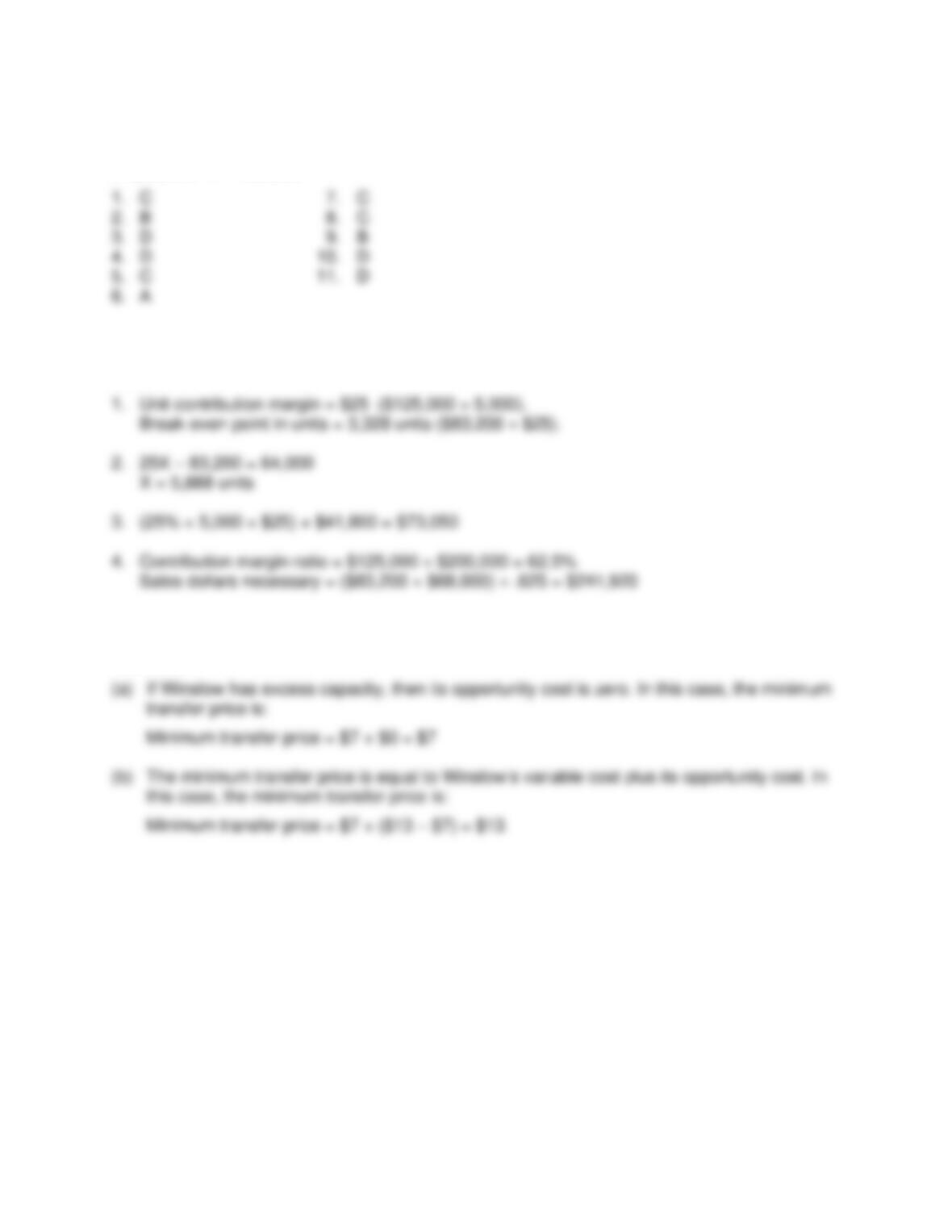
Problem B – I — Solution
Problem B – II — Solution
Problem B – III — Solution
Test Bank for Managerial Accounting, Sixth Edition
B – 8
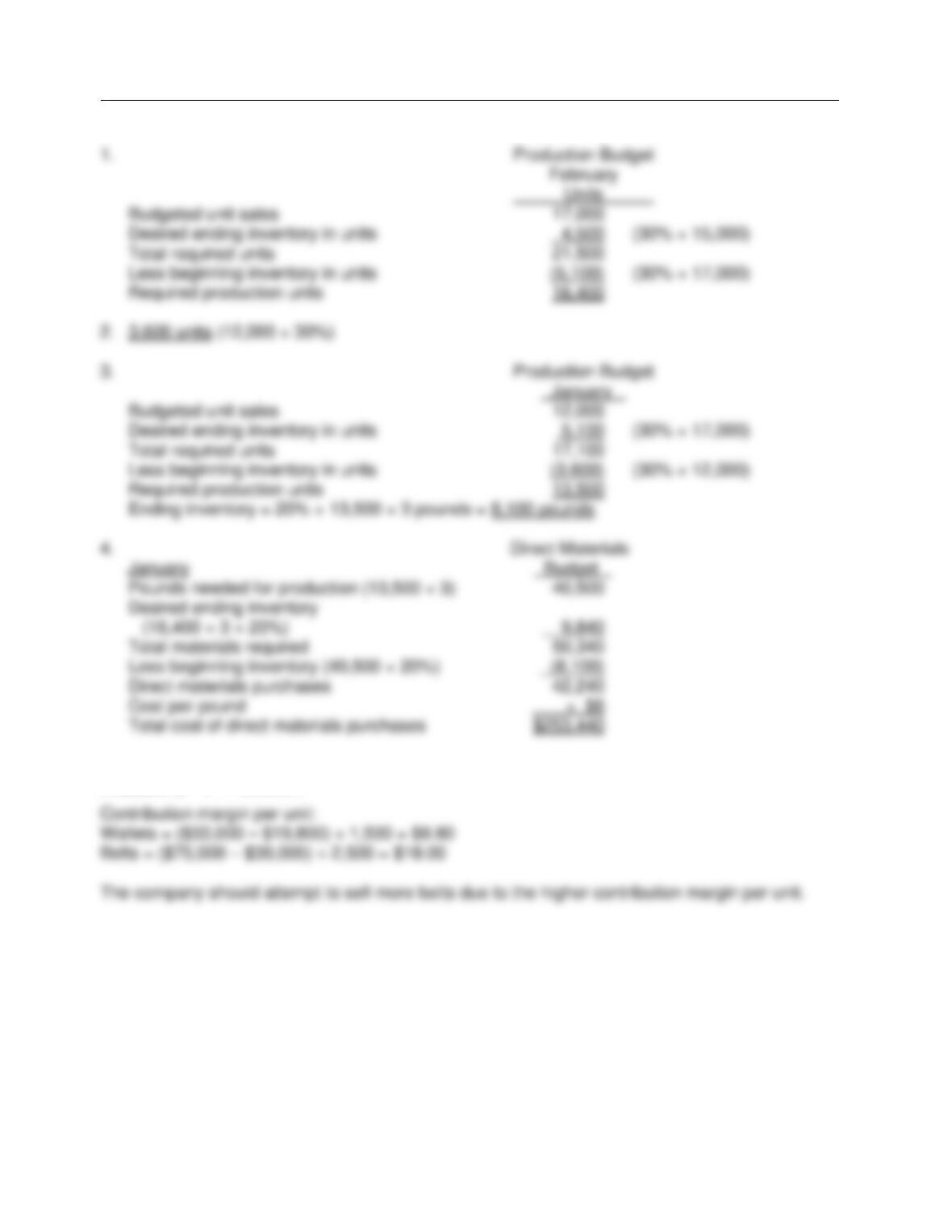
Problem B – IV — Solution
Problem B – V — Solution
Comprehensive Examination B
B – 9
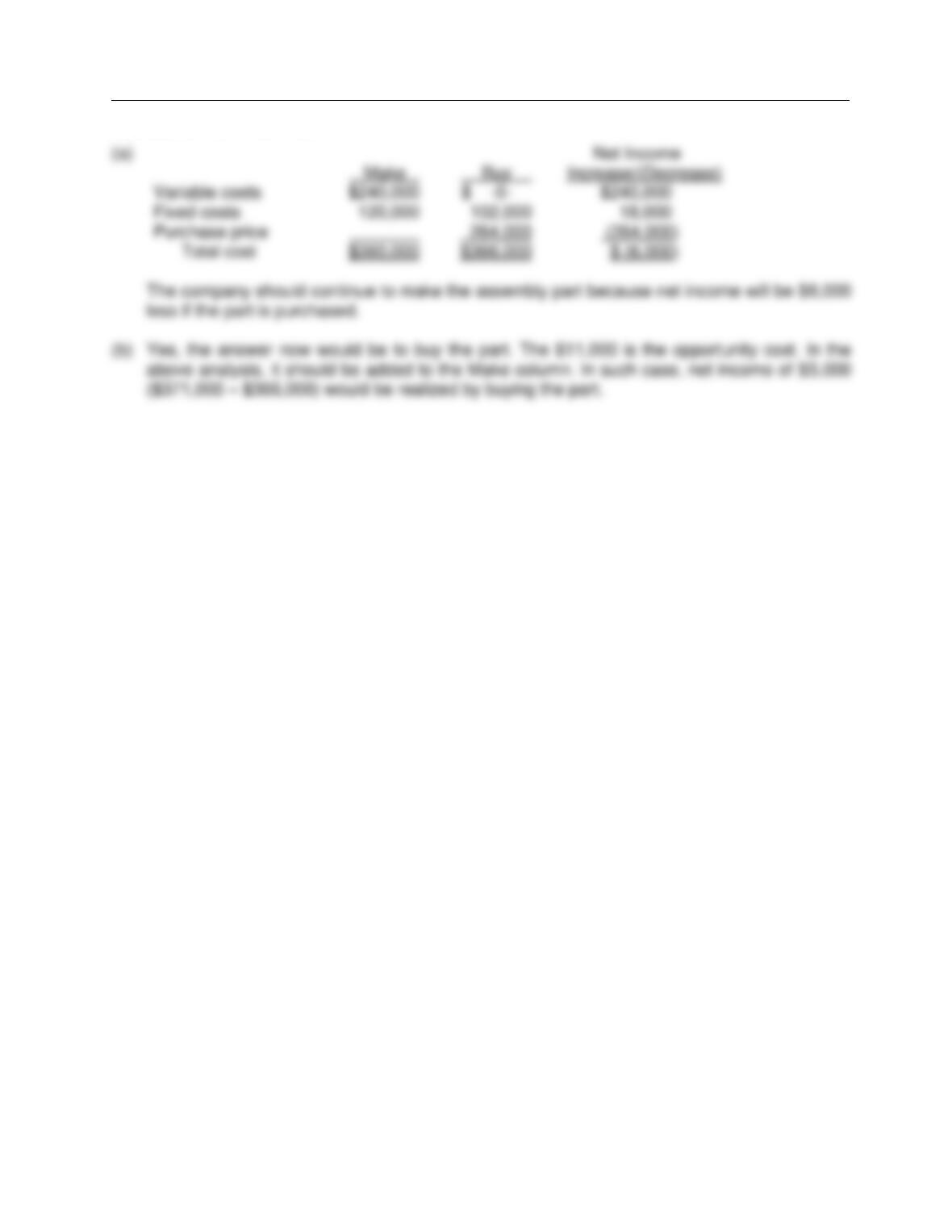
Problem B – VI — Solution
COMPREHENSIVE EXAMINATION C
(Chapters 10 – 14)
Approximate
Problem Topic Points Minutes
C – I Multiple Choice …………………………………….. 22 11
C – II Variance Analysis …………………………………. 12 12
C – III Capital Budgeting………………………………….. 16 16
C – IV Flexible Overhead Budget ………………………. 15 15
C – V Statement of Cash Flows ……………………….. 17 15
C – VI Ratios …………………………………………………. 18 16
100 85
Checking Work …………………………………….. 5
90

Test Bank for Managerial Accounting, Sixth Edition
C – 2
Problem C – I — Multiple Choice (22 points)
Circle the one best answer.
1. The standard number of hours that should have been worked for output attained is 5,100
direct labor hours, and the actual number of hours worked was 5,200. If the direct labor
price variance was $520 unfavorable, and the standard rate of pay was $14.20 per direct
labor hour, what was the actual rate of pay for direct labor?
a. $14.30 per direct labor hour
b. $14.20 per direct labor hour
c. $14.10 per direct labor hour
d. $14.00 per direct labor hour
2. Which one of the following does not affect cash?
a. Acquisition of bonds payable
b. Write-off of an uncollectible accounts receivable
c. Acquisition of treasury stock
d. Payment of cash dividend
3. Donaldson Company reported net income of $74,900 for 2014. The income statement
also indicates that interest expense for 2014 was $11,000. Assuming an income tax rate
of 30%, how much is the times interest earned for 2014?
a. 10.7 times
b. 6.8 times
c. 5.5 times
d. 9.9 times
4. During 2014, TeraVine had an asset turnover ratio of 3.5 times with sales totaling
$980,000. Net income was $25,200. How much is TeraVine’s return on assets in 2014?
a. 2.6%
b. 9.0%
c. 28.6%
d. 3.6%
5. Equipment was purchased for $122,400 and it is estimated to have a $6,000 salvage
value at the end of its estimated 8-year life. The equipment is estimated to generate cash
inflows of $18,000 each year and will be depreciated by using the straight-line method.
How long is the payback period on this investment?
a. 7.3 years
b. 7.6 years
c. 6.5 years
d. 6.8 years
6. DataStore purchased a new truck for $30,000 and will use the straight-line method of
depreciation over 6 years with no salvage value. The company expects to generate
$9,500 of operating cash flows per year. The company’s minimum annual rate of return is
9%. How much is the annual rate of return on this investment?
a. 63.3%
b. 15.0%
c. 19.0%
d. 30.0%

Comprehensive Examination C
C – 3
7. Items from Freedman Company’s budget for March in which 2,400 units were produced
and sold appear below:
Direct materials $12,000
Indirect materials—variable 2,100
Supervisor salaries 17,000
Depreciation on factory equipment 5,000
Direct labor 13,500
Property taxes on factory 1,500
Total $51,100
At 2,500 units, how much are budgeted variable manufacturing costs?
a. $28,750
b. $27,600
c. $53,225
d. $26,563
8. A company developed the following per-unit standards for its product: 2.4 pounds of direct
materials at $2 per pound. Last month, 700 pounds of direct materials were purchased
and used for $1,470. The company produced 290 units of product. How much is the direct
materials price variance for last month?
a. $8 unfavorable
b. $78 unfavorable
c. $70 unfavorable
d. $61.60 unfavorable
9. The per-unit standards for direct materials are 1.5 gallons at $2.50 per gallon. Last month,
4,180 gallons of direct materials that actually cost $10,659 were used to produce 3,000
units of product. How much is the direct materials standard?
a. $4,500
b. $11,250
c. $3.75
d. Not enough information
10. Wilson, Inc. sold one of its divisions that had been unprofitable for the past two years. The
current period loss from operations of this division totaled $30,000. Wilson’s sale of the
division created a gain of $16,000 on the sale of the division’s assets. The income tax rate
is 40%. What amount will Wilson report as the income or loss from discontinued
operations?
a. $14,000 loss
b. $9,600 gain
c. $8,400 loss
d. $18,000 loss
*11. Widget, Inc.’s balance sheet shows the May 1, 2014 and May 31, 2014 accounts
receivable balances as $14,500 and $12,300, respectively. Sales for the month totaled
$156,000 while cost of goods sold totaled $85,000. How much is cash received from
customers to be reported on the statement of cash flows?
a. $153,800
b. $158,200
c. $170,500
d. $73,200

Test Bank for Managerial Accounting, Sixth Edition
C – 4
Problem C – II — Variance Analysis (12 points)
Pillow Talk manufactures luxury down bed pillows. Each pillow requires 3.9 pounds of down and
takes 0.25 hours of direct labor. The standard cost of the down used is $6.50 per pound, and the
standard labor cost is $12 per hour. In November, Pillow Talk purchased and used 25,000
pounds of down for $157,500. It manufactured 6,200 pillows. Payroll reported a total of 1,520
direct labor hours at a cost of $17,936.
Instructions
(a) Compute the materials price and quantity variances and indicate whether the variances are
favorable or unfavorable.
(b) Compute the labor price and quantity variances and indicate whether the variances are
favorable or unfavorable.
Problem C – III — Capital Budgeting (16 points)
Weston Company is considering a capital investment of $145,000 in new equipment. The
equipment is expected to have a useful life of 10 years with no salvage value. Depreciation is
computed by the straight-line method. During the life of the investment, annual net income and
cash inflows are expected to be $11,000 and $25,500, respectively. Easton requires either a 10%
cost of capital “hurdle” rate, or a payback period of 7 years.
Instructions
Compute the (a) cash payback period, (b) net present value, (c) internal rate of return (to the
nearest percent), and (d) annual rate of return. Show all computations. State whether the project
should be accepted or rejected for each of the four capital budgeting techniques.
Present Value of an Annuity of 1
(n)
Periods 5% 6% 8% 9% 10% 11% 12% 15%
10 7.72173 7.36009 6.71008 6.41766 6.14457 5.88923 5.65022 5.01877

Comprehensive Examination C
C – 5
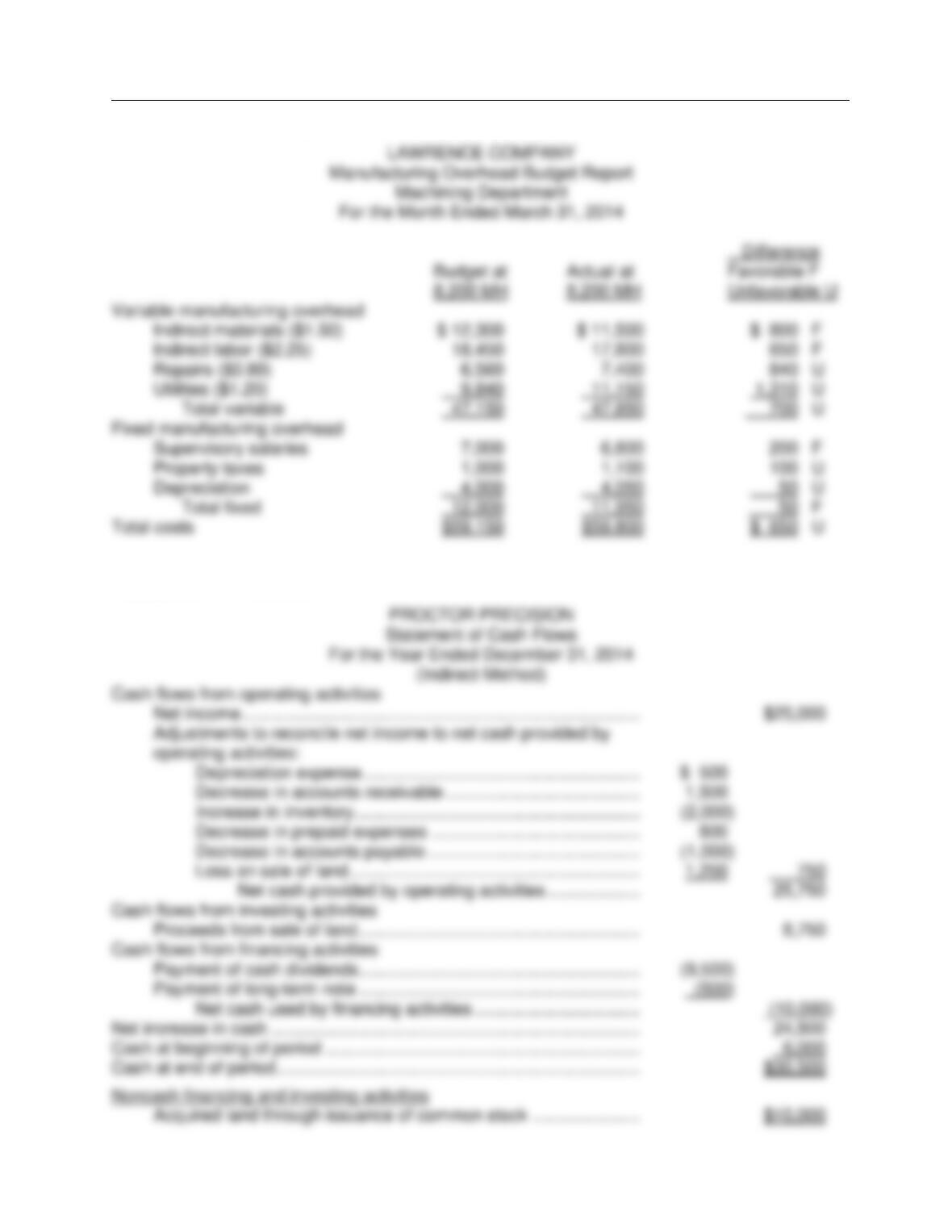
Problem C – IV — Flexible Overhead Budget (15 points)
Lawrence Company budgeted a level of activity of 8,000 machine hours to be worked each month
in the Machining Department. At this level of activity, manufacturing overhead costs were
budgeted as follows:
Variable manufacturing overhead
Indirect materials $ 12,000
Indirect labor 18,000
Repairs 6,400
Utilities 9,600
Fixed manufacturing overhead
Supervisory salaries 7,000
Property taxes 1,000
Depreciation 4,000
Total manufacturing overhead $58,000
Instructions
The actual manufacturing costs incurred for the month of March, when 8,200 machine hours were
worked, are listed below on a partially completed budget report. Complete the budget report in a
manner that would be most useful for evaluating the performance of the Machining Department
manager for the month of March, 2014.
LAWRENCE COMPANY
Manufacturing Overhead Budget Report
Machining Department
For the Month Ended March 31, 2014
Difference
Budget at Actual at Favorable F
Unfavorable U
Variable manufacturing overhead
Indirect materials $ $ 11,500 $
Indirect labor 17,800
Repairs 7,400
Utilities 11,150
Total variable 47,850
Fixed manufacturing overhead
Supervisory salaries 6,800
Property taxes 1,100
Depreciation 4,050
Total fixed 11,950
Total costs $ $59,800 $

Test Bank for Managerial Accounting, Sixth Edition
C – 6
Problem C – V — Statement of Cash Flows (17 points)
The comparative balance sheet for Proctor Precision appears below:
PROCTOR PRECISION
Comparative Balance Sheet
Dec. 31, 2014 Dec. 31, 2013
Assets
Cash……………………………………………………………………………….. $30,500 $6,000
Accounts receivable ………………………………………………………….. 2,500 4,000
Inventory …………………………………………………………………………. 5,500 3,500
Prepaid expenses……………………………………………………………… 1,000 1,500
Building …………………………………………………………………………… 10,000 10,000
Accumulated depreciation—building ……………………………………. (1,500) (1,000)
Total assets ………………………………………………………………… $48,000 $24,000
Liabilities and Stockholders’ Equity
Accounts payable ……………………………………………………………… $ 1,000 $ 2,000
Long-term note payable……………………………………………………… 6,500 7,000
Common stock …………………………………………………………………. 19,000 9,000
Retained earnings …………………………………………………………….. 21,500 6,000
Total liabilities and stockholders’ equity …………………………... $48,000 $24,000
The income statement for the year is as follows:
PROCTOR PRECISION
Income Statement
For the Year Ended December 31, 2014
Sales (all on credit) ……………………………………………………………. $155,000
Expenses and losses
Cost of goods sold …………………………..…………………………... $101,000
Operating expenses, exclusive of depreciation …………………. 22,150
Depreciation expense …………………………………………………… 500
Interest expense ………………………………………………………….. 600
Loss on sale of land ……………………………………………………… 1,250
Income taxes ………………………………………………………………. 4,500
Total expenses and loss ………………………………………….. 130,000
Net income ………………………………………………………………………. $ 25,000
Cash dividends were paid during the year. Land costing $10,000 was acquired by the issuance of
common stock. The property was subsequently sold for $8,750 cash.
Instructions
Prepare a statement of cash flows for the year ended December 31, 2014 using the indirect
method.

Comprehensive Examination C
C – 7
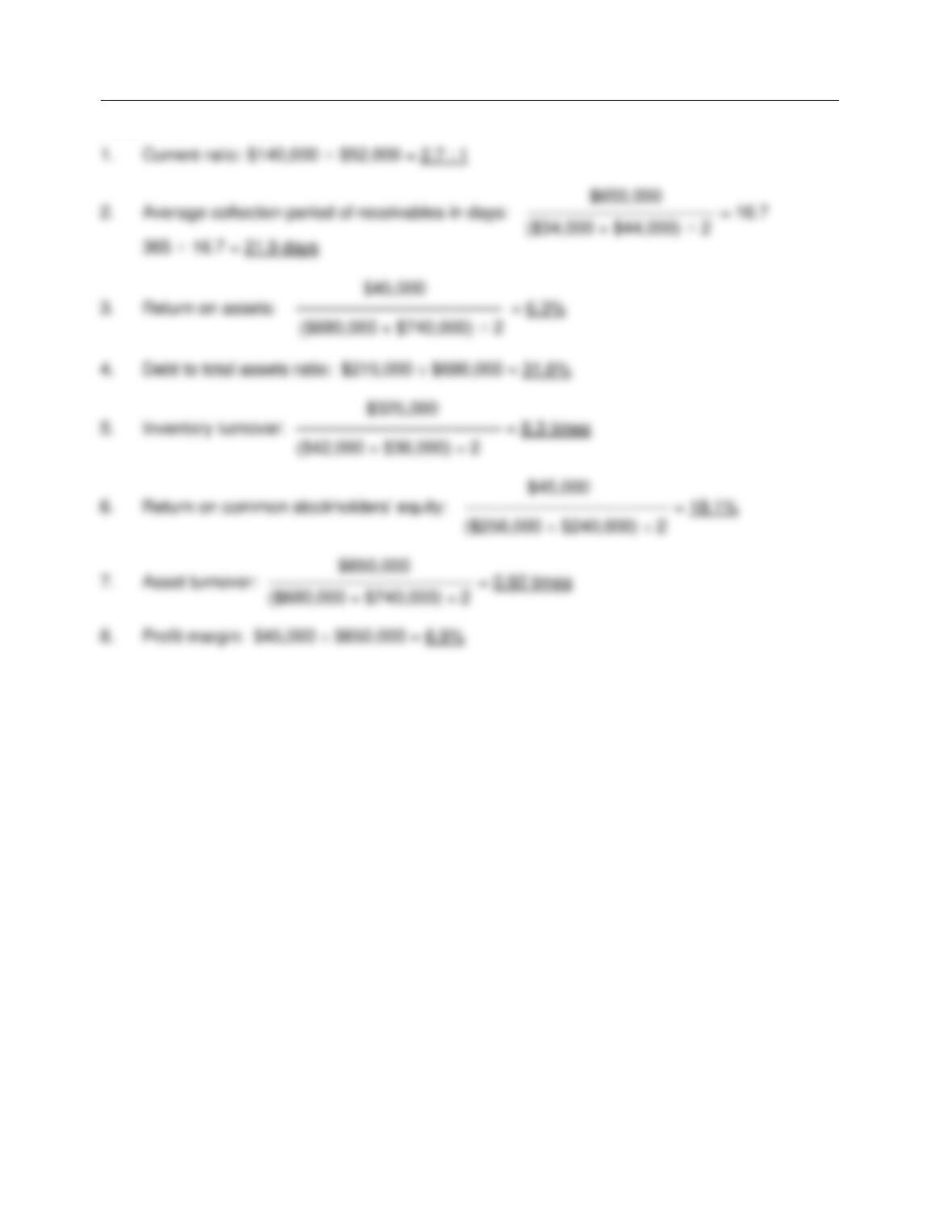
Problem C – VI —Ratios (18 points)
The financial information below was taken from the annual financial statements of Falls Company.
2014 2013
Current assets $140,000 $120,000
Current liabilities 52,000 44,000
Total assets 680,000 740,000
Sales (net) 650,000 620,000
Cost of goods sold 325,000 310,000
Inventory 42,000 36,000
Receivables (net) 34,000 44,000
Net income 45,000 30,000
Common stockholders’ equity 256,000 240,000
Total liabilities 215,000 180,000
Instructions
Calculate the following ratios for Falls Company for 2014.
1. Current ratio
2. Average collection period of receivables in days
3. Return on assets
4. Debt to total assets ratio
5. Inventory turnover
6. Return on common stockholders’ equity
7. Asset turnover
8. Profit margin
Test Bank for Managerial Accounting, Sixth Edition
C – 8
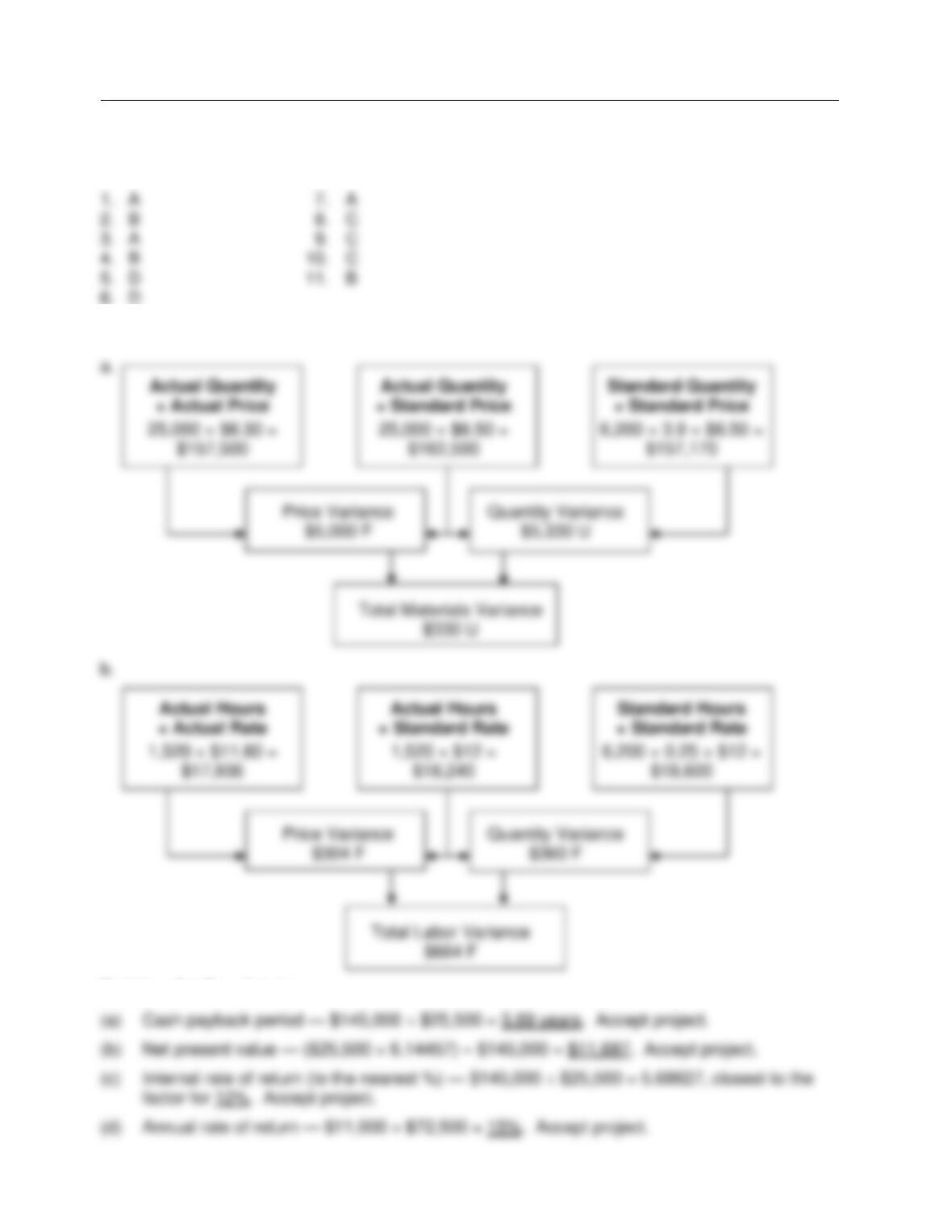
Solutions — Comprehensive Examination C
Problem C – I — Solution
Problem C – II — Solution
Problem C – III — Solution
Comprehensive Examination C
C – 9
Problem C – IV — Solution
Problem C – V — Solution
Test Bank for Managerial Accounting, Sixth Edition
C – 10
Problem C – VI — Solution