Comprehensive Final Exam (Chapters 1
31)
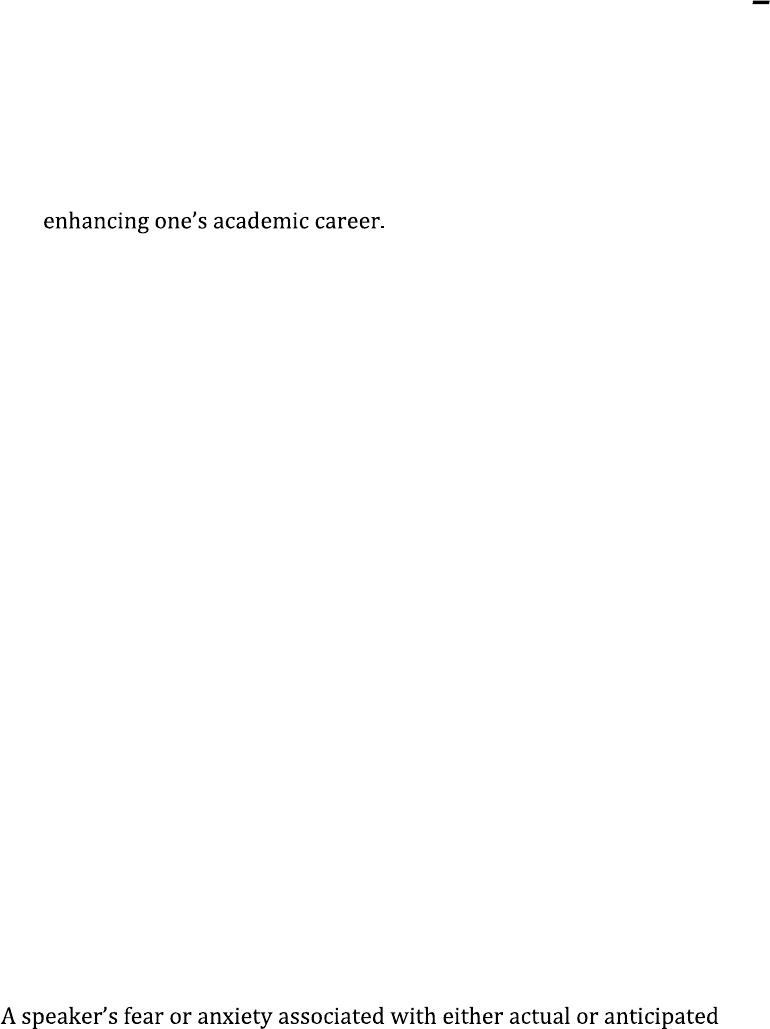
1. Benefits of public speaking do not include
A) advancing professional goals.
B)
C) improving intrapersonal skills.
D) contributing to public discourse.
2. Which of the following is not one of the five canons of rhetoric?
A) invention C) persuasion
B) delivery D) arrangement
3. Factors that distinguish public speaking from other forms of communication
include
A) opportunities for feedback.
B) level of preparation.
C) degree of formality.
D) All of the options are correct.
4. The first step in the speechmaking process is ______, and the last step is ______.
A) analyzing the audience; considering presentation aids
B) selecting a topic; practicing delivery of the speech
C) determining the speech purpose; outlining the speech
D) composing a thesis statement; gathering supporting materials
5. To inform, to persuade, and to mark a special occasion are the three types of
A) general speech purposes. C) thesis statements.
B) specific speech purposes. D) speech occasions.
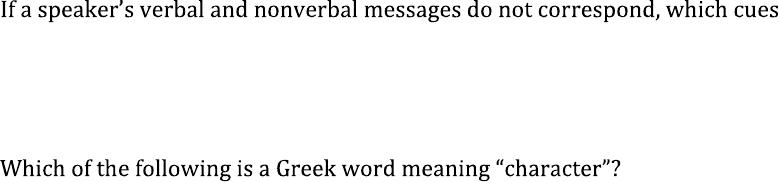
6.
communication to an audience is known as
A) communication nervousness. C) public speaking anxiety.
B) communication uneasiness. D) stage fright.
7. Each of the following is a successful strategy for gaining public speaking
confidence except
A) modifying thoughts and attitudes.
B) avoiding movement during the speech.
C) enjoying the speech occasion.
D) practicing the speech.
8. Which of the following is not true of visualizing?
A) It strengthens positive attitudes and expectations for speechmaking.
B) It helps a speaker summon feelings and actions consistent with effective
performance.
C) It involves the mental exercise of seeing oneself give a successful speech.
D) It involves physically going through the motions of giving a speech.
9. The conscious act of recognizing, understanding, and accurately interpreting
the messages communicated by others is called
A) hearing. C) circular response.
B) listening. D) the message-perception gap.
10. The largely reflexive or automatic process of perceiving sound is called
A) hearing. C) circular response.
B) listening. D) the message-perception gap.
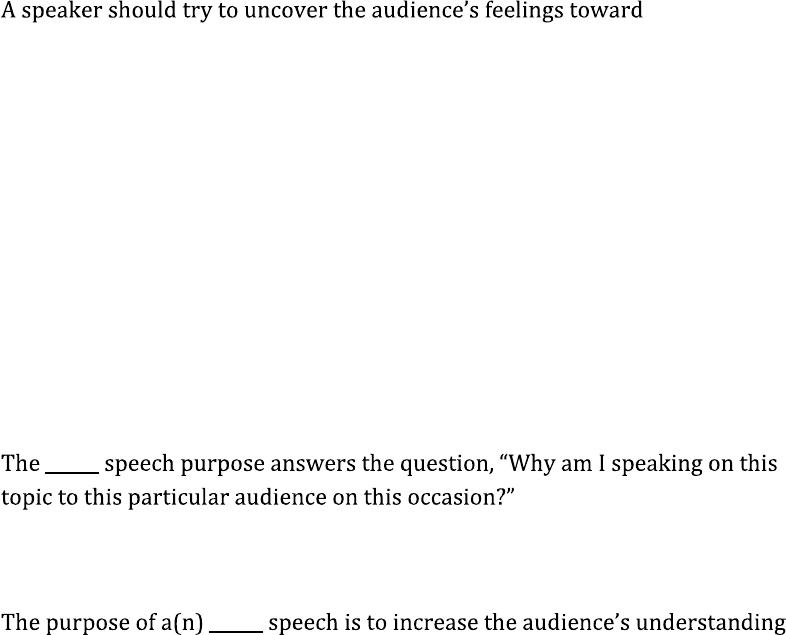
11.
are usually the more honest?
A) verbal C) selective
B) nonverbal D) listening echoes
12.
A) logos C) pathos
B) ethos D) mythos
13. The following comprise positive ethos:
A) competence, charisma, and candor.
B) competence, dramatic ability, and charisma.
C) competence, good moral character, and goodwill.
D) competence, charisma, and good moral character.
14. Which of the following is not a way for a speaker to demonstrate respect for the
audience?
A) by focusing on issues rather than personalities
B) by addressing issues from only his or her point of view
C) by avoiding in-group and out-group distinctions
D) by allowing the audience the power of rational choice
15.
A) the speech topic. C) the speech occasion.
B) the speaker. D) All of the options are correct.
16. Which of the following would not be considered a demographic characteristic?
A) gender C) self-esteem
B) ethnic or cultural background D) religious affiliation
17. Characteristics of the speech setting include
A) the size of the audience and physical setting.
B) the time and length of the speech.
C) the speech context.
D) All of the options are correct.
18.
A) general C) informative
B) specific D) persuasive
19.
and awareness of a topic.
A) informative C) commemorative
B) persuasive D) challenge
20. The ______ is the theme or central idea of the speech stated in the form of a
single, declarative sentence.
A) topic C) purpose
B) thesis statement D) claim
21. Which type of example offers a single illustration of a point?
A) brief C) factual
B) extended D) hypothetical
22. Brief stories of interesting and often humorous incidents based on real life are
called
A) facts. C) statistics.
B) testimony. D) anecdotes.
23. Which type of average provides the center-most score in a distribution?
A) mean C) median
B) mode D) None of the options are correct.
24. A speaker selectively presenting only those statistics that buttress his or her
point of view while ignoring competing data is said to be
A) giving expert testimony. C) speaking ethically.
B) cherry-picking. D) giving lay testimony.
25. Which of the following is not a primary source?
A) eyewitness testimony C) biographies
B) surveys D) letters and diary entries
26. A(n) _____ is a website maintained by individuals or groups containing journal-
type entries.
A) social news site C) biographical resource
B) almanac D) blog
27. Which of the following is a potential problem associated with the exclusive use
of popular search engines during the research process?
A) finding false and/or biased information
B) overlooking key sources not found on these sites
C) information overload
D) All of the options are correct.
28. The portion of the Web that general search engines often fail to find is called
the
A) imperceptible Web. C) undetectable Web.
B) unseen Web. D) deep Web.
29. Which of the following ways of gathering evidence is the most personal?
A) interviews C) surveys
B) Web research D) library portal
30. Speakers need not credit sources for ideas that are
A) published in periodicals. C) gathered by others.
B) common knowledge. D) found on the Web.
31. Information not your own may be presented as summaries, direct quotations,
or
A) qualifiers. C) abstracts.
B) paraphrases. D) None of the options are correct.
32. The body of a speech consists of
A) thesis statements and introductions.
B) main points, supporting points, and transitions.
C) specific purpose statements and internal summaries.
D) All of the options are correct.
33. Research indicates that audiences can comfortably take in ______ main points.
A) one to two C) five to ten
B) two to seven D) at least six
34. Effective transitions move listeners from
A) one main point to the next.
B) a main point to a supporting point.
C) one supporting point to another supporting point.
D) All of the options are correct.
35. To describe or explain the physical arrangement of a place, a scene, or an
object, a speaker should use which pattern of arrangement?
A) topical C) spatial
B) chronological D) causal
36. To stress natural divisions in a topic, a speaker should use which pattern of
arrangement?
A) topical C) spatial
B) chronological D) causal
37. Which of the following outlines is an in-process document to be revised and
rearranged until the speaker is satisfied with the speech content?
A) working C) phrase
B) speaking D) key-word
38. Which type of outline permits better control of thoughts and actions than any
other?
A) preparation C) key-word
B) sentence D) working
39. An effective introduction should
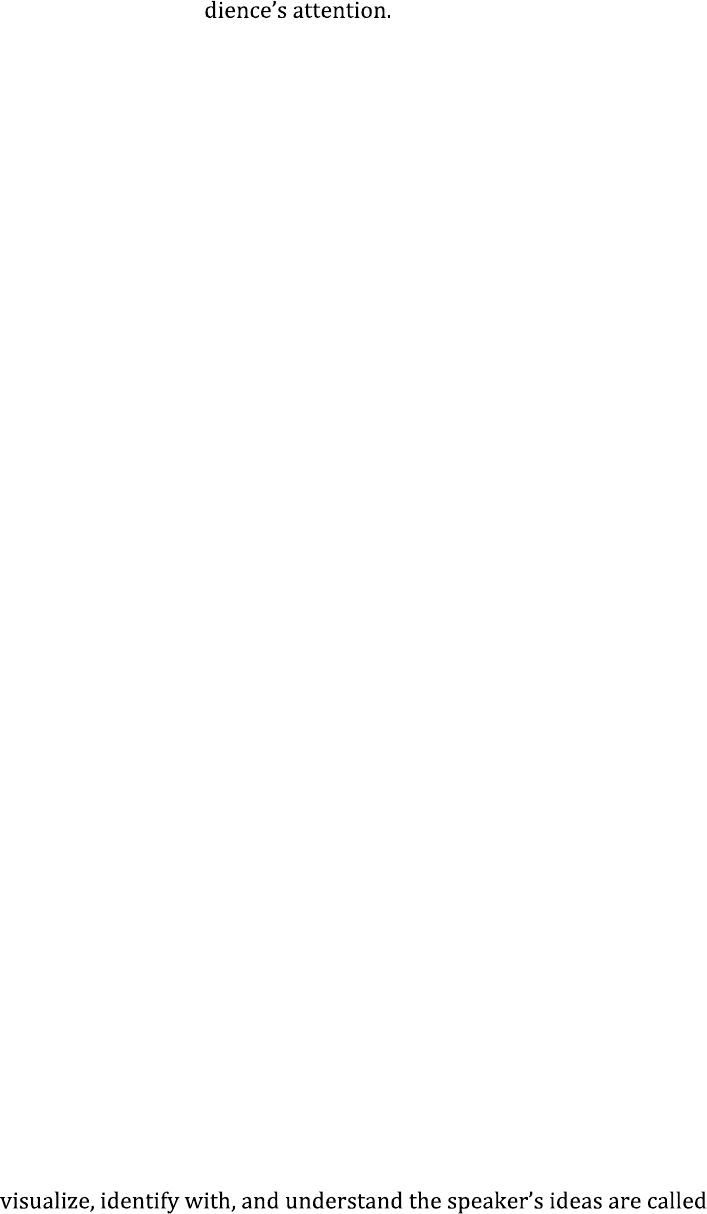
A) capture your au
B) comprise at least 25 percent of your total speech.
C) be prepared before the body of the speech.
D) All of the options are correct.
40. Using a story as a speech introduction
A) personalizes issues. C) discourages identification.
B) makes ideas irrelevant. D) None of the options are correct.
41. During the speech introduction, the audience decides whether or not they are
interested in the topic and the speaker. To build credibility, a speaker should
establish his or her
A) family background. C) qualifications.
B) supporting material. D) logos.
42. Speech conclusions fulfill which of the following functions?
A) signaling to the audience that the speech is coming to an end
B) summarizing the key points and goals of the speech
C) challenging the audience to respond
D) All of the options are correct.
43. A concluding challenge that asks an audience to act in response to the speech,
see the problem in a new way, or change their beliefs about the problem is
termed a
A) persuasive attempt. C) reiteration.
B) call to action. D) signpost.
44. Which of the following represents a difference between spoken and written
language?
A) Spoken language is more interactive than written language.
B) Spoken language uses easier-to-follow sentences and more straightforward
syntax.
C) Spoken language uses more repetition and transitions than does written
language.
D) All of the options are correct.
45. Forms of expression that make striking comparisons that help listeners
A) alliteration. C) figures of speech.
B) libelous language. D) conjunctions.
46.
illustrates which of the following techniques?
A) anaphora C) personification
B) metaphor D) alliteration
47. Effective speech delivery should be all of the following:
A) natural, monotone, confident, and comfortable.
B) natural, self-deprecating, direct, and abstract.
C) natural, enthusiastic, confident, and direct.
D) natural, confident, extremely formal, and animated.
48. Which type of delivery falls somewhere between impromptu and written or
memorized deliveries?
A) unpracticed C) extemporaneous
B) manuscript D) All of the options are correct.
49. The method of speech delivery that offers the most flexibility and is generally
preferred by speakers is
A) speaking extemporaneously. C) speaking impromptu.
B) speaking from memory. D) speaking from manuscript.
50. Pitch is
A)
B) the speed at which a speaker talks.
C) the rate at which a speaker stops and starts.
D)
versa).
51.
convey meaning, is to vary
A) speaking rate. C) pronunciation.
B) intonation. D) articulation.
52. Incorrect word pronunciations
A) are a matter of habit.
B) distract the audience.
C) may be associated with a regional dialect.
D) All of the options are correct.
53. can respond to it and
make the audience feel recognized and respected.
A) feedback C) vocal variety
B) credibility D) articulation
54. Which nonverbal behavior is most important in maintaining the quality of
directness in speech delivery?
A) eye contact C) gestures
B) movement D) body posture
55. When rehearsing a speech, the speaker should
A) revise the speaking outline as necessary.
B) practice under realistic conditions.
C) time the speech.
D) All of the options are correct.
56. Presentation aids should be appropriate to
A) the audience. C) the occasion.
B) the speech topic. D) All of the options are correct.
57. Which type of chart best illustrates a sequence of activities or the directional
flow in a process?
A) flowchart C) pictogram
B) organizational chart D) table
58. To minimize listener distraction, a speaker should
A) distribute handouts at the beginning of the speech.
B) distribute handouts in the middle of the speech.
C) distribute handouts when he or she is finished talking.
D) create a lengthy packet of handouts to maintain audience interest.
59. When designing a presentation aid, the speaker should strive for
A) abstraction. C) complexity.
B) simplicity. D) diversity.
60. How many major ideas should be present on each presentation aid?
A) one C) three
B) two D) four
61. The two categories of typefaces are sans serif and
A) script. C) font.

B) sans script. D) serif.
62. Which of the following PowerPoint options includes forty-eight predesigned
templates that allow the user to convey a consistent look or feel?
A) Slide Layout C) Blank slide layout
B) Design tab D) Guidebook pattern
63. Which of the following can be inserted into PowerPoint slides?
A) clip art C) movies and sound
B) photos D) All of the options are correct.
64. The goal of informative speaking is
A) to decrease audience frustration and boredom.
B) to influence attitudes, values, beliefs, and behaviors.
C) to increase audience awareness or deepen understanding.
D) All of the options are correct.
65. Defining one topic by comparing it to something that has an equivalent
meaning is called
A) definition by synonym. C) definition by etymology.
B) operational definition. D) None of the options are correct.
66. A presentation that is reinforced with pictures and diagrams will appeal most
to _____ learners.
A) visual C) aural
B) kinesthetic D) read/write
67. Under which of the following conditions is the persuasive purpose appropriate?
A) when a speaker seeks
about something
B)
C)
or behavior
D) All of the options are correct.
68. According to Aristotle, persuasive appeals consist of
A) logos, pathos, and ethos. C) logos, pathos, and mythos.
B) logos, mythos, and ethos. D) logos, ethos, and credos.
69. A three-part argument consisting of a general case, a specific case, and a
conclusion is called
A) a syllogism. C) an elaboration.
B) an enthymeme. D) central processing.
70. An argument consists of
A) a claim, opinions, and a conclusion.
B) a claim, evidence, and warrants.
C) a claim, fallacies, and opinions.
D) a claim, warrants, and a conclusion.
71. I should be paid $50 for mowing the lawn because this lawn is worth $50. This
statement is an example of
A) begging the question. C) an overgeneralization.
B) bandwagoning. D) an ad hominem argument.
72.
the proposed solution?
A) action C) need
B) attention D) satisfaction
73.
superior to alternative viewpoints?
A) problem-solution C) cause-effect
B) refutation D) comparative advantage
74. Which of the following is a function of a special occasion speech?
A) to entertain C) to set a social agenda
B) to inspire D) All of the options are correct.
75. A speaker who delivers a speech of introduction should avoid
A)
B) talking briefly.
C) evaluating or offering critical commentary on the speech of the person
being introduced.
D) round.
76. One of the most successful strategies a speaker can use in inspirational
speaking is
A) memorizing the speech.
B) using lots of charts and graphs.

C) incorporating hypothetical examples.
D) employing a dynamic speaking style.
77. Which type of presentation connects the presenter and audience live and at the
same time?
A) recorded presentations C) real-time presentations
B) off-line presentations D) asynchronous presentations
78. A(n) _______ presentation involves three or more people in a discussion.
A) single-speaker C) interview-style
B) speaker-audience interactive D) moderated panel
79. ______ are real-time seminars, meetings, training sessions, or other
presentations that connect presenters and audiences from their desktops,
regardless of where they are in the world.
A) Webinars C) Screen captures
B) Podcasts D) None of the options are correct.
80.
A) interpersonal roles. C) task roles.
B) dyadic roles. D) counterproductive roles.
81. Productive conflict is
A) issues-based. C) groupthink-based.
B) personal-based. D) motivation-based.
82. Sales presentations, proposals, staff reports, progress reports, and crisis-
response presentations are examples of
A) public speaking. C) conversational speaking.
B) presentational speaking. D) ethical speaking.
83. Professor Buchanan informed her colleagues about the various intercom
systems she had investigated. She then recommended that the university
purchase a particular system. What type of presentation did Professor
Buchanan give?
A) a proposal C) a sales presentation
B) a staff report D) a progress report
84. Which of the following is helpful when giving a crisis-response presentation?

A) knowledge of the basic sales technique
B) familiarity with a range of image-restoration strategies
C) progress reports
D) a case study
85. College students may be asked to deliver oral presentations in the form of
A) reviews of academic articles. C) poster sessions.
B) team presentations and debates. D) All of the options are correct.
86. Which of the following audience types brings to the presentation the least
amount of knowledge of the given topic and field?
A) expert audience
B) colleagues within the field audience
C) lay audience
D) mixed audience
ANSWER KEY FOR COMPREHENSIVE FINAL EXAM