Finding Credible Online and Print Materials 9
TRUE/FALSE QUESTIONS
1. Classical rhetoricians termed the process of selecting material that best
invention.
2. Primary sources provide firsthand accounts or direct evidence of events.
3. Two types of secondary research are interviews and surveys.
4. Secondary sources provide analysis or commentary about phenomena produced
by others.
5. Before beginning any search, speakers should assess their research needs.
6. Relying exclusively on popular search engines for research can present a host
of potential problems.
7. Books usually explore topics superficially, not in depth.
8. A regularly published magazine or journal is called a periodical.
9. Articles in peer-reviewed journals are evaluated by experts before being
published.
10. All blogs and social news sites should be considered reputable speech sources.
11. U.S. Government Printing Office publications are not good sources for
congressional reports and hearings.
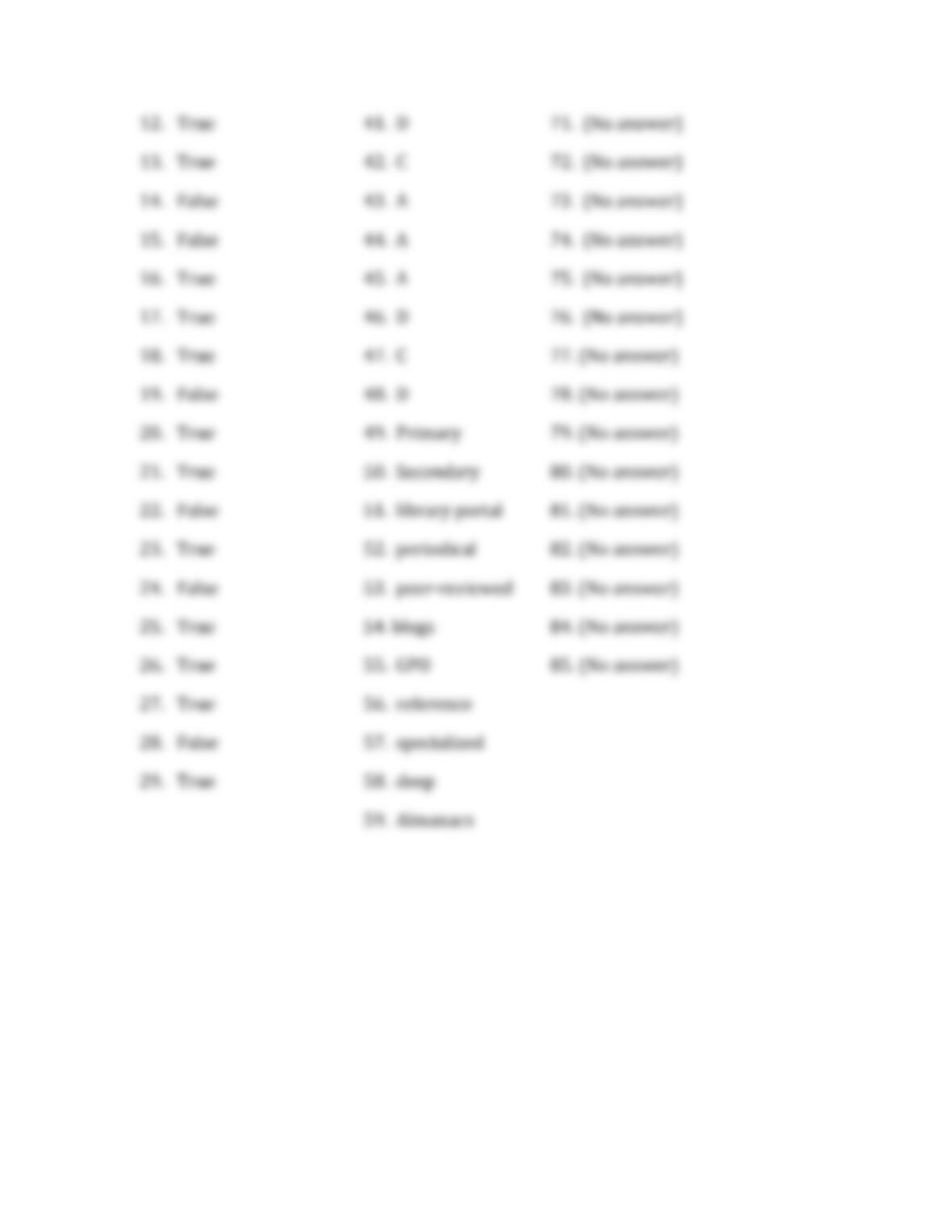
12. Digital collections include oral histories, photographs, and audio recordings.
13. Encyclopedias, almanacs, and atlases are examples of reference works.
14. General encyclopedias delve deeply into one subject area.
15. The Encyclopedia Britannica is an example of a specialized encyclopedia.
16. Almanacs may be general or specialized.
17. Almanacs and fact books are good places to find interesting facts and statistics
in support of a speech topic.
18. Biographical resources contain information about famous or noteworthy
people.
19. Books of quotations and poetry collections are not examples of reference
works.
20. An atlas is a collection of maps, text, and accompanying charts and tables.
21. A speaker can gain considerably more insight into a topic by conducting an
interview with an expert.
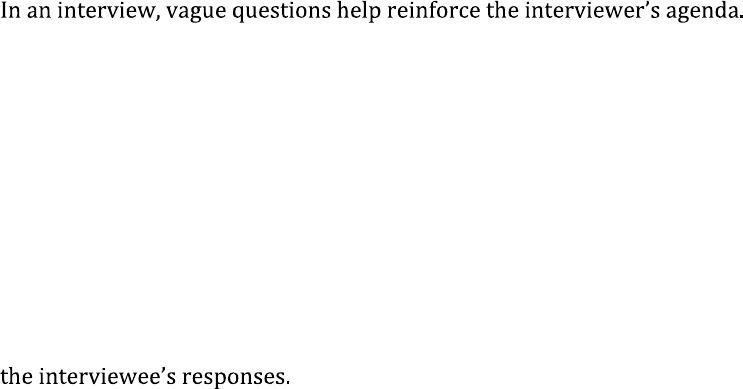
22.
23. In an interview, avoid posing questions that encourage or force a particular
response.
24. It is in the conclusion of the interview that you should pose your substantive
questions.
25. After the interview, you should offer to send the interviewee the results of the
interview.
26. You might consider recording an interview to avoid inaccurately representing
27. Like interviews, surveys are useful tools for investigating audience attitudes.
28. It is not necessary to be familiar with the most recent sources you can find.
29. To assess the credibility of a publication, the speaker should check out the
publisher and determine whether that person or organization is reputable.
30. A speaker who cites statistics in a speech is not responsible for checking the
reliability of the statistics.
31. The term misinformation refers to the deliberate falsification of information.
32. Propaganda is central to presenting a primary source.

MULTIPLE-CHOICE QUESTIONS
33. Eyewitness testimony, diary entries, interviews, and surveys are examples of
______ sources.
A) primary C) tertiary
B) secondary D) chronicle
34. Which of the following is not a type of secondary source?
A) books C) surveys
B) biographies D) periodicals
35. A regularly published magazine or journal is called a(n)
A) annual. C) periodical.
B) yearbook. D) guide.
36. The portion of the Web that general search engines often fail to find is referred
to as the
A) imperceptible Web. C) deep Web.
B) unseen Web. D) undetectable Web.
37. A(n) _____ is a website maintained by individuals or groups containing journal-
type entries.
A) social news site C) biographical resource
B) almanac D) blog
38. GPO stands for
A) Government Printing Office. C) Government Production Office.
B) Government Prototype Office. D) Government Publishing Office.
39. The U.S. GPO publishes and distributes all
A) information collected and produced by federal agencies.
B) general encyclopedias.
C) almanacs about other countries.
D) information about the president.
40. Which type of reference work summarizes knowledge that is found in original
form elsewhere?
A) encyclopedias
B) almanacs
C) biographical resources
D) poetry collections
41. An atlas is a collection of maps that can provide information on
A) human anatomy. C) geography.
B) art history. D) All of the options are correct.
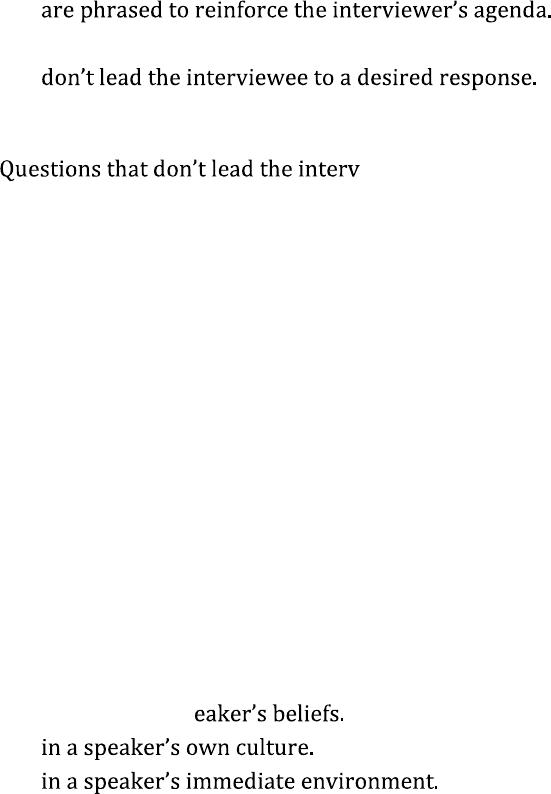
42. Effective interview questions
A)
B) are made up spontaneously during the interview.
C)
D) are closed-ended and to the point.
43. iewee to a desired response are known as
A) neutral questions. C) loaded questions.
B) vague questions. D) closed questions.
44. Which types of search engines are devoted entirely to one field?
A) specialized search engines C) meta-search engines
B) subject directories D) individual search engines
45. At the end of the interview, you should
A) offer a brief, positive summary of important things you learned.
B) provide a rebuttal.
C) inform the interviewee of your own point of view.
D) ask the interviewee to take a brief survey about the interview quality.
46. Surveys are an especially effective source of support for topics related to the
attitudes, values, and beliefs of the people
A) who know the speaker personally.
B) who share a sp
C)
D)
47. ______ is information presented in such a way as to provoke a specific response.
A) Disinformation
B) Fabrication
C) Propaganda
D) Misinformation

48. ______ refers to the deliberate falsification of information.
A) Information C) Propaganda
B) Misinformation D) Disinformation
FILL-IN-THE-BLANK QUESTIONS
49. ______ sources provide firsthand accounts or direct evidence of events.
50. _______ sources provide analysis or commentary about phenomena produced by
others.
51. A(n) ______ is a
e-resources.
52. A regularly published magazine or journal is called a(n) ______.
53. Articles printed in _______ journals are evaluated by experts before being
published.
54. Though ______ and social news sites can provide information and opinions on
certain speech topics, these types of sources must be used with extreme care.
55. Publications that are good sources for U.S. government information and
statistics are often produced by the ______.
56. Encyclopedias, almanacs, and atlases are examples of ______ works.
57. Encyclopedias that delve deeply into one subject area are known as ______
encyclopedias.
58. The ______ Web is the portion of the Web that general search engines often fail
to find.
59. ______ and fact books are published annually and contain interesting facts and
statistics on many subjects.
60. Resources that contain information about famous or noteworthy people are
termed ______ resources.
61. A collection of maps, text, and accompanying charts and tables is called a(n)
______.
62. Questions in an interview that encourage or force a particular response from
the interviewee are known as ______ questions.
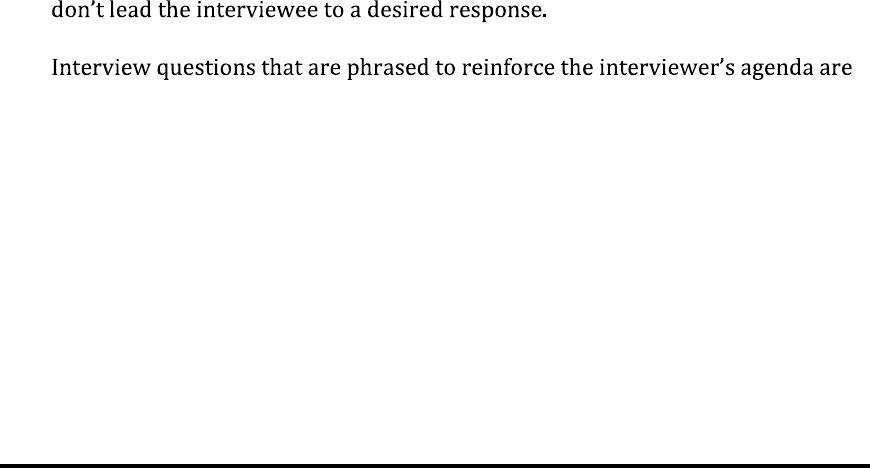
63. When conducting interviews, you should aim to create _______ questions that
64.
known as ______ questions.
65. _______ search engines are databases created by researchers, government
agencies, businesses, or other parties with a deep interest in a topic.
66. _______ is information represented in such a way as to provoke a desired
response.
67. An urban legend is an example of ______.
ESSAY AND SHORT ANSWER QUESTIONS
68. Explain the difference between primary and secondary sources.
69. Why is it important to assess your research needs before beginning your
search?
70. When preparing a speech, why might books be valuable as supporting
material?
71. What is a periodical? Give one example.
72. What is a peer-reviewed journal?
73. What is a blog, and how might you use one as a speech source?
74. Describe a speech in which a citation from a government publication would be
useful.
75. What is the difference between a general and a specialized encyclopedia?
76. Explain why books of quotations and poetry collections are good sources for
speech introductions and conclusions.
77. Provide an example of a speech topic for which a speaker might consult an
atlas.
78. Describe situations in which surveys and interviews would make effective
research tools for public speakers.
79. Give an example of a vague interview question.
80. Give an example of a leading interview question.
81. Give an example of a loaded interview question.
82. Provide three tips for how an interviewer can get off to a good start at the
beginning of an interview.
83. What should you consider when critically evaluating your sources?
84. Describe and provide an example of a specialized search engine.
85. What is the difference between propaganda and misinformation, and why are
both considered unethical?
ANSWER KEY FOR CHAPTER 9