Instructor Resource
Neuliep, Intercultural Communication, 8e
SAGE Publishing, 2021
Test Bank
Chapter 8: The Nonverbal Code
Multiple Choice
1. Which of the following terms refers to the study of communication with the body,
including the use of hands, arms, legs, and face, to send messages?
a. paralanguage
b. haptics
c. proxemics
d. kinesics
2. Which of the following terms refers to the study of communication with the voice,
including vocal characteristics such as volume, pitch, and rate to send messages?
a. paralanguage
b. haptics
c. proxemics
d. kinesics
3. Which of the following terms refers to the study of communication with the perception
and use of space?
a. paralanguage
b. haptics
c. proxemics
d. kinesics
4. Which of the following terms refers to the study of communication via touch?
a. paralanguage
b. haptics
c. proxemics
d. kinesics
5. A key distinction between the verbal and nonverbal systems of communication is that
______.
a. animals do not possess a verbal system of communication
Instructor Resource
Neuliep, Intercultural Communication, 8e
SAGE Publishing, 2021
b. the verbal system is based on haptics, whereas the nonverbal system is based on
kinesics
c. the verbal system is based on symbols whereas the nonverbal system is signal based
d. the verbal system regulates communication whereas the nonverbal system
complements communication
6. Emblems are primarily ______.
a. vocal characteristics of volume and pitch
b. perceptions of smell
c. hand gestures that have a direct verbal translation
d. dress artifacts
7. In high-context and collectivistic cultures, nonverbal greeting rituals often differ
according to ______.
a. one’s social status
b. perceptions of smell and haptics
c. the perception and use of gestures
Instructor Resource
Neuliep, Intercultural Communication, 8e
SAGE Publishing, 2021
d. violations of expectancies
8. Which of the following channels of nonverbal communication has the highest sending
capacity?
a. affect displays
b. haptics
c. proxemics
d. illustrators
9. Which of the following channels of nonverbal communication is regarded as universal
across cultures?
a. affect displays
b. haptics
c. proxemics
d. illustrators
Instructor Resource
Neuliep, Intercultural Communication, 8e
SAGE Publishing, 2021
10. Which of the following channels of nonverbal communication is regarded as the
most primitive form of communication?
a. affect displays
b. haptics
c. proxemics
d. illustrators
11. Which of the following countries is considered low contact?
a. United States
b. England
c. France
d. Puerto Rico
Instructor Resource
Neuliep, Intercultural Communication, 8e
SAGE Publishing, 2021
12. According to research, approximately how many compounds can the average
human detect by smell?
a. 100
b. 1,000
c. 10,000
d. 100,000
13. Some of the finest perfumes in the world contain olfactory hints of ______.
a. sweat
b. hair
c. vomit
d. urine
Instructor Resource
Neuliep, Intercultural Communication, 8e
SAGE Publishing, 2021
14. The evaluation of violations of nonverbal expectancies depends largely on the
______.
a. culturally learned expectancies
b. attractiveness or reward value of the violator
c. duration of the proxemics
d. duration of the chronemics
15. The phenomena known as the own-race bias—that is, that people recognize the
faces of others of their own race better than they do the faces of others of a different
race—occurs because ______.
a. people in all cultures are racists
b. when viewing cross-race faces, people focus more on the other’s race than on
individual identity
c. people prefer to interact with people of their own race
d. people prefer to interact with people of other races
16. Digital communication refers to ______ communication.
Instructor Resource
Neuliep, Intercultural Communication, 8e
SAGE Publishing, 2021
a. cross-cultural
b. intercultural
c. verbal
d. nonverbal
17. Verbal and nonverbal language are similar in that they both have a ______.
a. formal set of grammar rules
b. formal set of syntax rule
c. set of prescribed denotative rules
d. set of culturally constructed contexts
18. The broad category of nonverbal communication that involves body movement is
called ______.
a. oculesis
b. olfactics
c. kinesics
d. chronemics
Instructor Resource
Neuliep, Intercultural Communication, 8e
SAGE Publishing, 2021
19. ______ is/are considered the most dynamic form of nonverbal communication.
a. Gestures
b. Eye contact
c. Regulators
d. Emblems
20. Their eyes met across a crowded room, and they knew they were meant for each
other. It was love at first sight. This common romantic fairy tale is based on the culturally
appropriate assumption that direct eye gaze is associated with ______.
a. friendliness
b. power and control
c. threat
d. magic
Instructor Resource
Neuliep, Intercultural Communication, 8e
SAGE Publishing, 2021
21. According to Audry Nelson’s research on eye contact, women enhance their eyes
more than men do in most cultures. Which of the following statements is accurate?
a. Saudi men only make eye contact with Saudi women.
b. India, women place jewels around their eyes to draw attention to them.
c. In the U.S., women use eye contact more to assert status and dominance than
affiliation.
d. Korean women make direct eye contact with strangers to establish affiliation.
22. When a speaker clears their throat or sighs, they are exhibiting paralinguistic
______.
a. voice qualities
b. vocalizations
c. linguistics
d. referents
Instructor Resource
Neuliep, Intercultural Communication, 8e
SAGE Publishing, 2021
23. Bobbi broke a vase after throwing a baseball inside the house. Bobbi knew it was
against the rules to throw the ball inside the house but did it anyway. When Bobbi’s
parents got home, they asked how the vase got broken. Bobbi stammered in a high–
pitched voice and had trouble saying words. Bobbi’s inability to manage paralinguistic
______ cues signaled to the parents that Bobbi was lying.
a. voice qualities
b. vocalizations
c. linguistics
d. referents
24. Languages are composed of different sounds. A language that is tonal is a language
that will ______.
a. change meaning as tones change
b. have consistent meanings regardless of the tone
c. consist of a monosyllabic sound
d. always sound lyrical and melodic
Instructor Resource
Neuliep, Intercultural Communication, 8e
SAGE Publishing, 2021
25. According to research, people who live in individualistic cultures tend to be ______
proximally.
a. close
b. synchronized
c. high
d. distant
26. Pierre is very organized and is Ralph’s boss. Everything is entered into electronic
organizers, written on calendars and color coded. Ralph is very in-tune to nature. Start
times are merely suggestions; deadlines are fluid; communing with nature and enjoying
the now takes priority over clocks and schedules. Pierre doesn’t think Ralph takes the
job seriously, and Ralph thinks Pierre is always stressed out and should relax. Their
misunderstandings can be explained by ______.
a. kinesics
b. chronemics
c. olfactics
d. oculesics
Instructor Resource
Neuliep, Intercultural Communication, 8e
SAGE Publishing, 2021
Difficulty Level: Hard
True/False
1. Verbal communication is often called digital communication and nonverbal
communication is called analogic communication.
2. Proxemics includes the study of gestures, hand and arm movements, leg
movements, facial expressions, eye gaze and blinking, and stance or posture.
3. Researchers believe that some facial expressions of emotion are universal.
4. In many Asian cultures, such as South Korea, Vietnam, and Japan, direct eye contact
is prohibited between persons of differing status.
Instructor Resource
Neuliep, Intercultural Communication, 8e
SAGE Publishing, 2021
5. Some languages, called tonal languages, rely on vocalized tones to communicate
meaning.
6. Nonnative accents are associated with a wide range of negative stereotypes,
including perceptions that the people who speak them are less intelligent, less loyal,
less competent, and lower in social status.
7. Privacy in densely populated locations is often accomplished affectively rather than
physiologically.
Instructor Resource
Neuliep, Intercultural Communication, 8e
SAGE Publishing, 2021
8. The United States is regarded as a high-contact culture, whereas many Asian
countries are considered moderate contact.
9. Violations of our nonverbal expectancies (i.e., someone standing too close) trigger
arousal.
10. Persons in large power distance cultures are generally less aware of their vocalics
(e.g., volume, intensity) than are persons in small power distance cultures.
Instructor Resource
Neuliep, Intercultural Communication, 8e
SAGE Publishing, 2021
11. Research indicates that by 6 months of age, babies in all cultures begin to use
gestures to communicate to their parents.
12. Often, paralinguistic qualities, vocalizations, and nonfluencies reveal a speaker’s
emotional state or veracity.
13. Nonverbal communication is considered analogic communication.
Instructor Resource
Neuliep, Intercultural Communication, 8e
SAGE Publishing, 2021
Essay/Short Answer
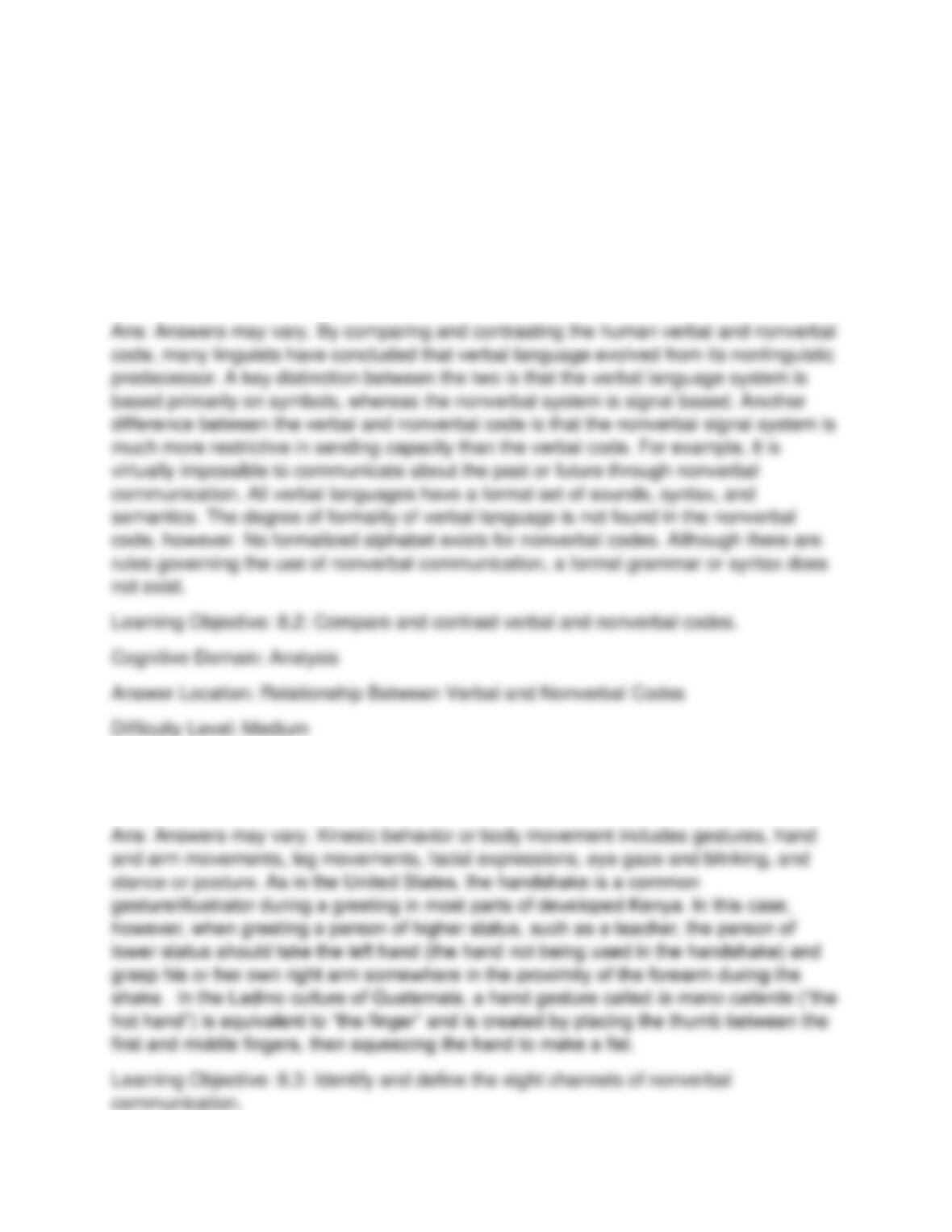
1. Compare and contrast verbal and nonverbal codes; how are they similar and
different?
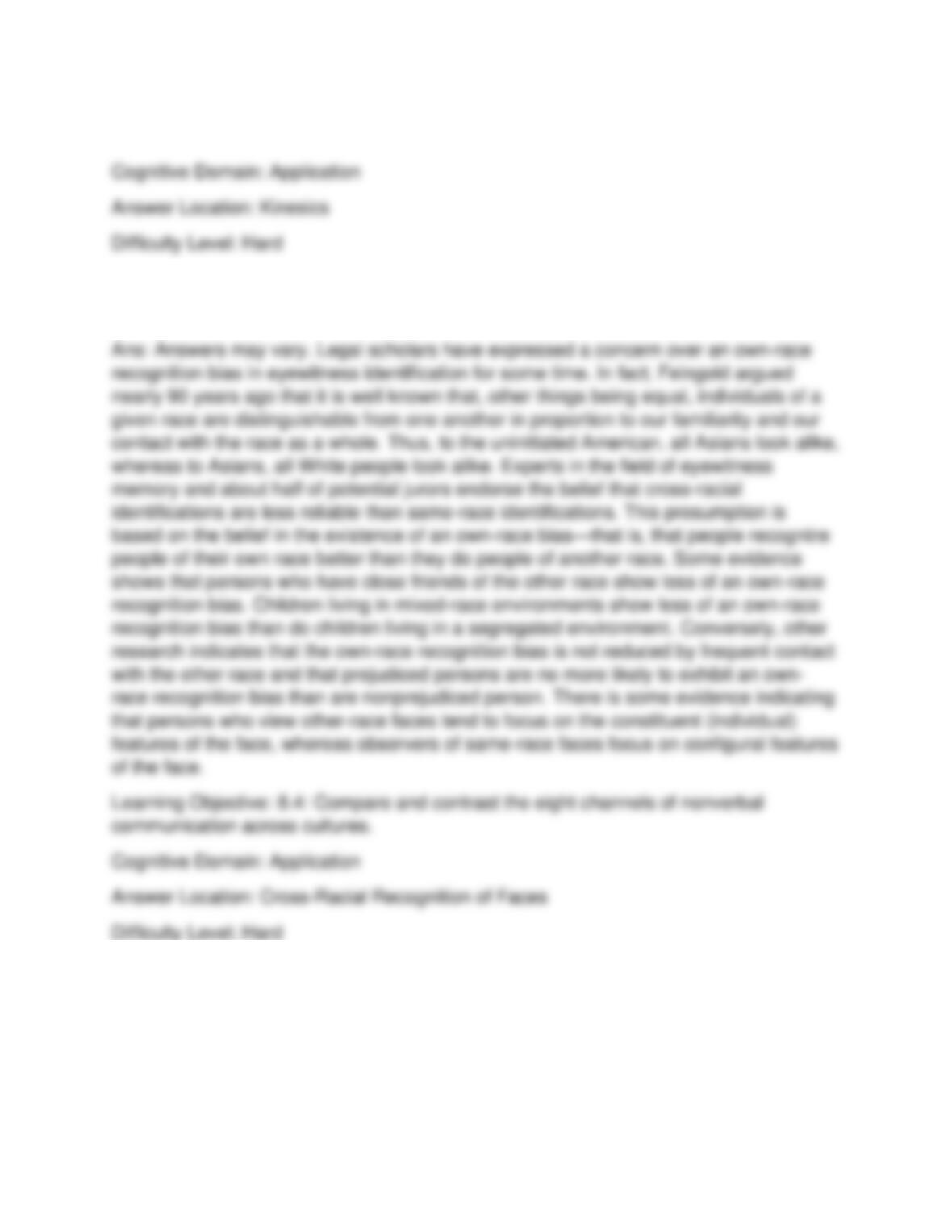
2. Define kinesics and provide examples of kinesic behavior across cultures.
Instructor Resource
Neuliep, Intercultural Communication, 8e
SAGE Publishing, 2021
3. Defend or refute the idea that persons of different races “all look alike.”