Managing Speech Anxiety 3
TRUE/FALSE QUESTIONS
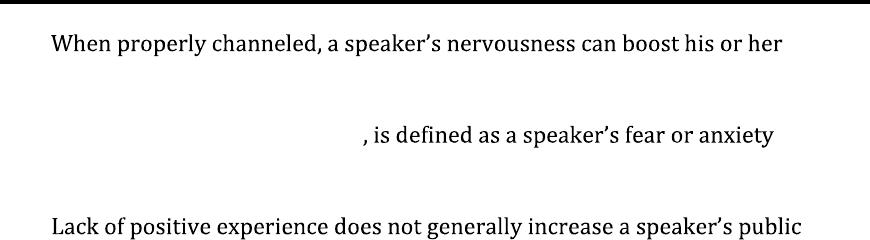
1.
performance.
2. Public speaking anxiety, or PSA
associated with either actual or anticipated communication to an audience.
3.
speaking anxiety.
4. The audience is likely to see the speaker more critically than the speaker sees
him- or herself.
5. The onset of public speaking anxiety can occur as early as when a speaker first
learns that he or she will have to give a speech.
6. Pre-preparation anxiety usually occurs when a speaker rehearses the speech.
7. For most people, anxiety tends to be highest just before speaking begins.
8. Those with high trait anxiety are likely to comment positively about the speech
after it is over.
9. Low trait-anxious people are generally most nervous when starting a speech
but gain confidence throughout the speech.
10. Preparation and practice can help you develop a quality speech, but it cannot
help to alleviate public speaking anxiety.
11. Having a positive attitude toward speechmaking results in a raised heart rate
during delivery of a speech.
12. Visualization is not an effective technique for building speaker confidence.
13. Stage one of stress-control breathing involves using a soothing word such as
calm or relax.
14. It is recommended that speakers stand perfectly still behind a podium and do
not walk around.
15.
attention.
16. Speech evaluations by others are usually more distorted than self-evaluations.
17. Giving a speech can be a satisfying and empowering experience.
MULTIPLE-CHOICE QUESTIONS
18. xiety associated with either actual or anticipated
communication to an audience is known as
A) communication nervousness. C) public speaking anxiety.
B) communication uneasiness. D) stage fright.
19. Which of the following is most likely to cause someone to avoid public speaking
altogether?
A) lack of a positive experience C) being the center of attention
B) disagreement on current issue D) lack of quality subjects
20. Feeling ______ is one reason many people have anxiety about public speaking.
A) attractive C) different
B) superior to the audience D) depersonalized
21. Tyson began to panic as soon as his instructor gave the speech assignment to
the class. Tyson experienced
A) pre-preparation anxiety. C) pre-performance anxiety.
B) preparation anxiety. D) performance anxiety.
22. ________ is a technique for combating pre-performance anxiety in which you
allow your anxiety to present itself for up to a few minutes until you declare
time for confidence to step in so you can proceed to complete your practice.
A) Nervousness alleviation C) Anxiety stop-time
B) Communication release D) Stress-control breathing
23. Ben noticed that his anxiety was most pronounced during the introduction of
his speech. Ben experienced
A) pre-preparation anxiety. C) pre-performance anxiety.
B) preparation anxiety. D) performance anxiety.
24. People with ________ are naturally anxious much of the time, whereas people
with ________ will experience nervousness usually only in novel situations.
A) high trait anxiety; low trait anxiety
B) moderate trait anxiety; no trait anxiety
C) low trait anxiety; high trait anxiety
D) None of the options are correct.
25. Each of the following is a successful strategy for gaining public speaking
confidence except
A) modifying thoughts and attitudes.
B) avoiding movement during the speech.
C) seeking enjoyment in the occasion.
D) practicing the speech.
26.
speaker do?
A) Speak as quickly as possible.
B) Learn and incorporate jargon.
C) Practice difficult words in English.
D) Avoid all words from his or her native tongue.
27. Which of the following is not true of visualizing?
A) It can strengthen your positive attitude.
B) It is a highly effective technique for building public speaking confidence.
C) It involves the mental exercise of seeing yourself give a successful speech.
D) It involves physically going through the motions of giving your speech.
28. Activating the relaxation response through techniques such as meditation or
stress-control breathing can
A) help you confront a threat head-on.
B) help you make a hasty escape from a threat.
C)
D) improve how you respond to stress.
29. Speech evaluations

A) are usually more helpful if they are objective in nature.
B)
C) are designed to make you feel embarrassed about your speech.
D) None of the options are correct.
FILL-IN-THE-BLANK QUESTIONS
30. Feeling different from the audience, a lack of public speaking experience, and
uneasiness about being the center of attention can lead to ______.
31. Katarina experienced ______ anxiety as soon as she first learned that she had to
give a speech.
32. The onset of nervousness that occurs during the rehearsal of a speech is called
______ anxiety.
33. The type of anxiety that occurs when a speaker utters the first words of the
speech is termed ______ anxiety.
34. People with high _______ are naturally anxious most of the time.
35. Research points to the advantages of _________ your speech in front of a small
audience.
36. A(n) __________ attitude results in lowered heart rate and reduced anxiety during
speech delivery.
37. As Bizhi prepared to give her speech, she mentally pictured herself giving a
successful speech a confidence-building technique called ______.
38. A form of breathing in which you feel more movement in the stomach than in
the chest is called ______ breathing.
39. One way to prepare for more fluid but controlled __________ during delivery is to
exercise early on the day of your speech.
ESSAY AND SHORT ANSWER QUESTIONS
40. Explain why public speaking is such a source of anxiety for most people.
41. Explain how being the center of attention can contribute to an uncomfortable
speech situation.
42. Describe some ways a speaker may feel conspicuous when presenting a speech.
43. Pinpoint the usual moment when you initially experience speech anxiety, and
describe how you address it.
44. List two times that PSA can occur in the speechmaking process.
45. How do individuals with high and low trait anxiety typically experience
nervousness during the speechmaking process?
46. Write a brief account of how you can use visualization to build public speaking
confidence.
47. Discuss two relaxation techniques that public speakers can use to help reduce
public speaking anxiety.
48. Identify the relaxation technique that is most helpful to you as a public speaker.
Explain how it has helped you.
ANSWER KEY FOR CHAPTER 3