25 Developing Arguments for the
Persuasive Speech
TRUE/FALSE QUESTIONS
1. Arguments are composed of three elements: claims, evidence, and reasoning.
2. An argument is a stated position, with support for or against an idea or issue.
3. Supporting material that provides grounds for belief in a claim is called
evidence.
4. A warrant
5. Speculative claims focus on conditions that actually exist or have existed in the
past.
6. Claims of value address issues of judgment and attempt to show that something
is right or wrong, good or bad, worthy or unworthy.
7. Claims of policy recommend that a specific course of action be taken.
8. Claims of policy generally contain the word should
condition.
9. A claim of value consists of a need or a problem, a solution, and evidence of the
10.
evidence.
11. External evidence can be thought of as supporting material.
12. Narratives, testimony, and facts drawn from an outside source are examples of
external evidence.
13. More often than not, motivational warrants are stated outright rather than
implied.
14. The success or failure of authoritative warrants rests on how highly the
audience regards the authority figure.
15.
reliability of factual evidence.
16. The two types of substantive warrants that occur most commonly in speeches
are causation and analogy.
17. Warrants by cause compare two similar cases and imply that what is true in
one case is true in the other.
18. The New York Times, therefore the same
is probably true for the New York Post,
19. In a two-sided message, a speaker will mention opposing points of view and
sometimes attempt to refute them.
20. If the audience is aware of counterarguments and the speaker raises and
refutes them, the speaker risks losing credibility with the audience.
21. A logical fallacy is either a false or erroneous statement or an invalid or
deceptive line of reasoning.
22. Using a circular thought pattern, begging the question is a fallacy in which an
argument is stated in such a way that it cannot help but be true, even though no
evidence has been presented.
23.
question.
24. A speaker who relies on bandwagoning poses arguments that use general
opinions as their bases.
25. The either-or fallacy poses an argument stated in terms of only two alternatives.
26. Ad hominem
making the argument.
27. Slippery slope arguments make faulty assumptions that one case will lead to a
series of events or actions.
MULTIPLE-CHOICE QUESTIONS
28. An argument consists of
A) a claim, opinions, and a conclusion.
B) a claim, evidence, and warrants.
C) a claim, fallacies, and opinions.
D) a claim, warrants, and a conclusion.
29. A claim is also called
A) a proposition. C) a value.
B) a policy. D) a testimony.
30. Echinacea is an effective remedy for treating the common cold. This statement is
a claim of
A) value. C) policy.
B) fact. D) proposition.
31. The Chicago Bulls were the best NBA team of the 1990s. This statement is a claim
of
A) value. C) policy.
B) fact. D) generalization.
32. Students who earn an A average on all speech assignments should be exempt from
the final exam. This statement is a claim of
A) value. C) policy.
B) fact. D) proposition.
33. Claims of ______ recommend that a specific course of action be taken or
approved.
A) value C) policy
B) fact D) third order
34. Which of the following can be considered external evidence?
A) narratives C) statistics
B) facts D) All of the options are correct.
35.
A) speculative C) authoritative
B) motivational D) substantive
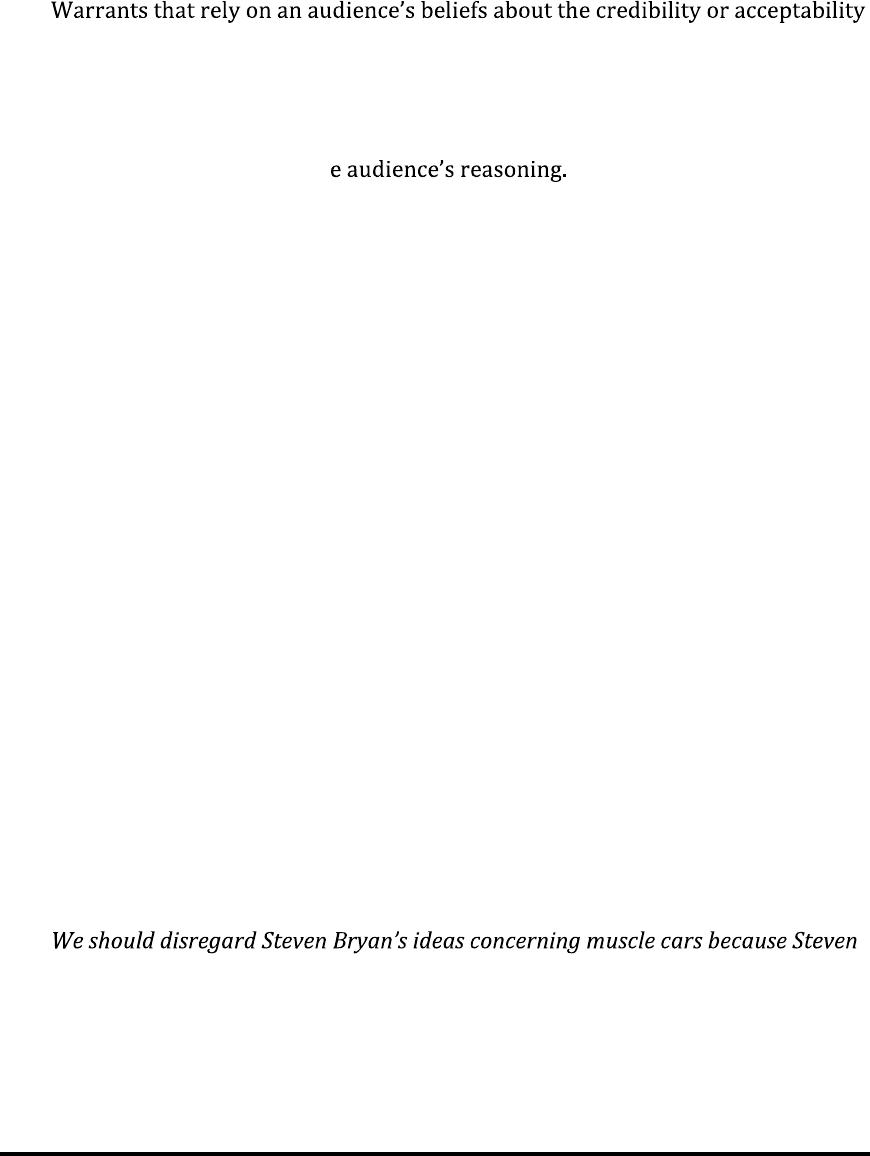
36.
of a source of evidence are termed ______ warrants.
A) speculative C) authoritative
B) motivational D) substantive
37. ______ warrants appeal to th
A) Speculative C) Authoritative
B) Motivational D) Substantive
38. A warrant that compares two similar cases and implies that what is true in one
case is true in the other is a
A) warrant by sign. C) warrant by cause.
B) warrant by analogy. D) warrant by evidence.
39. A speaker who anticipates counterarguments and then addresses or rebuts
them is delivering a(n)
A) authoritative warrant. C) speculative claim.
B) one-sided message. D) two-sided message.
40. I should be paid $50 for mowing the lawn because this lawn is worth $50. This
statement is an example of
A) begging the question. C) an overgeneralization.
B) bandwagoning. D) an ad hominem argument.
41. Cheating on an exam is acceptable because all college students cheat on an exam
at least once. This statement is an example of
A) begging the question. C) a red herring fallacy.
B) bandwagoning. D) an ad hominem argument.
42.
Bryan is an idiot. This statement is an example of
A) begging the question. C) an overgeneralization.
B) bandwagoning. D) an ad hominem argument.
FILL-IN-THE-BLANK QUESTIONS
43. A(n) ______ is a stated position, with support for or against an idea or issue.
44. A(n) ______ is a statement that provides a logical connection between a claim
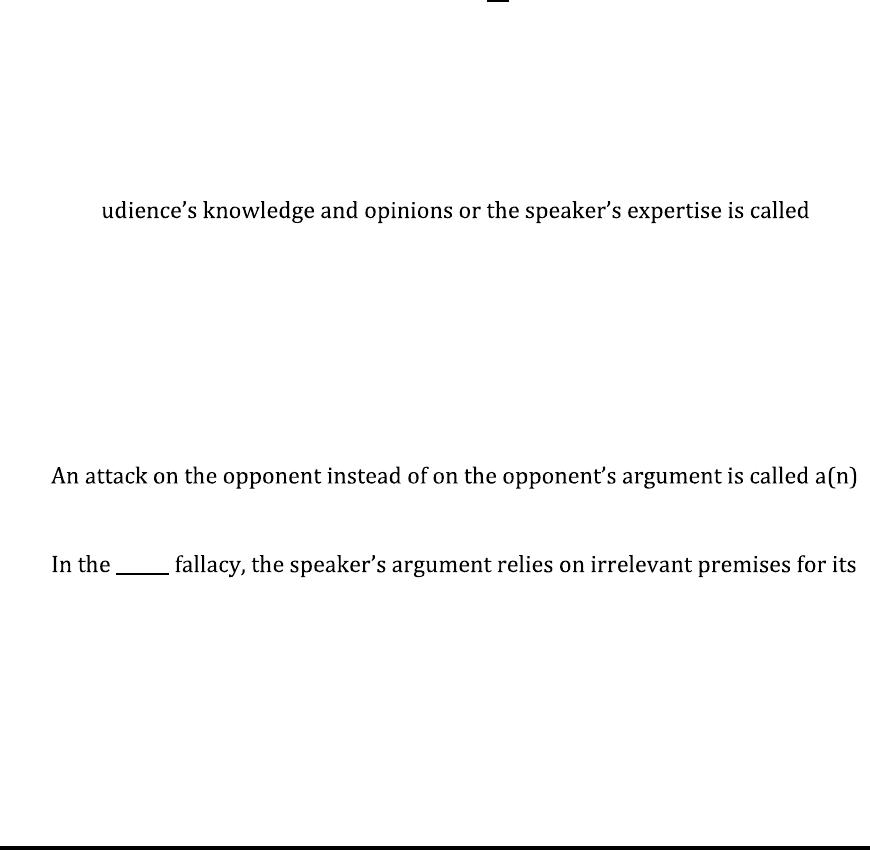
and its evidence.
45. Claims of ______ focus on whether something is or is not true or whether
something will or will not happen.
46. Claims of ______ address issues of judgment whether something is right or
wrong, good or bad, worthy or unworthy.
47. Claims of ______ recommend that a specific course of action be taken or
approved.
48. Any information in support of a claim that originates with sources other than
the a
______ evidence.
49. Warrants by ______ compare two similar cases and imply that what is true in one
case is true in the other.
50. A false or erroneous statement, or an invalid or deceptive line of reasoning, is
called a logical ______.
51.
______ argument.
52.
conclusion.
53. Speakers who use the appeal to _____ phrase arguments to suggest that the
audience should agree with the claim because that is the way it has always been
done.
ESSAY AND SHORT ANSWER QUESTIONS
54. What is an argument, and why is it important for a speaker to understand how
to construct one?
55. Explain the differences between a claim, evidence, and warrants.
56. Give an example of a claim of value.
57. Give an example of a claim of policy.
58. Discuss the importance of addressing culture in a persuasive speech.
59. Provide three examples of external evidence.
60. List and explain the three tests of evidence.
61.
the credibility of a source of evidence.
62. Explain the difference between a motivational warrant and an authoritative
warrant.
63. Explain the difference between a warrant by analogy and a warrant by cause.
64. Give an example of a substantive warrant, as well as the claim and evidence it
attempts to tie together.
65. Describe how a speaker can use two-sided messages in a persuasive speech.
66. List two reasons why it is important to be able to identify fallacious reasoning.
67. Give an example of the logical fallacy called begging the question.
68. Give an example of an either-or fallacy.
69. Give an example of an ad hominem argument.
70. Give an example of a red herring fallacy.
ANSWER KEY FOR CHAPTER 25