23 The Informative Speech
TRUE/FALSE QUESTIONS
1. The goal of informative speaking is to persuade or convince an audience to
change attitudes, beliefs, or values.
2. With information available today in so many forms, electronic and otherwise,
we have little need for informative speeches.
3. The informative speech seeks to advocate, whereas the persuasive speech
seeks to enlighten.
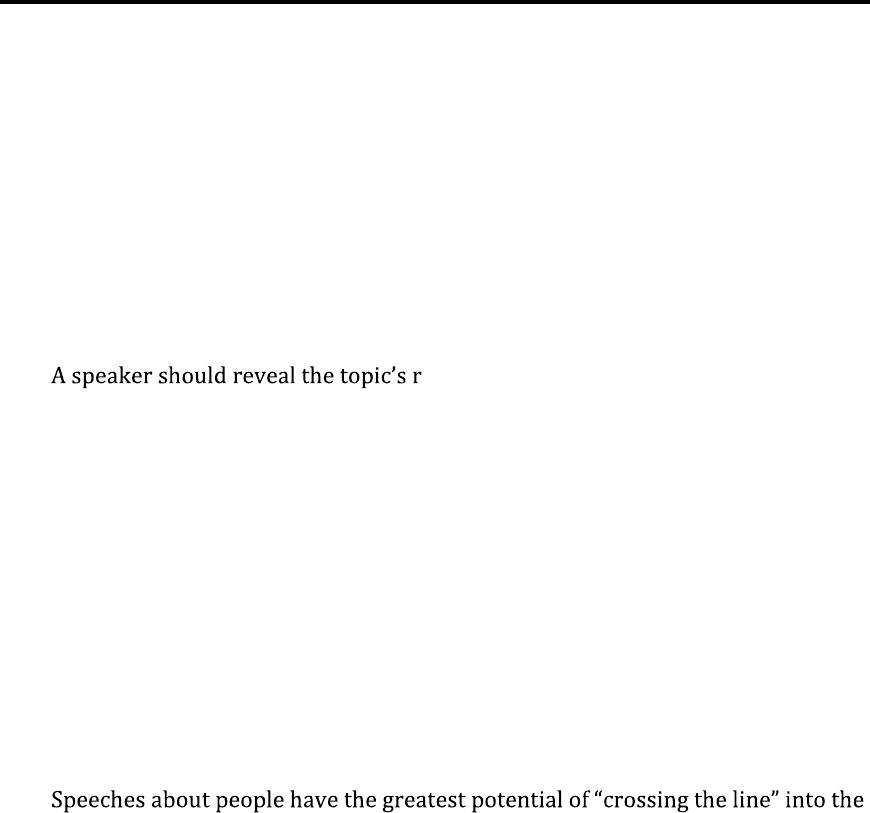
4. Audience analysis is insignificant in delivering an effective informative speech.
5. elevance to the audience early on in the
speech.
6. Speakers should seek to uncover information that is fresh and compelling.
7. An appropriate organizational pattern can help listeners mentally organize
ideas.
8. Speeches about events focus on noteworthy occurrences, both past and
present.
9. When discussing a process, a speaker can explain how something works or
develops, or actually teach audience members to perform the process.
10.
persuasive realm.
11. Speeches about concepts focus on abstract or complex ideas, theories, or beliefs
and attempt to make them concrete and understandable to an audience.
12. Typically we communicate information by defining, describing, demonstrating,
or explaining it.
13. Operational definitions define the topic by explaining what it does.

14. Definition by etymology defines the topic by explaining what it is not.
15. Definition by synonym defines the topic by providing several concrete
examples.
16. Etymology is a term for the comparison of a word with its opposite.
17. When describing information, the speaker should provide an array of details
that paint a mental picture of the topic.
18. Speeches that rely on demonstration often work with the actual object, models
of it, or visual aids that diagram it.
19. The point of a speech of explanation is to offer a vivid portrayal of the topic.
20. By linking the unfamiliar with the familiar through an analogy, a speaker gives
his or her listeners an easier way to venture into new territory.
21. Speeches about processes rely on reportage.
22. In order to appeal to different audience members, a speaker should consider
four learning styles: visual learners, aural learners, read/write learners, and
kinesthetic learners.
23. Visual learners are most comfortable processing information that is text-based.
24. Kinesthetic learners learn best by experiencing information directly, through
real-life demonstrations, simulations, and hands-on experience.
25. Informative speeches can be organized using the topical, chronological, spatial,
cause-effect, comparative advantage, or narrative patterns.
MULTIPLE-CHOICE QUESTIONS
26. An informative speech might introduce listeners to
A) traditional topics.
B) novel ways of thinking.
C) foundational insights on familiar subjects.
D) various ways to take action.

27. The goal of informative speaking is
A) to decrease audience frustration and boredom.
B) to influence attitudes, values, beliefs, and behaviors.
C) to increase audience awareness or deepen understanding.
D) to entertain audience members.
28. Listener comprehension is aided by
A) an appropriate organizational pattern.
B)
C) effective presentation aids.
D) All of the options are correct.
29. Speeches about ______ explore anything that is not human, but is animate or
inanimate.
A) people C) objects or phenomena
B) events D) processes
30. Speeches about ______ inform audiences about compelling individuals or groups.
A) people C) objects or phenomena
B) events D) processes
31. A speech on the Battle of Gettysburg is which type of informative speech?
A) a speech about a process C) a speech about a concept
B) a speech about an issue D) a speech about an event
32. Speeches about ______ refer to a series of steps that lead to a finished product or
end result.
A) people C) objects or phenomena
B) events D) processes
33. Speeches about ______ present a matter in dispute in order to raise awareness
and deepen understanding.
A) concepts C) objects or phenomena
B) issues D) processes
34. Which type of informative speech has the greatest potential to cross over into
the persuasive realm?
A) speeches about events C) speeches about issues
B) speeches about concepts D) speeches about processes

35. Speeches about ______ focus on abstract or complex ideas and attempt to make
them concrete and understandable.
A) concepts C) objects or phenomena
B) issues D) processes
36. Which type of informative speech relies on reportage and backstory?
A) speeches about processes C) speeches about events
B) speeches about concepts D) speeches about demonstration
37. Defining one term by comparing it to another term that has an equivalent
meaning is called
A) definition by synonym. C) definition by etymology.
B) operational definition. D) definition by analogy.
38. A definition by word origin is called
A) definition by synonym. C) definition by etymology.
B) operational definition. D) definition by negation.
39. Audience members will understand a new concept more easily if the speaker
uses a(n) ___________ to link the unfamiliar with the familiar.
A) demonstration C) internal preview
B) analogy D) backstory
40. A speaker who uses pictures and diagrams will appeal most to _____ learners.
A) visual C) aural
B) kinesthetic D) read/write
41. _____ learners are most comfortable processing information that is text-based.
A) Kinesthetic C) Visual
B) Read/write D) Aural
42. ______ learners learn best by experiencing information directly, through real-life
demonstrations, simulations, and hands-on experience.
A) Kinesthetic C) Visual
B) Read/write D) Aural
FILL-IN-THE-BLANK QUESTIONS
43. To ______ is to communicate knowledge.
44. The informative speech seeks to enlighten, whereas the ______ speech seeks to
advocate.
45. Speeches about ______ focus on noteworthy occurrences, both past and present.
46. Speeches about ______ refer to a series of steps that lead to an end result.
47. Speeches about ______ provide an overview of problems in order to raise
awareness and deepen understanding.
48. A(n) ______ definition defines a topic by explaining what it does.
49. Definition by ______ defines a topic by describing what it is not.
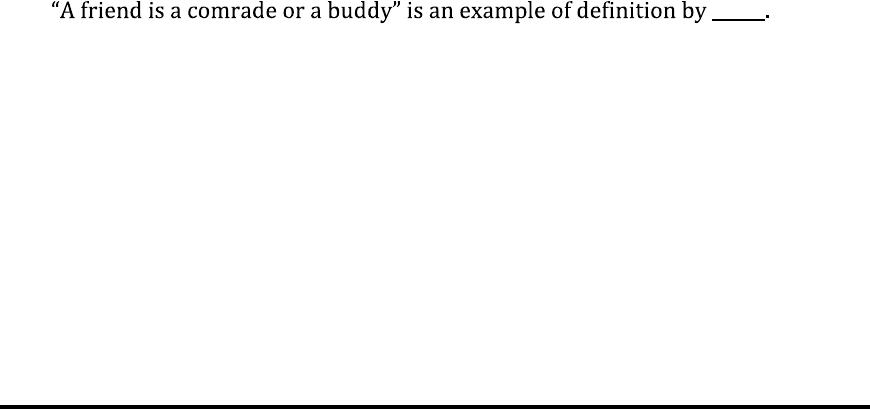
50.
51. The origin of a word is its ______.
52. ______ are preferred ways of processing information.
53. ______ learners understand most easily through the spoken word, by hearing
and speaking.
ESSAY AND SHORT ANSWER QUESTIONS
54. List three ways a speaker can focus on sharing knowledge with an audience.
55. How can a speaker gauge the informational needs of an audience?
56. List the categories of informative speeches.
57. List three types of definition, and provide an example of each type.
58. How is explaining information different from describing information?
59. What is an analogy, and how can it be used to help a speaker inform his or her
audience about a new concept?
60. List the four types of learning styles, and provide an example of what a speaker

can do to appeal to each style.
61. Why is it important for a speaker to appeal to different learning styles?
ANSWER KEY FOR CHAPTER 23