19 The Body in Delivery
TRUE/FALSE QUESTIONS
1. Beyond the spoken words, audiences receive information from a speech
through aural and visual channels.
2. Paralanguage refers to what is said, not to how something is said.
3. Nonverbal communication can clarify the meaning of verbal messages.
4. The aural channel includes general body movement.
5. The visual channel refers to movements, such as facial expressions, and
gestures.
6. Moving out from behind a podium and walking or standing among audience
members establishes a formal speech atmosphere.
7.
8. Audience members respond less positively to speakers whom they perceive to
be well dressed and attractive because such speakers are intimidating.
9. Smiling is an effective way for a speaker to build rapport with an audience.
10. Making eye contact with the audience is one of the most important physical
actions in public speaking.
11. Scanning is a technique whereby speakers move their gaze from one listener to
another and from one section of the audience to another, pausing along the
way.
12.
13. As space and time allow, a speaker should try to get out from behind the
podium and stand with the audience.
14. How a speaker dresses when delivering a speech is unimportant.

15. The first thing an audience is likely to notice about a speaker is his or her
clothing.
16. Gestures may have different meanings in different cultures.
17. A speaker who focuses on the message is likely to make his or her delivery
more natural and confident.
18. Speakers should avoid audio- or videorecording practice sessions of their
speech to avoid overanalysis.
19. During practice, a speaker should be prepared to revise his or her speaking
notes.
20. When practicing a speech, the speaker should try to simulate the actual speech
setting.
21. Practicing a speech in front of someone and welcoming constructive criticism is
helpful for speakers.
22. When practicing a speech, it is not important for the speaker to time the speech.
23. Many expert speakers recommend practicing a speech at least five times in its
final form.
MULTIPLE-CHOICE QUESTIONS
24. The aural channel includes
A) volume and pitch. C) gestures and body movement.
B) facial expressions. D) eye behavior.
25. Nonverbal communication
A) diminishes the meaning of verbal messages.
B) complicates feedback between speaker and audience.
C) helps establish speaker credibility.
D) increases the ultimate pitch of a speech.
26. By and large, few behaviors are more effective at building a solid rapport with
an audience than
A) smiling. C) serious facial expressions.
B) shaking hands. D) self-deprecation.
27. If an audience member perceives a speaker as unattractive, the audience
member is apt to
A) respond less positively to the speaker.
B) take the speaker more seriously.
C) be more objective in responding to the speaker.
D) feel badly for the speaker.
28. Which nonverbal behavior is most important in maintaining the quality of
directness in speech delivery?
A) eye contact C) gestures
B) facial expressions D) body posture
29. A speaker who
which involves
A)
B) focusing on the three nearest listeners.
C) choosing three audience members to focus on in three different areas of the
room.
D)
30. A speaker who remains steadily positioned in one place behind a microphone
or a podium
A) is especially effective. C) energizes the audience.
B) can lose audience attention. D) exudes seriousness.
31. Which of the following may distract listeners?
A) the color red C) flashy jewelry
B) dark-colored suits D) the color orange
32.
A) a businesslike attitude. C) friendliness.
B) credibility. D) formality.
33. A speaker should avoid using ______ when practicing a speech.
A) a watch C) an audio recorder
B) a videorecorder D) None of the options are correct.
34. Videorecording ______ practice sessions can provide valuable feedback to a
speaker.
A) two C) five
B) four D) six
35. The most ideal time to begin practicing your speech is
A) hours before your speech.
B) the day before your speech.
C) several days before your speech.
D) the day you begin writing your speech.
FILL-IN-THE-BLANK QUESTIONS
36. _______ refers to how something is said, not to what is said.
37. Nonverbal communication helps the speaker establish _______.
38. Audience members respond more _______ to speakers whom they perceive to be
well dressed and attractive.
39. _______ is an effective nonverbal tool for building rapport with an audience.
40. _______ is probably the most important physical action in public speaking.
41. _______ is a technique used by speakers whereby they briefly gaze at individual
members of the audience.
42.
43. Gestures have different meanings in different _______.
44. _______ is essential to effective delivery and can reduce the uncertainty that
leads to speech anxiety.
45. A speaker who focuses on the _______ is likely to make his or her delivery more
natural and more confident.
46. After practicing aloud, a speaker will often ________ his or her speaking notes.
47. Speakers should practice under ______ conditions.
48. Many expert speakers recommend practicing a speech at least _______ times in
its final form.
ESSAY AND SHORT ANSWER QUESTIONS
49. Identify and explain the two nonverbal channels of communication from which
audiences receive information during a speech.
50. List three functions of nonverbal communication in delivery.
51.
nonverbal communication, rather than the words they say?
52. How does effective use of nonverbal behavior establish relationships between
the speaker and the audience?
53. List two tips for using effective facial expressions.
54. List and explain ways that a speaker can maintain eye contact with the
audience.
55.
56. List two tips for effective gesturing.
57. Why should a speaker avoid standing stiffly behind a podium?
58. ode.
59. Explain why a speaker should be aware of variations in nonverbal
communication patterns in different cultures.
60. Give three guidelines for practicing a speech.
61. Why might a speaker revise his or her speaking outline after practicing the
speech?
62. Why should a speaker time the speech during practice?
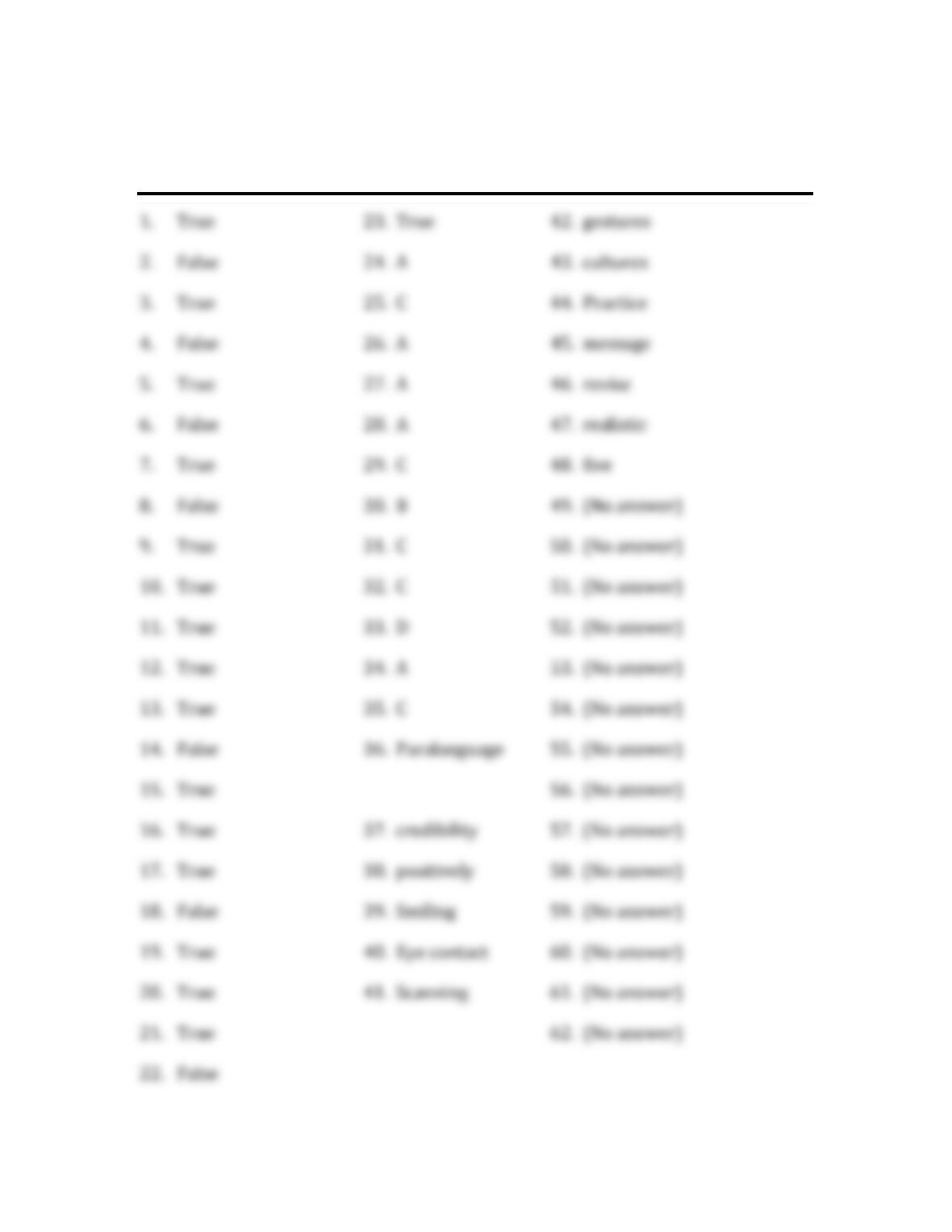
ANSWER KEY FOR CHAPTER 19