Using Language to Style the Speech 16
TRUE/FALSE QUESTIONS
1. Rhetorical devices are techniques of language that speakers use to express their
ideas and achieve their speech purpose.
2. Speeches make less frequent use of repetition and transitions than do most
forms of written communication.
3. Spoken communication is more interactive than written language.
4. Speakers should strive for simplicity by using jargon in their speeches.
5. filibustering.
6. Listeners prefer complex language over simple language when listening to a
speech.
7. Concise spoken language includes the use of contractions.
8. Phrases and sentence fragments should be avoided in spoken language.
9. Effective speakers often repeat key words or phrases.
10. Abstract language is specific, tangible, and definite.
11. The words old, thing, big, and bad are all examples of abstract language.
12. Speakers can create imagery by modifying nouns with descriptive adjectives.
13. A metaphor compares one thing to another, using like or as to do so.
14.
15. An analogy compares an unfamiliar concept or process to a more familiar one
to help audience members understand the unfamiliar one.
16. Irony refers to endowing abstract ideas or inanimate objects with human
qualities.
17. Speakers should use malapropisms in their speeches to inspire audience
confidence.
18. The connotative meaning is the literal, or dictionary, definition of a word.
19. Speaking in the pass
statements clear and assertive instead of indirect and weak.
20.
impression of conviction.
21. A mixed metaphor is a predictable or stale comparison.
22. Colloquial expressions are sayings that are specific to a certain region or group
of people.
23. Speakers should word their speeches with gender-neutral language.
24. A speaker using anaphora is repeating a word or phrase at the end of
successive sentences.
25. Alliteration is the arrangement of words, phrases, or sentences in a similar
form.
26. Parallelism is the repetition of the same sounds, usually initial consonants, in
two or more neighboring words or syllables.
MULTIPLE-CHOICE QUESTIONS
27. Which of the following represents a difference between spoken and written
language?
A) Spoken language is more interactive than written language.
B) Spoken language uses easier-to-follow sentences and straightforward
syntax.
C) Spoken language uses more repetition and transitions than does written
language.
D) All of the options are correct.
28. Which technique can help a speaker prepare his or her speech to be heard
rather than read?
A) choosing the more compl
B) experimenting with sentence fragments
C) using more rather than fewer words to express his or her thoughts
D) avoiding contractions
29. A speaker who uses vivid imagery
A) diminishes meaning.
B) distracts listeners from the main point of the speech.
C) encourages listener involvement.
D) makes good use of visual aids during a speech.
30. Forms of expression that make striking comparisons that help listeners
visualize, identify with, and understand the
A) alliteration. C) figures of speech.
B) libelous language. D) conjunctions.
31.
techniques?
A) simile C) personification
B) metaphor D) alliteration
32. –
A) simile C) analogy
B) metaphor D) alliteration
33. A speaker should avoid using expressions that are
A) clichés. C) appealing to the senses.
B) analogies. D) figures of speech.
34. The mixing in of casual language, dialects, a second language, or slang in a
speech is called
A) hyperbole. C) allusion.
B) mixed metaphor. D) code-switching.
35. The literal, or dictionary, definition of a word is its
A) hyperbolic meaning. C) denotative meaning.
B) analogous meaning. D) connotative meaning.
36.
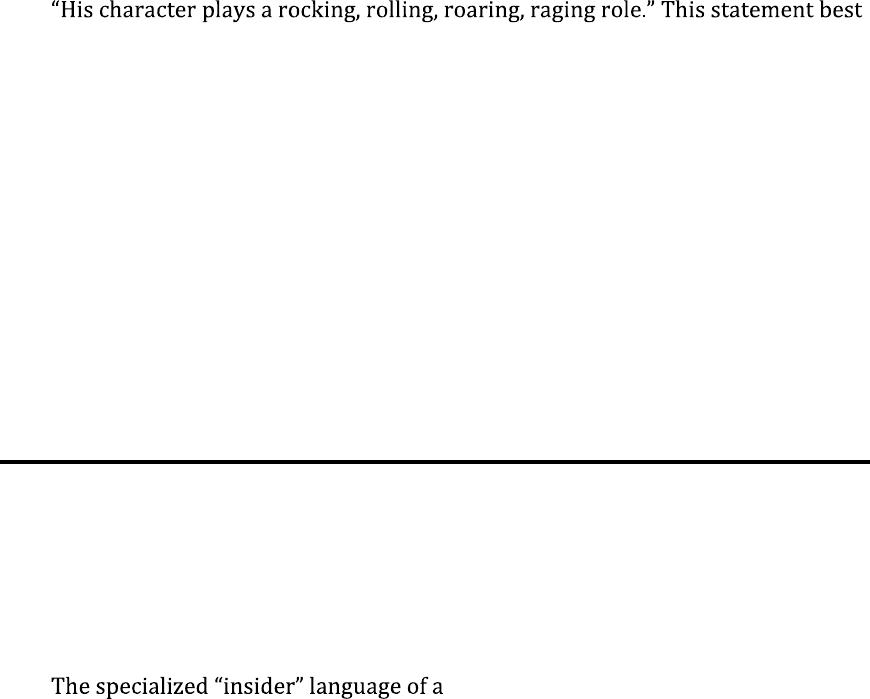
A) hackneyed language. C) alliteration.
B) parallelism. D) epiphora.
37. One way that a speaker can leave a lasting impression on listeners is to
incorporate oral language that is artfully arranged and infused with rhythm.
One device that helps a speaker accomplish this is
A) repetition. C) analogy.
B) personification. D) parallelism.
38.
illustrates which of the following techniques?
A) anaphora C) personification
B) metaphor D) alliteration
39. Parallelism can be used by a speaker
A) to emphasize important ideas in the speech.
B) to create a sense of steady or building rhythm.
C) to create a powerful, poetic effect for the audience.
D) All of the options are correct.
FILL-IN-THE-BLANK QUESTIONS
40. Speeches make much more frequent use of repetition and transitions than do
most forms of ______ communication.
41. ______ communication is generally more interactive than written language.
42. given profession is called ______.
43. ______ language is specific, tangible, and definite.
44. ______ language is general or nonspecific, leaving meaning open to
interpretation.
45. A(n) ______ explicitly compares one thing to another, using like or as to do so.
46. A(n) ______ compares two things, but does so by describing one thing as actually
being the other.

47. A(n) ______ compares an unfamiliar concept or process to a more familiar one to
help audience members understand the unfamiliar one.
48. ______ refers to endowing abstract ideas or inanimate objects with human
qualities.
49. ______ uses obvious exaggeration to drive home a point.
50. A(n) ______ is the inadvertent use of a word or a phrase in place of one that
sounds like it.
51. The ______ meaning of a word is its literal, or dictionary, definition.
52. The ______ meaning of a word is the special association that different people
bring to bear on it.
53. A(n) ______ is predictable or stale comparison.
54. ______ expressions are sayings that are specific to a certain region or group of
people, and so may be confusing to listeners.
55. ______ is the repetition of the same sounds, usually initial consonants, in two or
more neighboring words or syllables.
ESSAY AND SHORT ANSWER QUESTIONS
56. List three ways in which spoken and written language differ.
57. Explain why speakers should strive for simplicity in language.
58. When is it appropriate for a speaker to use jargon, and why?
59. Why are speeches that contain mostly concrete words and phrases more
effective than speeches that rely solely on abstract language?
60. How can a speaker create vivid imagery for the audience?
61. Explain the difference between a metaphor and a simile, and give an example of
both.
62. Define personification and give an example.
63. Define hyperbole and give an example.
64. Why is it important for a speaker to understand the connotative meanings of
words?
65. What is the active voice? Give an example of the same sentence in first the
passive voice and then the active voice.
66. Provide two examples of clichés.
67. Explain and give an example of a rhetorical device that a speaker can use to
create effective rhythm and a lasting impression in his or her speech.
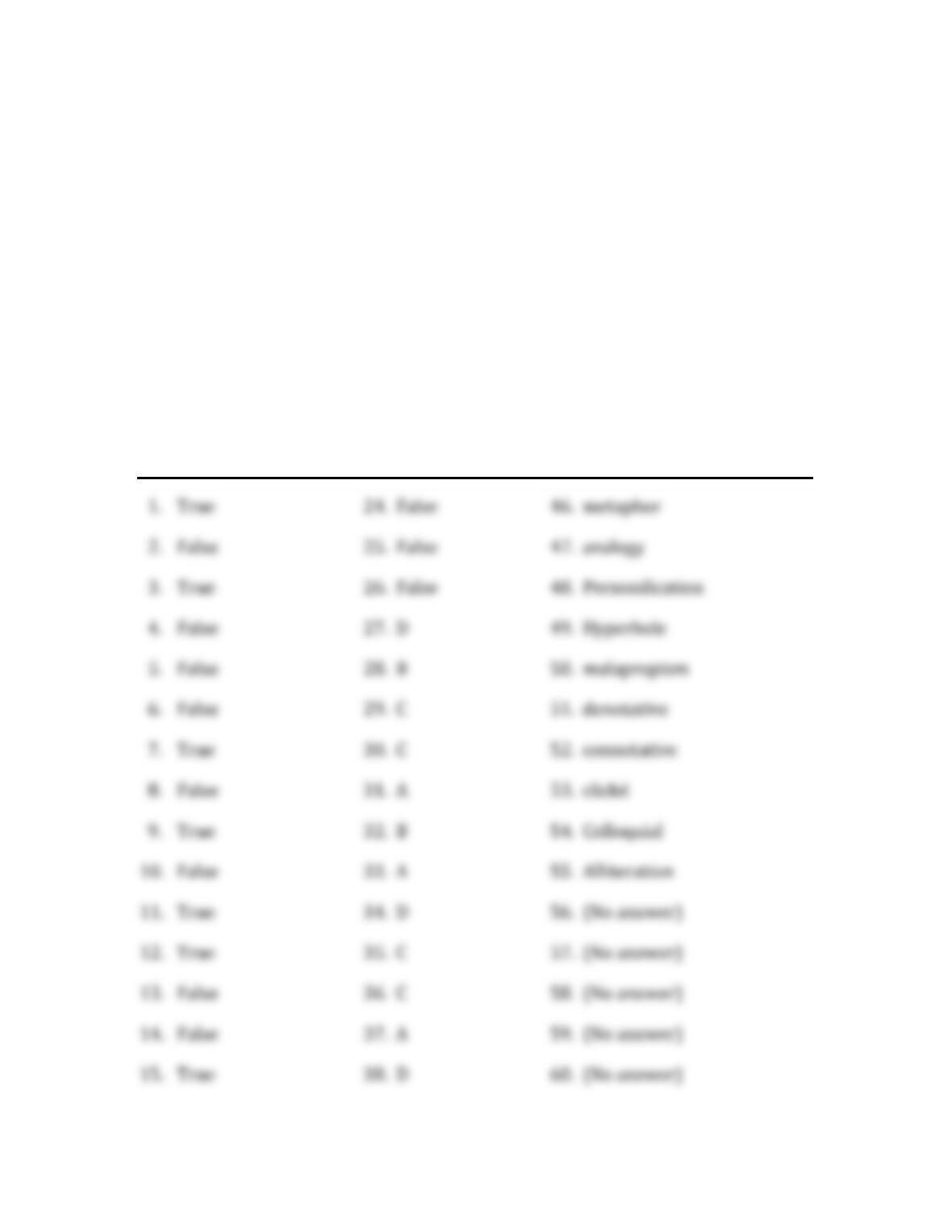
ANSWER KEY FOR CHAPTER 16