Becoming a Public Speaker 1
TRUE/FALSE QUESTIONS
1. Learning to speak effectively can enhance your career as a student and help you
advance your professional goals.
2. Oral and written communication skills top the list of job skills most employers
seek in college graduates.
3.
4. Public speaking skills will prevent you from entering the public conversation
about social concerns.
5. The practice of oratory, or rhetoric, emerged full force in Greece in the fifth
century B.C.E.
6. The Greeks referred to legal speech as epideictic oratory.
7. According to Aristotle and other classical rhetoricians, memory is one of the five
canons of rhetoric.
8. Delivery refers to adapting speech information to the audience in order to make
your case.
9. The five canons of rhetoric are invention, adaptation, arrangement, timing, and
delivery.
10. feedback.
11. Unlike dyadic communication, public speaking usually occurs in formal
settings.
12. The source is the person who receives the message.
13. The process of converting thoughts into words is termed encoding.
14. The receiver decodes, or interprets, the message.

15. Audience members often sel
message.
16. The content of a message can be expressed both verbally and nonverbally.
17. Another term for noise is interference.
18. Noise is the medium through which a speaker sends a message.
19. The channel is the content of the communication process.
20. Shared meaning is the mutual understanding of a message between speaker
and audience.
21. Context includes any outside factors that influence the speaker, the audience, or
the occasion.
22. The circumstance that calls for a public response is known as the rhetorical
situation.
23. A speech does not need a clearly defined goal to be effective.
24. Public speaking is similar in many ways to engaging in an important
conversation.
25. Effective speaking and effective writing both require a sense of who the
audience is.
26. In general, speakers use more unfamiliar words and complex sentences than do
writers.
27. Public speakers must learn to cultivate their cultural intelligence.
MULTIPLE-CHOICE QUESTIONS
28. Benefits of public speaking do not include
A) gaining real-life skills.
B) advancing professional goals.
C) improving budgetary skills.
D) enhancing your career as a student.

29. The Athenians demonstrated their oratorical talent in a public space called a(n)
A) public forum. C) city-state.
B) deliberative forum. D) agora.
30. The Greeks referred to legislative or political speech as
A) epideictic oratory. C) forensic oratory.
B) deliberative oratory. D) informative oratory.
31. Which of the following is not one of the five canons of rhetoric?
A) invention C) persuasion
B) delivery D) arrangement
32. Invention refers to
A) developing information for your audience in order to make your case.
B) the way the speaker uses langua
C) practicing the speech until it can be artfully delivered.
D) None of the options are correct.
33. A form of communication between two people is called
A) mass communication. C) dyadic communication.
B) small group communication. D) public speaking.
34. In this form of communication, the receiver is physically removed from the
messenger, and feedback is delayed.
A) mass communication C) public speaking
B) small group communication D) dyadic communication
35. Factors that distinguish public speaking from other forms of communication
include
A) opportunities for feedback. C) degree of formality.
B) level of preparation. D) All of the options are correct.
36. Which of the following is the most formal type of communication?
A) small group communication
B) dyadic communication
C) public speaking
D) mass communication
37. Converting thoughts into words is called
A) encoding. C) receiving.
B) decoding. D) channeling.
38. message is
A) the encoder. C) the receiver.
B) the channel. D) the sender.
39.
is referred to as
A) shared meaning. C) the medium.
B) feedback. D) decoding.
40. Anything that influences the speaker, the audience, the speech, the occasion, or
the situation is called
A) context. C) the outcome.
B) shared meaning. D) the communication process.
41. To learn public speaking, you can draw on skills that you already possess from
these two types of communication:
A) interviewing and arguing.
B) small group communication and conversation.
C) mass communication and composition.
D) conversation and composition.
42. How does spoken language differ from written communication?
A) Speakers use unfamiliar words and complex sentences.
B) Oral language is less interactive than written language.
C) Speakers make more references to themselves and to the audience.
D) Written communication is far more formal than spoken language.
FILL-IN-THE-BLANK QUESTIONS
43. The practice of giving speeches was originally known as ______, also called
oratory.
44. In the Roman republic, citizens met in a public space called a(n) ______.
45. ______ is the canon of rhetoric that refers to discovering types of information to
make your case to an audience.

46. A form of communication between two people, such as a conversation, is
termed ______ communication.
47. ______ is the process of interpreting a message.
48. verbal or nonverbal response to a message.
49. ______ is any interference with the message; this disruption to communication
may be physical, psychological, or environmental.
50. The mutual understanding of a message between the speaker and the audience
is called ______.
51. The ______ is the circumstance that calls for a public response.
52. The language, beliefs, values, norms, behaviors, and material objects that are
passed on from one generation to the next are termed ______.
53. Cultural ______ means being skilled and flexible about understanding a culture.
ESSAY AND SHORT ANSWER QUESTIONS
54. List and explain three benefits of public speaking.
55. How does public speaking training enhance your career as a student?
56. Explain how developing public speaking skills can help you become a more
engaged citizen.
57. List and describe three of the five canons of rhetoric.
58. Discuss the shared characteristics of mass communication and public speaking.
59. Explain how public speaking is similar to conversation.
60. List and describe one similarity and one difference between public speaking
and small group communication.
61. Explain why public speaking is usually more formal than other types of
communication.
62. Give two examples of noise in a public speaking situation.
63. List and describe the elements of the communication process.
64. Define speech context and rhetorical situation.
65. What does it mean to develop an effective oral style?
66. What is culture, and why should a speaker consider it when preparing a
speech?
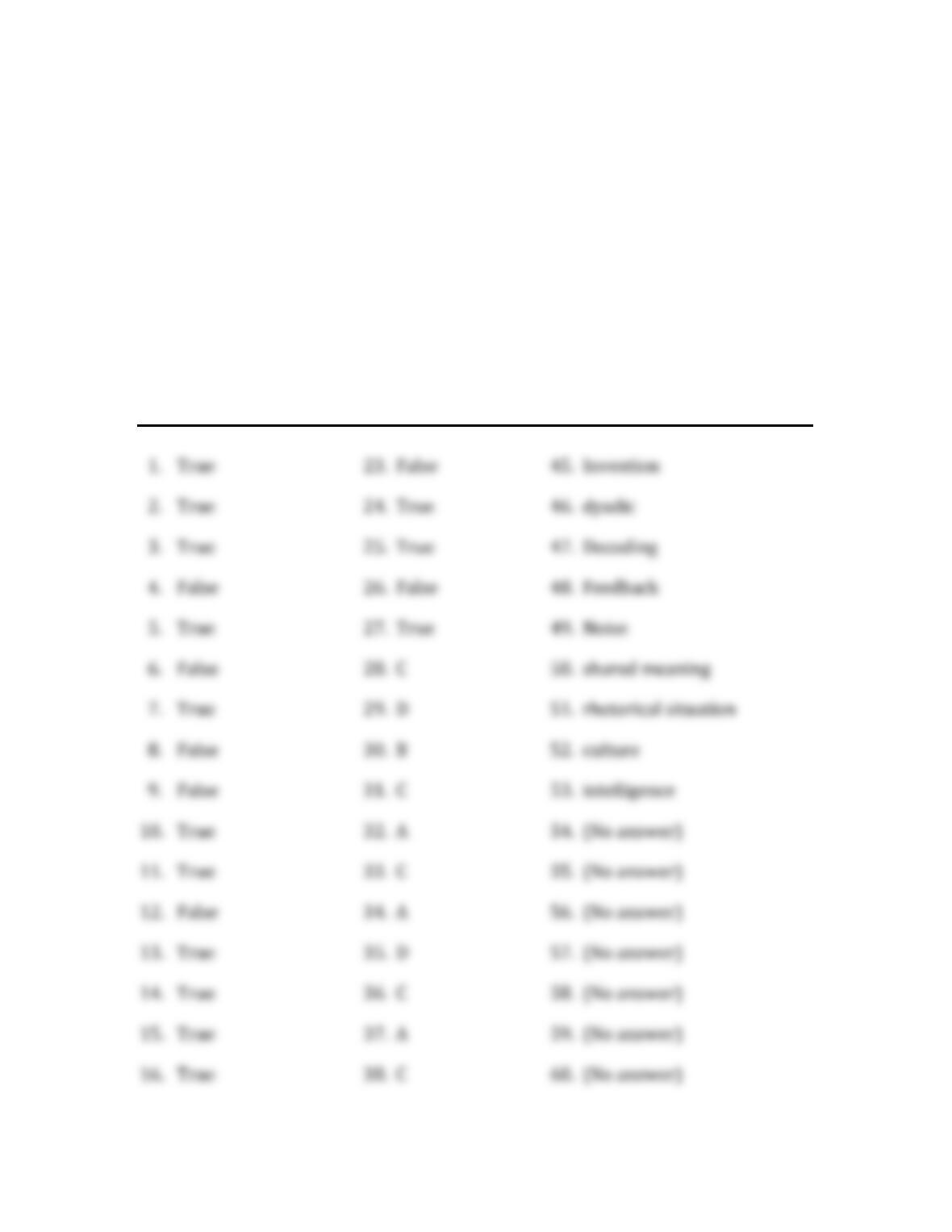
ANSWER KEY FOR CHAPTER 1