CHAPTER 1: Democratic Citizenship and the Ethics of Public Speaking
Multiple-Choice Questions
1.
democracies?
A) U.S. citizens vote in far greater numbers than those in other democracies.
B) U.S. citizens vote in slightly higher numbers than those in other democracies.
C)
D) U.S. citizens trail all other democracies.
2. Reading newspapers, voting in elections, and participating in voluntary and civic associations
are all signs of ___________.
A) civic engagement
B) widespread apathy
C) deteriorating democracy
D)
3.
A) the attempted assassination of President Reagan
B) the terrorist attacks of September 11, 2001
C) the success of unmanned missions to Mars
D)
2
4. A recent survey of incoming college freshmen revealed __________ level of political interest
since the survey began in the 1960s.
A) the lowest
B) a slightly decreased
C) an unchanged
D) the highest
5.
political activities, like circulating petitions or supporting political candidates, is because
__________.
A) as a community volunteer, we immediately see the tangible impact we have made
B) the work of a petitioner often requires more hours than we wish to expend
C) supporting a political candidate often requires more hours than we wish to expend
D) as a community volunteer, we enjoy competing with other volunteers and causes
6.
accurate?
A) Many of the problems we face are, in the final analysis, political problems.
B)
C) Since citizens have less power than politicians, they ultimately should seek office.
D) Since citizens have less power than legislators, they should become lobbyists.
7. To get involved in politics today and make a difference, one must __________.
A) learn to talk in a loud, combative style in order to be heard and taken seriously
B) learn to become completely certain that you are right and your opponent is wrong
C) learn to speak in a manner that fosters respect and helps find solutions to problems
D) –
8. When activists emerge who are highly passionate about a particular cause, a healthy response
is to __________.
A) criticize them for their radical view
B) ask that they be made silent
C) allow them to have their say
D) communicate forcefully and proactively to drown out their voice
9. __________ helps citizens recognize the difference between an informed opinion and one
grounded in ignorance and prejudice, as well as to formulate a better opinion themselves.
A) Listening to their favorite radio talk show personality for talking points
B) Religiously viewing cable news shows that reflect their ideological view
C) Keeping up with current events from multiple, credible sources and weighing all arguments
D) Attending a political rally for the candidate of their choice during a political campaign
10. During a question-and-answer session after a speech in which she had advocated school
uniforms for students, Randi politely and open-mindedly listened as fellow citizens raised
behavior reveals her __________.
A) commitment to respect the opinions of others
B) inability to effectively debate her position when challenged
C) willingness to pander to her listeners to maintain her image
D) lack of conviction in her own position
4
11. In the mid-1990s, which issue prompted 85-year-old Doris Haddock to walk across the
United States, addressing citizens along the way to rally their support?
A) campaign finance reform
B) prescription drug benefits for seniors
C) Social Security reform
D) Medicare and Medicaid reform
12. __________ has long been considered an important part of democratic citizenship.
A) The ability to contribute campaign dollars
B) The ability to communicate in public
C) The ability to hold a political office
D)
13. What are the implications of living in a diverse, multicultural society?
A) We can no longer discuss important issues and find common ground.
B) It is more important than ever that we rise above our own selfish interests.
C) We no longer face the same problems but a different, more subtle set.
D) We do not share the same dreams and aspirations as our fellow citizens.
14. If we hope to resolve the difficult problems we face, we must __________.
A) increase the decibel level of American politics
B) score enough political points to defeat opponents
C) find a way to silence the highly passionate voices
D) learn to deliberate together and find common ground
15. Public speaking in a democratic society must be __________.
A) grounded in a strong code of ethics and a commitment to the public good
B) careful to avoid tough political issues that some might find offensive
C) loyal to the views of an established political party, even when controversial
D) effective in discouraging dissent and criticism in an attempt to achieve consensus
16. What are the implications for us given that we reside in –
A) We can take great confidence in knowing our society is more informed than ever.
B) We must rely on our government and religious leaders to interpret media content.
C) We can rely on consumer watchdogs to protect us against those who would deceive us.
D) We must learn to distinguish between a reasonable argument and an attempt to deceive.
17. Jerome took classes in public speaking and history, and he reads widely about current events
from reputable news agencies. As a result, he honed his ability to evaluate claims, weigh all the
evidence, and come to reasoned conclusions based on a careful examination of the arguments on
all sides of an issue. Jerome has become __________.
A) a citizen-critic
B) a consumer watchdog
C) a proponent of competing claims
D) an advocate skilled in manipulation
18. Bruce Cole, former chairman of the National Endowment for the Humanities, laments that
A) clouds our vision of the future
B)
C) threatens our ability to excel in science and math
D) requires that we convene a new Constitutional Convention
19. To what extent do we profit from a study of history?
A) We profit greatly, by better understanding various issues as well as our principles.
B) We profit moderately, by better understanding our failures a
C) We profit little, since all events are tied to a particular place and time.
D) We profit none, since history is written from a viewpoint and can mislead.
20. American history is, in large measure, a history of people who made a difference by ____.
A) speaking out
B) silencing their opponents
C) following, without question, elected officials
D) outspending their opponents during campaigns
21.
A) Cite the source only if doing so would bolster your own credibility.
B) There is no need to cite a source since you are using your own words.
C) Cite the source only if the audience would be familiar with the source.
D) Cite a source any time you ha
22. Desari is uncertain whether she should cite a source regarding how survival rates have
dramatically improved the past few decades for several types of cancer. She thinks the progress
should be common knowledge and, hence, require no use of source material, but she is not sure.
What would you advise her to do for her speech?
A) Trust your instincts that such progress is, indeed, common knowledge.
B) Know such progress is common knowledge and your classmates should know so.
C) Ask for a show of hands during your speech to discern whether to cite a source.
D) Verify what you believe in one or more reputable sources and cite one of them.
23.
increase until they have raised the minimum wage. He used the idea in his speech, choosing to
paraphrase rather than quote the senator
while presenting that idea?
A) Using his own wording removes the need to acknowledge the senator.
B)
C) He should cite the senator only if the senator is someone his listeners respect.
D) He should quote the senator verbatim, rather than dare use other language.
24. Joe is trying to finish his speech about gun control. He reads on a blog that death rate due to
gun violence has risen 12% in the last year but cannot figure out how the blogger arrived at the
number. What is the best choice Joe can make?
A) Cite the blogger, but not mention that she is a blogger and not an expert.
B) Paraphrase the statistic in his own words instead of citing it directly.
C) Keep searching for a better source on gun violence, rather than cite the blogger.
D) Cite the blogger, but mention that she is a blogger and not an expert.
8
25. Jayson Blair is no longer a New York Times reporter. His blatant use of stolen and fabricated
stories led not only to his own forced resignation, but also to the resignations of two high-
ranking editors at the Times. What can we learn from this incident?
A) We can no longer trust the mainstream news media to tell the truth.
B) e readership.
C) Our society has become increasingly obsessed with punishing white collar crime.
D) Penalties for plagiarism are severe and the consequences can be devastating.
26. Jodhaa has carefully researched the factors contributing to why several labor unions have
fewer members than before and is confident that his conclusions are thoughtful and fair. He is to
speak on a panel with others who have analyzed the trends and may or may not agree with his
analysis. What advice would you give Jodhaa and his fellow panelists?
A) Recognize that the time to be open-minded is during preparation, not during speeches.
B) If others have reached different conclusions, there must be a problem with their math.
C) Given your confidence, hold steadfast to your opinion until others adopt your view.
D) You may need to reevaluate your opinion in light of new information others present.
27. Robbi wants to persuade local business leaders to contribute to Toys for Tots. He asks you
to critique his speech as he practices. In the speech, Robbi cites statistics, reminding listeners of
how many jobs had recently been lost in the community, and how the number of those living
below the poverty level had increased. He notes that many cannot afford the basic necessities,
let alone gifts for Christmas. As he concludes, Robbi recalls how he had felt one Christmas, as a
child, when all his parents could afford to get him was a new belt from the dollar store. He asks
listeners to imagine children in their own community watching commercial after commercial of
gifts going to good kids while they receive none. Ho
emotional appeal as he ends the speech?
A) He has made a self-interested appeal, traceable to his childhood.
B) He has enlisted a demagogic tactic to try to influence listeners.
C) His emotional appeal is ethical and could be a powerful motivator.
D) His emotional appeal is ethical but should be avoided to establish objectivity.
9
28. The talk show host told his listeners that if they did not vote for a particular candidate, they
would betray all things good and moral. He denounced the other candidate as morally inferior,
would not allow anyone to take her seriously. In light of these pronouncements, we could
consider the talk show host to be __________.
A) a patriot
B) a demagogue
C) a citizen-critic
D) a rhetorical critic
29. During a public debate over whether companies who use hydraulic fracturing to extract
natural gas should disclose the chemicals they use, an advocate against requiring such
-hugging liberal who would protect the livelihood
in name-calling, the advocate __________.
A) recognizes that due to the many special interest groups that exist, we must profile others with
name-calling if we are to preserve liberty
B) embraces his duty to talk loudly and with heightened passion so those with other views will
be unable to drown out his voice
C) reminds us all of the importance of labeling opponents in such a way as to undermine their
credibility and distract from their argument
D) fails to recognize or appreciate that demeaning those with different points of view can, in
effect, silence them and undermine democratic debate
30. During a public debate over whether their public school should require student uniforms, an
advocate against uniforms referred to her op
By engaging in name-calling, the advocate __________.
10
A) recognizes that due to the many special interest groups that exist, we must profile others with
name-calling if we are to preserve liberty
B) embraces her duty to talk loudly and with heightened passion so those with other views will
be unable to drown out her voice
C) reminds us all of the importance of labeling opponents in such a way as to undermine their
credibility and distract from their argument
D) fails to recognize or appreciate that demeaning those with different points of view can, in
effect, silence them and undermine democratic debate
True/False Questions
31. al orator was someone who could promote their own interest while
convincing their audience that it was for the common good.
32.
instances of plagiarism.
33. When paying tribute to the astronauts of Challenger, whose crew perished during the
f, President Reagan delivered a speech written predominately by Peggy Noonan,
a professional speechwriter on his staff. In this instance, he is not required to cite her as the
author of the speech unless directly asked.
34. Your most basic ethical obligation as a speaker is to avoid using emotional appeal when
debating.
35. Mandy like
than to
rather than quote the famous author verbatim. By using her own wording, she removes the need
to acknowledge Douglass.
36. When deliberating with others, you must be completely objective, ridding yourself of all
bias.
37.
a public forum are less interested in where you got your information or how carefully you
prepared.
38. deliberating with others with a view toward arriving at sound
collective decisions.
39. When it comes to free speech, as with any civil liberty, we all generally recognize there
must be some limits to free speech.
12
40.
ple of an ad hominem attack.
41. You are ethically obligated to give credit where credit is due for ideas or language that you
borrow from others.
42. One of the major themes of Hill th National Prayer
Breakfast was the need for more civility and cooperation among people of differing views.
43. A truly successful citizen-speaker prioritizes his or her ideas over being a responsible,
ethical person.
Essay Questions
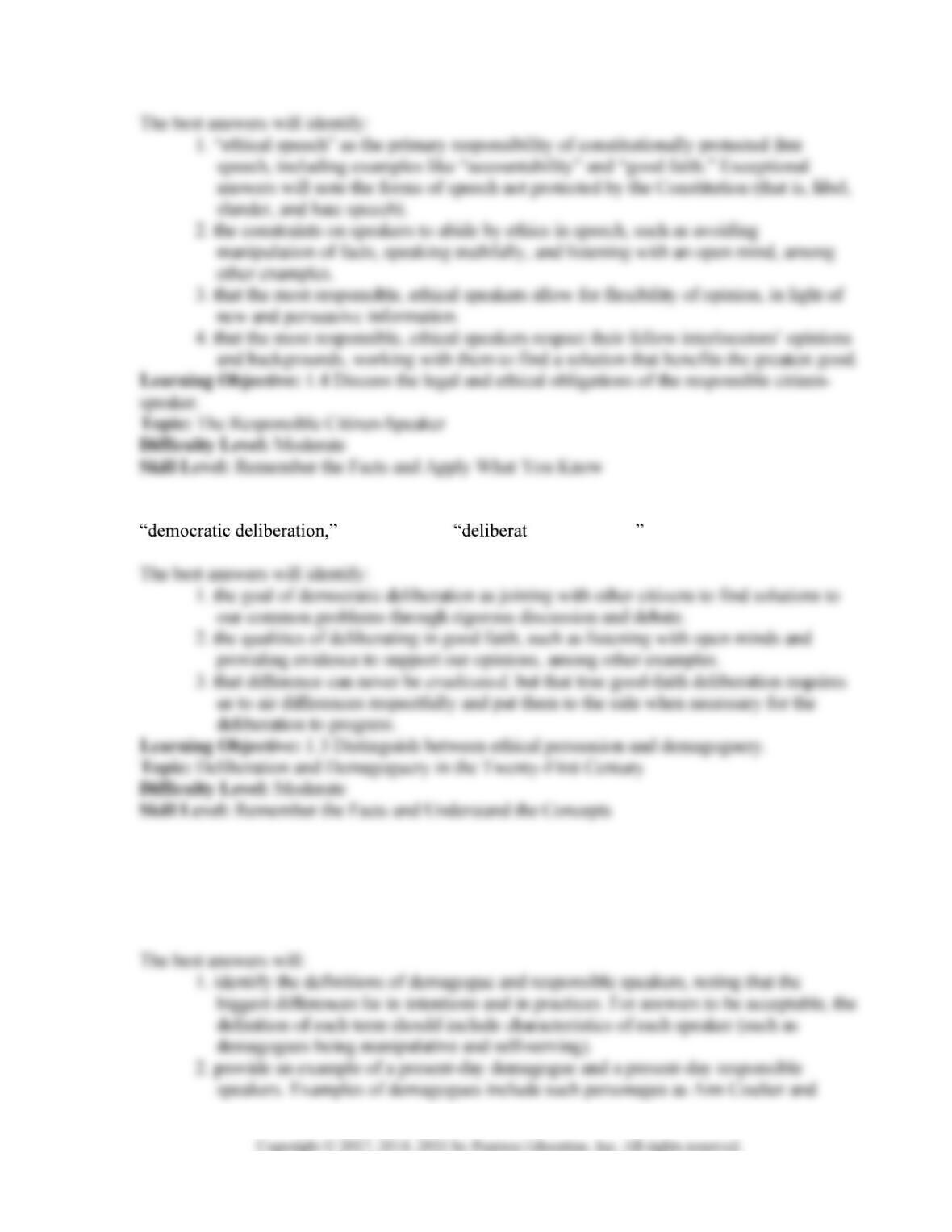
44. The right to free speech in a democratic society carries with it certain responsibilities. What
are those responsibilities, and how do those responsibilities affect speakers ability to advocate
for their ideas?
13
45. The goal of citizenship within a democracy is democratic deliberation. What do we mean by
and what does e in good faith entail?
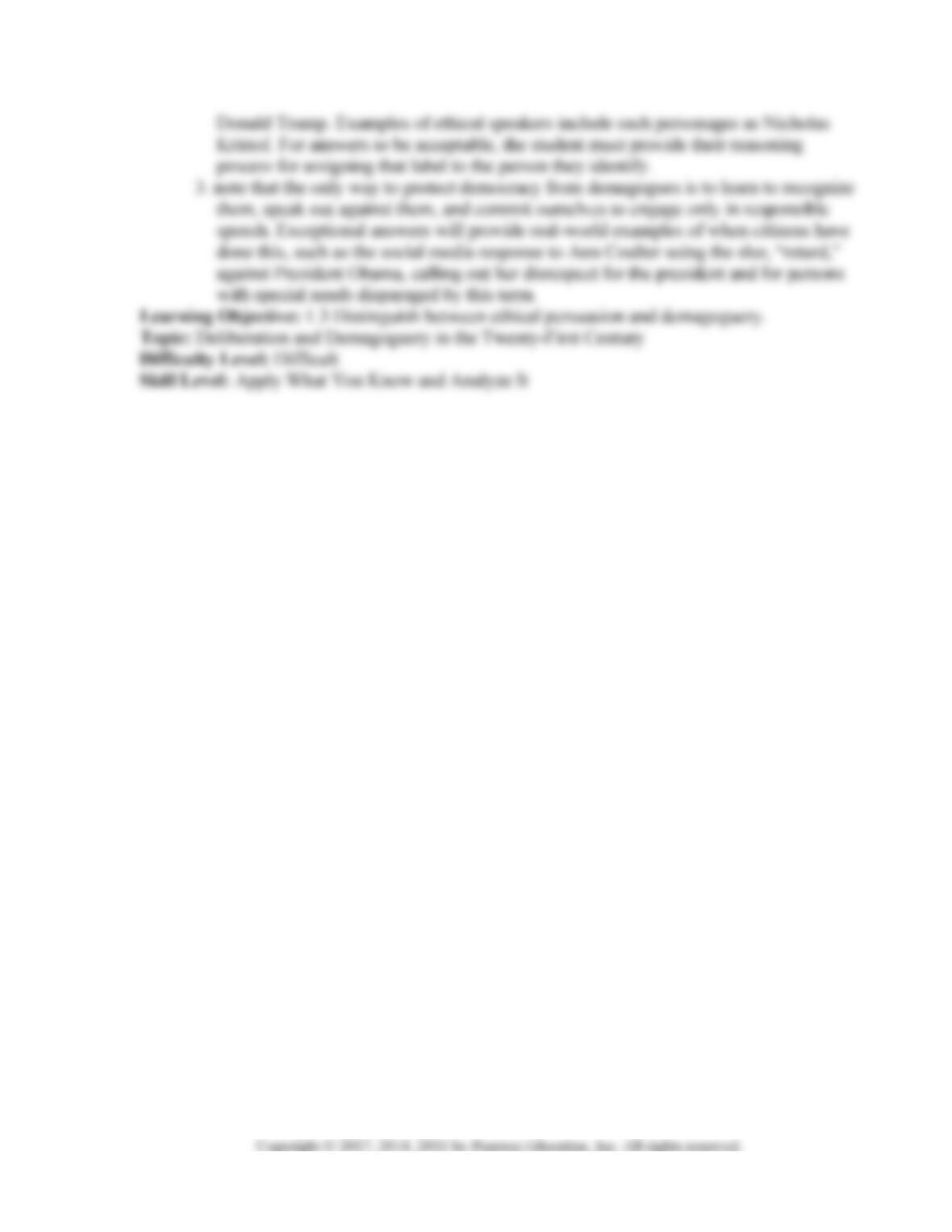
46. Explain the differences between a demagogue and a responsible speaker. Whom would you
identify as an example of present-day demagogue and as an example of a present-day
responsible speaker? Why do you think each deserves that label? How we can safeguard our
democracy against the influence of demagogic voices?
14