1. Dimension is a physical quantity, such as length, time, mass, or temperature, that makes it
possible for us to communicate.
a. True
b. False
2. We need not only physical dimensions to describe our surroundings but also some way to
scale or divide these physical dimensions.
a. True
b. False
3. What is the difference between “dimensions” and “units?”
4. Which of the following are fundamental dimensions:
a. area, volume, power, pressure, energy
b. temperature, time, mass, length
c. force, energy, power, weight
d. heat, power, power, weight
e. electric resistance, electrical voltage, electric power
5. Which of the following are fundamental SI units?
a. seconds, meters, liters
b. seconds, meters, grams
c. Newton, seconds, kilograms
d. seconds, kilograms, Kelvins
e. hours, meters, Watts

Test Bank Engineering Fundamentals, 5th ed. Chapter 6
6. Which of the following are fundamental British Gravitational units?
a. seconds, meters, liters
b. pound force, seconds, feet
c. Newton, seconds, kilograms
d. seconds, kilograms, Kelvins
e. hours, meters, Watts
7. Which of the following are U.S. Customary units?
a. gallons, yards, horsepower
b. barrels, Fahrenheit, Watts
c. acres, hectares, liters
d. cubic yards, Pascals, Joules
8. Write the fundamental SI units adjacent to each of the fundamental dimension given.
Length _________
Temperature _________
Electrical Current _________
Time _________
Luminous intensity _________
Mass _________
Amount of a substance _________
9. One slug is equal to
a. 32.2 lbm
b. 1 lbm
c. 1/32.2 lbm
d. None of the above
10. How many times does the average human heart beat during an average lifetime (75 years)?
11. The ice at a certain hockey rink is made by freezing water that is 1.5 inch deep. How many
gallons of water does it take? Approximate the rink as a
ft200
by
ft85
rectangle.
12. Convert the information given in the table below from SI units to U.S. Customary units.
SI Units
U.S. Customary Units
90 km/h
hr
miles
and
sec
ft
30 m/s
hr
miles
and
sec
ft
20 m
ft
20 kg
m
lb
SI Units
U.S. Customary Units
90 km/h
55.9 miles/h and 82 ft/s
20 m
65.6 ft
20 kg
44 lbm
13. Convert the information given in the table below from SI units to the U.S. customary units.
SI Units
U.S. Customary Units
3
2700 m
kg
3
ft
lbm
N500
f
lb
kPa 3.101
psi
SI Units
U.S. Customary Units
14. Convert the information given in the table below from the U.S. customary units to SI units.
U.S. Customary Units
SI Units
60 mph
hr
km
and
s
m
24000 Btu/h
W
100 miles
m
and
km
U.S. Customary Units
SI Units
60 mph
96.5 km/h and 26.8 m/s
24000 Btu/h
7033 W
100 miles
161000 m and 161 km
15. Convert the information given in the table below from the U.S. customary units to SI units.
U.S. Customary Units
SI Units
2
2.32 s
ft
2
s
m
60 psi
Pa
180 lbf
N
Answers:
60 psi
413685 Pa
180 lbf
800 N
16. Calculate the number of gallons of water that will fit into an aquarium with dimensions:
ftftft 532
17. The friction force between two surfaces is modeled using the following equation:
Nf
=
where
=f
friction force in
f
lb
=
coefficient of friction
=N
normal force in
f
lb
What is the appropriate unit for
if the preceding equation is to be homogeneous in units?
18. The amount of time it takes for an object bounce up and down through one complete cycle is
called the “period” and is calculated using the following equation:
k
m
T
2=
where
=T
period in seconds
=m
mass of object in kilograms
=k
spring rate
What is the appropriate unit for k if the preceding equation is to be homogeneous in units?
19. The fundamental frequency of a vibrating guitar string is modeled by the following equation:
T
L
f2
1
=
where
=f
vibration frequency in Hertz
=L
length of string in meters
=T
string tension in Newtons
=
string density
What is the appropriate unit for
if the preceding equation is to be homogeneous in units?
20. The speed of sound in a fluid can be calculated using the following equation:
B
v=
where
=v
speed of sound in
s
m
=B
bulk modulus
=
fluid density in
3
m
kg

Test Bank Engineering Fundamentals, 5th ed. Chapter 6
What is the appropriate unit for B if the preceding equation is to be homogeneous in units?
21. When an aluminum cookie sheet is placed in an oven and heated up, it expands due to the
temperature change. The change in area of the cookie sheet is modeled using the following
equation:
TAA =
0
where
=A
change in area in
2
in
=
0
A
original area in
2
in
=
area coefficient of thermal expansion
=T
change in temperature in
F
What is the appropriate unit for
if the preceding equation is to be homogeneous in units?
22. The force between two charged particles can be calculated using the following equation:
2
21
r
qq
kF =
where
=F
force in Newtons (N)
k = electrostatic constant
=
1
q
charge of particle #1 in Coulombs (C)
=
2
q
charge of particle #2 in Coulombs (C)
=r
distance between particles in meters (m)
What is the appropriate unit for k if the preceding equation is to be homogeneous in units?

23. The amount of heat needed to change the temperature of an object can be calculated using the
following equation:
TmcQp=
where
=Q
amount of heat in Joules (J)
=m
mass of object in kilograms (kg)
=
p
c
specific heat of object
=T
change in temperature in °C
What is the appropriate unit for
p
c
if the preceding equation is to be homogeneous in units?
24. The conduction heat transfer rate through a wall is modeled by the following equation:
T
L
A
kQ =
where
=Q
heat transfer rate in
hr
Btu
=k
thermal conductivity of the wall
=A
area of the wall in
2
ft
=L
wall thickness in
ft
=T
steady-state temperature difference between the inside and the outside surfaces of
the wall, in
F
What is the appropriate unit for k if the preceding equation is to be homogeneous in units?
25. The absolute pressure of a fluid point at a certain depth can be calculated using the following
equation:
ghPP atm
+=
where
=P
absolute pressure of the fluid
( )
Pa
Test Bank Engineering Fundamentals, 5th ed. Chapter 6
=
atm
P
atmospheric pressure
( )
Pa
=
density of fluid
=g
gravitational acceleration,
2
8.9 s
m
=h
depth of the point below the fluid surface
( )
m
What is the appropriate unit for
if the preceding equation is to be homogeneous in units?
26. Determine the number of significant digits for the following numbers:
Number of Significant Digits
7.8
11
10673.3 −
109.3
0.003856
Answers:
109.3
4
0.003856
4
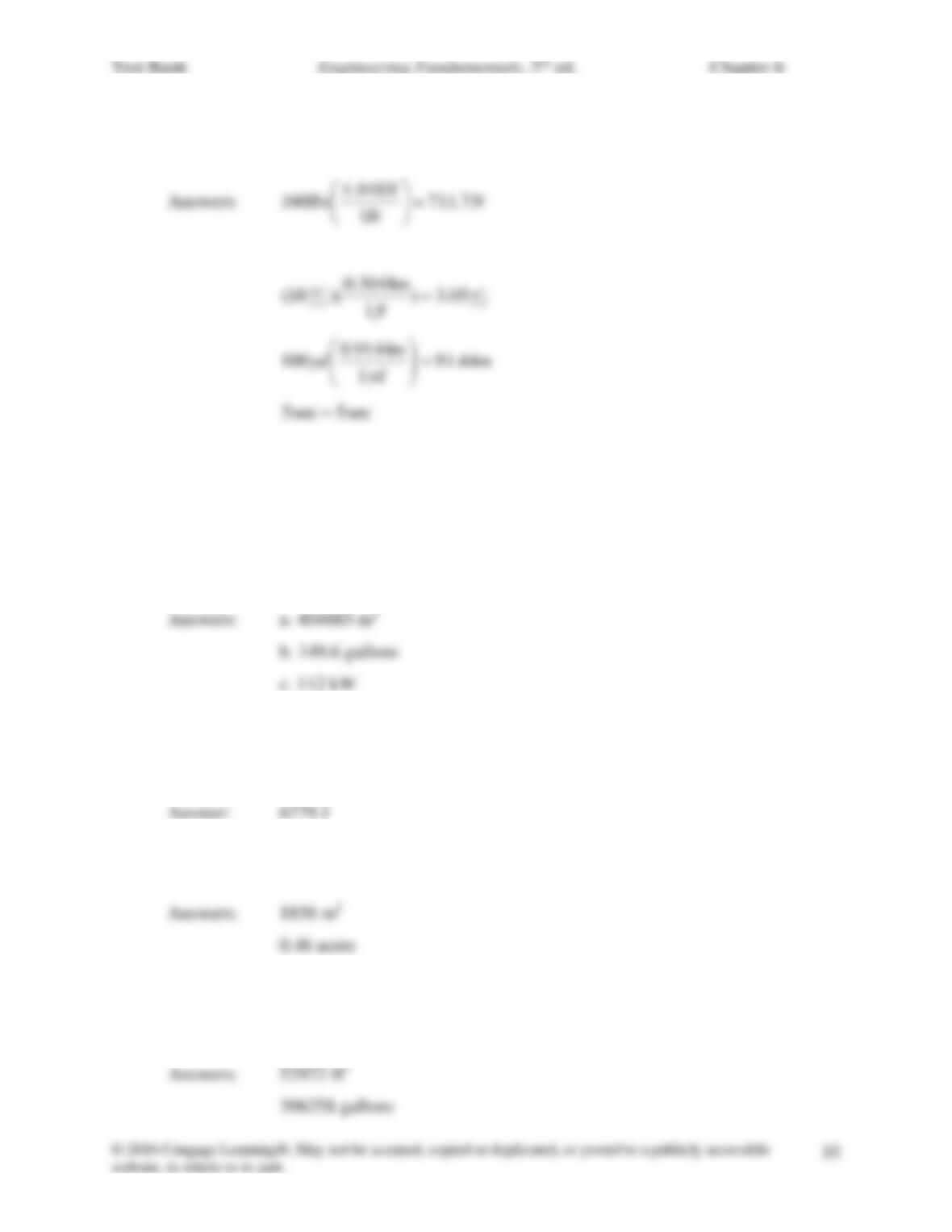
27. An engineering professor weighs 200 lbf. Express the mass and the weight of the professor
in SI and U.S. Customary units.
28. A motorcyclist who weighs 160 lbf accelerates his motorcycle at a rate of 10 ft/s2 over a
distance of 100 yards in 5 seconds. Convert all of the values given to SI units.
29. Convert the following:
a.
acresarea 100=
to
2
m
b.
3
20 ftvolume =
to gallons
c.
horsepowerpower 150=
to kW
30. Express the work done [work = (force)(distance)] by a 100 lbf force exerted over a distance
of 50 ft using SI units.
31. A parking lot is
ft200
long by
ft100
wide. Express the area of the garden in m2and acres.
32. A swimming pool is 50 m long, 10 m wide and 3 m deep. Express the volume of the water in
the swimming pool in ft3 and gallons.

33. An individual running on a treadmill machine generated an average power of approximately
0.27 hp. Express this power in Watts.
34. The density of steel is approximately 7600 kg/m3. Express the density in BG and U.S.
Customary units.
35. A one degree temperature difference in Fahrenheit is equal to one degree temperature
difference in Celsius.
a. True
b. False
36. A one degree temperature difference in Fahrenheit is equal to one degree temperature
difference in Rankine.
a. True
b. False
37. A one degree temperature difference in Celsius is equal to one degree temperature difference
in Kelvin.
a. True
b. False
38. A barrel can hold 42 gallons of oil. How many liters of oil are in the barrel?
a. 15.9 liters
b. 42 liters
c. 159 liters

Test Bank Engineering Fundamentals, 5th ed. Chapter 6
d. 4.2 liters
39. The Btu (British thermal unit) is defined as the amount of heat required to raise the
temperature of 1 lbm of water by 1°F. If a home has a furnace that is rated at 1000 Btu/min what
is this rating in kW?
a. 17.584 kW
b. 17584 kW
c. 293 kW
d. 0.293 kW
40. The acceleration due to gravity at the surface of the moon is approximately 1/6 of the earth’s.
The acceleration due to gravity at the surface of moon is equal to:
a. 1.6 ft/s2
b. 64 in/s2
c. 5.4 m/s2
d. none of the above
41. A 500 sheet rim of copy paper has a thickness of 2.25 inch. What is the average thickness of
each sheet in mm?
a. 0.11 mm
b. 1.1 mm
c. 11 mm
d. none of the above
42. What is the SI unit for momentum?

Test Bank Engineering Fundamentals, 5th ed. Chapter 6
a. kg.m/s
b. N.m/s
c. m/s2
d. m2/s
42. What is the SI unit for angular velocity?
a. m/s
b. rad/s
c. cm/s
d. mm/s
43. What is the SI unit for pressure?
a. Pa
b. N/m2
c. kg/m.s2
d. All of the above
44. What is the SI unit for power?
a. W
b. J/S
c. kg.m2/s3
d. All of the above
45. What is the SI unit for torque?
a. N.m
b. kg.m

Test Bank Engineering Fundamentals, 5th ed. Chapter 6
c. N/m
d. kg/m