
Test Bank Engineering Fundamentals, 5th ed. Chapter 20
1. Economic factors always play important roles in engineering design decision making.
a. True
b. False
2. Visual aids that show the flow of costs and revenues over a period of time are known as
a. cash flow diagrams.
b. cost – revenue diagrams.
c. Venn diagrams.
d. business plans.
3. The interest that would be paid only on the initial borrowed or deposited amount is
a. initial interest.
b. simple interest.
c. compound interest.
d. present value interest.
4. When the interest paid on the initial principal also collects interest, this is called
a. initial interest.
b. simple interest.
c. compound interest.
d. present value interest.
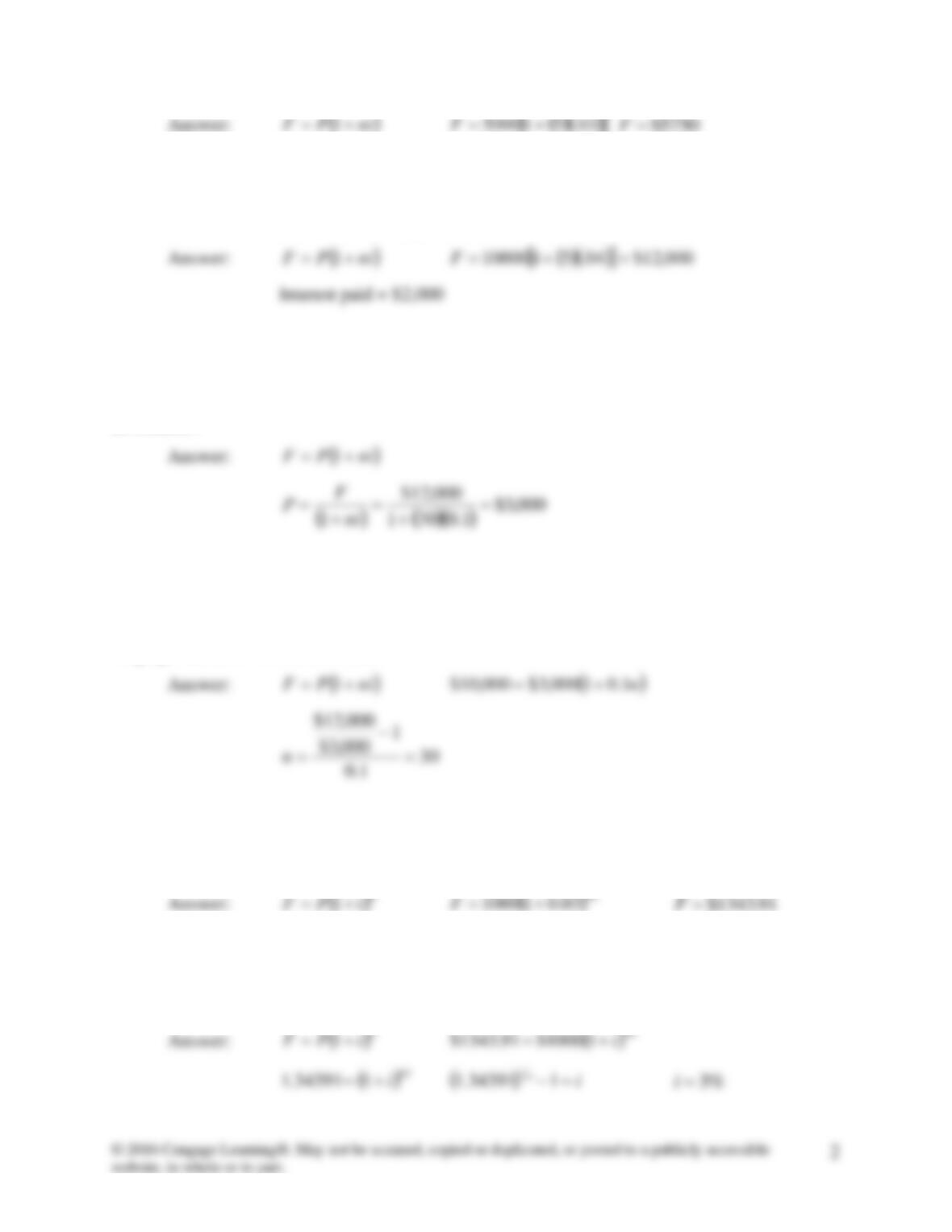
5. If you deposit $100 into an account that pays 6% simple interest, what would be the value in
the account after 10 years?
6. If you deposit $5,000 into a CD (certificate of deposit) that pays 3% simple interest for 5
years, what is its value at maturity?
Test Bank Engineering Fundamentals, 5th ed. Chapter 20
7. If you were to take out a $10,000 student loan for 5 years, and promise to pay 4% simple
interest, how much interest would you pay at the end of the fifth year?
8. Your parents give you $12,000 as a college graduation gift. They tell you that it is from an
investment they made 30 years ago that paid 10% simple interest. What was their original
investment?
9. Your parents give you $12,000 as a college graduation gift. They tell you that it’s from a
$3,000 investment they made when they first got married that paid 10% simple interest. How
long ago was their investment made?
10. If you deposit $1000 into an account that pays 3% interest compounded annually, what
would be the value in the account after 10 years?
11. If you deposit $1000 into an account that pays an interest rate that is compounded annually,
what is the interest rate if there is $1343.91 in the account after 10 years?
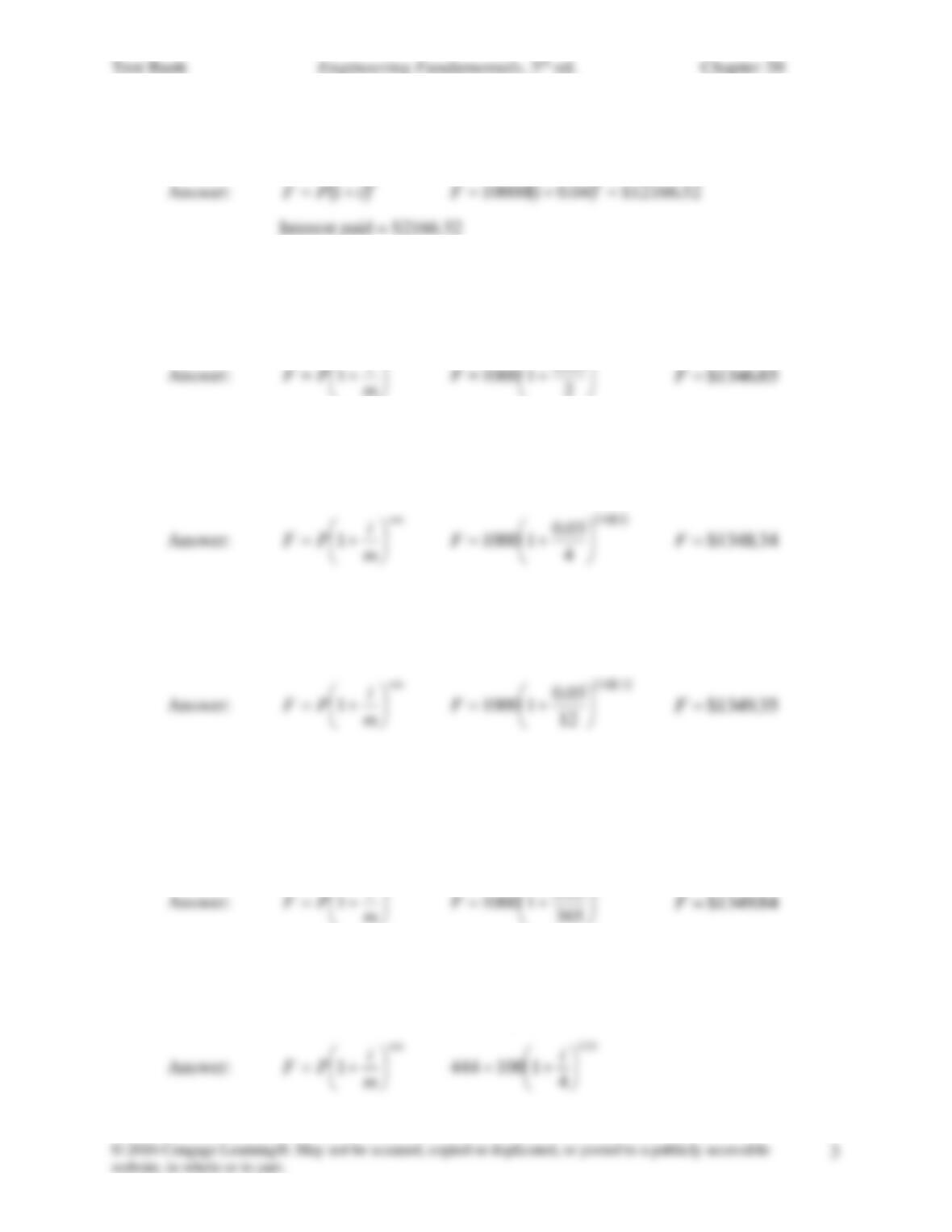
12. If you were to take out a $10,000 student loan for 5 years, and promise to pay 4% interest
compounded annually, how much interest would you pay?
13. If you deposit $1000 into an account that pays 3% compounded semiannually, what would be
the value in the account after 10 years?
nm
( )( )
210
( )( )
410
14. If you deposit $1000 into an account that pays 3% compounded quarterly, what would be the
value in the account after 10 years?
15. If you deposit $1000 into an account that pays 3% compounded monthly, what would be the
value in the account after 10 years?
16. If you deposit $1000 into an account that pays 3% compounded daily, what would be the
value in the account after 10 years?
nm
( )( )
36510
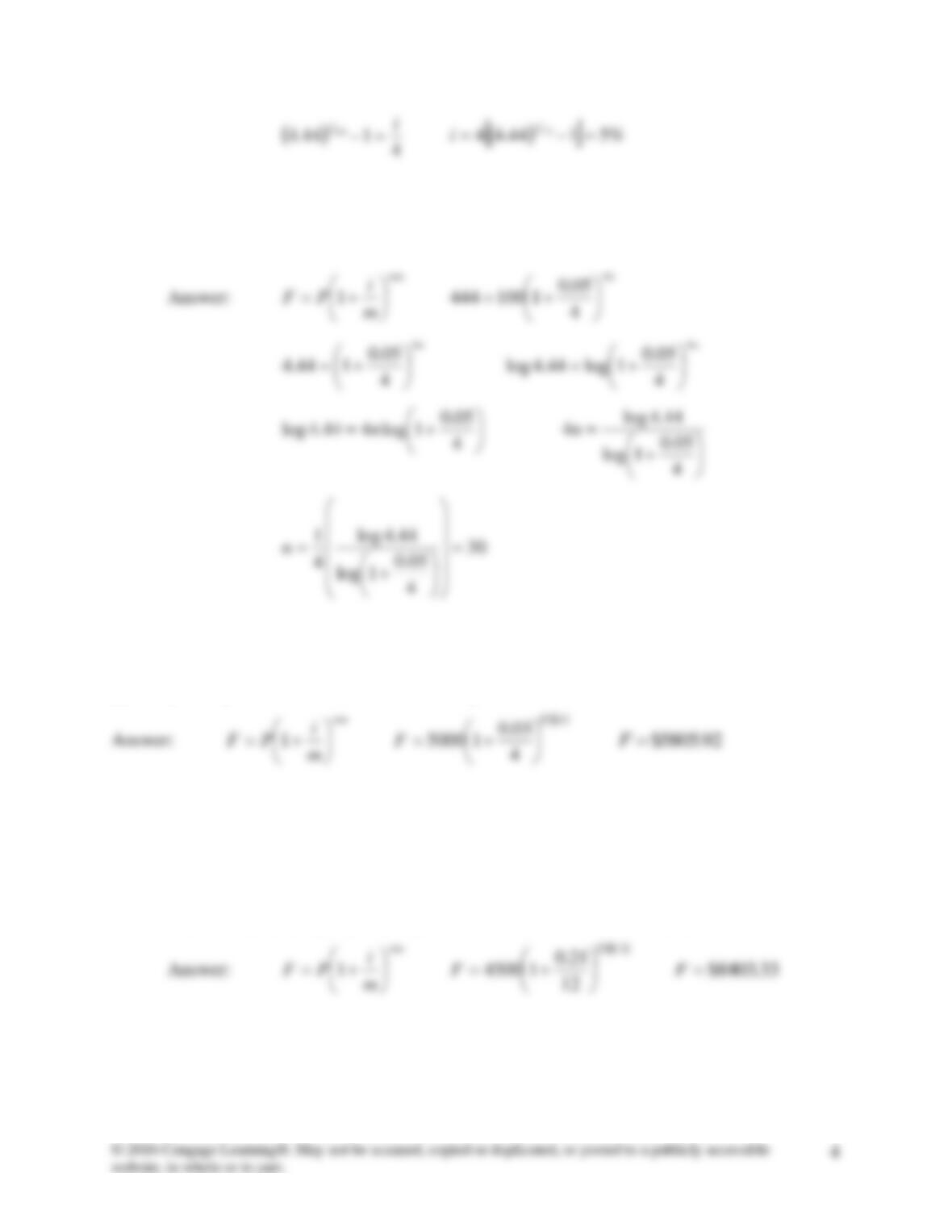
17. If you deposit $100 into an account that pays an interest rate that compounds quarterly, what
is the interest rate if the value in the account after 30 years is $444?
Test Bank Engineering Fundamentals, 5th ed. Chapter 20
18. If you deposit $100 into an account that pays 5% compounded quarterly, how many years
will it take to reach a value of $444?
19. If you deposit $5,000 into a CD (certificate of deposit) that pays 3% interest compounding
quarterly for 5 years, what is its value at maturity?
20. A bank charges interest at a rate of 21% per year, compounded monthly. If a senior in
college borrows $4500 from the bank to pay her last tuition bill and intends to pay it 3 years later
(after she gets a high-paying engineering job), how much will she have to pay?
21. The stated or the quoted interest rate is called the nominal interest rate, and the actual earned
interest rate is called the effective interest rate.
a. True
Test Bank Engineering Fundamentals, 5th ed. Chapter 20
b. False
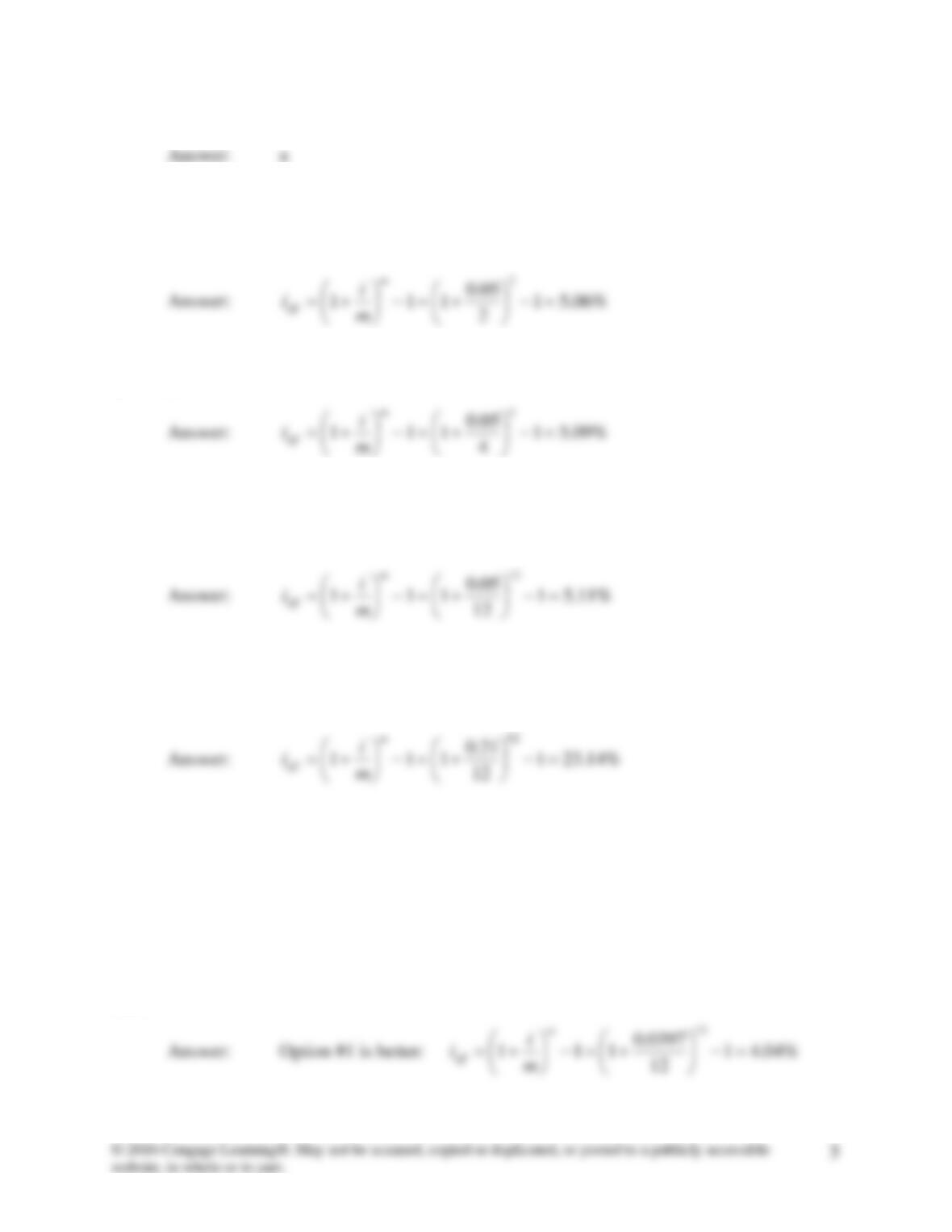
22. What is the effective interest rate corresponding to the nominal rate of 5% compounded
semiannually?
23. What is the effective interest rate corresponding to the nominal rate of 5% compounded
quarterly?
24. What is the effective interest rate corresponding to the nominal rate of 5% compounded
monthly?
25. What is the effective interest rate of a credit card corresponding to the nominal rate of 21%
compounded monthly?
26. You walk into a bank with $1,000 that you wish to invest in a CD (certificate of deposit).
The bank gives you two options:
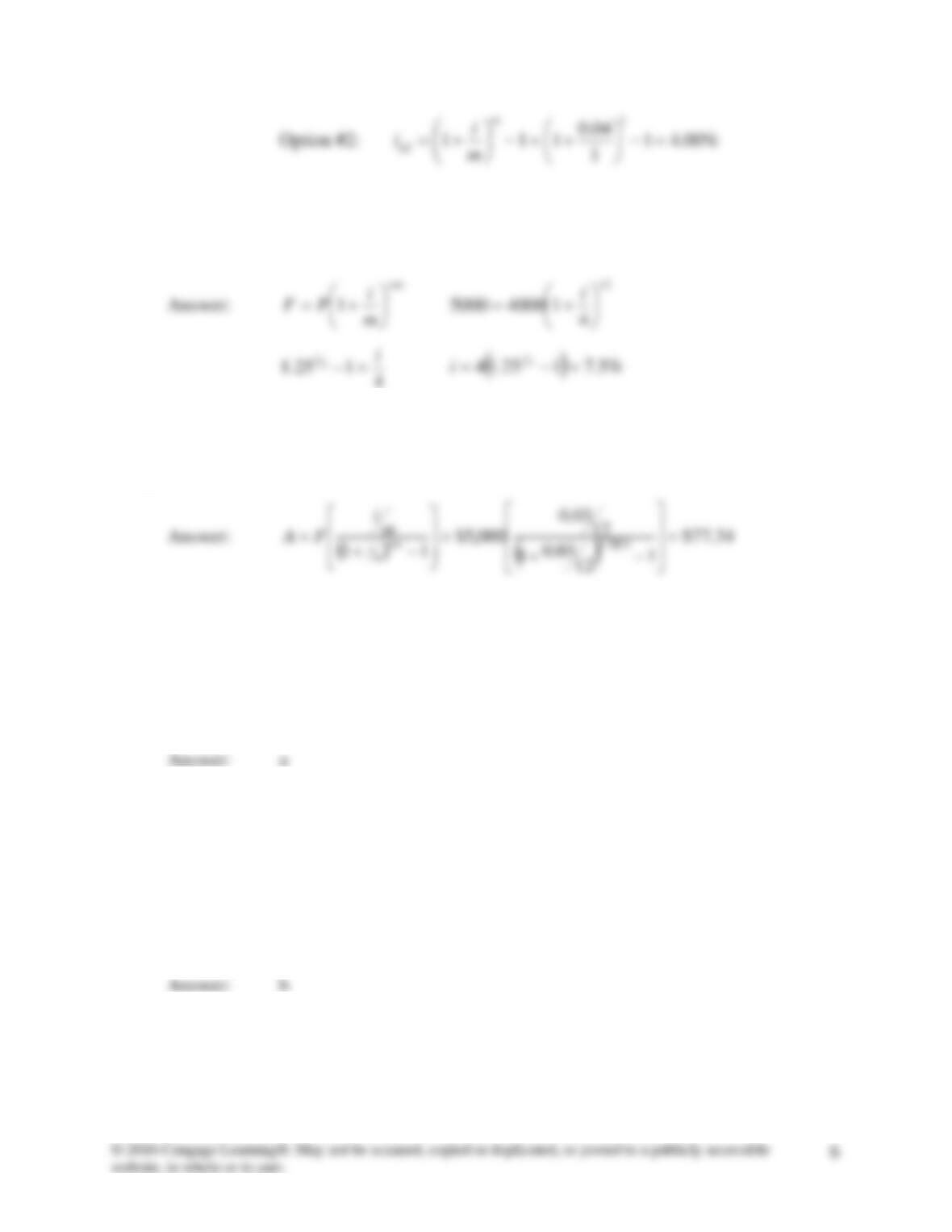
Option #1: 3.97% compounded monthly
Option #2: 4.00% compounded annually
Which option is better for you? Compare the two options by comparing their effective interest
rates.
Test Bank Engineering Fundamentals, 5th ed. Chapter 20
27. If you put $4000 in a CD (certificate of deposit), what fixed interest rate compounded
quarterly would yield $5000 at the end of three years?
28. How much do you have to put away each month, at 3% compounded monthly, to have $5000
in 5 years?
29. There are many different types of bonds, but basically, they are loans that investors make to
government or corporations in return for some gain.
a. True
b. False
30. When a bond is issued, it will have
a. an issue date, a maturity date and an interest rate.
b. a maturity date, a par value, and an interest rate.
c. an issue date, a par value, and an interest rate.
d. an issue date, a maturity date, and a par value.
31. The par value of a bond is
a. the amount originally paid for the bond.
b. the amount that will be repaid at maturity date.

Test Bank Engineering Fundamentals, 5th ed. Chapter 20
c. all of the above.
32. The percentage of par value that is paid to the bond holder at regular intervals is known as
a. par rate
b. par dividend
c. interest rate
d. annuity payment
33. The Straight Line and the Modified Accelerated Cost Recovery System (MACRS) are
examples of
a. accounting schemes.
b. depreciation methods.
c. investment strategies.
d. profit schemes.
34. In engineering, the term that refers to the sum of all costs that are associated with a structure,
a service, or a product during its entire life span is
a. life-cycle cost.
b. life-span cost.
c. sustainability cost.
d. total cost.
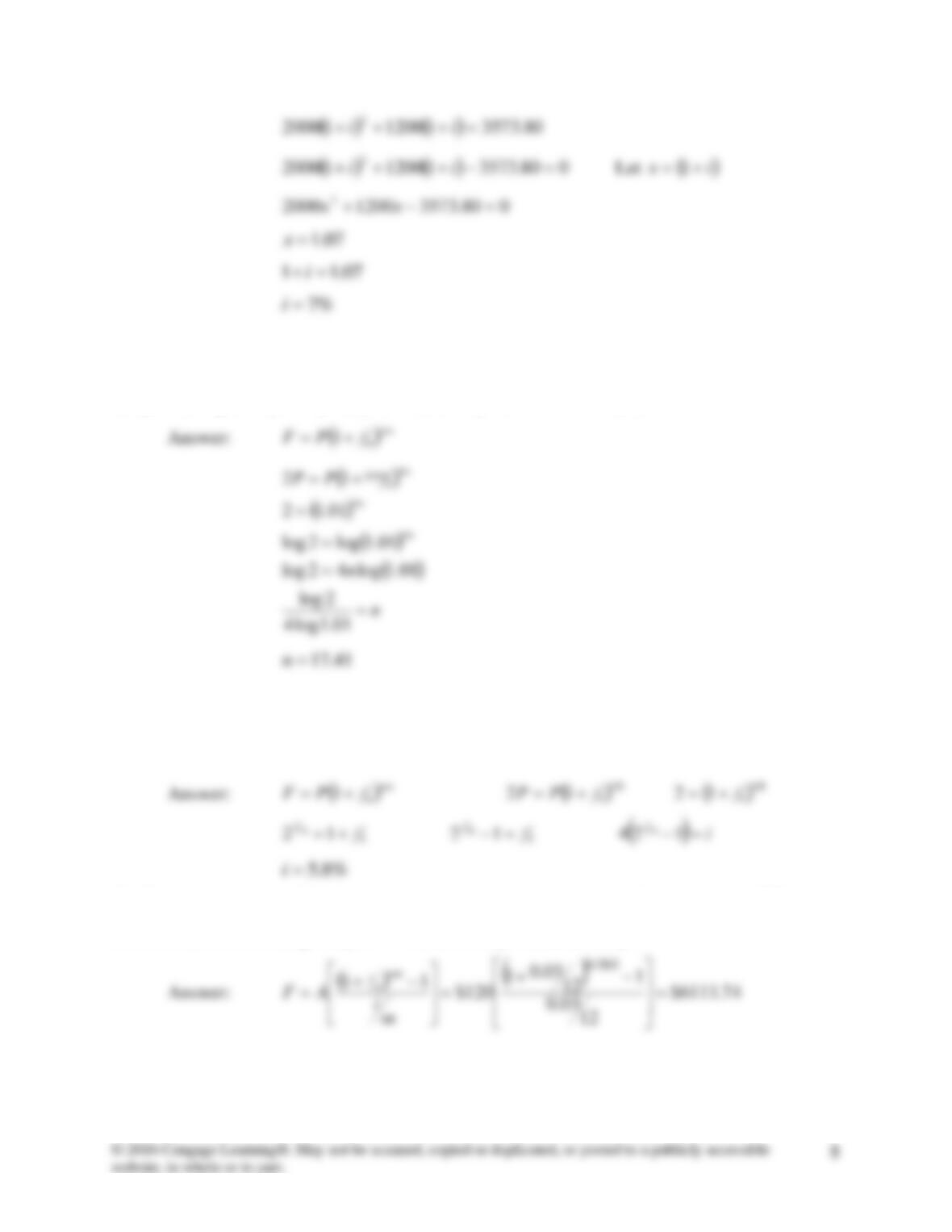
35. In early 2013, $2000 was invested at a certain interest rate compounded annually. One year
later, $1200 was deposited in another account at the same interest rate, also compounded
annually. At the end of that year, there was a total of $3573.80 in both accounts. What is the
annual interest rate?
Test Bank Engineering Fundamentals, 5th ed. Chapter 20
36. How many years will it take an investment to double at an annual interest rate of 4%
compounded quarterly? Express your answer in years to 2 decimal places.
37. What interest rate, compounded quarterly, would cause an investment to double in twelve
years?
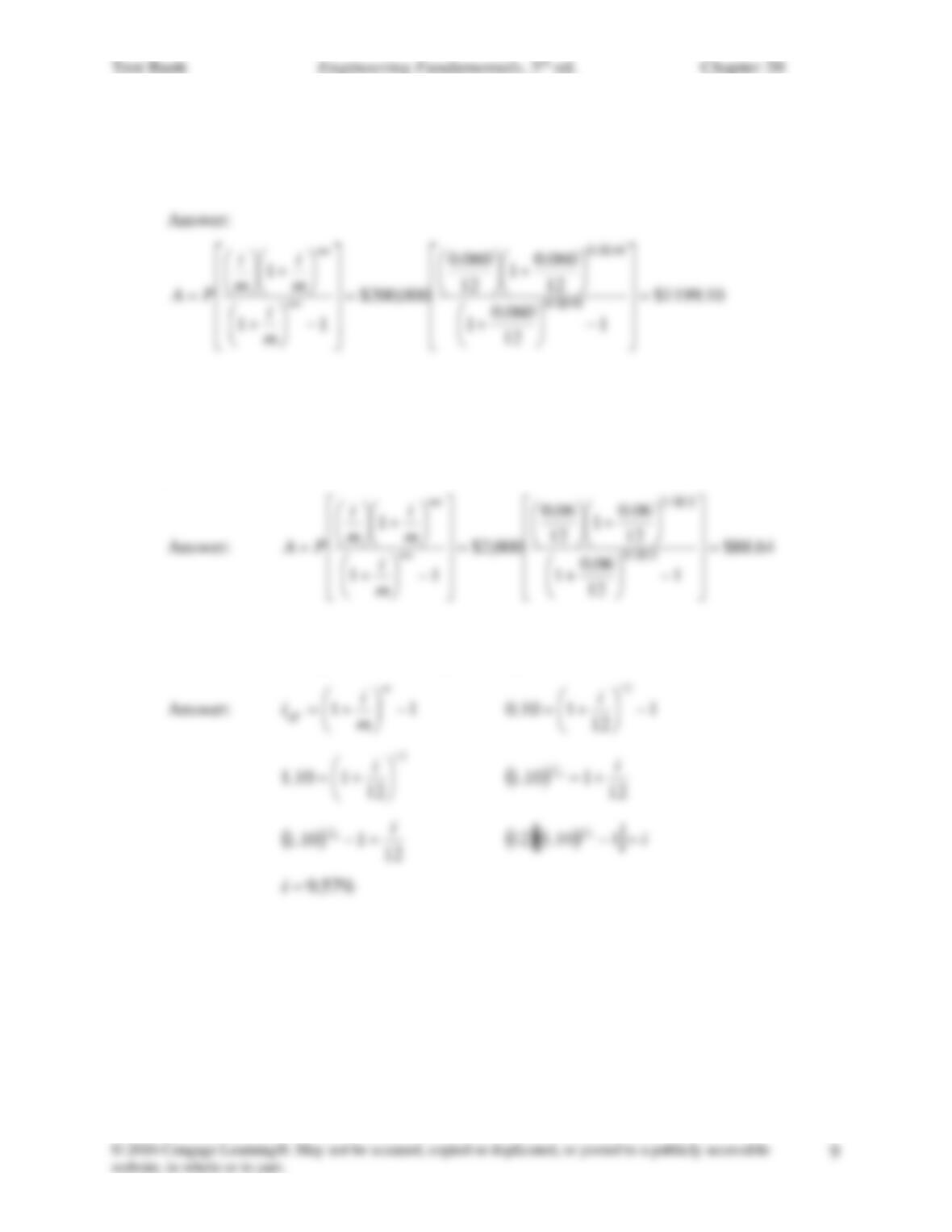
38. How much money will you have available to you after four years if you put aside $120 a
month in an account that gives you 3% interest compounded monthly?
39. You have taken out a mortgage for a new home in the amount of $200,000. You have agreed
to repay the mortgage in 30 years. What is your monthly payment if you agree to pay an interest
rate of 6.0% compounded monthly?
40. You have loaned your roommate $2,000. Your roommate has agreed to repay the loan in two
years. What is the monthly payment if he agrees to pay an interest rate of 6% compounded
monthly?
41. What nominal rate, compounded monthly, would yield an effective rate of 10%?
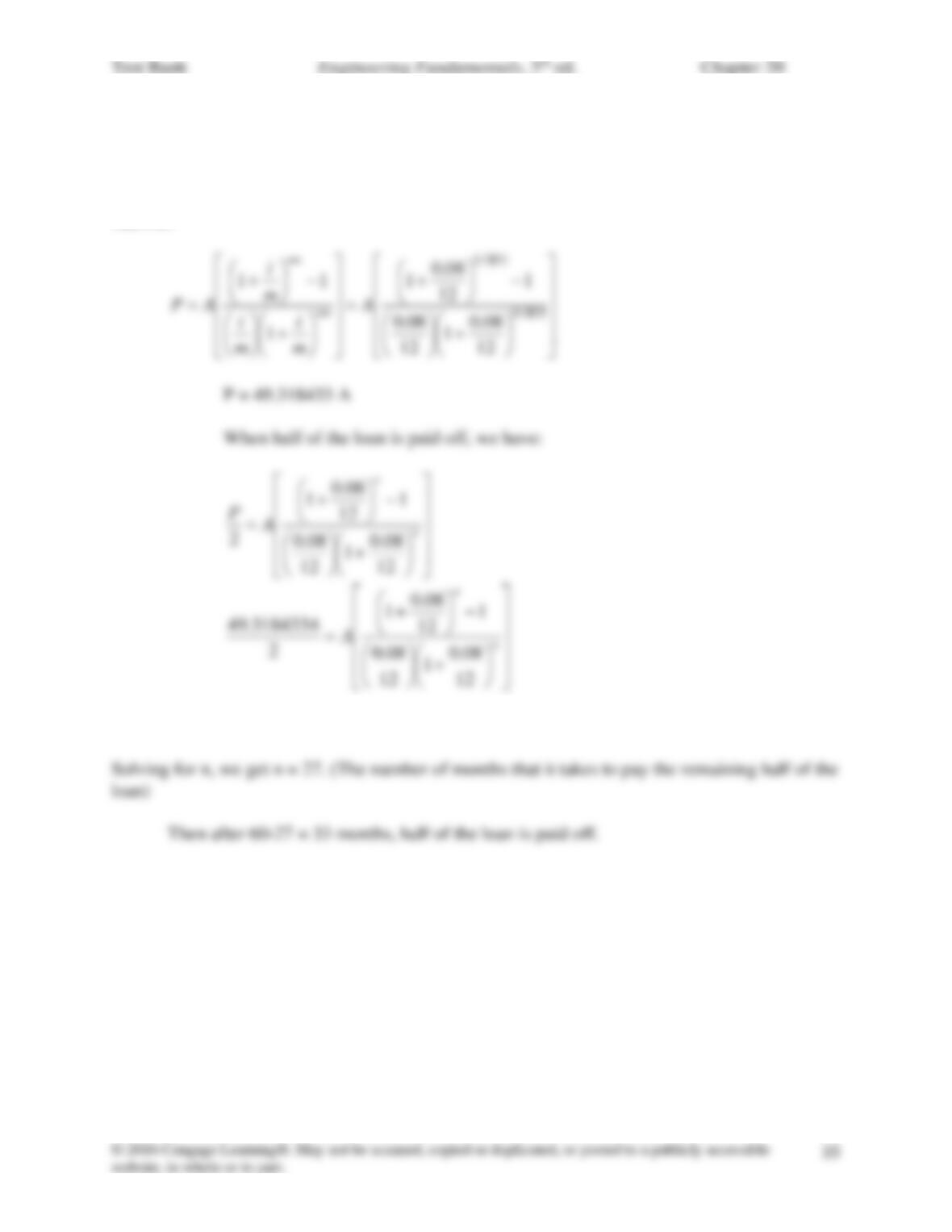
42. Imagine, your car loan payment extends for 5 years at 8% interest compounded monthly.
After how many months do you pay off half of your loan?
Answer:
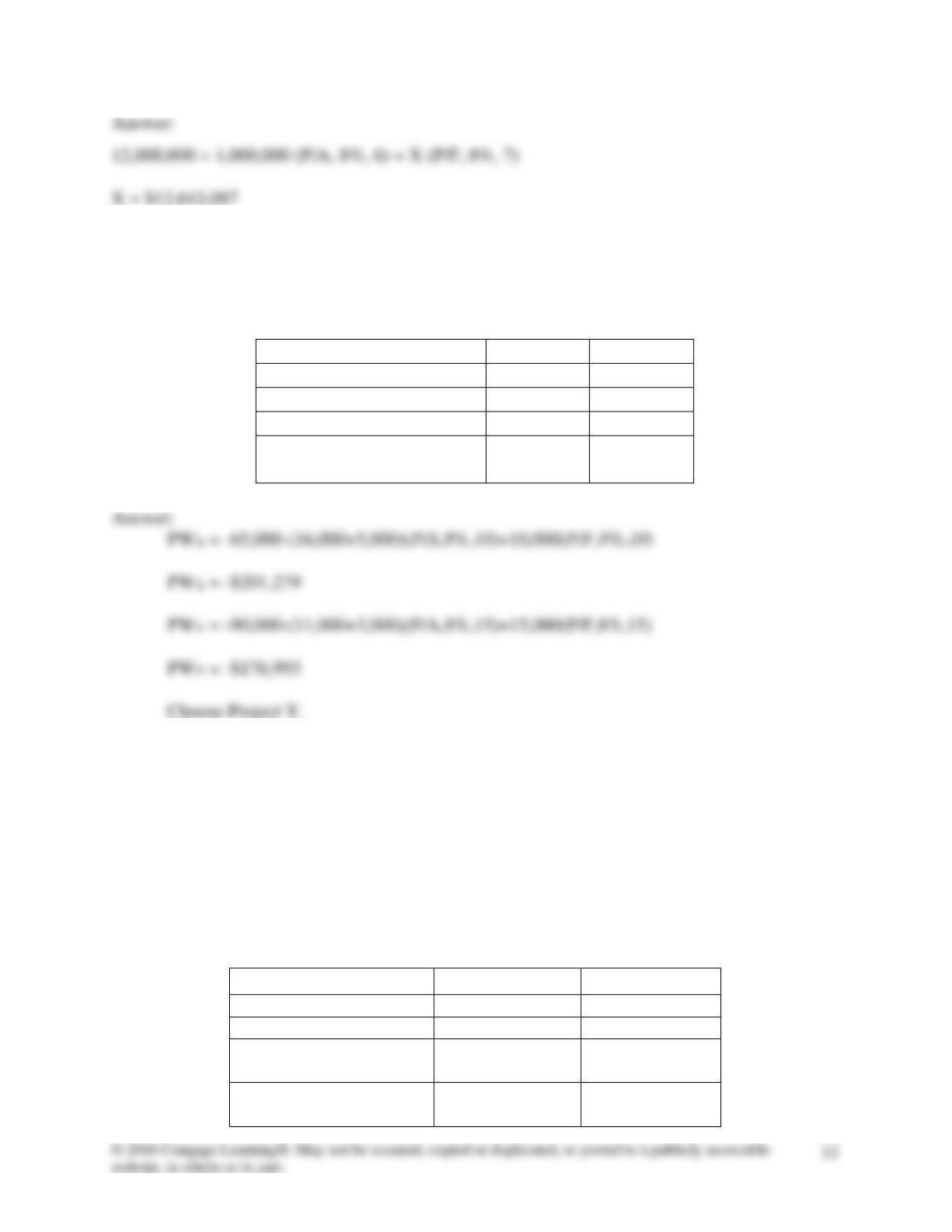
43. Imagine the company that you work for borrows $12,000,000 at 8% interest, and the loan is
to be paid in seven years according to the schedule shown. Determine the amount of the last
payment.
Year
Amount
1
$1,000,000
2
$1,000,000
3
$1,000,000
4
$1,000,000
5
$1,000,000
6
$1,000,000
7
$?
Test Bank Engineering Fundamentals, 5th ed. Chapter 20
44. You are to consider the following projects. Which project would you approve if each project
creates the same income? Assume i = 8%, and a period of 10 years.
Project X
Project Y
Initial cost
$65,000
$90,000
Annual operating cost
$16,000
$11,000
Annual maintenance cost
$5,000
$3,000
Salvage value at the end
of 10 years
$10,000
$15,000
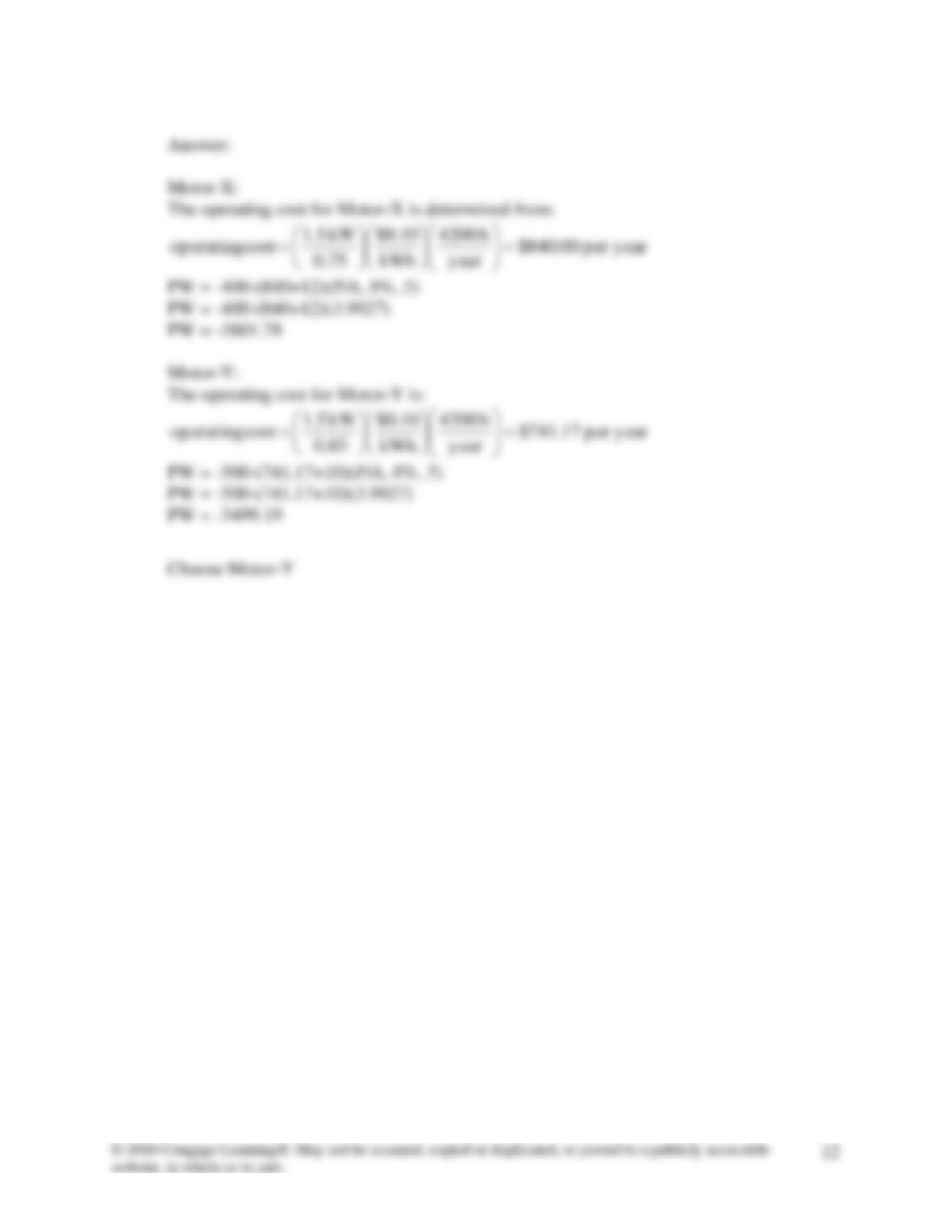
45. Imagine that as an engineering intern you have been assigned the task of selecting a motor
for a pump. After reviewing motor catalogs you narrow your choice to two motors that are rated
at 1.5 kW. Additional information collected is shown in an accompanying table. The pump is
expected to run 4200 hours every year. After checking with your electric utility company, you
determine the average cost of electricity is about 10 cents per kWh. Based on the information
given here, which one of the motors will you recommend to be purchased? Assume i = 8%.
Criteria
Motor X
Motor Y
Expected useful life
5 years
5 years
Initial cost
$400
$500
Efficiency at the
operating point
0.75
0.85
Estimated maintenance
cost
$12 per year
$10 per year
Test Bank Engineering Fundamentals, 5th ed. Chapter 20