
1. Every engineer needs to understand the fundamentals of electricity and magnetism.
a. True
b. False
2. Electric current is a fundamental dimension.
a. True
b. False
3. Which subatomic particle has a negative charge?
a. Proton
b. Neutron
c. Electron
d. Ion
4. Which subatomic particle has a positive charge?
a. Proton
b. Neutron
c. Electron
d. Ion
5. Which subatomic particle has no charge?
a. Proton
b. Neutron
c. Electron
d. Ion

6. The basic law of electric charges states that unlike charges attract each other while like
charges repel.
a. True
b. False
7. In SI units, the unit of charge is the coulomb (C).
a. True
b. False
8. The SI unit for electric current is
a. amperes
b. electrons per second
c. coulombs
d. watts
9. The flow of charge will occur when the two bodies are connected by an electrical conductor
such as a copper wire. The flow of electric charge is called electric current.
a. True
b. False
10. One coulomb is defined as the amount of charge that passes a point in a wire in 1 second
when a current of 1 ampere is flowing through the wire.
a. True
b. False
11. The amount of work required to move charge between two points is represented by
a. electric current

Test Bank Engineering Fundamentals, 5th ed. Chapter 12
b. resistance
c. voltage
d. energy
12. Voltage is sometime referred to as emf. What does emf stand for?
a. Electromagnetic frequency
b. Electromotive frequency
c. Electromagnetic force
d. Electromotive force
13. In all batteries, electricity is produced by
a. light
b. heat
c. a chemical reaction
d. all of the above
14. Primary cells are batteries that can be recharged while secondary cells are batteries that
cannot be recharged.
a. True
b. False
15. Which of the following batteries is an example of a primary cell?
a. Nickel-cadmium (NiCd) also known as “nicad”
b. Nickel-metal hydride (NiMH)
c. Alkaline
d. Lead acid

16. In general, there are two ways in which the sun’s energy is converted into electricity:
a. photovoltaic and photothermal
b. photovoltaic and photochemical
c. photovoltaic and photosynthetic
d. none of the above
17. The flow of electric charge that occurs in one direction that is typically produced by batteries
is known as
a. ac current.
b. dc current.
c. ac/dc current.
d. unidirectional current.
18. The flow of electric charge that periodically reverses direction that is typically produced by
rotating generators is known as
a. ac current.
b. dc current.
c. ac/dc current.
d. omni directional current.
19. The law that states that at any given time, the sum of the currents entering a node must equal
the sum of the currents leaving the node is know as
a. Kirchoff’s current law
b. Kirchoff’s voltage law
c. Ohm’s law
d. Coulomb’s law

20. An electrical circuit refers to the combination of various electrical components that are
connected together.
a. True
b. False
21. The electrical resistance of a material does not vary with temperature.
a. True
b. False
22. Some materials exhibit near-zero resistance at very low temperatures. This behavior is called
a. infra-resistance
b. anti-resistance
c. semiconductivity
d. superconductivity
23. Ohm’s law describes the relationship between voltage, resistance, and current. Which of
these is Ohm’s law?
a.
I
R
V=
b.
R
I
V=
c.
IRV=
d.
VIR=
24. A numbering system that describes the size of an electric conductor is AWG. What does
AWG stand for?
a. American Wire Gage

Test Bank Engineering Fundamentals, 5th ed. Chapter 12
b. Association of Wire Gages
c. Atlas of Wire Gages
d. All Wire Gages
25. The ratio of the diameter of No. 1 AWG wire to No. 2 is
a. 1.25
b. 1.5
c. 2.0
d. 1.12
26. When it comes to wire size, the larger the gage number the larger the wire diameter.
a. True
b. False
27. Electrical resistance is a fundamental dimension.
a. True
b. False
28. In certain circuits, if one of the elements fails, that failure prevents the current from flowing
through other elements in the circuit; thus the entire circuit fails. This type of circuit is a
a. parallel circuit
b. series circuit
c. none of the above
29. Electrical components that store energy on two oppositely charged electrodes, rather than
through a chemical reaction are known as
a. batteries

Test Bank Engineering Fundamentals, 5th ed. Chapter 12
b. inductors
c. transistors
d. capacitors
30. Capacitors are used for
a. energy storage
b. electronic filters
c. timing elements
d. all of the above
31. One kilowatt hour represents the amount of power consumed during 1 hour by a device that
uses one kilowatt (kW).
a. True
b. False
32. How many kW-hour is consumed by a TV set that uses 250 watts when it is left on for 4
hours?
a. 250
b. 1000
c. 1
d. 0.25
33. Some of the factors that engineers consider when selecting a motor for an application are:
a. motor type and speed (rpm).
b. motor performance and efficiency.
c. cost, life expectancy, and noise level.
d. maintenance and service requirements.

Test Bank Engineering Fundamentals, 5th ed. Chapter 12
e. all of the above
34. The distribution of light on a horizontal surface is known as
a. luminescence
b. luminosity
c. illuminescence
d. illumination
35. the amount of light emitted by a lamp is expressed in lumens.
a. True
b. False
36. A common unit of illumination intensity is called a footcandle and is equal to
a. the amount of light one foot away from a candle.
b. the amount of light from a one-foot long candle.
c. one lumen distributed over an area of 1-square-foot.
d. none of the above
37. The ratio of how much light is produced by a lamp (in lumens) to how much energy is
consumed by the lamp (in watts) is known as
a. efficacy
b. efficiency
c. illumination cost
d. energy cost
38. In lighting design, a variable called CRI is often used. What does CRI stand for?
a. Color Repeatability Index
Test Bank Engineering Fundamentals, 5th ed. Chapter 12
b. Color Rendition Index
c. Capacitive-Resistive Index
d. none of the above
39. Most indoor fluorescent light fixtures contain two or three 40-watt bulbs each. If a classroom
has 15 fluorescent light fixtures, each with three 40-watt bulbs, how much does it cost to leave
the lights on for a two-hour class? Assume the electric company charges approximately 10 cents
per kilowatt-hour.
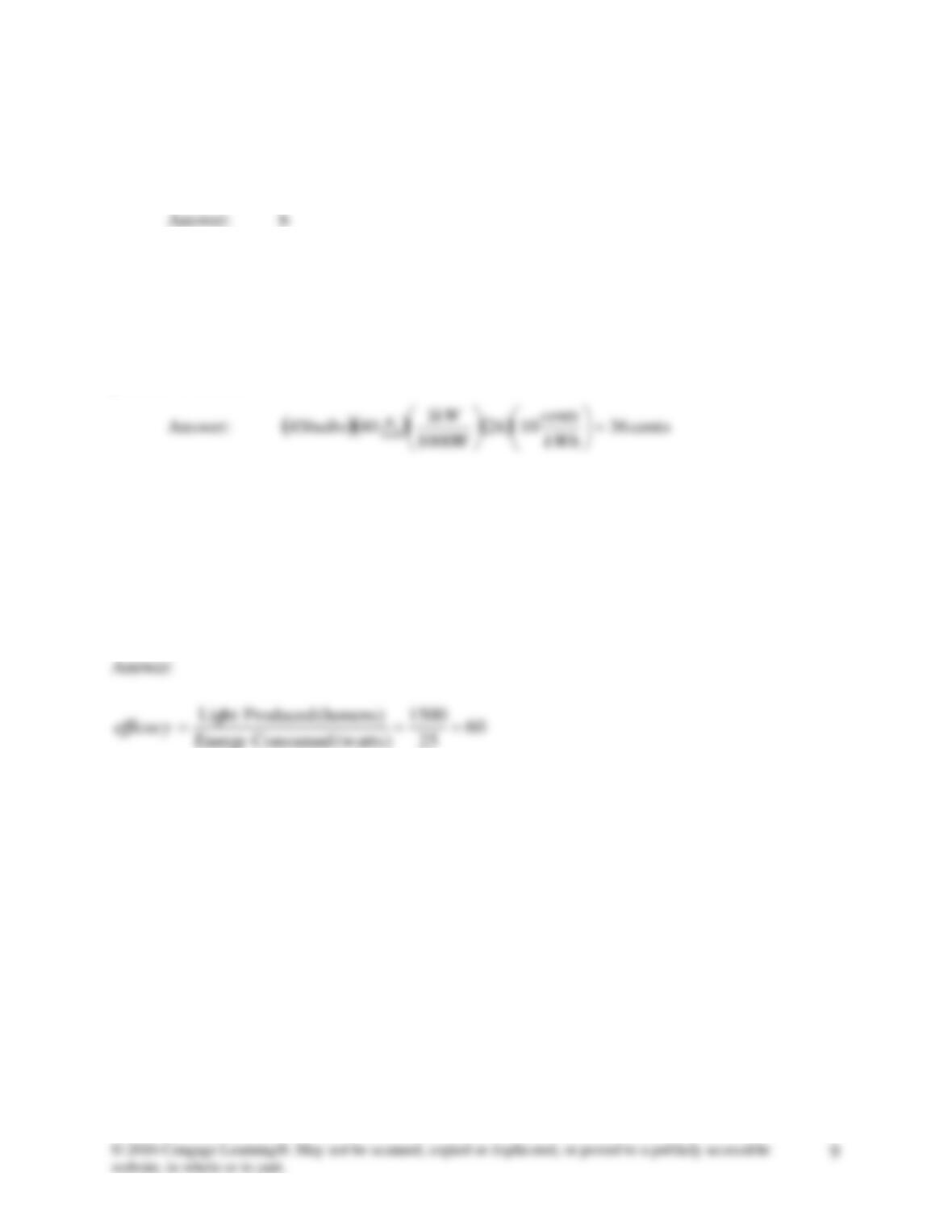
40. According to a light bulb manufacturer, its 75 W CFL floodlight consumes 25 W and
produces 1500 lumens. What is the efficacy of the floodlight?