
1. Civil engineers must design the structures in such a way as to allow for expansion and
contraction of materials, such as concrete and steel that occur due to changes in the surrounding
temperatures.
a. True
b. False
2. Material properties are not a function of temperature.
a. True
b. False
3. Temperature is a fundamental dimension.
a. True
b. False
4. Which of the following material properties varies with temperature?
a. density
b. viscosity
c. electrical resistance
d. all of the above
5. The physical quantity that provides a measure of molecular activity and the internal energy of
an object is
a. density
b. temperature
c. viscosity
d. specific weight

6. The physical quantity that quantifies or provides a measure of how active molecules are on a
microscopic level is
a. density
b. temperature
c. viscosity
d. specific weight
7. Temperature is a macroscopic measurement of a microscopic phenomenon.
a. True
b. False
8. Thermometers use varying physical properties to measure temperature. Which of the
following variable physical properties are utilized in thermometers?
a. expansion
b. electrical resistance
c. color
d. all of the above
9. A temperature-measuring device that consists of two dissimilar metals is known as a
a. Thermocouple
b. Thermistor
c. Thermojunction
d. RTD
10. A temperature-measuring device composed of a semiconductor material is known as a
a. Thermocouple
b. Thermistor
c. Thermojunction
d. RTD
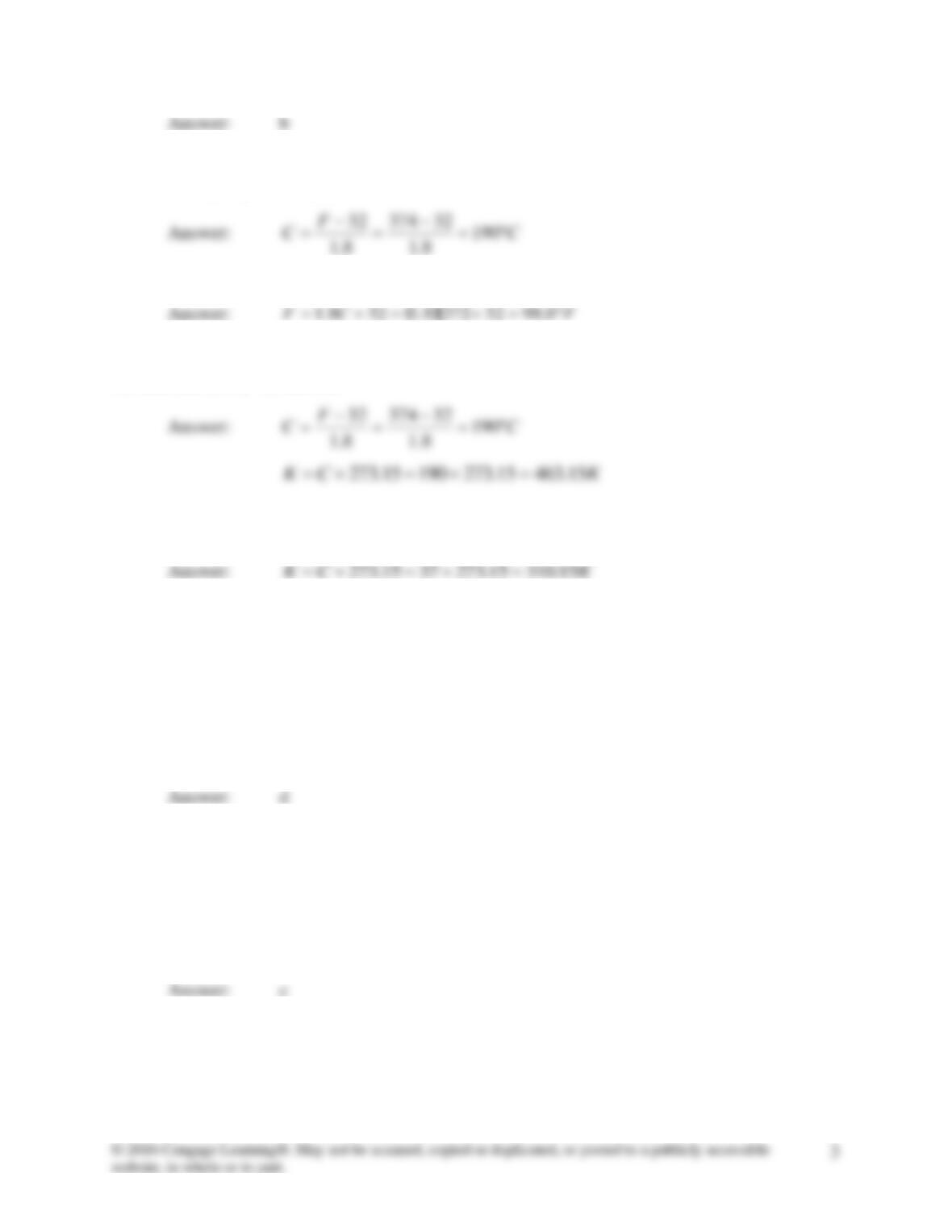
Test Bank Engineering Fundamentals, 5th ed. Chapter 11
11. Convert
F374
to Celsius
12. Convert
C37
to Fahrenheit
13. Convert
F374
to Kelvins
14. Convert
C37
to Kelvins
15. Which of the following temperature scales is known as an absolute scale?
a. Fahrenheit
b. Celsius
c. Centigrade
d. Kelvin
16. Which of the following temperature scales is known as an absolute scale?
a. Rankine
b. Kelvin
c. all of the above
17. The Kelvin and Rankine scales are based on the behavior of an ideal gas.
a. True
b. False

Test Bank Engineering Fundamentals, 5th ed. Chapter 11
18. What does P stand for in the following equation (ideal gas law)?
mRTPV =
a. Pounds
b. Pressure
c. Power
d. Permeability
19. What does V stand for in the following equation (ideal gas law)?
mRTPV =
a. Volume
b. Velocity
c. Voltage
d. Viscosity
20. What does T stand for in the following equation (ideal gas law)?
mRTPV =
a. Time
b. Period
c. Torque
d. Temperature
21. When using the ideal gas law,
mRTPV =
, what system of units should you use when
entering temperature values?
a. Fahrenheit
b. Celsius
c. Kelvin
d. any of the above

22. The temperature in a room is
F72
. The temperature outside the building is
F20
. What is
the temperature difference in Kelvins?
a. 52 K
b. 11 K
c. 20 K
d. 29 K
23. The temperature in this room is
F72
. The temperature outside the building is
F20
. What
is the temperature difference in degrees Celsius?
a.
C52
b.
C11
c.
C20
d.
C29
24. A
1
temperature difference in Celsius is equal to a
1
temperature difference in Fahrenheit.
a. True
b. False
25. A
1
temperature difference in Celsius is equal to a
1
temperature difference in Kelvin.
a. True
b. False
26. Which of the following is NOT a mode of heat transfer?
a. transposition
b. convection
c. radiation
d. conduction

27. Heat flows naturally from a hot object to a cold objects.
a. True
b. False
28. What does Btu stand for?
a. British temperature unit
b. British thermal unit
c. British thermocouple unit
d. Binary temperature unit
29. The amount of heat required to raise the temperature of 1 lbm of water by
F1
is known as a
a. Btu
b. calorie
c. Calorie
d. Joule
30. The amount of heat required to raise the temperature of
g1
of water by
C1
is known as a
a. Btu
b. calorie
c. Calorie
d. Joule
31. The energy content of food is typically expressed in Calories, which is equal to 1000
calories.
a. True
b. False

32. What is the SI unit of thermal energy?
a. Calorie
b. Watt
c. Btu
d. Joule
33. The mode of heat transfer that occurs when a temperature difference exists in a medium is
known as
a. conduction
b. convection
c. radiation
d. none of the above
34. Thermal conductivity is a property of materials that shows how good the material is in
transferring thermal energy (heat) from a high-temperature region to a low-temperature region
within the material.
a. True
b. False
35. The R-value or R-factor of a material provides a measure of resistance to heat flow: The
higher the value, the less resistance to heat flow the material offers.
a. True
b. False
36. The mode of heat transfer that occurs when a fluid in motion comes into contact with a solid
surface whose temperature differs from the moving fluid is known as
a. conduction

Test Bank Engineering Fundamentals, 5th ed. Chapter 11
b. convection
c. radiation
d. none of the above
37. For both the forced and the free convection situations, the overall heat transfer rate between
the fluid and the surface is governed by Fourier’s law of cooling.
a. True
b. False
38. All matter emits thermal radiation. This rule is true as long as the body in question is at a
nonzero absolute temperature.
a. True
b. False
39. When you touch a hot object with your finger, the heat transferred to your finger is by
a. conduction
b. convection
c. radiation
d. none of the above
40. Before taking a bite of a piece of hot pizza you blow on it to cool it What mode of heat
transfer are you using in this situation?
a. conduction
b. convection
c. radiation
d. none of the above

41. If you stay out too long at the beach you may get a sunburn as a result of too much heat being
transferred to your skin. What mode of heat transfer is responsible for this?
a. conduction
b. convection
c. radiation
d. none of the above
42. The physical measurement that is intended to account for the combined effect of wind speed
and air temperature is known as
a. Dew point
b. Ambient conditions
c. Wind chill index
b. Relative temperature
43. A unit commonly used to express the metabolic rate for an average person under sedentary
conditions is called
a. metabavg
b. mravg
c. met
d. msed
44. A unit that is generally used to express the insulating value of clothing is called
a. clo
b. ciu
c. cins
d. ivc
45. In general, as the temperature of a material is increased, the material’s length will
Test Bank Engineering Fundamentals, 5th ed. Chapter 11
a. increase
b. decrease
c. remain the same
46. In general, as the temperature of a material is increased, the material’s volume will
a. increase
b. decrease
c. remain the same
47. The physical quantity that provides a quantitative way to show how much thermal energy is
required to raise the temperature of an object by a certain amount is
a. thermal conductivity
b. specific heat
c. specific weight
d. density
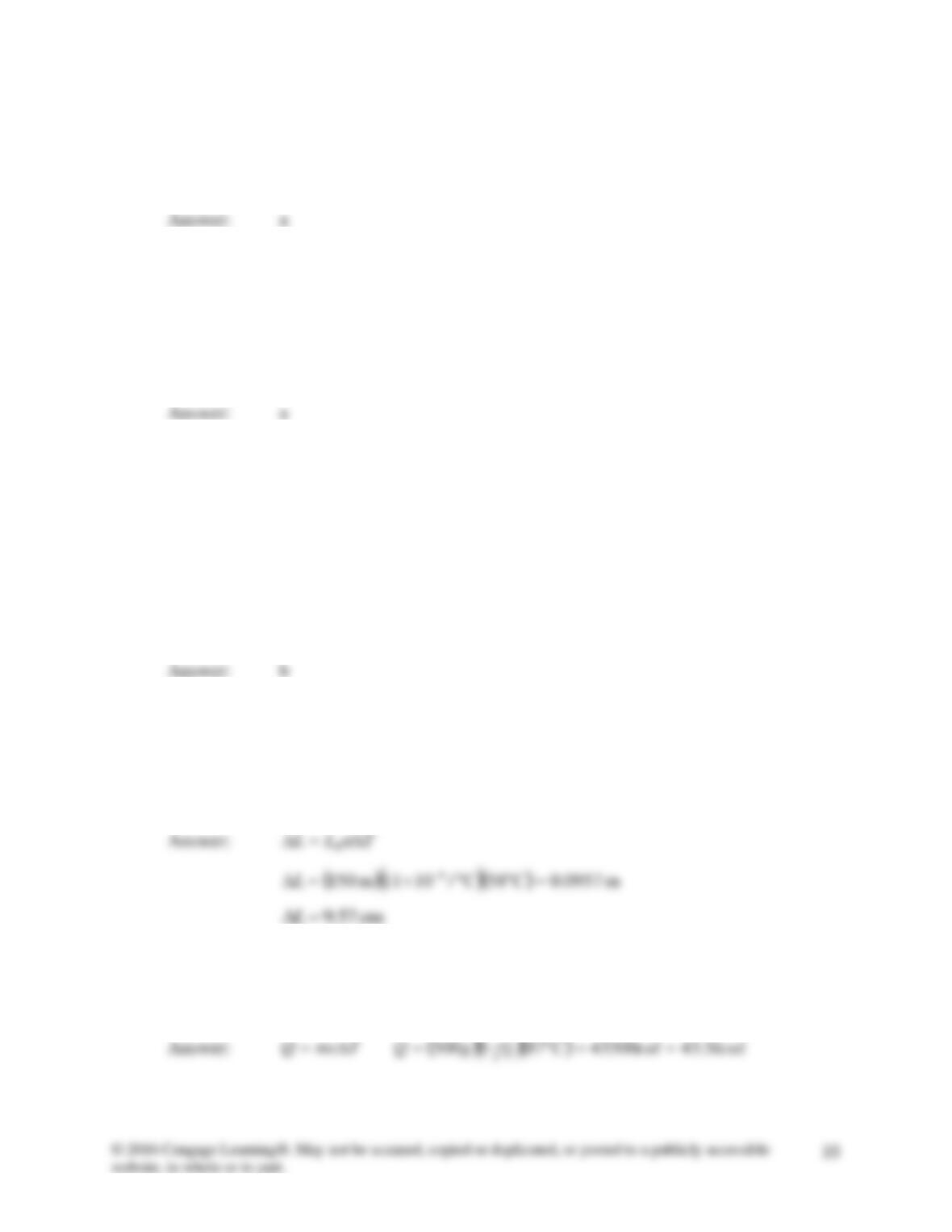
48. A steel bridge is 150 m long when the temperature is
C20−
. By how much will its length
increase when the temperature is
F38
? (Steel has a coefficient of linear expansion of
)
C −/1011 6
49. You wish to make a large cup of tea. How much energy is needed to raise the temperature of
500 ml of tap water from
C13
to
C100
?

50. How much energy is required to raise the temperature of
kg3
of aluminum from
C20
to
C50
?
51. Most conventional fuels that we use today to generate power come from coal, natural gas, oil,
or gasoline.
a. True
b. False
52. The term that is used to quantify the amount of energy that is released when a unit mass or a
unit volume of fuel is burned is known as
a. heating value
b. specific heat
c. specific mass
d. specific volume
53. The energy released by fuel when the combustion by-products include water in liquid form is
known as the
a. higher heating value
b. lower heating value
c. all of the above
d. none of the above
54. The energy released by fuel when the combustion by-products include water in vapor form is
known as the
a. higher heating value
b. lower heating value
c. all of the above

Test Bank Engineering Fundamentals, 5th ed. Chapter 11
d. none of the above
55. A degree-day (DD) is the difference between 65°F (typically) and the average temperature of
the outside air during a 24-hour period.
a. True
b. False