General Chemistry, 11e (Petrucci)
Chapter 6 Gases
1) Pressure is a force per unit area with the SI unit of 1 pascal.
2) The relationship between the “absolute temperature” on the Kelvin scale and the Celsius temperature is
given by T(K) = 5/8[t(°C)] – 32.
3) Liquid mercury freezes at a temperature of -39 °C. The freezing point of mercury on the Kelvin scale is
234 K.
4) The statement, “For a fixed mass of gas at constant temperature, gas volume is inversely proportional
to gas pressure” is known as Charles’ Law.
5) The ideal gas equation connects three basic variables: volume, amount, and temperature of a gas.
6) Gas densities depend strongly on gas temperature and pressure.
7) A gaseous mixture consists of 50.0% O2, 25.0% N2, and 25.0% Cl2, by mass. At standard temperature
and pressure, the partial pressure of N2(g) is equal to 0.20 atm.
8) According to the kinetic-molecular theory of gases, at constant temperature, all particles have equal
translational kinetic energy.
9) If someone were to light a cigar at one end of a closed room, persons at the other end of the room
might soon perceive an odor due to gaseous emissions from the cigar. Such a phenomenon is an example
of effusion.
10) The mutual attraction of gas molecules is an important aspect of van der Waals equation.
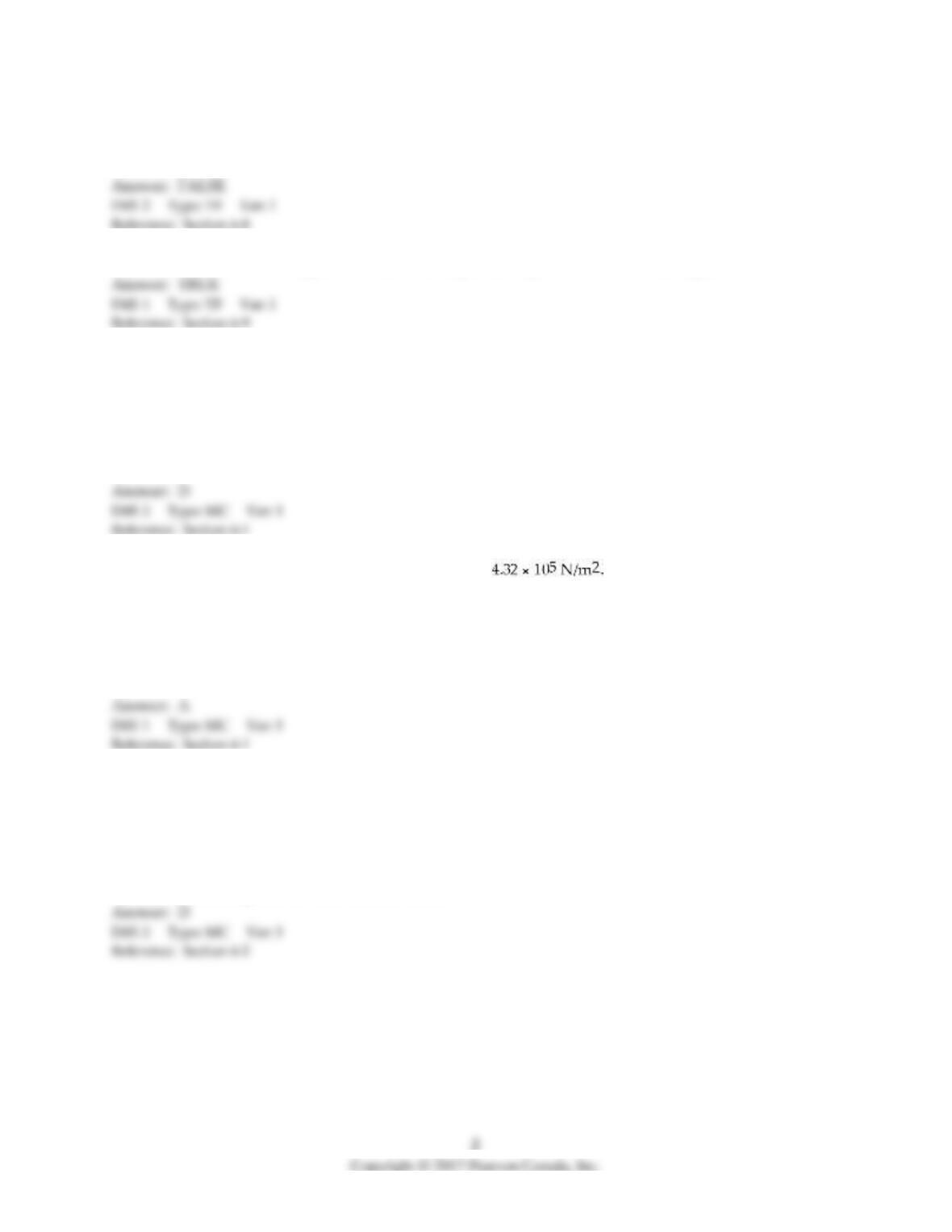
11) Convert 8.50 kg/cm2 to the equivalent pressure in atmospheres.
A) 8.78 atm
B) 1.12 atm
C) 9.53 atm
D) 8.23 atm
E) 7.47 atm
12) Convert to the equivalent pressure in atmospheres,
A) 4.26 atm
B) 4.38 × 10¹⁰ atm
C) 4.26 × 10³ atm
D) 3.31 × 10⁵ atm
E) 0.235 atm
13) To increase the volume of a fixed amount of gas from 100 cm3 to 200 cm3:
A) increase the temperature from 25.0 to 50.0 °C at constant pressure
B) increase the pressure from 1.00 to 2.00 atm at constant temperature
C) reduce the temperature from 400 K to 200 K at constant pressure
D) reduce the pressure from 608 mmHg to 0.40 atm at constant temperature
E) decrease the temperature from 600 K to 400 K
14) If gas volume is doubled but the temperature remains constant:
A) the pressure stays the same
B) the molecules move faster
C) the final pressure is twice the pressure before the volume change.
D) the molecules move slower
E) the final pressure is 1/2 of the pressure before the volume change.
15) The relationship between the “absolute temperature” on the Kelvin scale and the Celsius temperature
is given by:
A) T(K) = t(°C) + 273.15
B) t(°C) = T(K) + 273.15
C) T(K) = 5/8[t(°C)] – 32
D) T(K) = 8/5[t(°C)] + 32
E) t(°C) = 98.6 + T(K)
16) The statement, “For a fixed mass of gas at constant temperature, gas volume is inversely proportional
to gas pressure.” is known as:
A) Avogadro’s Law
B) Boyle’s Law
C) Charle’s Law
D) Graham’s Law
E) Kelvin’s Law
17) Two containers are connected by an open tube. One container (A) is at 300 K, the other (B) is at 600 K.
These two containers must have:
A) equal number of moles
B) greater pressure in A than B
C) greater pressure in B than A
D) equal volume
E) none of these
18) Of the following values, the most likely to be observed for the volume of 1.00 mole of He(g) at 0 °C
and 1000 atm is:
A) 17.4 mL
B) 46 mL
C) 22.4 mL
D) 11.2 mL
E) 22.4 L
19) 2.24 L NH3(g) at 2.0 atm and 0 °C:
A) contains 0.050 mole NH3
B) weighs 1.70 g
C) contains 6.02 × 10²² molecules of NH3
D) contains 3.6 × 10²³ H atoms
E) contains 3.6 × 10²³ N atoms
20) Assuming ideal gas behavior, which of the following gases would have the lowest density at standard
temperature and pressure?
A) SF6
B) CF2Cl2
C) CO2
D) N2
E) Kr
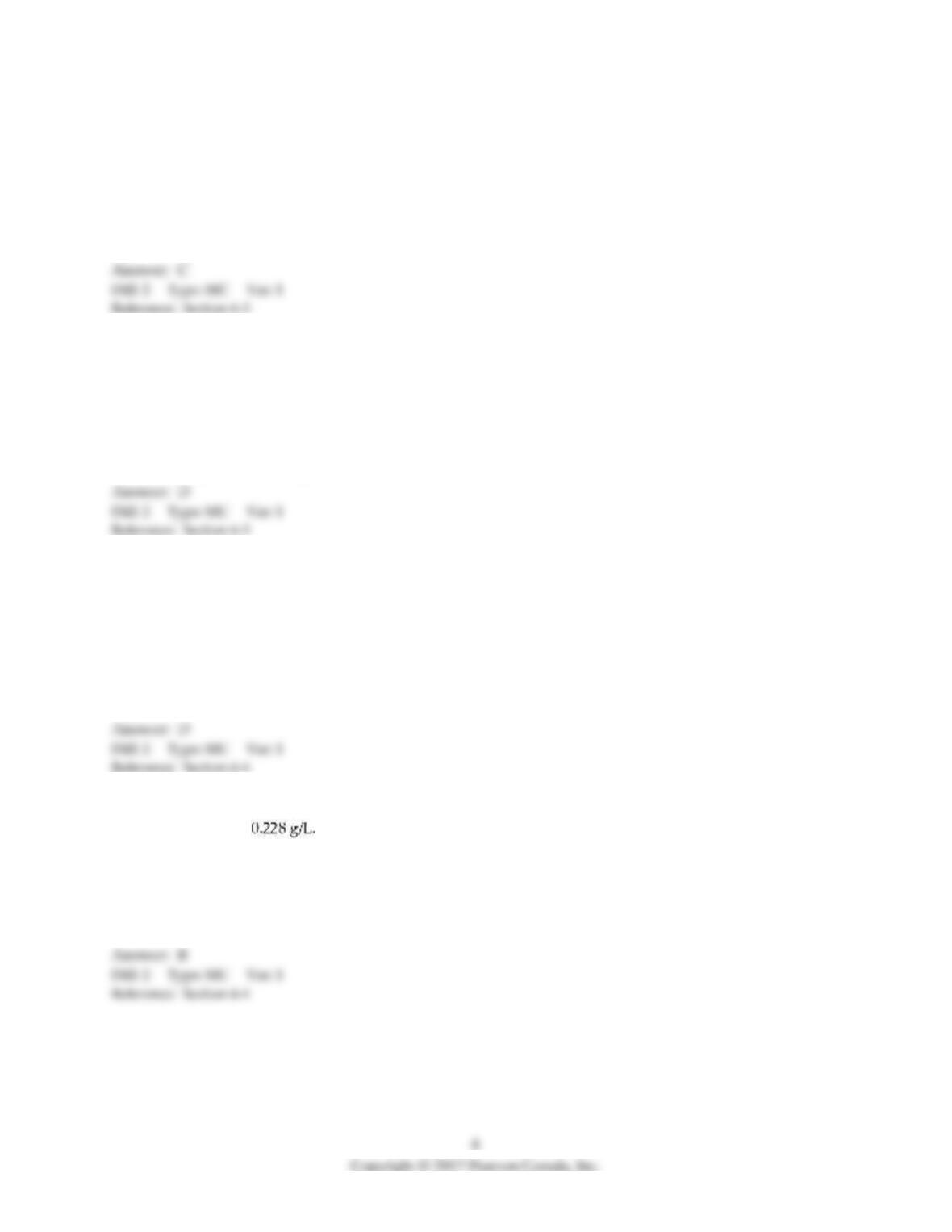
21) 53.5 g of an ideal gas of molecular weight = 30.5 g/mol is confined at a pressure of 133 mmHg. The
density of the gas is Compute the temperature of the gas in degrees Celsius.
A) 261 °C
B) 12 °C
C) -57 °C
D) 285 °C
E) -12 °C
22) What volume of acetylene gas, C2H2, would be required at 0 °C and 1 atm to obtain a 200.0 g C2H2
sample?
A) 4480 L
B) 1.309 × 10⁵ L
C) 320.0 L
D) 0.6304 L
E) 172.1 L
23) What volume would be occupied by 4.8 g of oxygen gas at 0.50 atm and 133 °C?
A) 19 L
B) 13 L
C) 10 L
D) 6.7 L
E) 3.3 L
24) Of the following gases, the one with the greatest density at STP is:
A) CH4
B) NH3
C) Ne
D) H2
E) He
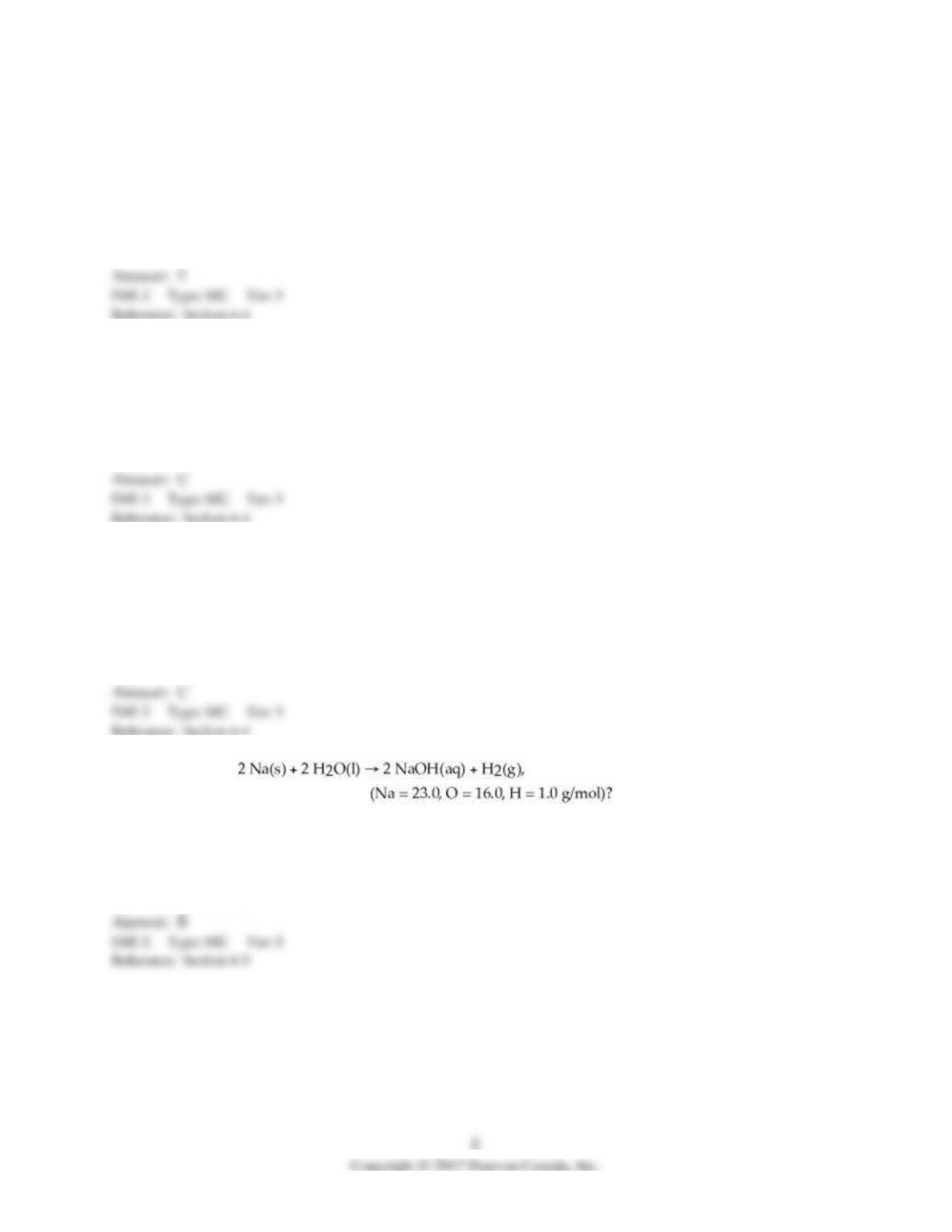
25) In the reaction how many liters of hydrogen at STP are
produced from 50.0 grams of sodium
A) (55.0/18.0)(22.4) L
B) (50.0/23.0)(22.4/2) L
C) (50.0/23.0)(2)(22.4) L
D) (50.0/23.0)(22.4) L
E) (55.0/23.0)(22.4) L
26) When one volume of CO reacts with one volume of Cl2 phosgene is obtained as the only product.
What is empirical formula of phosgene?
A) COCl2
B) C2O2Cl2
C) C2O2Cl
D) C3O3Cl2
E) COCl4
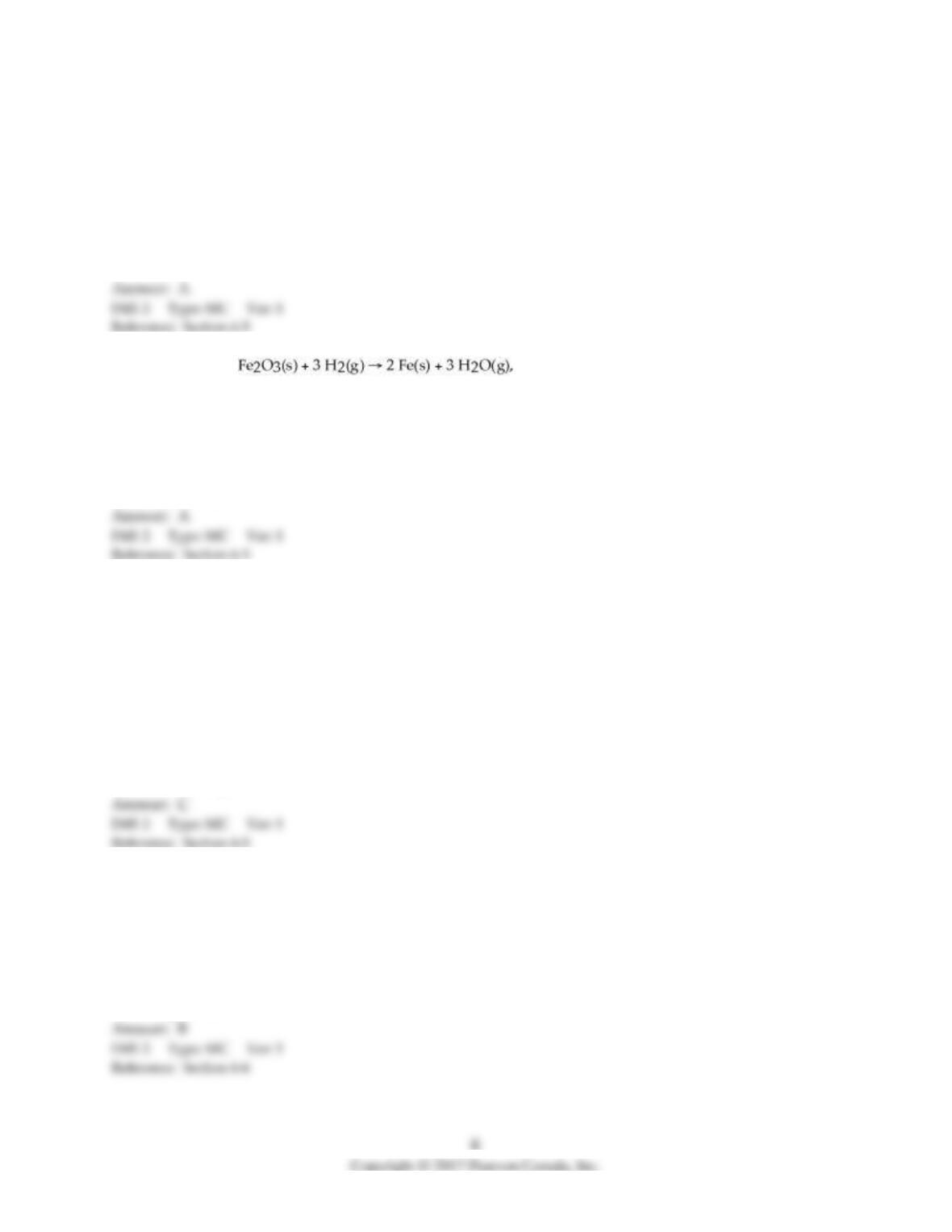
27) In the reaction how many moles of iron can be produced
using 17.4 liters of hydrogen at STP?
A) (17.4/22.4)(2/3) mol
B) (17.4/22.4)(3/2) mol
C) (17.4)(2/3) mol
D) (17.4/22.4) mol
E) (17.4)(22.4/3) mol
28) In the reaction:
2 Al(s) + 6 HCl(aq) → 2 AlCl3(aq) + 3 H2(g)
A) 67.2 L of H2(g) at STP is collected for every mole of Al(s) reacted
B) 33.6 L of H2(g) is collected for every mole of Al(s) reacted, regardless of the temperature and pressure
C) 1.24 cm3 H2(g) at STP is collected for every milligram of Al(s) reacted
D) 6 L HCl(aq) is consumed for every 3 L H2(g) produced
E) 22.4 L of H2(g) is produced for every mole of Al(s) reacted
29) Subtracting the vapor pressure of water from the total pressure of a gas collected over water is an
example of the application of:
A) Avogadro’s Hypothesis
B) Dalton’s Law
C) Graham’s Law
D) van der Waals Theory
E) ideal gas law
30) The addition of 2.0 g He(g) to a vessel of 10.0 L fixed volume already containing O2(g) at 25 °C and
740 mmHg will:
A) have no effect on the final gas pressure
B) cause the final pressure to exceed 2 atm
C) produce a 20% increase in gas pressure
D) bring the final pressure to just slightly more than 1 atm
E) cause the final pressure to exceed 4 atm
31) If a liter of CO2 is compared to a liter of H2, both at 25 °C and one atmosphere pressure, then:
A) the CO2 and H2 molecules have the same average speed
B) there are more H2 molecules than CO2 molecules
C) the average kinetic energy of the CO2 molecules is greater than that of the H2 molecules
D) the CO2 molecules are, on the average, moving more slowly than the H2 molecules
E) the mass of one liter of CO2 equals the mass of one liter of H2
32) A gaseous mixture consists of 50.0% O2, 25.0% N2, and 25.0% Cl2, by mass. At standard temperature
and pressure, the partial pressure of:
A) Cl2(g) is greater than 0.25 atm
B) O2(g) is equal to 380 torr
C) Cl2(g) is less than 0.25 atm
D) N2(g) is equal to 0.20 atm
E) O2(g) is equal to 1.6 atm
33) Three volumes of O2 and one volume of CH4 are placed in a sealed container. The temperature and
pressure of this mixture are 120 °C and 600 kPa. What is the pressure in the same container after the
explosion of the mixture and after it was cooled to the initial temperature?
A) 350 kPa
B) 600 kPa
C) 950 kPa
D) 750 kPa
E) 575 kPa
34) A balloon with volume 750 cm3 is filled with O2 at 27 °C has a mass of 83.3 g. The mass of empty
balloon is 82.1 g. Calculate the pressure of O2.
A) 125 kPa
B) 150 kPa
C) 250 kPa
D) 75 kPa
E) 400 kPa
35) The energy of molecules of a gas:
A) is dependent on concentration
B) is distributed over a wide range at constant temperature
C) is the same for all molecules at constant temperature
D) increases with a decrease in temperature
E) increases with an increase in pressure
36) Which of the following is a characteristic of an ideal gas?
A) The gas cannot be compressed infinitely.
B) Inter-particle forces are prominent.
C) Collisions between gas particles are perfectly elastic.
D) Collisions between gas particles and container walls are not elastic.
E) Individual gas particles occupy fixed volume.
37) Calculate urms, in m/s, for H2(g) molecules at 30 °C.
A) 6.09 × 10² m/s
B) 5.26 × 10³ m/s
C) 6.12 × 101 m/s
D) 1.94 × 10³ m/s
E) 2.74 × 10³ m/s
38) At 27 °C and 750 Torr, both a 16 g sample of methane gas (CH4) and a 16 g sample of oxygen gas (O2)
will have the same:
A) average molecular velocities
B) average molecular kinetic energies
C) number of gaseous particles
D) total gaseous volumes
E) average effusion rates
39) According to the kinetic-molecular theory of gases:
A) gaseous particles are in constant, nonlinear motion
B) at constant temperature, all particles have equal translational kinetic energy
C) the faster a given particle is moving, the greater its translational kinetic energy
D) at constant temperature, average kinetic energy is a function of gas volume
E) all interparticle collisions are completely inelastic
40) If 0.50 mole H2(g) and 1.0 mole He(g) are compared at standard temperature and pressure, the two
gases will:
A) have equal effusion rates
B) have equal average molecular velocities
C) have equal average molecular kinetic energies
D) occupy equal volumes
E) have equal weights
41) If 4.800 × 10⁻⁵ mol of uranium-238 at 4500 K effuses through a hole in 125 seconds, how many mol of
uranium-235 will effuse through the same hole, at the same temperature and in the same amount of time?
A) 4.74 × 10⁻⁵ mol
B) 4.77 × 10⁻⁵ mol
C) 4.80 × 10⁻⁵ mol
D) 4.86 × 10⁻⁵ mol
E) 4.83 × 10⁻⁵ mol
42) The fact that a balloon filled with helium will leak more slowly than one filled with hydrogen is
explained by citing:
A) Avogadro’s Hypothesis
B) Dalton’s Law
C) Graham’s Law
D) van der Waals Theory
E) ideal gas law
43) If someone were to light a cigar at one end of a closed room, persons at the other end of the room
might soon perceive an odor due to gaseous emissions from the cigar. Such a phenomenon is an example
of:
A) monometry
B) ideality
C) effusion
D) diffusion
E) barometry
44) Under conditions for which chlorine gas has an effusion rate of 2.4 × 10⁻⁶ mol/sec, what would be the
effusion rate for bromine gas, in mol/sec?
A) 1.1 × 10⁻⁶ mol/sec
B) 1.6 × 10⁻⁶ mol/sec
C) 2.3 × 10⁻⁶ mol/sec
D) 3.6 × 10⁻⁶ mol/sec
E) 5.4 × 10⁻⁶ mol/sec
45) The volume correction term in the van der Waals equation is present because:
A) barometers are inaccurate
B) molecules are diatomic
C) molecules attract each other
D) molecules occupy volume
E) molecules repel each other
46) The mutual attraction of gas molecules is an important aspect of:
A) Avogadro’s Hypothesis
B) Dalton’s Law
C) Graham’s Law
D) van der Waals Theory
E) ideal gas law
47) Gases tend to behave ideally at:
A) low temperature and low pressure
B) low temperature and high pressure
C) high temperature and low pressure
D) high temperature and high pressure
E) gases always behave ideally
48) In which of the following cases is the gas most likely to behave as an ideal gas?
A) H2O(g), 375 K, 750 Torr
B) He(g), 37.5 K, 7500 Torr
C) CH4(g), 37.5 °C, 7.5 atm
D) Ne(g), 375 °C, 0.75 atm
E) SF6, -37.5 °C, 0.75 atm
49) Calculate the height of a column of liquid glycerol (d = 1.26 g/cm3), in meters, required to exert the
same pressure as 4.91 m of water.
A) 4.91 m
B) 3.90 m
C) 6.19 m
D) 3.65 m
E) 5.16 m
50) Convert 1250 mmHg to the equivalent pressure in atmospheres.
A) 9.50 × 10⁵ atm
B) 490 atm
C) 1.64 atm
D) 0.608 atm
E) 1.22 atm
51) Convert 421 kPa to the equivalent pressure in atmospheres.
A) 4.27 × 10⁵ atm
B) 320 atm
C) 0.554 atm
D) 0.00415 atm
E) 4.15 atm
52) Convert 780 Torr to the equivalent pressure in atmospheres.
A) 0.974 atm
B) 1.03 atm
C) 20 atm
D) 5.93 × 10⁵ atm
E) 5.85 atm
53) Calculate the height in meters of a column of liquid glycerol (d = 1.26 g/cm3) required to exert the
same pressure as 760 mmHg (d = 13.60 g/cm3).
A) 8.20 m
B) 8.20 × 10³ m
C) 70.4 m
D) 0.704 m
E) 44.4 m

54) Calculate the height in meters of a column of liquid ethanol (d = 0.7893 g/cm3) required to exert the
same pressure as 760 mmHg (d = 13.60 g/cm3).
A) 1.31 × 10⁴ m
B) 13.1 m
C) 70.8 m
D) 0.0708 m
E) 44.1 m
55) A 40.2 L constant-volume cylinder containing 2.21 mol He is heated until the pressure reaches 4.20
atm. What is the final temperature?
A) 258 K
B) 658 K
C) 931 K
D) 804 K
E) 1074 K
56) Liquid mercury freezes at a temperature of -39 °C. The freezing point of mercury on the Kelvin scale
is ________.
A) 234 K
B) 39 K
C) 312 K
D) 273 K
E) -39 K
57) A 50.0 mL canister of Freon-12 (CF2Cl2) was heated in boiling water (100.0 °C) until the canister burst.
If the canister was not defective, and had a burst rating of 103.4 bar, what minimum amount of Freon-12
was in the canister, assuming no volume change before bursting?
A) 9.63 g
B) 11.5 g
C) 20.2 g
D) 27.5 g
E) 75.0 g
58) A 4.0 L sample of N2(g) at 760 mmHg is compressed, at constant temperature, to 3.2 atm. What is the
final gas volume?
A) 950 L
B) 13 L
C) 59 L
D) 1.3 L
E) 0.77 L
59) A sample of helium gas occupies a volume of 38 L at 780 torr and 25 °C. What volume would the gas
occupy at 0 °C and 1 atm?
A) 40 L
B) 38 L
C) 36 L
D) 34 L
E) 25 L
60) A sample of gas has a volume of 2.5 L at 30 °C and 720 mmHg. What will be the volume of this gas at
22 °C and 750 mmHg?
A) 1.8 L
B) 3.3 L
C) 2.7 L
D) 2.3 L
E) 2.5 L
61) A 500.0 mL sample of O2(g) is at 780 mmHg and 30 °C. What will be the new volume if, with constant
pressure and amount of gas, the temperature is decreased to -15 °C?
A) 587 mL
B) 250 mL
C) 437 mL
D) 426 mL
E) 500 mL