62) An automobile tire at 32.0 psi at 25.0 °C is driven on a trip. At the end of the trip the pressure is 35.0
psi. What is the temperature of the tire in degrees Celsius?
A) 27.3 °C
B) 22.8 °C
C) 52.9 °C
D) 57.0 °C
E) 60.0 °C
63) A gaseous hydrocarbon weighing 0.290 g occupies a volume of 125 mL at 25 °C and 760 mmHg. What
is the molar mass of this compound?
A) 113 g/mol
B) 4.76 × 10³ g/mol
C) 43.1 g/mol
D) 10.5 g/mol
E) 56.7 g/mol
64) A 5.00 L container of unknown gas at 25.0 °C has a pressure of 2.45 atm. The mass of the gas is 32.1 g.
What gas is in the container?
A) Cl2
B) F2
C) NO2
D) SO3
E) SO2
65) A 10.0 L container of unknown gas at 25.0 °C contains 87.1 g of gas at 12.5 atm. What gas is in the
container?
A) NH3
B) C2H2
C) SO2
D) F2
E) NO2
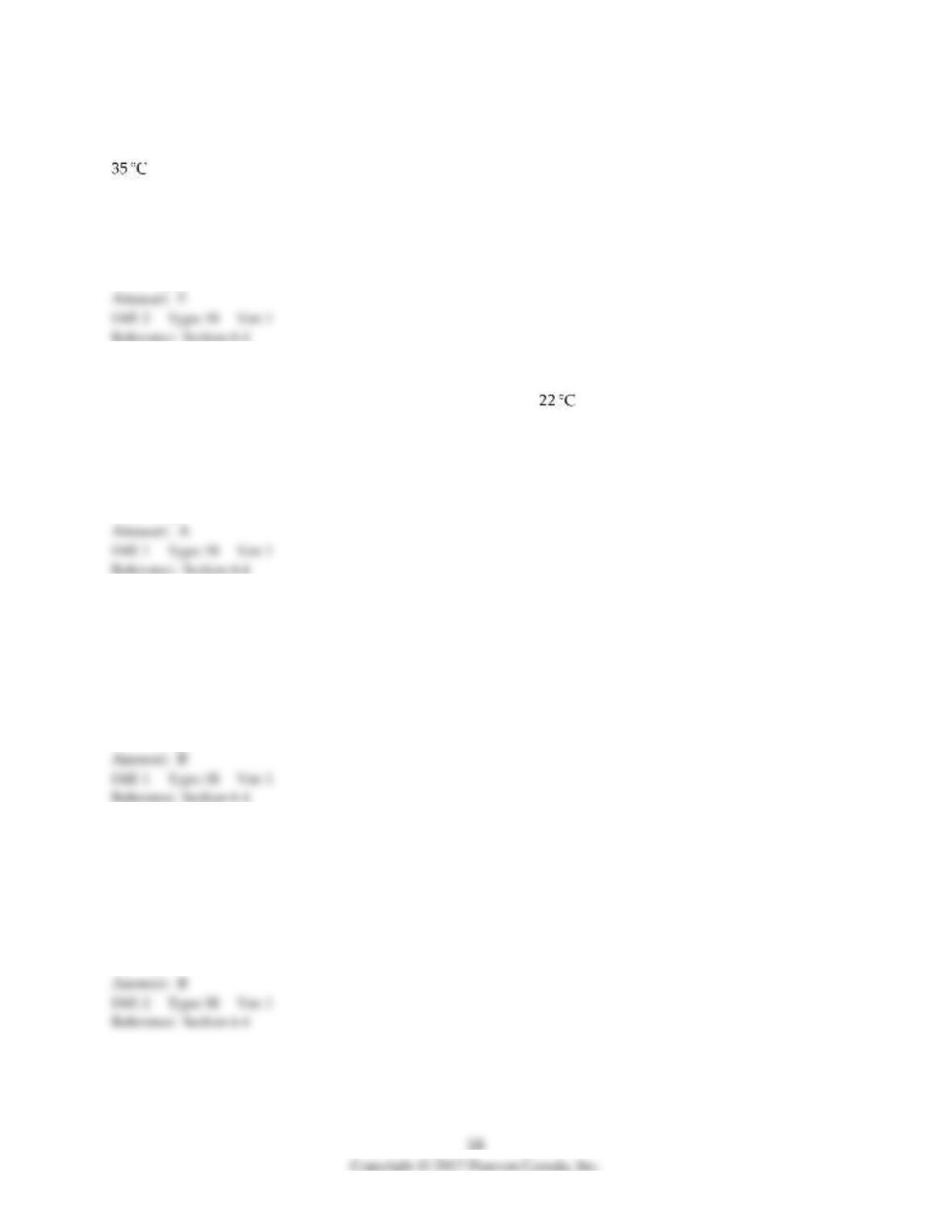
66) Chloroform (CHCl3) became popular as an anesthetic after Queen Victoria delivered her eighth child
while anesthetized by chloroform in 1853. What is the density in grams per liter of chloroform at
and 850 Torr?
A) 4.21 g/L
B) 0.190 g/L
C) 2.14 g/L
D) 4.00 × 10³ g/L
E) 5.28 g/L
67) Halothane (CHBrClCF3) is one of the modern anesthetics that is nonflammable and relatively safe for
patients. What is the density of halothane in grams per liter at and 805 Torr?
A) 8.64 g/L
B) 7.68 g/L
C) 6.55 × 10³ g/L
D) 19.3 g/L
E) 0.130 g/L
68) A sample of gas weighs 0.250 g and occupies a volume of 112 cm3 at 0 °C and 1 atm. The molar mass
of the gas is ________.
A) 25.0 g/mol
B) 50.0 g/mol
C) 2.23 g/mol
D) 8.0 g/mol
E) 200 g/mol
69) What mass of water vapor would occupy a volume of 54 L at 200 °C and 76 Torr, assuming ideal
behavior?
A) 1.8 g
B) 2.5 g
C) 4.3 g
D) 5.4 g
E) 7.2 g
70) How many liters of gas is 23.4 grams of nitrogen at 750 mmHg and 28.0 °C?
A) 586 L
B) 20.9 L
C) 0.771 L
D) 20.4 L
E) 1.94 L
71) Butane (C4H10) is used as a fuel where natural gas is not available. How many grams of butane will
fill a 3.50 liter container at 35.6 °C and 758 Torr?
A) 0.138 g
B) 69.5 g
C) 422 g
D) 8.01 g
E) 0.0105 g
72) Butane (C4H10) is used as a fuel where natural gas is not available. How many grams of butane will
fill a 45.0 liter container at 27 °C and 3.05 atm?
A) 26.6 g
B) 3.60 × 10³ g
C) 5.58 g
D) 10.4 g
E) 324 g
73) How many liters of gas is 10.8 grams of nitrogen at 780 mmHg and 38.0 °C?
A) 10.1 L
B) 1.17 L
C) 9.59 L
D) 269 L
E) 0.353 L
74) Diethyl ether was the first general anesthetic. It was first used in 1846 for surgical procedures. What is
the molar mass of diethyl ether if 3.54 grams is 1.06 liters at 27 °C and 1.11 atm?
A) 74.1 g/mol
B) 6.67 g/mol
C) 103 g/mol
D) 91.3 g/mol
E) 84.7 g/mol
75) Chloroform became popular as an anesthetic after Queen Victoria delivered her eighth child while
anesthetized by chloroform in 1853. What is the molar mass of chloroform if 4.85 grams is 0.918 liters at
35 °C and 850 Torr?
A) 149 g/mol
B) 119 g/mol
C) 123 g/mol
D) 134 g/mol
E) 110 g/mol
76) Halothane is one of the modern anesthetics which is nonflammable and relatively safe for patients.
What is the molar mass of halothane if 456 milligrams is 52.8 milliliters at 22 °C and 805 Torr?
A) 1.06 × 10³ g/mol
B) 209 g/mol
C) 197 g/mol
D) 221 g/mol
E) 14.7 g/mol
77) Diethyl ether (CH3CH2OCH2CH3) was the first general anesthetic. It was first used in 1846 for
surgical procedures. What is the density in g/L of diethyl ether at 27 °C and 1.11 atm?
A) 37.1 g/L
B) 2.03 × 10³ g/L
C) 2.71 g/L
D) 3.34 g/L
E) 0.299 g/L
78) What is the density of carbon dioxide gas at -15 °C and 728 Torr?
A) 2.17 g L–1
B) 2.08 g L–1
C) 1.99 g L–1
D) 1.84 g L–1
E) 1.27 g L–1
79) What pressure must be applied to N2(g) to obtain a density of 2.00 g/L at 25 °C?
A) 1.75 atm
B) 0.146 atm
C) 111 atm
D) 3.49 atm
E) 2.29 atm
80) Calculate the volume of H2(g) expressed at STP, required to react with 3.00 L of CO(g) at STP in the
following reaction:
3 CO(g) + 7 H2(g) → C3H8(g) + 3 H2O(l)
A) 3.00 L
B) 7.00 L
C) 10.0 L
D) 22.4 L
E) 1.00 L
81) Consider the following reaction:
N2(g) + 3 H2(g) → 2 NH3(g)
What volume of NH3(g) can be produced from 200.0 L of H2(g) if the gases are measured at 350 °C and
400 atm pressure?
A) 300.0 L
B) 66.7 L
C) 133.3 L
D) 400.0 L
E) 200.0 L
82) What volume of oxygen gas, at 533 °C and 750 Torr, could be produced by the decomposition of 38.1
g of potassium chlorate? The other product is potassium chloride.
A) 35.9 L
B) 31.3 L
C) 30.4 L
D) 20.7 L
E) 10.4 L
83) How many liters of H2 are needed to make 327 L of NH3 by the reaction:
N2(g) + 3 H2(g) → 2 NH3(g),
if the gases are at the same temperature and pressure?
A) 654 L
B) 491 L
C) 218 L
D) 38.5 L
E) 327 L
84) If 250. L of nitrogen reacts with 582 L of hydrogen by the reaction:
N2(g) + 3 H2(g) → 2 NH3(g),
how much nitrogen is unreacted? All gases are at the same temperature and pressure.
A) 1.9 × 10² L
B) 3.3 × 10² L
C) 56 L
D) 3.0 × 10² L
E) 41 L
85) Phosphine gas oxidizes spontaneously on exposure to air, as represented by:
2 PH3(g) + 3 O2(g) → P2O3(s) + 3 H2O(g)
What volume of oxygen gas, at 720 Torr and 37 °C, would be consumed in the formation of 22.0 g of
P2O3 by this process?
A) 16.1 L
B) 12.5 L
C) 11.2 L
D) 8.05 L
E) 1.92 L
86) When 8.21 L of C3H8(g) is completely burned in oxygen, how many liters of oxygen are consumed?
All gas volumes are measured at the same temperature and pressure but not at STP.
A) 57.5 L
B) 41.1 L
C) 1.17 L
D) 1.64 L
E) 23.7 L
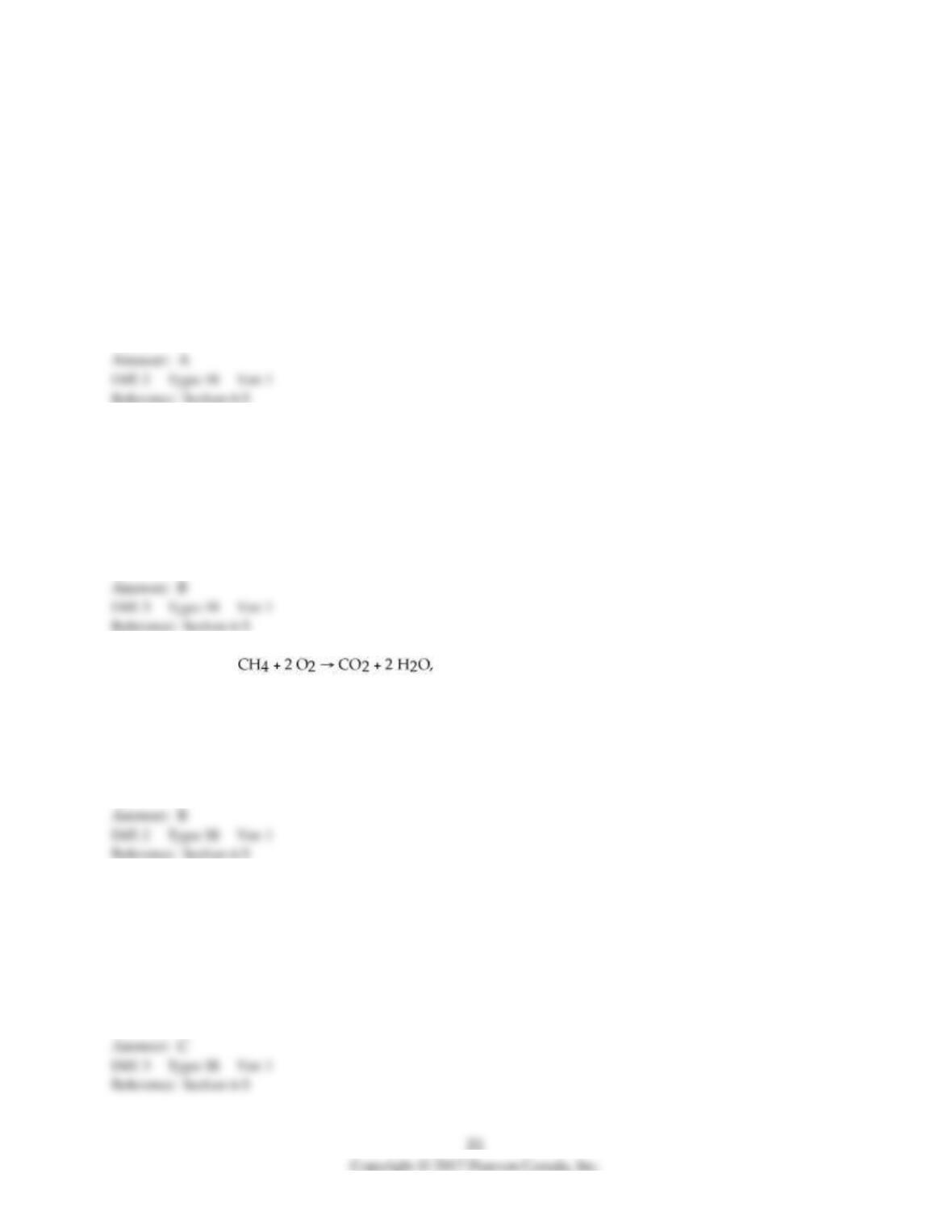
87) In the reaction how many liters of O2 react with 5.0 liters of CH4? All gas
volumes are measured at the same temperature and pressure but not at STP.
A) 0.22 L
B) 10 L
C) 5.0 L
D) 2.5 L
E) 20 L
88) The volume in L H2(g) (measured at 22 °C and 745 mmHg) required to react with 30.0 L CO(g)
(measured at 0 °C and 760 mmHg) in the reaction 3 CO(g) + 7 H2(g) → C3H8(g) + 3 H2O(l) is:
A) 63.5 L
B) 74.1 L
C) 77.2 L
D) 70.0 L
E) 33.1 L
89) The complete combustion of octane, a component of gasoline, is represented by the equation:
2 C8H18(l) + 25 O2(g) → 16 CO2(g) + 18 H2O(l)
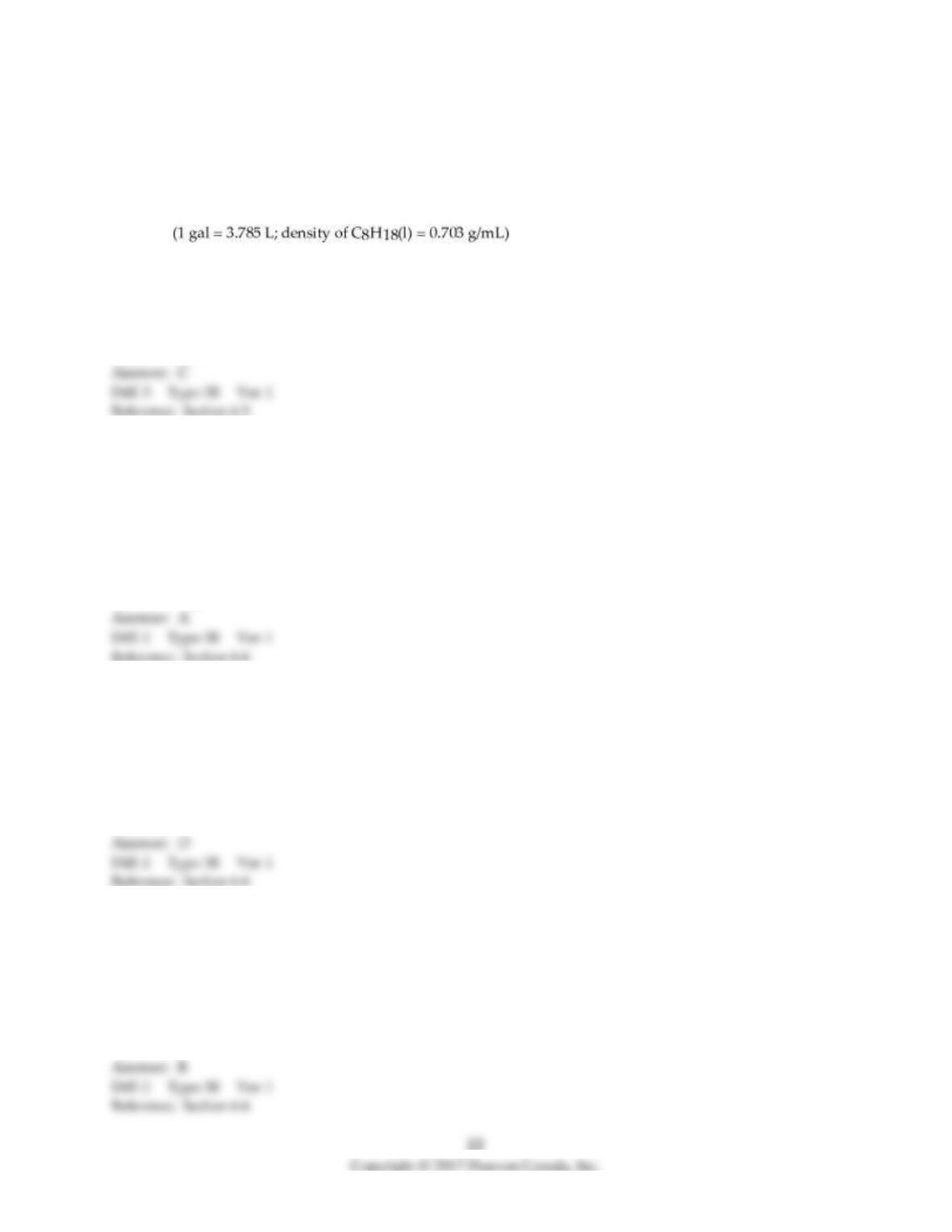
How many liters of CO2(g), measured at 63.1 °C and 688 mmHg, are produced for every gallon of octane
burned?
A) 7.48 L
B) 7.11 × 10² L
C) 5.68 × 10³ L
D) 5.68 L
E) 1.07 × 10³ L
90) A sample of oxygen gas is collected over water at 23 °C at a barometric pressure of 751 mmHg (the
vapor pressure of water at 23 °C = 21 mmHg). The partial pressure of oxygen gas in the sample collected
is ________.
A) 0.96 atm
B) 21 mmHg
C) 751 mmHg
D) 1.02 atm
E) 44 mmHg
91) What volume would be occupied by a mixture of 0.33 g of hydrogen gas and 0.67 g of nitrogen gas at
157 °C and 4.4 atm?
A) 12 L
B) 4.2 L
C) 3.1 L
D) 1.5 L
E) 0.55 L
92) What is the volume, in L, occupied by a mixture of 16.0 g Ne(g) and 42.0 g Ar(g) at 15.0 atm pressure
and 25 °C?
A) 94.6 L
B) 3.01 L
C) 1.71 L
D) 1.29 L
E) 0.252 L
93) A 31.4 mL sample of nitrogen gas was collected over water at 23.7 °C and a barometric pressure of 706
mmHg. What mass of nitrogen was collected? [The vapor pressure of water at 23.7 °C is 22 mmHg.]
A) 39.3 mg
B) 37.7 mg
C) 34.6 mg
D) 33.4 mg
E) 32.5 mg
94) A 34.8 mL sample of an unknown, water-insoluble gas was collected over water at 22.6 °C and a
barometric pressure of 0.895 atm. When the gas was dried and chilled, it formed 114.6 mg of liquid. What
was the molar mass of this substance? [The vapor pressure of water at 22.6 °C is 20. mmHg]
A) 22.9 g/mol
B) 38.4 g/mol
C) 57.3 g/mol
D) 84.2 g/mol
E) 92.0 g/mol
95) A 1.37 L vessel contains He at a temperature of 24.5 °C and a pressure of 205 mmHg. A 721 mL vessel
contains Ne at a temperature of 36.2 °C and a pressure of 0.185 atm. Both of these gases are placed in a
2.00 L vessel at 302 K. What is the final pressure (in atm) in the 2.00 L vessel?
A) 0.253 atm
B) 0.187 atm
C) 0.0657 atm
D) 0.455 atm
E) 0.390 atm
96) In a sample of air at STP, the ratio of the root-mean-square velocity of O2 to that of N2, that is
urms(O2)/urms(N2), is equal to ________.
A) 0.88
B) 0.94
C) 1.00
D) 1.07
E) 1.14
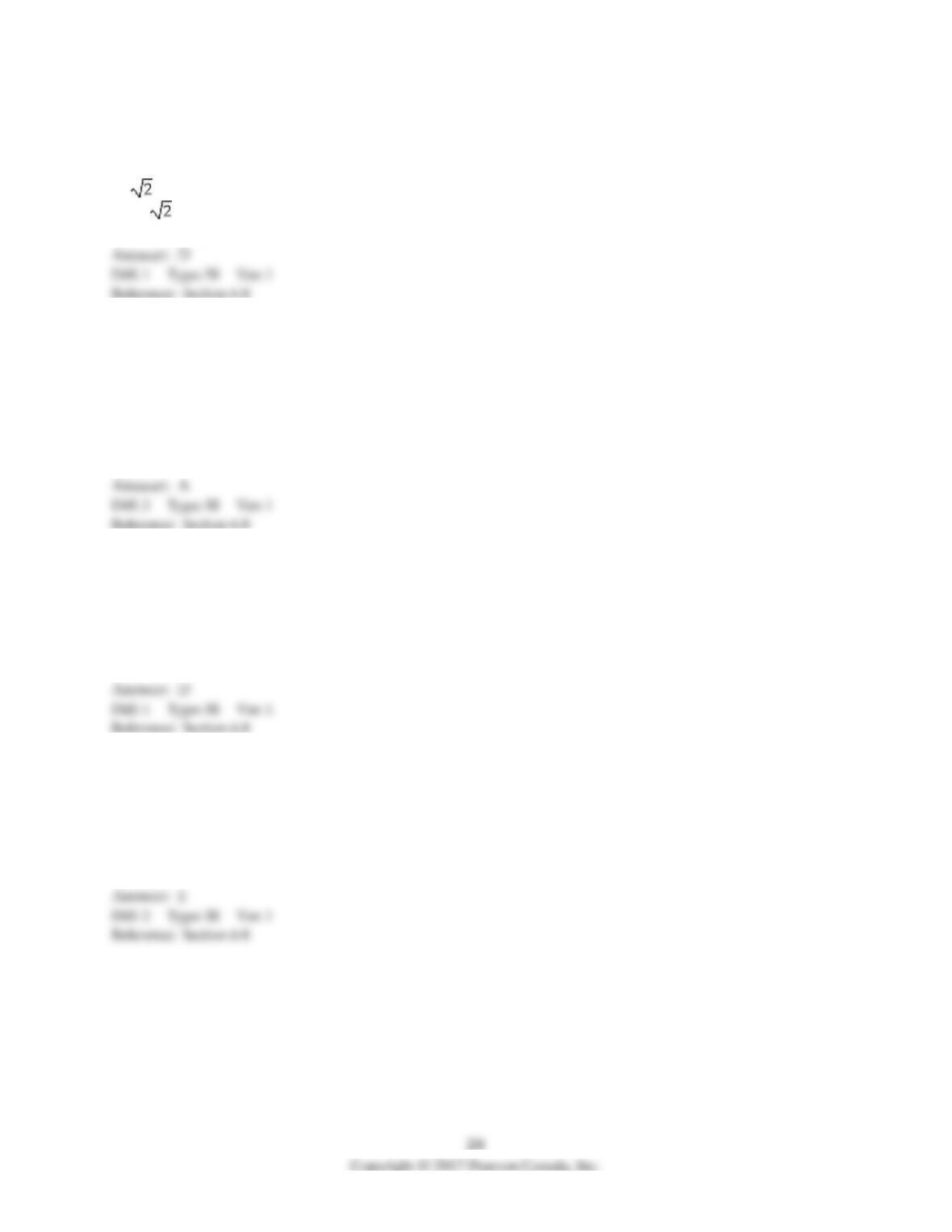
97) A gas of twice the molecular mass as CO2 will pass through a small hole how much faster than CO2?
A) 1/2 as fast
B) 2 times as fast
C) as fast
D) (1/ ) as fast
E) 4 times as fast
98) A sample of N2(g) effuses through a tiny hole in 19.0 s. How long would it take for a sample of
N2O2(g) to effuse under the same conditions?
A) 27.8 s
B) 13.0 s
C) 8.87 s
D) 40.7 s
E) 19.0 s
99) What is the effusion ratio of equal volumes of uranium-238 to uranium-235 at 4500 K?
A) 1.000
B) 0.987
C) 1.02
D) 0.994
E) 1.01
100) What is the ratio of the diffusion rates of Cl2 and O2? (Rate)Cl2/ (Rate)O2 =
A) 0.45
B) 0.69
C) 0.47
D) 1.5
E) 0.67
101) What is the pressure in a gas container that is connected to an open-end U-tube manometer if the
pressure of the atmosphere is 742 Torr and the level of mercury in the arm connected to the container is
8.60 cm higher than the level of mercury open to the atmosphere?
A) 656 mmHg
B) 733 mmHg
C) 751 mmHg
D) 828 mmHg
102) If the pressure in a gas container that is connected to an open-end U-tube manometer is 116 kPa and
the pressure of the atmosphere at the open end of the tube is 752 mmHg, the level of mercury in the tube
will:
A) be 118 mm higher in the arm open to the atmosphere
B) be 118 mm higher in the arm connected to the gas cylinder
C) be 870 mm higher in the arm open to the atmosphere
D) be 870 mm higher in the arm connected to the gas cylinder
103) A container filled with gas is connected to an open-end manometer that is filled with mineral oil. The
pressure in the gas container is 753 mmHg and atmospheric pressure is 724 mmHg. How high will the
level rise in the manometer if the densities of Hg and mineral oil are 13.6 g mL-1 and 0.822 g mL-1,
respectively?
A) 1.75 mm
B) 23.8 mm
C) 29.0 mm
D) 480 mm
104) A balloon filled with helium gas at 20 °C occupies 4.91 L at 1.00 atm. The balloon is immersed in
liquid nitrogen at -196 °C, while the pressure is raised to 5.20 atm. What is the volume of the balloon in
the liquid nitrogen?
A) 0.25 L
B) 3.6 L
C) 6.7 L
D) 97 L
105) The volume of 350. mL of gas at 25 °C is decreased to 135 mL at constant pressure. What is the final
temperature of the gas?
A) -158 °C
B) 9.6 °C
C) 65 °C
D) 500 °C
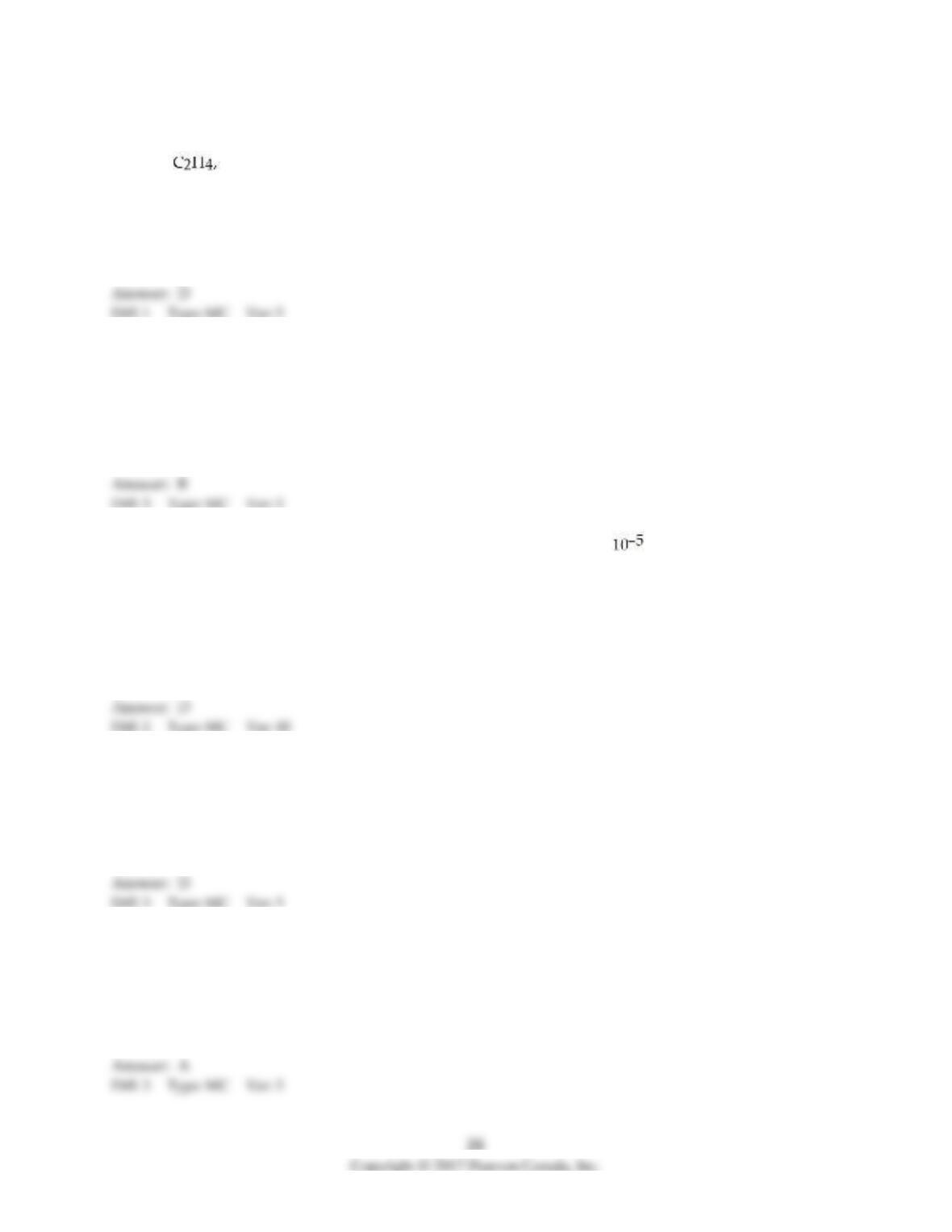
106) Three identical flasks contain three different gases at standard temperature and pressure. Flask A
contains flask B contains O3, and flask C contains F2. Which flask contains the largest number of
molecules?
A) flask A
B) flask B
C) flask C
D) All contain the same number of molecules.
107) You have three cylinders containing O2 gas at the same volume and pressure. Cylinder A is at -15
°C, cylinder B is at -5 °F, cylinder C is at 255 K. Which cylinder contains the largest mass of oxygen?
A) cylinder A
B) cylinder B
C) cylinder C
D) All cylinders contain the same mass of O2.
108) The mole fraction of nitrous oxide in dry air near sea level is 1.818 × , where the molar mass of
nitrous oxide is 44.013. The concentration of nitrous oxide in the atmosphere is ________ ppm.
A) 2.0 × 10¹²
B) 5.0 × 10⁻⁵
C) 500
D) 18.18
E) 5.0 × 10⁻¹³
109) What is the average speed (actually the root mean square speed) of a neon atom at 27 °C?
A) 5.78 m s-1
B) 19.3 m s-1
C) 183 m s-1
D) 609 m s-1
110) Which of the following gases has the highest average speed at 400 K?
A) N2
B) O2
C) F2
D) Cl2
111) Which of the following gases has the lowest average speed at 25 °C?
A) C3H8
B) Kr
C) CH3NH2
D) SO2
112) What is the temperature of NO2 gas if the average speed (actually the root mean square speed) of the
molecules is 750 m s-1?
A) 1.38 K
B) 1.04 × 10³ K
C) 1.38 × 10³ K
D) 1.04 × 10⁶ K
113) If CO2 and NH3 are allowed to effuse through a porous membrane under identical conditions, the
rate of effusion for NH3 will be ________ times that of CO.
A) 0.39
B) 0.62
C) 1.6
D) 2.6