72) What is the proper coefficient for water when the following equation is completed and balanced for
the reaction in basic solution?
C2O42- (aq) + MnO4– (aq) → CO32- (aq) + MnO2(s)
A) 4
B) 3
C) 2
D) 1
E) 0
73) Balance the following equation for an oxidation-reduction reaction occurring in an acidic solution:
HCl(aq)+ H2C2O4(aq) + MnO2(s) → MnCl2(aq) + CO2(g) + H2O(l)
The sum of the coefficients is ________.
A) 7
B) 15
C) 45
D) 12
E) 9
74) Balance the following equation for an oxidation-reduction reaction occurring in an acidic solution:
CuS(s) + HNO3(aq) → Cu(NO3)2(aq) + H2O(l) + NO(g) + S(s)
The sum of the coefficients is ________.
A) 23
B) 18
C) 35
D) 33
E) 45
75) Balance the following equation for an oxidation-reduction reaction occurring in an acidic solution:
HNO3(aq) + I2(s) → HIO3(aq) + NO2(g) + H2O(l)
The sum of the coefficients is ________.
A) 26
B) 27
C) 28
D) 33
E) 45
76) Balance the following equation for an oxidation-reduction reaction occurring in an acidic solution:
ClO4–(aq) + SO32-(aq) → SO42-(aq) + Cl–(aq)
The sum of the coefficients is ________.
A) 8
B) 12
C) 10
D) 4
E) 6
77) Balance the following equation for an oxidation-reduction reaction occurring in an acidic solution:
IO3–(aq) + N2H4(aq) → I–(aq) + N2(g) + H2O(l)
The sum of the coefficients is ________.
A) 8
B) 25
C) 18
D) 16
E) 32
78) Balance the following oxidation-reduction reaction in acid solution:
SO32-(aq) + MnO4–(aq) → SO42-(aq) + Mn2+(aq) + H2O(l)
The sum of the coefficients is ________.
A) 23
B) 30
C) 13
D) 45
E) 28
79) Balance the following oxidation-reduction reaction in acid solution:
Fe(s) → Fe2+ + H2(g)
The sum of the coefficients is ________.
A) 2
B) 5
C) 8
D) 7
E) 9
80) Balance the following oxidation-reduction reaction in acid solution:
MnO4–(aq) + H2C2O4(aq) → Mn2+(aq) + CO2(g) + H2O(l)
The sum of the coefficients is ________.
A) 25
B) 47
C) 33
D) 18
E) 21
81) Balance the following equation in basic solution:
Br2 + Mn2+ → MnO2 + Br–
The sum of the coefficients is ________.
A) 8
B) 15
C) 12
D) 17
E) 11
82) Balance the following equation in basic solution:
Cr3+ + O22- → CrO42-
The sum of the coefficients is ________.
A) 13
B) 53
C) 27
D) 18
E) 38
83) What is the sum of all coefficients in the complete and balanced net equation for the reaction
occurring when chlorine gas is bubbled through aqueous sodium hydroxide to form aqueous sodium
hypochlorite (NaOCl) and sodium chloride?
A) 15
B) 11
C) 10
D) 8
E) 6
84) Balance the following equation in basic solution:
Al(s) + O2(g) → [Al(OH)4]–(aq)
The sum of the coefficients is ________.
A) 6
B) 12
C) 21
D) 25
E) 33
85) Gold does not react with either nitric acid or hydrochloric acid but with a combination of both called
aqua regia. Identify the reducing agent in the following equation:
Au(s) + 4 H+(aq)+ NO3–(aq)+ 4 Cl–(aq) → [AuCl4]–(aq) + 2 H2O(l)+ NO(g)
A) Au
B) H+
C) NO3–
D) Cl–
E) Au and Cl–
86) Gold does not react with either nitric acid or hydrochloric acid but with a combination of both called
aqua regia. Identify the oxidizing agent in the following equation:
Au(s) + 4 H+(aq) + NO3–(aq) + 4 Cl–(aq) → [AuCl4]–(aq) + 2 H2O(l) + NO(g)
A) Au
B) H+
C) NO3–
D) Cl–
E) NO3– and H+
87) The analysis for iron usually is done by titration with permanganate. Identify the oxidizing agent in
the following equation:
MnO4–(aq) + 5 Fe2+(aq) + 8 H+(aq) → 5 Fe3+(aq) + Mn2+(aq) + 4 H2O(l)
A) MnO4–
B) Fe2+
C) H+
D) Mn2+
E) It is not a redox reaction.
88) Identify the reducing agent in the following reaction:
2 NO2(g) + 7 H2(g) → 2 NH3(g) + 4 H2O(g)
A) NO2
B) NH3
C) H2O
D) H2
E) There is no reducing agent.
89) A 5.00 mL sample of a nitric acid solution is titrated with 33.5 mL of 0.201 M NaOH. What is the
molarity of the nitric acid solution?
A) 0.0300 M
B) 0.149 M
C) 1.35 M
D) 6.7 M
E) 0.522 M
23
90) A solution is 0.20 M Ba(OH)2(aq). How many moles of HCl(aq) must be added to neutralize 100.0 mL
of the solution?
A) 0.020 mol
B) 0.080 mol
C) 0.040 mol
D) 0.40 mol
E) 0.80 mol
91) What volume of 0.110 M H2SO4 is required to exactly neutralize 10.0 mL of 0.085 M NaOH?
A) 7.7 mL
B) 1.9 mL
C) 0.39 mL
D) 3.9 mL
E) 0.19 mL
92) The neutralization of 25.0 mL of 0.24 M HCl requires 5.0 mL of NaOH. What is the molarity of the
NaOH solution?
A) 0.6 M
B) 2.4 M
C) 5.0 M
D) 0.048 M
E) 1.2 M
93) A piece of iron wire weighing 1.63 g is converted to Fe2+(aq) and requires 21.9 mL of KMnO4 solution
for its titration. What is the molarity of the KMnO4 solution? The reaction occurring during the titration
is:
5 Fe2+ (aq) + MnO4– (aq) + 8 H+ (aq) → 5 Fe3+ (aq) + Mn2+ (aq) + 4 H2O
A) 1.33 M
B) 0.267 M
C) 2.67 × 10⁻⁴ M
D) 14.9 M
E) 1.33 × 10⁻³ M
94) What volume of 0.38 M hydrochloric acid is required for complete neutralization of 15 mL of 0.19 M
calcium hydroxide?
A) 38 mL
B) 30 mL
C) 19 mL
D) 15 mL
E) 7.5 mL
95) A 5.000 mL aqueous sample containing hydrogen peroxide was diluted to 25 mL and analyzed by
titration with permanganate:
2 MnO4–(aq) + 5 H2O2(aq) + 6 H+(aq) → 5 O2(g) + 2 Mn2+(aq) + 8 H2O(l)
The sample required 42.8 mL of 0.0175 M permanganate to reach the end point. What is the concentration
of hydrogen peroxide in the original sample?
A) 0.150 M
B) 0.0748 M
C) 0.375 M
D) 0.0599 M
96) A sample of magnesium oxide was dissolved in 50.0 mL of 0.183 M hydrochloric acid, and the excess
acid was titrated to a phenolphthalein end-point by 13.4 mL of 0.105 M sodium hydroxide. What was the
mass of the magnesium oxide sample?
A) 312 mg
B) 184 mg
C) 156 mg
D) 104 mg
E) 77.8 mg
97) A solution of potassium permanganate was standardized by titration of a solution prepared by
dissolving 0.268 g of pure sodium oxalate in approximately 25 mL of distilled water. A 31.4 mL volume of
titrant was required to reach the end-point. The reaction is:
2 MnO4– + 5 C2O42- + 16 H+ → 2 Mn2+ + 10 CO2 + 8 H2O
What is the molarity of MnO4-?
A) 0.0174 M
B) 0.0255 M
C) 0.0348 M
D) 0.0637 M
E) 0.159 M
98) A 0.411 g sample of powdered copper mixed with an inert, soluble additive was fully consumed by
23.4 mL of 0.602 M nitric acid, producing copper(II) nitrate, water, and nitric oxide (NO) gas. What was
the percent copper (by mass) in the sample?
3 Cu + 8 HNO3 → 3 Cu(NO3)2 + 2 NO + 4 H2O
A) 81.7%
B) 68.3%
C) 65.3%
D) 56.9%
E) 34.4%
99) Reactive metals such as iron will reduce arsenic acid (H3AsO4) to the highly poisonous arsine gas
(AsH3) in the presence of acid. What mass of iron would be required for such a reaction with 250 mL of
0.90 M arsenic acid, assuming that the iron is oxidized to Fe3+?
3 H3AsO4 + 8 Fe + 24 H+ → 3 AsH3 + 12 H2O + 8 Fe3+
A) 45 g
B) 38 g
C) 34 g
D) 21 g
E) 13 g
100) Aqueous solutions of HBr , HI , HNO3, NaBr , and KNO3 are all classified as:
A) acids
B) nonelectrolytes
C) strong electrolytes
D) weak electrolytes
101) Which one of the following compounds is insoluble in water?
A) K2Br
B) NaNO3
C) AgBr
D) Rb2CO3
102) Which one of the following compounds is soluble in water?
A) Cu3(PO4)2
B) CoS
C) Pb(NO3)2
D) ZnCO3
103) Which pair of compounds is soluble in water?
A) HgBr2 and Hg2I2
B) CuS and Na2S
C) LiI and Ca(NO3)2
D) KNO3 and CaCO3
104) The mixing of which pair of reactants will result in a precipitation reaction?
A) CsI(aq) + NaOH(aq)
B) HCl(aq) + Ca(OH)2(aq)
C) K2SO4(aq) + Hg2(NO3)2(aq)
D) NaNO3(aq) + NH4Cl(aq)
105) The mixing of which pair of reactants will result in a precipitation reaction?
A) Ba(NO3)2(aq) + Na2CO3(aq)
B) K2SO4(aq) + Cu(NO3)2(aq)
C) NaClO4(aq) + (NH4)2S(aq)
D) NH4Br(aq) + NH4I(aq)
106) What reagent could be used to separate Br– from CH3CO2– when added to an aqueous solution
containing both?
A) AgNO3(aq)
B) Ba(OH)2(aq)
C) CuSO4(aq)
D) NaI(aq)
107) What reagent could not be used to separate Br– from CO32- when added to an aqueous solution
containing both?
A) AgNO3(aq)
B) Ca(NO3)2(aq)
C) Cu(NO3)2(aq)
D) Fe(NO3)2(aq)
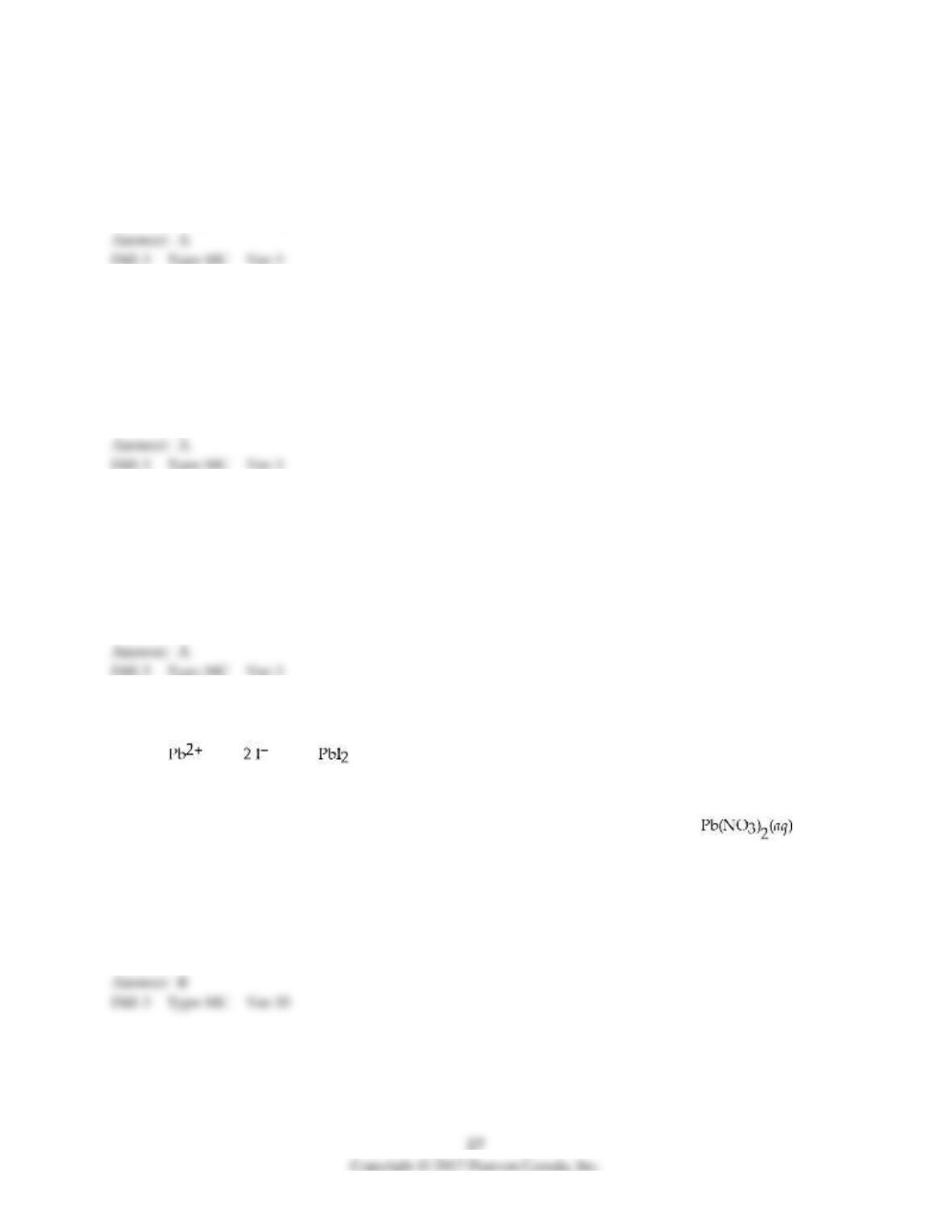
108) Lead ions can be precipitated from aqueous solutions by the addition of aqueous iodide:
(aq) + (aq) → (s)
Lead iodide is virtually insoluble in water so that the reaction appears to go to completion. How many
millilitres of 3.550 mol L-1 HI(aq) must be added to a solution containing 0.700 mol of to
completely precipitate the lead?
A) 2.54 × 10⁻³ mL
B) 394 mL
C) 197 mL
D) 0.197 mL
E) 0.394 mL
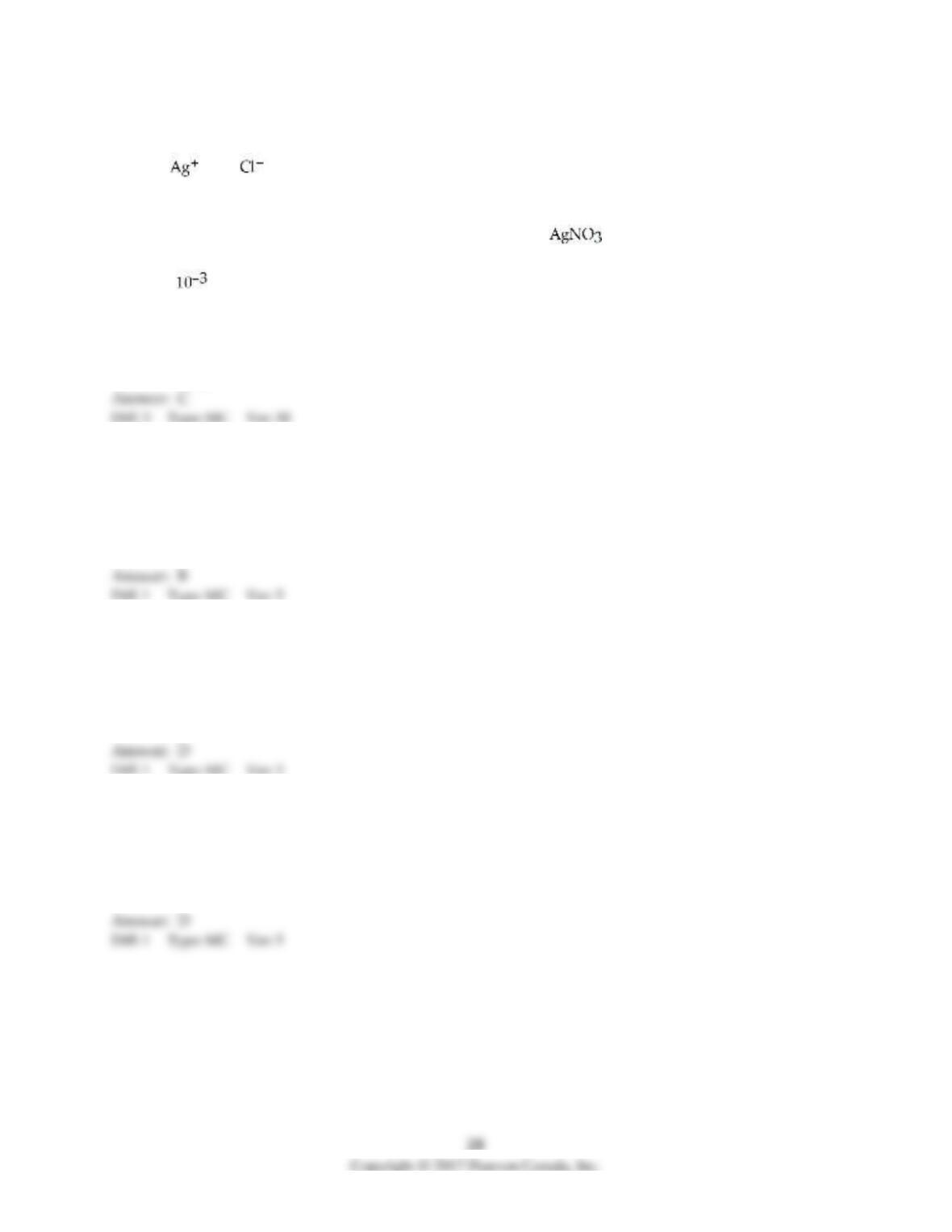
109) Silver ions can be precipitated from aqueous solutions by the addition of aqueous chloride:
(aq) + (aq) → AgCl(s)
Silver chloride is virtually insoluble in water so that the reaction appears to go to completion. How many
grams of solid NaCl must be added to 25.0 mL of 0.366 mol L-1 (aq) solution to completely
precipitate the silver?
A) 9.15 × g
B) 1.57 × 10⁻⁴ g
C) 0.535 g
D) 0.157 g
E) 6.39 × 10³ g
110) Which of the following compounds is an Arrhenius base?
A) CH3CO2H
B) CH3CH2NH2
C) HNO2
D) H2SO4
111) Which of the following compounds is an Arrhenius base?
A) C6H12O6
B) HOCl
C) H2SO4
D) C6H5NH2
112) Which of the following compounds is an Arrhenius base?
A) CH3OH
B) CH3CO2H
C) HOCl
D) CsOH
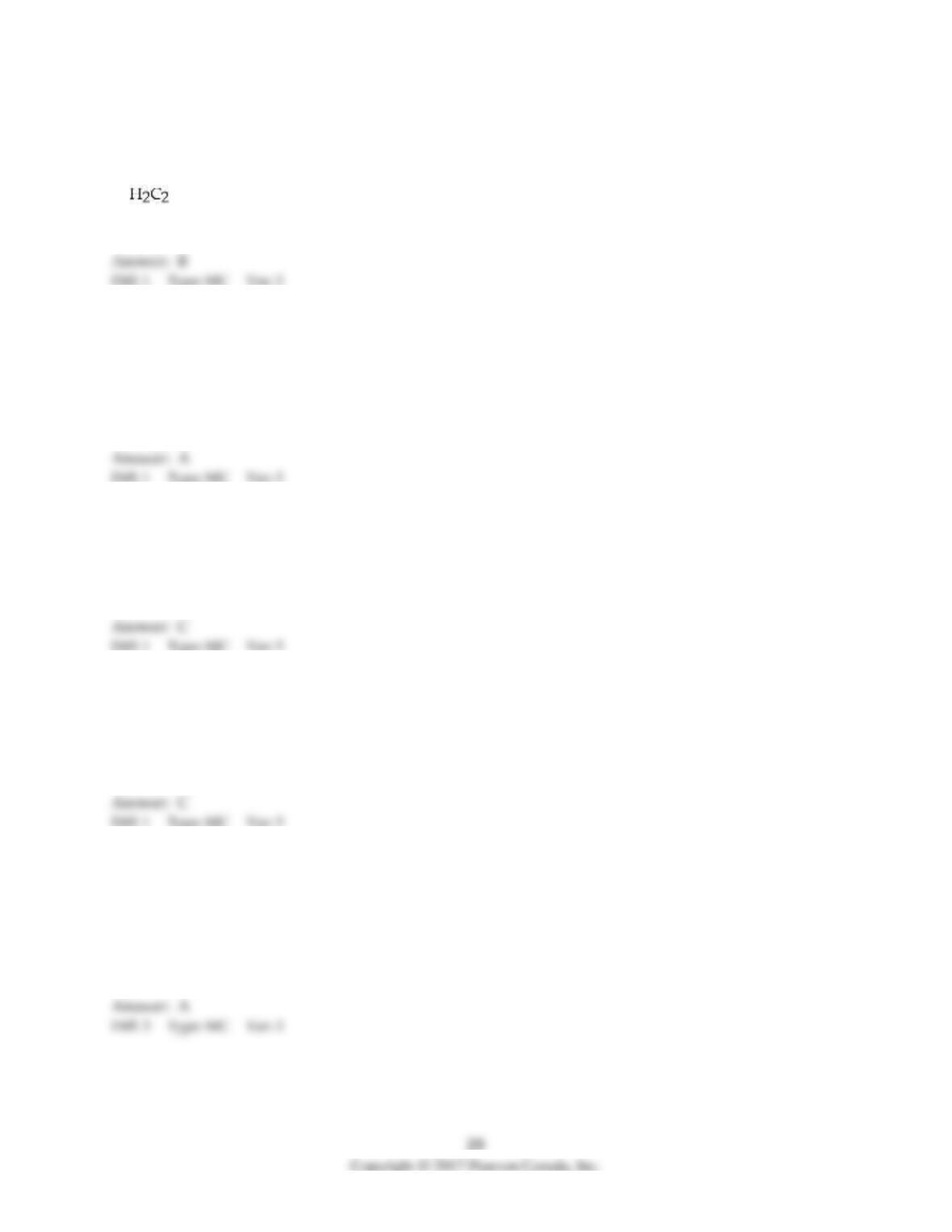
113) Which of the compounds of H2C2O4, Ca(OH)2, KOH, and HI behave as acids when they are
dissolved in water?
A) Ca(OH)2 and KOH
B) O4 and HI
C) only HI
D) only KOH
114) Which of the compounds H2C2O4, Ca(OH)2, KOH, and HI behave as bases when they are dissolved
in water?
A) Ca(OH)2 and KOH
B) H2C2O4 and HI
C) only HI
D) only KOH
115) Which one of the following compounds behaves as an acid when dissolved in water?
A) RaO
B) C4H10
C) HI
D) RbOH
116) When dissolved in water, KOH behaves as:
A) an acid that forms K+ and OH– ions
B) an acid that forms KO– and H+ ions
C) a base that forms K+ and OH– ions
D) a base that forms KO– and H+ ions
117) In an acid-base neutralization reaction, 38.74 mL of 0.500 mol L-1 potassium hydroxide reacts with
50.00 mL of sulfuric acid solution. What is the concentration of the H2SO4 solution?
A) 0.194 mol L-1
B) 0.387 mol L-1
C) 0.775 mol L-1
D) 1.29 mol L-1
118) When 280 mL of 1.50 × 10⁻⁴ mol L-1 hydrochloric acid is added to 105 mL of 1.75 × 10⁻⁴ mol L-1
Mg(OH)2, the resulting solution will be:
A) acidic
B) basic
C) neutral
D) It is impossible to tell from the information given.
119) A solution is prepared by mixing 50.0 mL of 0.100 mol L-1 HCl and 10.0 mL of 0.200 mol L-1 NaCl.
What is the molarity of chloride ion in this solution?
A) 0.183
B) 8.57
C) 3.50
D) 0.0500
E) 0.117
120) How many millilitres of 0.550 mol L-1 hydriodic acid are needed to react with 15.00 mL of 0.217 mol
L-1 CsOH?
HI(aq) + CsOH(aq) → CsI(aq) + H2O(l)
A) 0.0263 mL
B) 0.169 mL
C) 5.92 mL
D) 38.0 mL
121) Identify the coefficient of Ca(OH)2(aq) when the following reaction is balanced, and determine the
number of millilitres of 0.00300 mol L-1 phosphoric acid required to neutralize 45.00 mL of 0.00150 mol L–
1 calcium hydroxide.
(unbalanced) Ca(OH)2(aq) + H3PO4(aq) → Ca3(PO4)2(aq) + H2O(l)
A) Coefficient 1, volume 3.04 mL
B) Coefficient 3, volume 15.0 mL
C) Coefficient 2, volume 22.5 mL
D) Coefficient 4, volume 33.8 mL
122) According to the balanced equation shown below, 4.00 moles of oxalic acid, H2C2O4, reacts with
________ moles of permanganate, MnO4–.
5 H2C2O4(aq) + 2 MnO4–(aq) + 6 H+(aq) → 10 CO2(g) + Mn2+(aq) + 8 H2O(l)
A) 1.60
B) 4.00
C) 8.00
D) 9.00
123) Based on the balanced chemical equation shown below, what volume of 0.250 mol L-1 K2S2O3(aq) is
needed to completely react with 24.88 mL of 0.125 mol L-1 KI3(aq), according to the following chemical
equation:
2 S2O32-(aq) + I3–(aq) → S4O62-(aq) + 3 I–(aq)
A) 6.22 mL
B) 12.4 mL
C) 24.9 mL
D) 99.5 mL
124) What is the molarity of a potassium triiodide solution, KI3(aq), if 30.00 mL of the solution is required
to completely react with 25.00 mL of a 0.200 mol L-1 thiosulfate solution, K2S2O3(aq)? The chemical
equation for the reaction is
2 S2O32-(aq) + I3–(aq) → S4O62-(aq) + 3 I–(aq)
A) 0.0833 mol L-1
B) 0.120 mol L-1
C) 0.167 mol L-1
D) 0.333 mol L-1
32
125) Based on the balanced chemical equation shown below, determine the molarity of a solution
containing Fe2+(aq) if 40.00 mL of the Fe2+(aq) solution is required to completely react with 30.00 mL of a
0.250 mol L-1 potassium bromate, KBrO3(aq), solution. The chemical equation for the reaction is
6 Fe2+(aq) + BrO3–(aq) + 6 H+(aq) → 6 Fe3+(aq) + Br–(aq) + 3 H2O(l)
A) 0.0312 mol L-1
B) 0.188 mol L-1
C) 1.12 mol L-1
D) 2.00 mol L-1
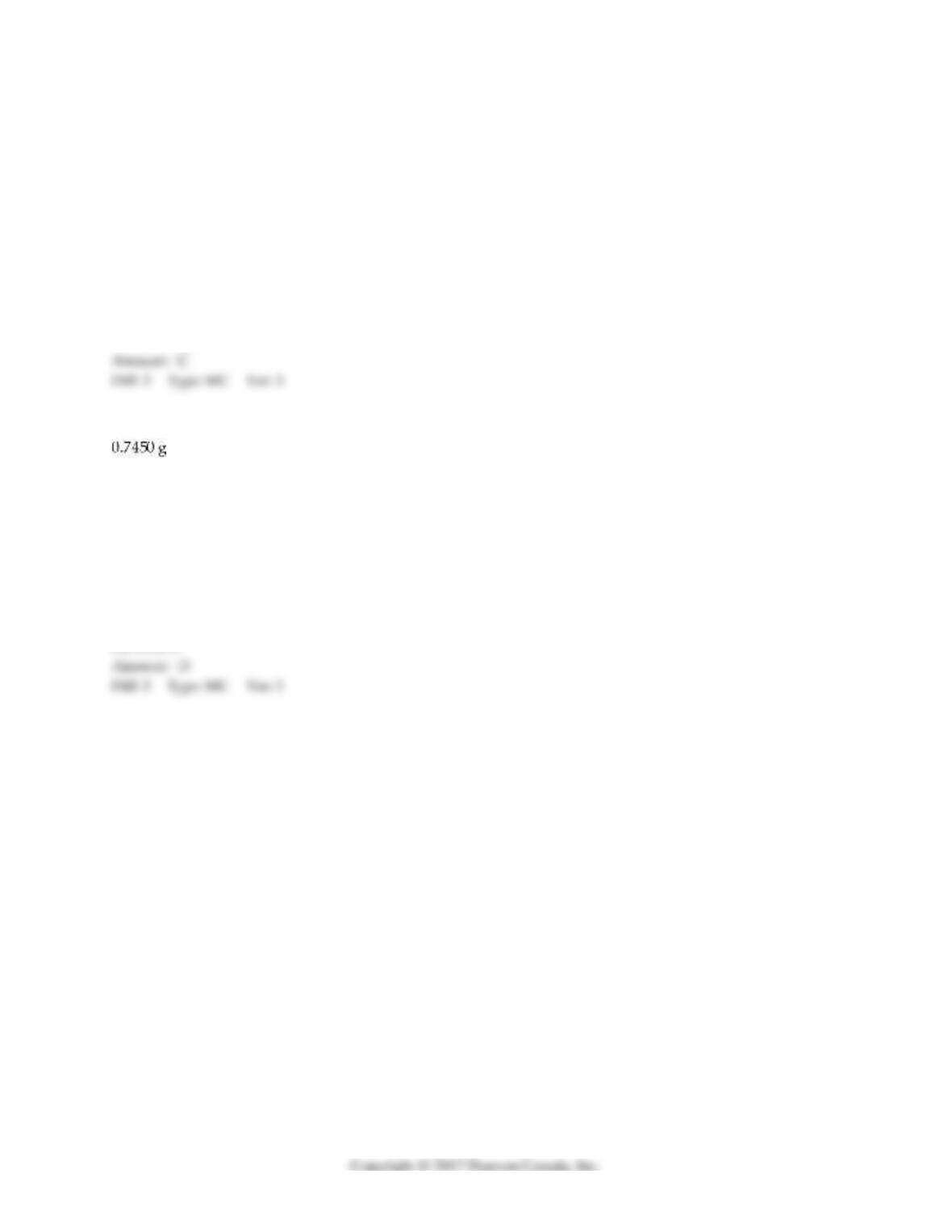
126) Based on the balanced chemical equation shown below, determine the mass percent of Fe3+ in a
sample of iron ore if 22.40 mL of a 0.1000 mol L-1 stannous chloride, SnCl2(aq), solution is
required to completely react with the Fe3+ present in the ore sample. The chemical equation for the
reaction is
2 Fe3+(aq) + Sn2+(aq) → 2 Fe2+(aq) + Sn4+(aq)
A) 5.365%
B) 8.396%
C) 16.79%
D) 33.58%