Page 1
1.
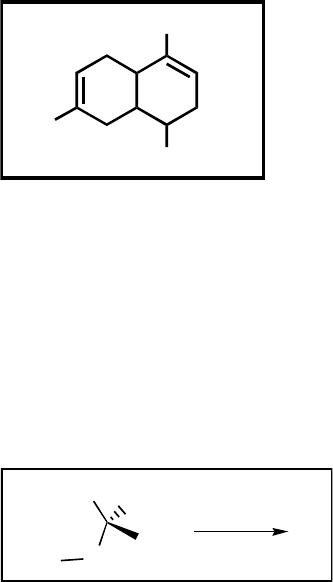
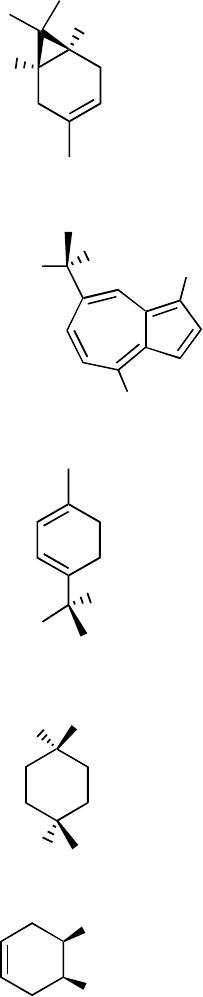
How many chiral centers are present in -cadinene?
CH3
CH(CH3)2
H3C
A)
none
B)
1
C)
2
D)
3
E)
4
2.
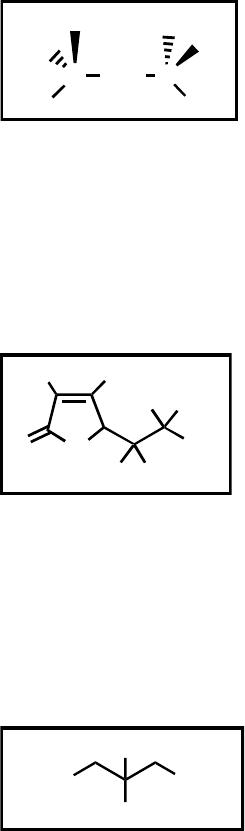
Counting all stereoisomers, how many monochlorinated products of the free-radical
chlorination of (R)-2-bromobutane are possible? (Note that the starting compound is one
enantiomer only.)
H3C
CH2
H3CBr
HCl2
h?
A)
3
B)
4
C)
5
D)
6
E)
8
3.
Optically pure (S)-monosodium glutamate has a specific rotation of + 24. What
specific rotation would (R)-monosodium glutamate of 50% optical purity have?
A)
+ 24
B)
– 24
C)
– 18
D)
– 12
E)
+ 18
Page 2
4.
What would be the complete name of the following?
H3C
CCH2C
CH3
CH3H
Br
H
A)
(2R,4S)-2-bromopentane
B)
(R)-2-bromo-4-methylpentane
C)
(S)-4-bromo-2-methylpentane
D)
(2R,4R)-2-bromo-4-methylpentane
E)
(S)-2-bromo-4-methylpentane
5.
How many total stereoisomers of the following are possible?
OOH
O
HO OH
H
H
H
HO
A)
1
B)
2
C)
3
D)
4
E)
6
6.
How many total stereoisomers of the following are possible?
HO2CCO2H
OH
CO2H
A)
1
B)
2
C)
3
D)
4
E)
6
Page 3
7.
How many total stereoisomers of the following are possible?
OO
OH HO
HHO OH H
A)
1
B)
2
C)
3
D)
4
E)
6
Page 4
8.
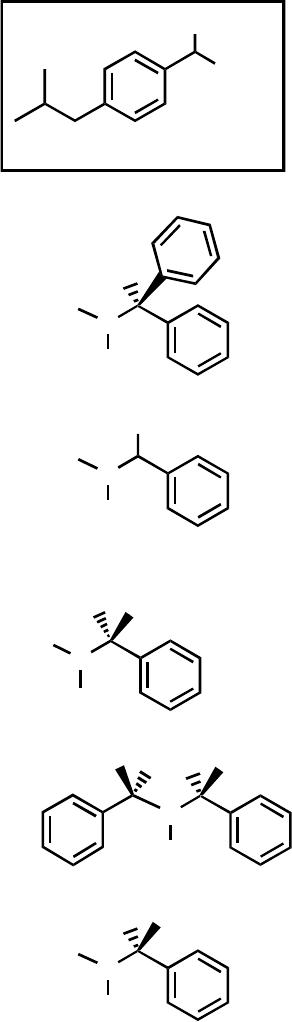
Which of the amines below might be appropriate for the resolution of racemic
Ibuprofen?
CO2H
CH3
Ibuprofen
A)
H3CN
H
H
B)
H3CN
H
CH3
(racemic)
C)
HN
H
CH3
H3C
D)
N
H
CH3
H
H3CH
E)
H3CN
H
CH3
H

Page 5
9.
Which of the following Fischer projections represents (2R,3R)-tartaric acid?
A)
CO2H
CO2H
HOH
OHH
B)
CO2H
CO2H
HO H
OHH
C)
CO2H
CO2H
HO H
HHO
D)
CO2H
CO2H
HOH
HHO
E)
None of the above.
10.
Which of the following statements is not true?
A)
Enantiomers have identical properties except in chiral environments or with
plane-polarized light.
B)
Reactions involving only achiral or racemic materials must produce achiral or
racemic products.
C)
Diastereomers have identical properties in all environments.
D)
Enantiomers exhibit equal and opposite optical rotations.
E)
All of the above are true.
Page 6
11.
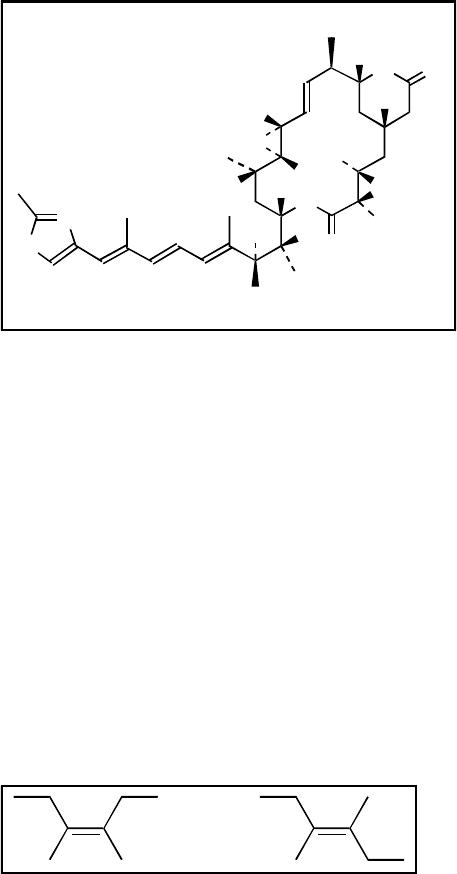
How many stereogenic (chiral) centers are found in Rhizoxin?
O
O
O
O
O
CH3
H
H
O
H
H
CH3
H
HO
HH
CH3
H
OCH3
H
N
O
Rhizoxin
A)
5
B)
7
C)
9
D)
11
E)
14
12.
The meso isomer of 3,4-dibromohexane has what stereochemical configuration?
A)
3R, 4S
B)
3R, 4R
C)
3S, 4S
D)
3S, 4R
E)
both A and D
13.
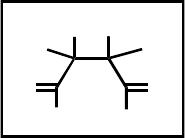
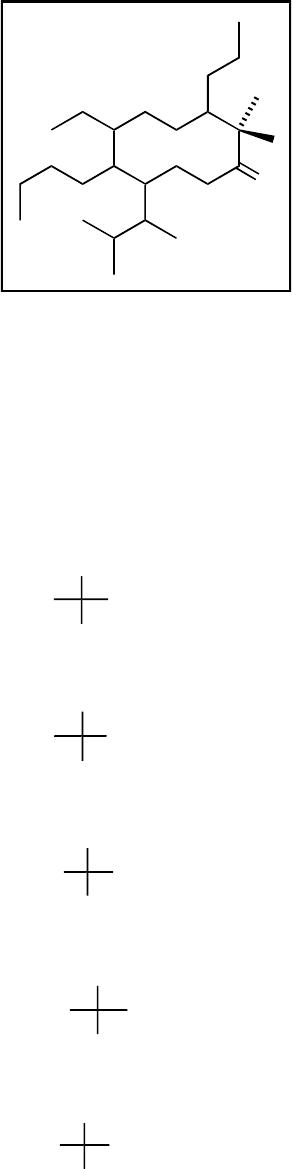
The following two molecules may be described as:
A)
constitutional isomers
B)
diastereomers
C)
enantiomers
D)
structural isomers
E)
None of the above.
Page 7
14.
The following molecule has how many possible stereoisomers?
O
A)
1
B)
4
C)
8
D)
16
E)
32
15.
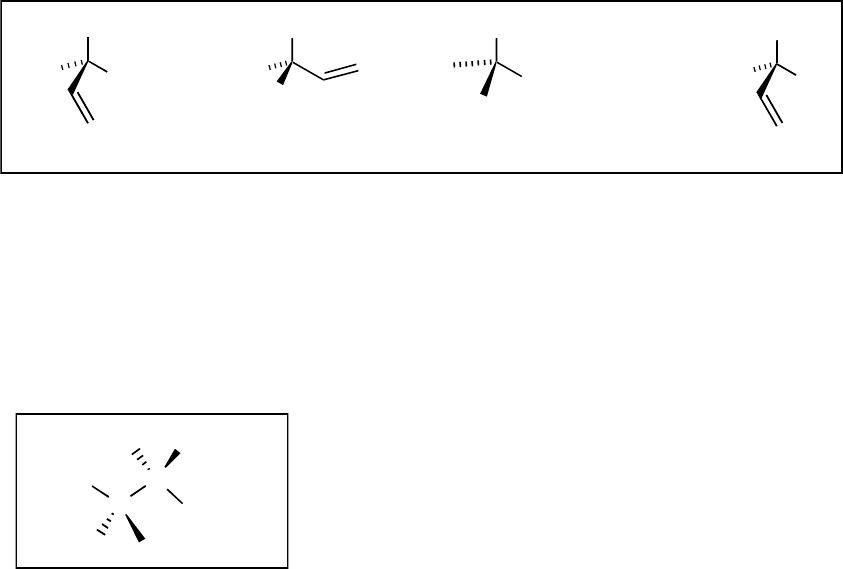
The correct structure for (R)-bromofluoroiodomethane is:
A)
I
H
Br
F
B)
I
Br
H
F
C)
H
Br
F
I
D)
Br
H
I
F
E)
F
I
H
Br
Page 8
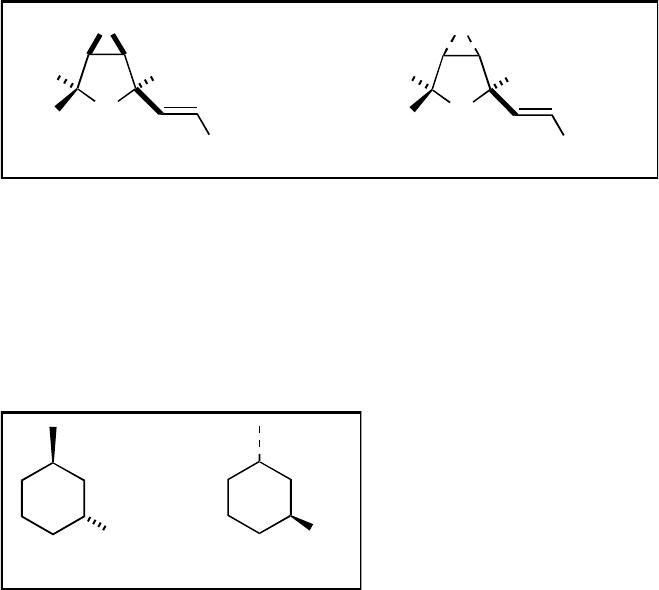
16.
The relationship between the following two compounds is:
O
O
Me
CO2Me
HMe
O
O
Me
CO2Me
HMe
A)
same molecule
B)
enantiomers
C)
diastereomers
D)
mesos
E)
conformers
17.
A particular reaction produces the following two alcohols in a ratio of 95:5.
OH OH
95 : 5
The enantiomeric excess (% ee) is:
A)
100
B)
95
C)
90
D)
85
E)
None of the above.
18.
(S)-Naproxen, []D = + 66, is an analgesic (pain reliever), while its enantiomer is toxic.
Say that you were given a solution that contains 1 g of Naproxen in 20 mL of liquid, but
the optical purity is not specified. You place it in a polarimeter tube (10 cm) and get a
reading of + 3.3 from the polarimeter. What is the percent optical purity of the
sample?
A)
50
B)
100
C)
0
D)
10
E)
75
Page 9
19.
Which of the following molecules have the S configuration?
H
Br
H3C
F
(CH3)3C
H
H
iso–propyl
H3C
Et
D
Br
H
III III IV
A)
I, II
B)
I, III
C)
III, IV
D)
I, II, IV
E)
All of the above.
20.
What (R) or (S) stereochemistry is proper for the following molecule?
H3CCC
CH2CH3
HBr
Cl H
5
4
3
2
1
A)
(2R,3R)
B)
(2R,3S)
C)
(2S,3S)
D)
(2S,3R)
E)
None of the above.
21.
The best (most reliable) test for the presence of chirality in a molecule is
A)
carbon attached to four different groups.
B)
existance of a mirror image.
C)
non-superimposability on mirror image.
D)
two or more isomers possible.
E)
observation of optical rotation in a sample.

Page 10
22.
Which of the following molecules is not chiral?
A)
O
B)
O
C)
C C
HO2CCO2H
OHH
H
HO
D)
HO2C
H2CCCH2
CO2H
OH
CO2H
E)
CH3
CH3
23.
What would be the proper name of the following?
OH
OH
A)
(1R,2R)-trans-1,2-cyclohexanediol
B)
(1R,2S)-trans-1,2-cyclohexanediol
C)
(1S,2R)-trans-1,2-cyclohexanediol
D)
(1S,2S)-trans-1,2-cyclohexanediol
E)
(1S,2R)-cis-1,2-cyclohexanediol
Page 11
24.
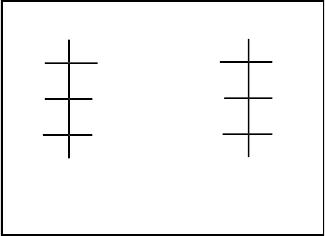
An unknown compound has been isolated in pure form and found to exhibit []D = +
15 (c = 4, CH2Cl2). Which of the following might be the structure of the compound?
A)
H
H
B)
H3C
H3C
HCH3
CH3
C)
H3CCH3
H
D)
H3C
H3CH
H
E)
OH
OH
Page 12
25.
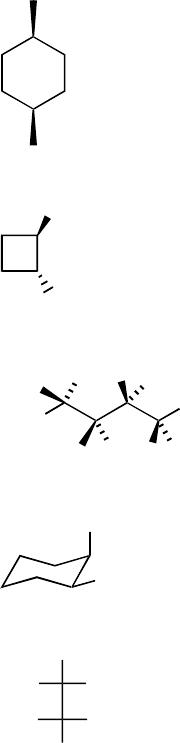
How would you most accurately describe the relationship between the following two
molecules?
H
CH3
F
OHH
CH3
IH
H
CH3
F
HHO
CH3
HI
Molecule I Molecule II
A)
enantiomers
B)
diastereomers
C)
meso compounds
D)
same compound
E)
Both C and D
Page 13
26.
Which of the following molecules represents a meso compound?
A)
B)
Br
Br
C)
H3CCH3
Br H
Br H
HBr
HBr
D)
Br
CH3
E)
H
CO2H
OH
CO2H
HO H
Page 14
27.
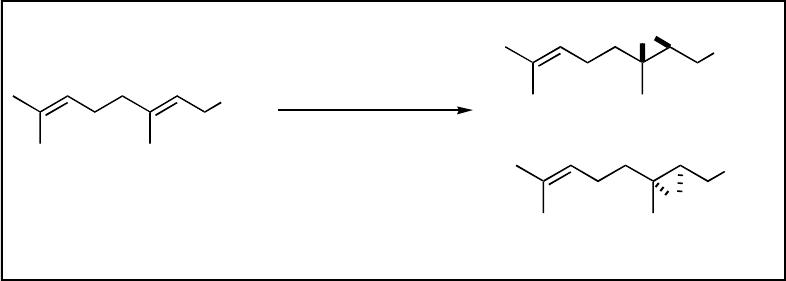
Sharpless epoxidation of geraniol gave two products, epoxide I (85%) and epoxide II
(15%). This mixture of epoxides represents what percent optical purity (or percent
enantiomeric excess, % ee)?
OH
OH
OH
O
O
CH2Cl2
Epoxide I (85%)
(+) DIPT / Ti (OiPr)
4
Epoxide II (15%)
(CH3)3COOH +
A)
0%
B)
15%
C)
70%
D)
85%
E)
100%
Page 15
28.
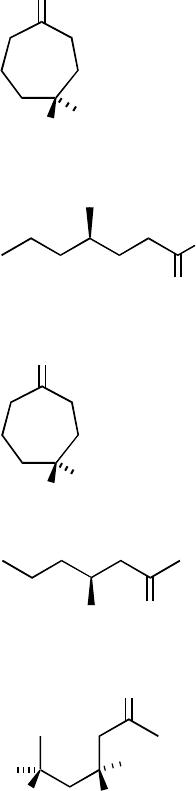
What is the correct structure for (R)- 4-methyl-2-heptanone?
A)
O
HCH3
B)
H
O
CH3
C)
O
H3CH
D)
O
CH3
E)
O
H
CH3
H
H
29.
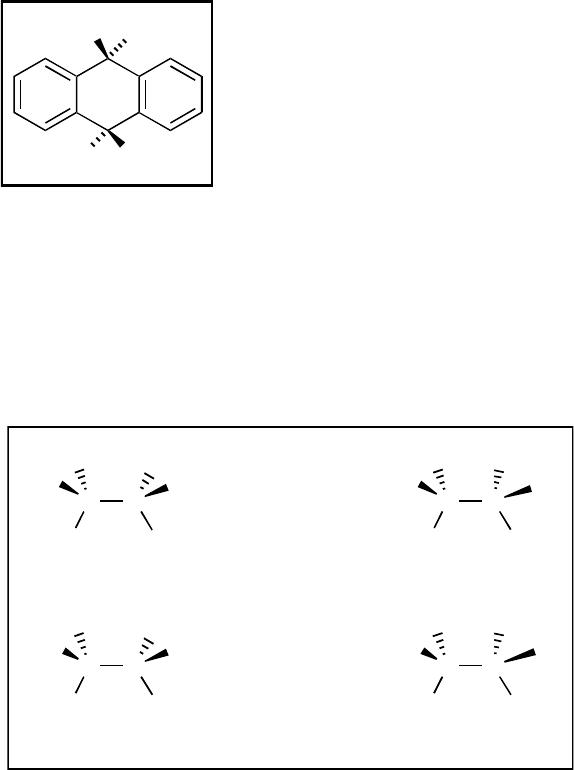
Which of the following is not true for a meso compound:
A)
It is achiral.
B)
It will rotate plane polarized light.
C)
It may be cyclic or acyclic.
D)
It is a stereoisomer.
E)
It has a mirror plane.
Page 16
30.
How many stereogenic (chiral) centers are present in the following molecule:
HCH3
HH
A)
none
B)
one
C)
two
D)
three
E)
four
31.
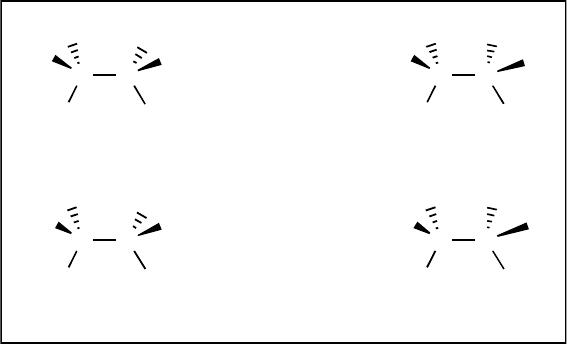
Which of the structures below are pairs of enantiomers?
C C CO2H
H
CH3
CH3
HO H
C C H
CO2H
CH3
CH3
HO H
C C CO2H
H
CH3
CH3
H
HO
C C H
CO2H
CH3
CH3
H
HO
1 2
34
A)
(1+2) and (3+4)
B)
(1+4) and (2+3)
C)
(1+3) and (2+4)
D)
All of the above.
E)
None of the above.
Page 17
32.
Which of the structures below are pairs of diastereomers?
C C CO2H
H
CH3
CH3
HO H
C C H
CO2H
CH3
CH3
HO H
C C CO2H
H
CH3
CH3
H
HO
C C H
CO2H
CH3
CH3
H
HO
4
3
21
A)
(1+4) and (2+3)
B)
(1+3) and (2+4)
C)
(1+2) and (3+4)
D)
both A and B
E)
both B and C
Page 18
33.
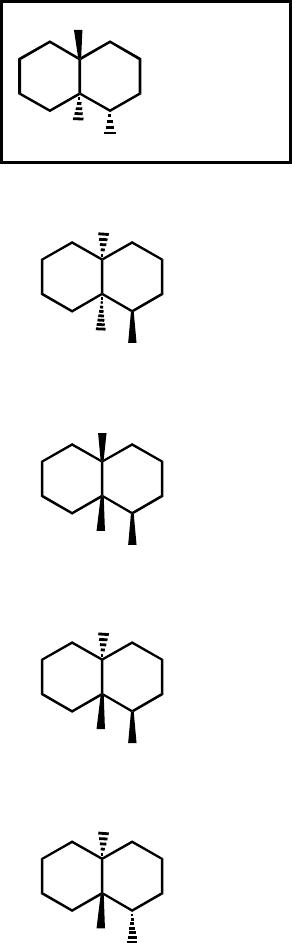
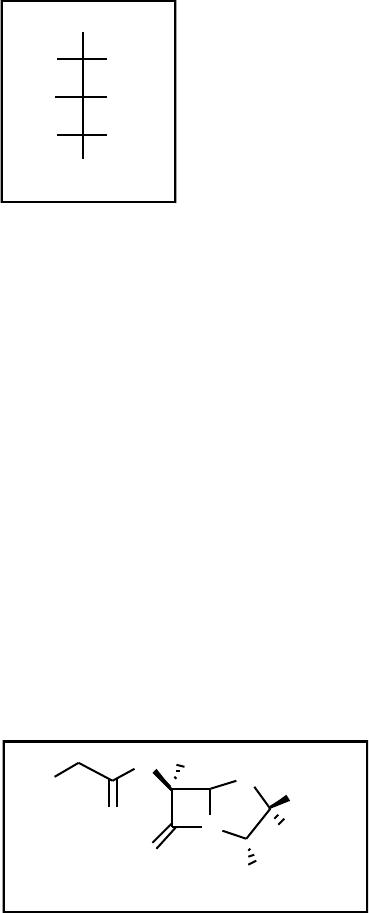
The structure of (-)-geosmin is shown below. Which structure would be that of its
enantiomer, (+)-geosmin?
(-)-geosmin
CH3
HO CH3
A)
CH3
HO
CH3
B)
CH3
HO CH3
C)
CH3
HO
CH3
D)
CH3
HO CH3
E)
None of the above.
Page 19
34.
What is the R and S configuration for each stereogenic center of the following sugar
from top to bottom?
CHO
OHH
HHO
OHH
CH2OH
A)
R, S, R
B)
S, S, R
C)
R, R, S
D)
R, R, R
E)
S, S, S
35.
What technique(s) can be used to obtain non-racemic compounds from racemic
material?
A)
resolution
B)
distillation
C)
extraction
D)
column chromatography
E)
both B and C
36.
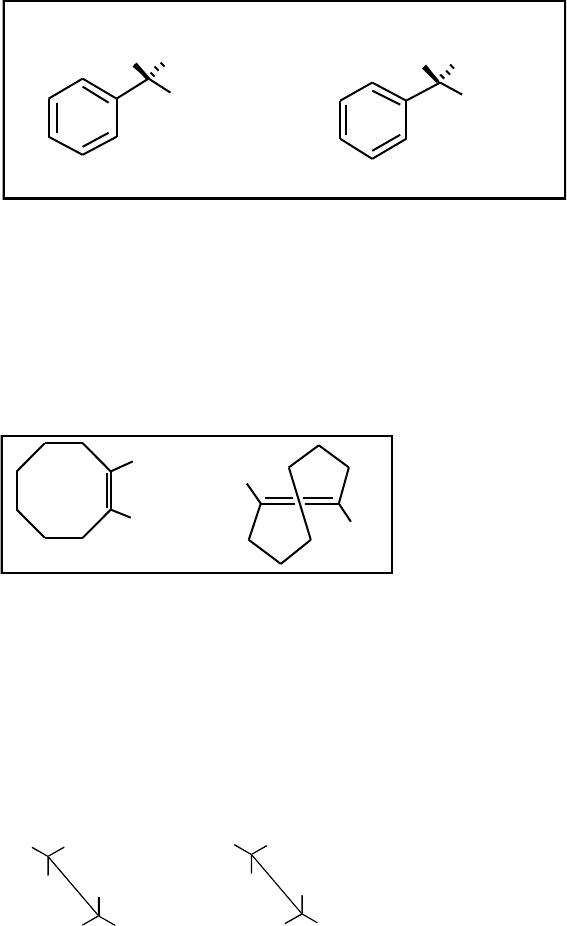
Penicillin V was discovered in the late 1920s by Sir Alexander Fleming in which he
won the Nobel Prize for the development of this wonder drug. How many sterogenic
centers does penicillin V contain?
N
S
N
O
PhO
OCO2H
Me
Me
H
Penicillin V
A)
1
B)
2
C)
3
D)
4
E)
5
Page 20
37.
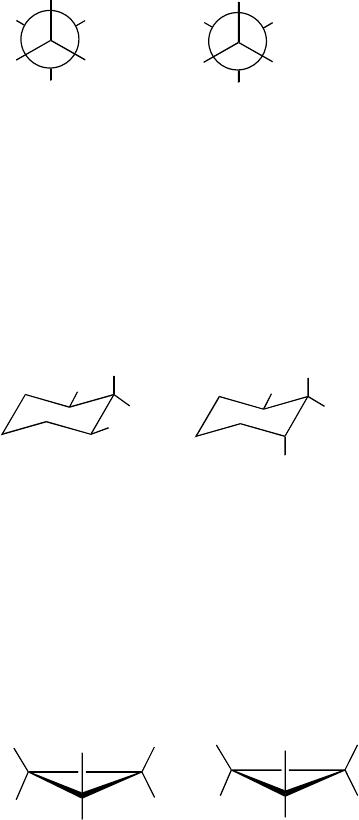
A graduate student wishes to separate a racemic mixture of acids prepared in the
laboratory as shown below. The best way(s) to accomplish this task is:
COOH COOH
HO CF3F3C OH
A)
distillation.
B)
water solubility.
C)
reaction with a chiral amine to form diastereomers, then crystallization.
D)
column chromatography.
E)
both A and B
38.
How are the following compounds related?
H
H
H
H
A)
diastereomers
B)
enantiomers
C)
meso compounds
D)
same compound
E)
not related
39.
How are the following compounds related?
COOH
H OH
HOOC
OHH
COOH
HO H
HOOC
HHO
A)
diastereomers
B)
enantiomers
C)
meso compounds
D)
same compound
E)
not related
Page 21
40.
How are the following compounds related?
CH3
H Br
CH3
BrH
CH3
H Br
Br
HH3C
A)
Diastereomers
B)
Enantiomers
C)
Meso compounds
D)
Same compound
E)
They are not related.
41.
How are the following compounds related?
CH3
CH3
CH3
CH3
Br
Br
Br
Br
A)
diastereomers
B)
enantiomers
C)
meso compounds
D)
same compound
E)
They are not related.
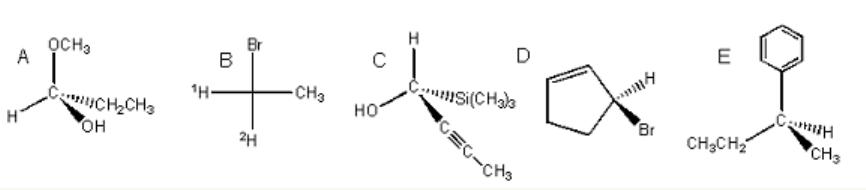
42.
How are the following compounds related?
H
Br
Cl
H
Br
Cl Br
H
Cl
Br
H
Cl
A)
diastereomers
B)
enantiomers
C)
meso compounds
D)
same compound
E)
Both meso and the same compound
Page 22
43.
Label the following carbons as either (R) or (S).
A)
A = R, B = R, C = R, D = R, E = R
B)
A = S, B = S, C = S, D = S, E = S
C)
A = S, B = R, C = S, D = S, E = S
D)
A = S, B = S, C = R, D = S, E = S
E)
A = S, B = S, C = S, D = R, E = S
44.
A racemic mixture will rotate light?
A)
0 degrees
B)
180 degrees
C)
need more information
D)
There is no such thing as a racemic mixture of enantiomers.
E)
none of the above
Page 23
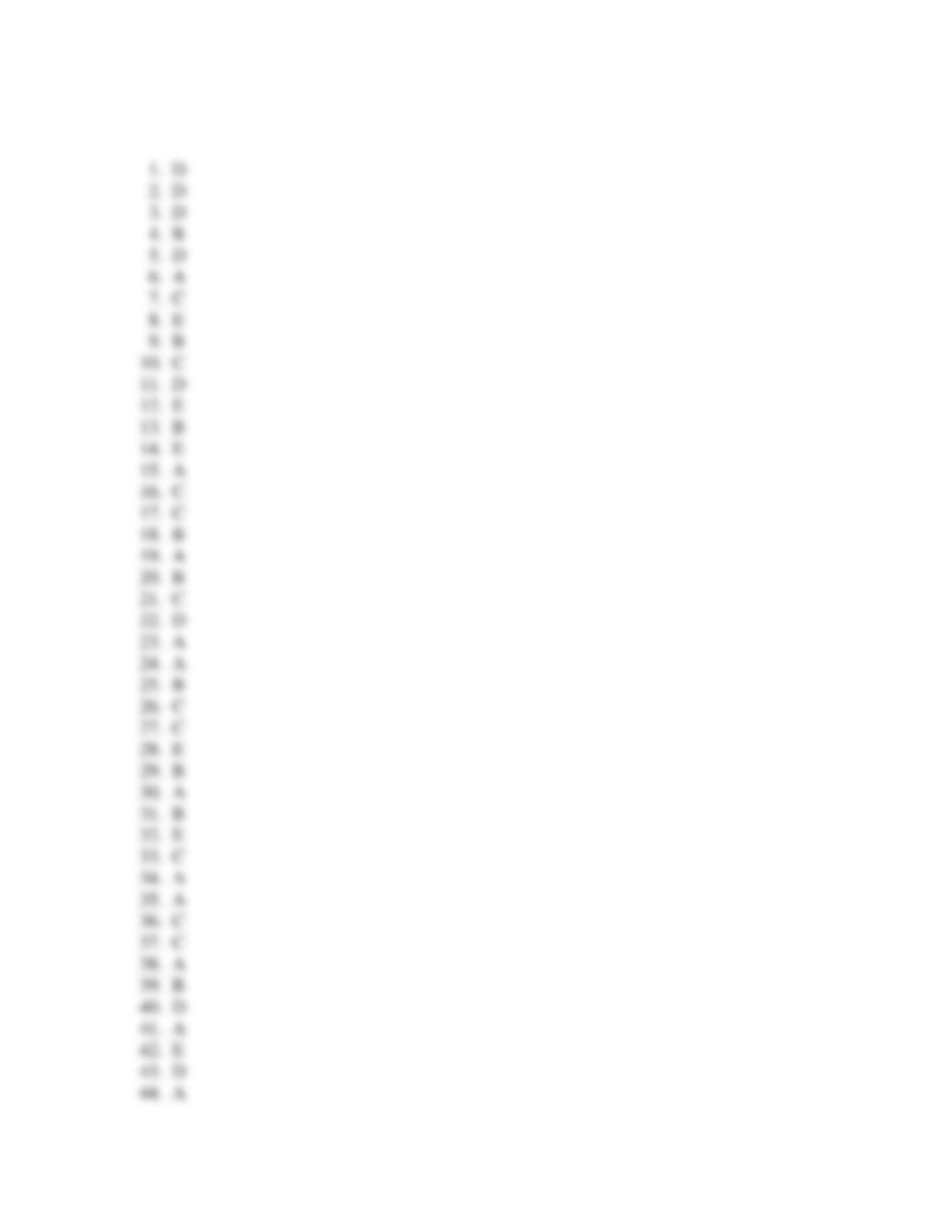
Answer Key
Page 24