74) “Washing soda” (sodium carbonate) may be used to “soften” water by the removal of certain ions that
would otherwise react with common soaps. When the “hardness” is due to calcium ion, the “softening”
process may be represented as:
Ca2+(aq) + CO32-(aq) → CaCO3(s)
What mass of sodium carbonate would be required to remove essentially all of the calcium ion from 750 L
of solution containing 43 mg Ca2+ per liter?
A) 85 g
B) 67 g
C) 12 g
D) 48 g
E) 22 g
75) If an aqueous solution containing 46 g of sodium carbonate per liter is mixed with an equal volume of
0.20 M aqueous hydrochloric acid, what would be the molarity of sodium chloride in the final solution,
assuming volumes were additive?
A) 0.10 M
B) 0.20 M
C) 0.22 M
D) 0.43 M
E) 0.50 M
76) The molarity of a solution that contains 14.7 g of H2SO4 in 200.0 mL solution is ________.
A) 1.5 M
B) 0.75 M
C) 0.77 M
D) 7.4 M
E) 3.0 M
77) What is the molarity of methanol, if 150.0 mL is dissolved in enough water
to make 4.00 L of solution?
A) 3.71 M
B) 1.17 M
C) 1.48 M
D) 0.927 M
E) 0.734 M
78) What is the molarity of a sucrose solution (C12H22O11) if 110.0 g of a 92.0% pure solid is dissolved
per 250.0 mL of water?
A) 0.296 M
B) 1.29 M
C) 0.321 M
D) 1.40 M
E) 1.18 M
79) What mass of MgCl2 in grams must be added to 250.0 mL of a 0.25 M MgCl2 solution to produce a
0.40 M solution, assuming no change of volume upon addition?
A) 9.5 g
B) 6.0 g
C) 2.2 g
D) 3.6 g
E) 19 g
80) You have 10.00 L of a 0.350 M KCl solution, but you need a solution that is 0.450 M. What volume of
water, in L, would you evaporate from the solution?
A) 4.38 L
B) 3.50 L
C) 2.85 L
D) 7.77 L
E) 2.22 L
81) To measure the volume of an irregularly shaped container filled with water, 1.00 mL of 2.00 M
potassium chloride solution is added. After stirring, a 5.00 mL sample was removed from the container
and found to contain 2.54 × 10⁻² mg of potassium ion. What is the volume of the container?
A) 15.4 L
B) 29.4 L
C) 2.94 × 10⁴ L
D) 3.97 × 10⁻⁴ L
E) 2.54 L
82) Given the reaction:
2 KMnO4 + 10 KI + 8 H2SO4 → 6 K2SO4 + 2 MnSO4 + 5 I2 + 8 H2O
How many moles of I2 are produced by reacting 28.0 g KMnO4, 18.0 g KI, and 46.0 g H2SO4?
A) 0.108 mol
B) 0.0542 mol
C) 0.293 mol
D) 0.443 mol
E) 0.886 mol
83) The chemical reaction during low current discharge of a simple “dry cell” involves:
(unbalanced) Zn + MnO2 + NH4Cl → ZnCl2 + Mn2O3 + NH3 + H2O
What is the coefficient for zinc in the balanced equation that uses the lowest whole number ratios, and
what is the limiting reagent for a process in which equal masses of reactants are mixed?
A) coefficient 1 and limiting reagent Zn
B) coefficient 2 and limiting reagent Zn
C) coefficient 1 and limiting reagent MnO2
D) coefficient 2 and limiting reagent MnO2
E) coefficient 2 and limiting reagent NH4Cl
84) The chemical reaction occurring during the discharge of a lead storage battery can be represented by
the equation:
Pb(s) + PbO2(s) +2 H2SO4(aq) → 2 PbSO4(s) + 2 H2O(l)
Which is the limiting reagent and the amount of PbSO4 produced if 53.0 g of Pb, 77.3 g of PbO2, and 534
mL of 0.544 M solution of H2SO4 is used?
A) limiting reagent PbO2, 196 g PbSO4
B) limiting reagent Pb, 77.6 g PbSO4
C) limiting reagent Pb, 155 g PbSO4
D) limiting reagent H2SO4, 88.1 g PbSO4
E) limiting reagent H2SO4, 176 g PbSO4
85) The chemical reaction occurring during the discharge of a lead storage battery can be represented by
the equation:
Pb(s) + PbO2(s) + 2 H2SO4(aq) → 2 PbSO4(s) + 2 H2O(l)
Which is the limiting reagent and the amount of PbSO4 produced if 39.8 g of Pb, 57.9 g of PbO2, and 352
mL of 0.375 M solution of H2SO4 is used?
A) limiting reagent PbO2, 146 g PbSO4
B) limiting reagent Pb, 58.2 g PbSO4
C) limiting reagent Pb, 116 g PbSO4
D) limiting reagent H2SO4, 80.0 g PbSO4
E) limiting reagent H2SO4, 40.0 g PbSO4
86) What is the percent yield if 185 grams of SiO2 are made from 328 g of Cr2O3 by the following
equation?
3 Si(s) + 2 Cr2O3(s) → 3 SiO2(s) + 4 Cr(l)
A) 142%
B) 70%
C) 56%
D) 105%
E) 95%
87) What is the percent yield if 122 grams of SiO2 are made from 246 g of Cr2O3 by the following
equation?
3 Si(s) + 2 Cr2O3(s) → 3 SiO2(s) + 4 Cr(l)
A) 83.6%
B) 49.6%
C) 125%
D) 33.1%
E) 59.3%
88) Consider the equation:
2 Na + 2 H2O → 2 NaOH + H2
If 92.0 g of sodium is reacted with 76.0 g of water until the reaction goes to completion, which reactant
will remain and in what quantity?
A) 72.0 g water
B) 43.5 g sodium
C) 3.9 g water
D) 10.0 g sodium
E) 10.0 g water
89) How many grams of sulfuric acid, H2SO4, can be obtained from 578 grams of iron ore if the ore is
76.0% by mass FeS? The reactions involved are given below. Each reaction is 92.0% efficient.
4 FeS + 7O2 → 2 Fe2O3 + 4 SO2
2 SO2 + O2 → 2 SO3
SO3 + H2O → H2SO4
A) 502 g
B) 307 g
C) 382 g
D) 95.5 g
E) 629 g
90) Sulfuric acid can be prepared by a multistep process summarized as:
2 SO2 + O2 + 2 H2O → 2 H2SO4
What mass of sulfuric acid could be produced daily by a process using 38 kg per day of sulfur dioxide
with a 70% conversion efficiency (“yield”), assuming that sulfur dioxide is the limiting reagent?
A) 27 kg/day
B) 41 kg/day
C) 54 kg/day
D) 58 kg/day
E) 83 kg/day
91) Nitroglycerin, used both in medicine and as an explosive, can be prepared by the carefully controlled
reaction of glycerol (C3H8O3) with nitric acid, as symbolized by:
C3H8O3 + 3 HNO3 → C3H5N3O9 + 3 H2O
What mass of nitric acid is required for the production of 2.8 g of nitroglycerin by a process having a 67%
yield?
A) 2.3 g
B) 0.39 g
C) 1.6 g
D) 3.5 g
E) 1.2 g
92) Chromium in its +VI oxidation state is considered a hazardous, carcinogenic species, destruction of
which may be accomplished by the process symbolized as:
4 Zn + K2Cr2O7 + 7 H2SO4 → 4 ZnSO4 + 2 CrSO4 + K2SO4 + 7 H2O
If 1.0 mol of each reactant is mixed, what is the limiting reagent, and what is the theoretical yield in moles
of chromium(II) sulfate?
A) limiting reagent Zn, 0.50 mol chromium(II) sulfate
B) limiting reagent K2Cr2O7, 2.0 mol chromium(II) sulfate
C) limiting reagent H2SO4, 0.29 mol chromium(II) sulfate
D) limiting reagent H2, 1.0 mol chromium(II) sulfate
E) no limiting reagent, 1.0 mol chromium(II) sulfate
93) In the following reaction:
2 KClO3(s) → 2 KCl(s) + 3 O2(g)
14.0 g KClO3 yielded 1.40 g KCl. What is the percent yield?
A) 6.08%
B) 16.4%
C) 11.0%
D) 32.9%
E) 10.0%
94) Cryolite is a compound needed for the Hall-Heroult process for producing aluminum. Cryolite is
produced by the following reaction:
6 HF + Al(OH)3 + 3 NaOH → Na3AlF6 + 6 H2O
How many grams of cryolite are produced if the reaction has a 67.3% yield and a limiting reagent of 35.4
grams of NaOH?
A) 61.9 g
B) 41.7 g
C) 125 g
D) 186 g
E) 20.2 g
95) One source of iodine is sodium iodate. Iodine is produced by a series of reactions. The first reaction is
a reduction reaction with sodium hydrogen sulfite.
IO3– (aq) + 3 HSO3– (aq) → I– (aq) + 3 SO42- (aq) + 3 H+ (aq)
5 I– (aq) + IO3– (aq) + 6 H+ (aq) → 3 I2(s) + 3 H2O
How many grams of iodine are produced from 1.00 × 10² grams of NaHSO3?
A) 81.3 g
B) 243 g
C) 62.6 g
D) 48.8 g
E) 205 g
96) If 8.52 g each of zinc, potassium dichromate, and sulfuric acid are reacted by the reaction:
4 Zn + K2Cr2O7 + 7 H2SO4→ 4 ZnSO4 + 2 CrSO4 +K2SO4 + 7 H2O
How many grams of zinc will be left unreacted?
A) 0.94 g
B) 3.65 g
C) 5.27 g
D) 1.89 g
E) 3.25 g
97) In the reaction: 4 Zn + K2Cr2O7 + 7 H2SO4→ 4 ZnSO4 + 2 CrSO4 +K2SO4 + 7 H2O, if 25.4 g of zinc
sulfate is to be made, how many grams of potassium dichromate is required?
A) 13.9 g
B) 3.48 g
C) 46.3 g
D) 6.35 g
E) 11.6 g
98) If the percent yield is 82.0%, how many grams of silicon is needed to make 105 g of chromium by the
reaction: 3 Si (s) + 2 Cr2O3 (s) → 3 SiO2 (s) + 4 Cr (l)?
A) 51.9 g
B) 92.2 g
C) 42.5 g
D) 34.9 g
E) 13.0 g
99) Acetylene gas may be produced by carefully adding water to calcium carbide, according to the
equation:
CaC2(s) + 2 H2O(l) → Ca(OH)2(s) + C2H2(g)
When a 37 g sample of an impure calcium carbide was treated with excess water, 13 g of acetylene gas
was produced. If the reaction is essentially 100% efficient, what was the percentage of nonreacting
impurity in the carbide sample?
A) 86%
B) 58%
C) 42%
D) 35%
E) 13.5%
100) Given the following reactions:
Fe + Br2 → FeBr2
3 FeBr2 + Br2 → Fe3Br8
If each reaction is 82.0% efficient, what mass of Fe3Br8 is produced from 1.00 g Fe?
A) 4.81 g
B) 3.94 g
C) 2.65 g
D) 3.24 g
E) 2.57 g
101) 306 mL of a 0.208 M solution of silver nitrate will react with 146 mL of a 0.170 M solution of sodium
phosphate to produce how many grams of silver phosphate precipitate? The balanced reaction is:
3 AgNO3 + Na3PO4 → Ag3PO4 + 3 NaNO3
A) 8.88 g
B) 26.6 g
C) 14.2 g
D) 10.4 g
E) 1.51 g
102) How many grams of sulfuric acid, H2SO4, can be obtained from 400 grams of iron ore if the ore is
80.0% by mass FeS? The reactions involved are given below.
4 FeS + 7O2 → 2 Fe2O3 + 4 SO2
2 SO2 + O2 → 2 SO3
SO3 + H2O → H2SO4
A) 557 g
B) 446 g
C) 357 g
D) 287 g
E) 89.3 g
103) How many grams of iron(II) sulfide is required to make 225 g of sulfuric acid, H2SO4? The reactions
involved are given below.
4 FeS + 7O2 → 2 Fe2O3 + 4 SO2
2 SO2 + O2 → 2 SO3
SO3 + H2O → H2SO4
A) 101 g
B) 251 g
C) 126 g
D) 202 g
E) 502 g
104) What thickness (in cm) is the silicon block (density = 2.33 g/cm3) that is 2.87 cm wide and long
necessary to react with 91.3 g of Cr2O3 by the reaction: 3 Si (s) + 2 Cr2O3 (s) → 3 SiO2 (s) + 4 Cr (l)?
A) 2.05 cm
B) 1.32 cm
C) 3.08 cm
D) 8.98 cm
E) 3.79 cm
105) In the reaction: 4 Zn + K2Cr2O7 + 7 H2SO4→ 4 ZnSO4 + 2 CrSO4 +K2SO4 + 7 H2O, if the extent of
reaction, x, is 0.0393, how many grams of potassium dichromate is required?
A) 13.9 g
B) 3.48 g
C) 46.3 g
D) 6.35 g
E) 11.6 g
106) What is the stoichiometric coefficient for oxygen when the following equation is balanced using the
lowest, whole-number coefficients?
________ CH14O(l) + ________ O2(g) → ________ CO2(g) + ________ H2O(l)
A) 3
B) 5
C) 7
D) 4
107) Aluminum metal reacts with aqueous iron(II) chloride to form aqueous aluminum chloride and iron
metal. What is the stoichiometric coefficient for aluminum when the chemical equation is balanced using
the lowest, whole-number stoichiometric coefficients?
A) 1
B) 2
C) 3
D) 4
108) Calcium phosphate reacts with sulfuric acid to form calcium sulfate and phosphoric acid. What is the
coefficient for sulfuric acid when the equation is balanced using the lowest, whole-number coefficients?
A) 1
B) 2
C) 3
D) none of the above
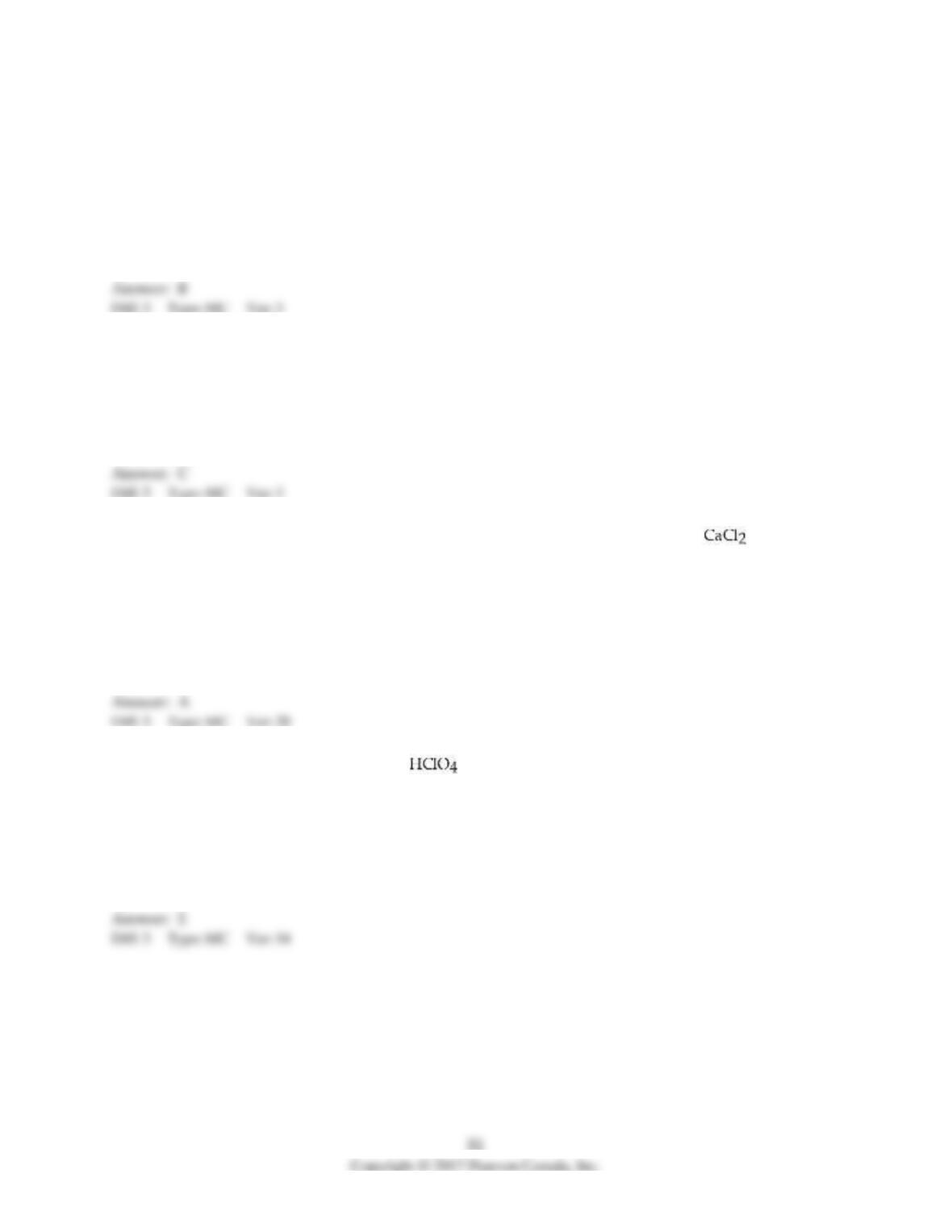
109) A solution is prepared by adding 1.60 g of solid NaCl to 50.0 mL of 0.100 mol L-1 . What is the
molarity of chloride ion in the final solution? Assume that the volume of the final solution is 50.0 mL.
A) 0.747 mol L-1
B) 0.647 mol L-1
C) 0.132 mol L-1
D) 0.232 mol L-1
E) 0.547 mol L-1
110) How many millilitres of 0.132 mol L-1 solution are needed to neutralize 50.00 mL of 0.0789
mol L-1 NaOH?
A) 0.521
B) 0.0120
C) 83.7
D) 0.0335
E) 29.9
111) What is the oxidation number change for the manganese atom in the following unbalanced reduction
half-reaction:
Mn O4– (aq) + H+(aq) → Mn2+(aq) + H2O(l)
A) -7
B) -5
C) +5
D) +7
112) What are the smallest, whole-number coefficients in front of NO3–(aq) and Zn(s) when the following
redox equation is balanced? The reaction occurs in acidic solution.
________ NO3–(aq) + ________ Zn(s) → ________ NO(g) + ________ Zn2+(aq)?
A) 2, 3
B) 2, 6
C) 3, 4
D) 3, 6
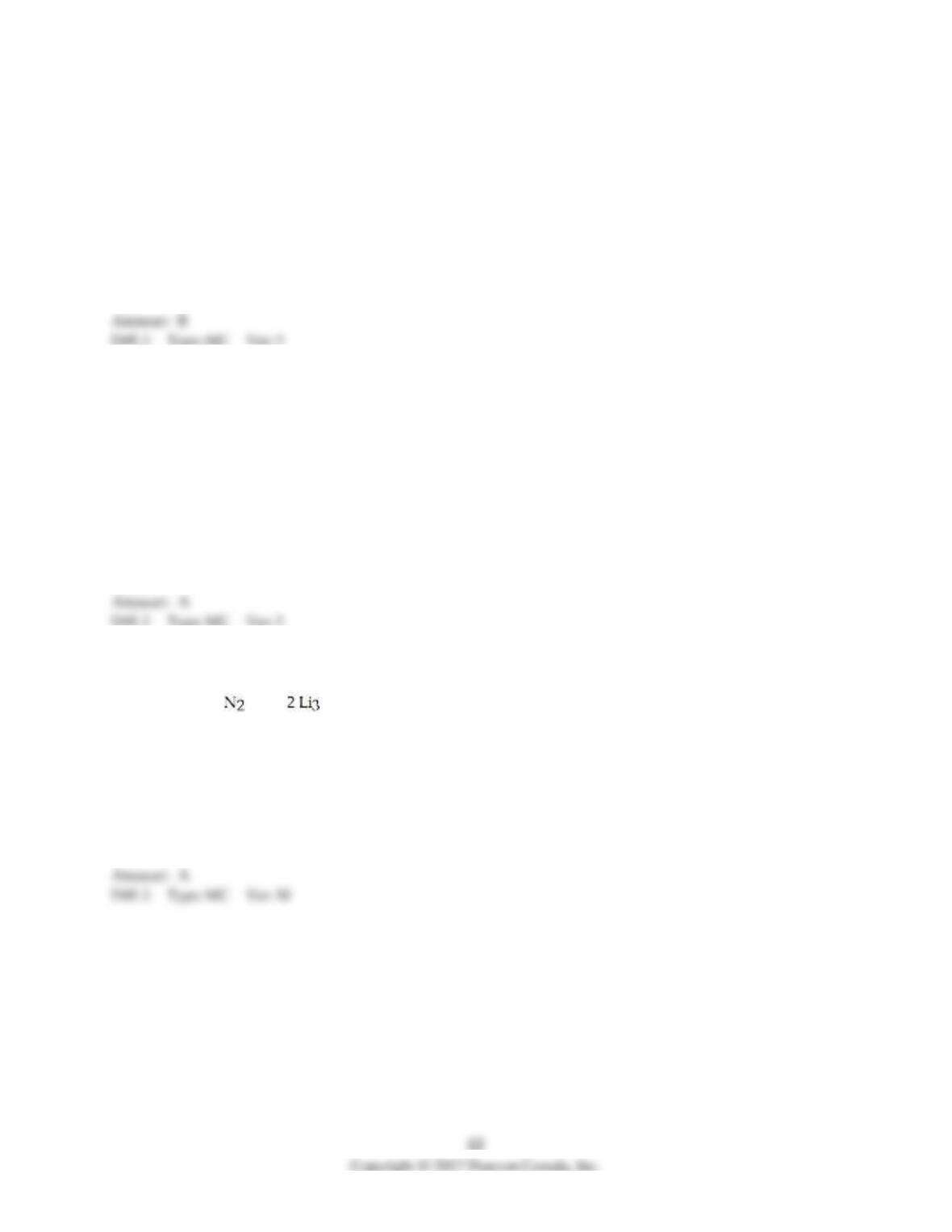
113) Lithium and nitrogen react to produce lithium nitride:
6 Li(s) + (g) → N(s)
How many moles of lithium nitride are produced when 0.450 mol of lithium react in this fashion?
A) 0.150
B) 0.900
C) 0.0750
D) 1.35
E) 0.225
114) Lithium and nitrogen react in a combination reaction to produce lithium nitride:
6 Li(s) + (g) → N(s)
How many moles of lithium are needed to produce 0.60 mol of N when the reaction is carried out in
the presence of excess nitrogen?
A) 0.30
B) 1.8
C) 0.20
D) 0.40
E) 3.6
115) Automotive air bags inflate when sodium azide decomposes explosively to its constituent elements:
(s) → 2 Na(s) + (g)
How many moles of are produced by the decomposition of 2.88 mol of sodium azide?
A) 1.92
B) 8.64
C) 4.32
D) 0.960
E) 1.44
116) Lithium and nitrogen react to produce lithium nitride:
6 Li(s) + (g) → N(s)
How many moles of are needed to react with 0.500 mol of lithium?
A) 3.00 mol
B) 0.500 mol
C) 0.167 mol
D) 1.50 mol
E) 0.0833 mol