General Chemistry, 11e (Petrucci)
Chapter 4 Chemical Reactions
1) A formula is a shorthand way of representing a chemical reaction.
2) In a balanced equation, the number of atoms of each element in the products must equal to the number
of atoms of each element in the reactants.
3) (aq) indicates that the compound is dissolved in alcohol.
4) In a chemical equation, Δ above the yield sign means the reaction will produce heat.
5) Stoichiometric factor relates the amounts, in moles, of any two substances involved in chemical
reaction.
6) In a solution of alcohol and water that is 70% water, alcohol is the solvent.
7) A chemical equation is a shorthand way of representing a chemical reaction.
8) The numbers in front of formulas in balanced equations are called stoichiometric coefficients.
9) Molarity is defined as moles of solute per kg of solution.
2
10) The reactant that is in excess determines the amount of products formed.
11) When the equation K2S2O3 + I2 → K2S4O6 + KI is balanced with the smallest integer coefficients, the
coefficient of KI is:
A) 2
B) 1
C) 3
D) 4
E) 5
12) When the equation Fe2(C2O4)3 → FeC2O4 + CO2 is balanced with the smallest integer coefficients,
the coefficient of CO2 is:
A) 1
B) 2
C) 4
D) 3
E) 5
13) When the equation CS2 + Cl2 → CCl4 + S2Cl2 is balanced with the smallest integer coefficients, the
sum of the coefficients is:
A) 5
B) 6
C) 4
D) 3
E) 7
14) What is the sum of the coefficients when the following is balanced with the smallest integer
coefficients?
K2O + H2O → KOH
A) 2
B) 6
C) 3
D) 8
E) 4
15) What is the sum of the coefficients when the following is balanced with the smallest integer
coefficients?
Na + HCl → NaCl + H2
A) 7
B) 4
C) 2
D) 10
E) 9
16) What is the sum of the coefficients in the balanced equation that represents the complete combustion
of the relatively new gasoline additive “MTBE,” for which the molecular formula is C5H12O?
A) 39
B) 37
C) 29
D) 24
E) 20
17) How many grams of N2 are required to react with 2.30 moles of Mg in the following process?
3 Mg + N2 → Mg3N2? (Mg = 24.3 g/mol, N = 14.0 g/mol)
A) 21.5 g
B) 0.767 g
C) 64.4 g
D) 0.027 g
E) 193.2 g
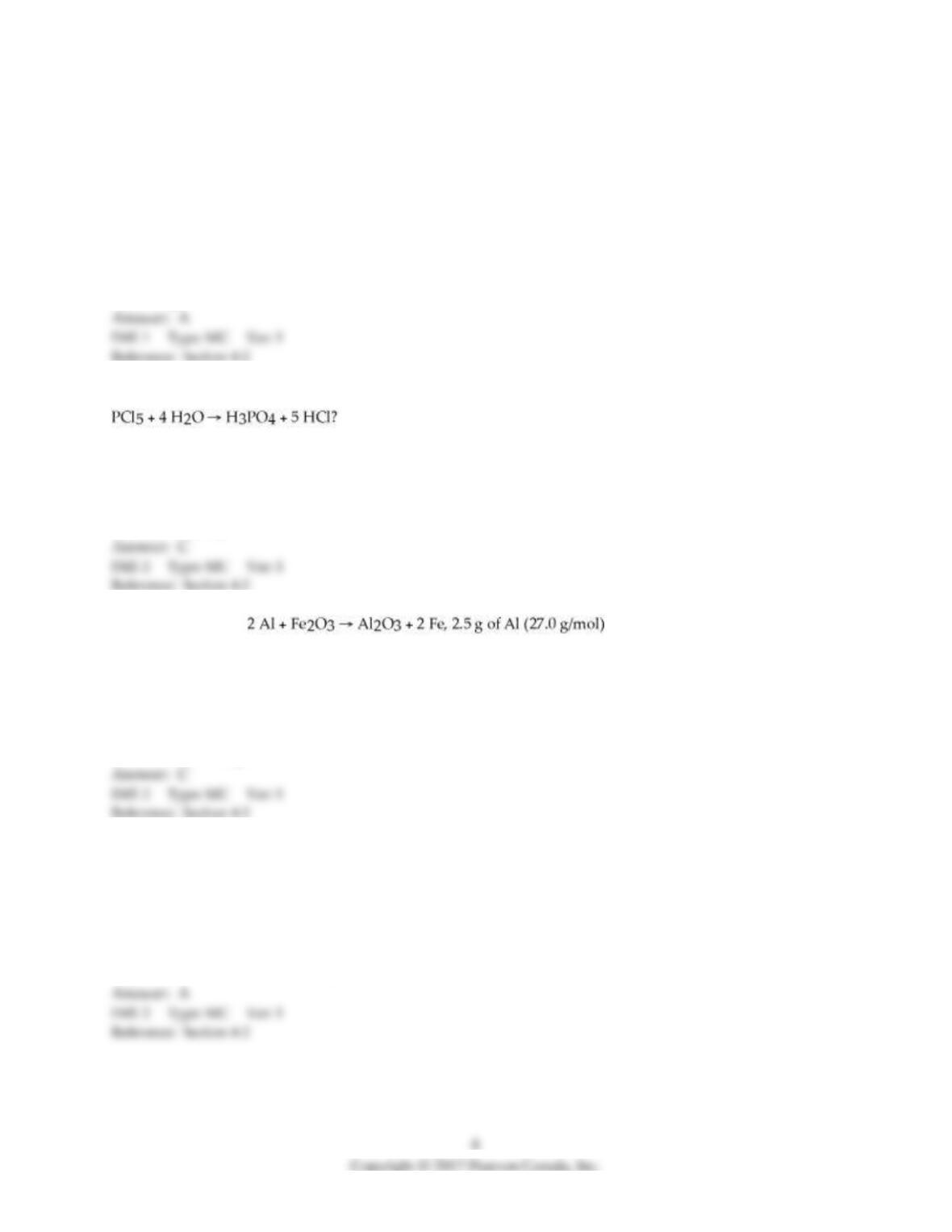
18) How many moles of H3PO4 are produced when 20.0 g of HCl are produced by the reaction
A) (20.0/36.5) g
B) (20.0/35.5)/5 g
C) (20.0/36.5)/5 g
D) (20.0/98.0) g
E) (20.0/98.0)/5 g
19) For the reaction and 7.2 g of Fe2O3 (159.8 g/mol)
produce how many g of Fe (55.9 g/mol)?
A) 2.5 (55.9/27.0) g
B) 2.5 (55.9)(2)/(27.0)(2) g
C) 7.2 (55.9)(2)/159.8 g
D) 7.2 (55.9/159.8) g
E) 2.5 (55.9/159.8) g
20) Which metal will produce the most hydrogen per gram of metal?
A) 2 Li + 2 HCl → 2 LiCl + H2
B) Sn + 4 HCl → SnCl4 + 2 H2
C) 2 Fe + 6 HCl →2 FeCl3 + 3 H2
D) Mg + 2 HCl → MgCl2 + H2
E) 2 Cr + 6 HCl → 2 CrCl3 + 3H2
21) Potassium superoxide (KO2) can simulate a plant-type action by consuming carbon dioxide (CO2) gas
and releasing oxygen (O2) gas. The other product is potassium carbonate (K2CO3). When the equation
for this process is balanced, it shows that:
A) 3 mol oxygen is produced per mol KO2 consumed
B) 2 mol KO2 is consumed per mol carbon dioxide
C) moles of reactants equals moles of product
D) 3 g of oxygen is produced per 2 g CO2 consumed
E) moles of products exceed moles of reactants
22) Gases emitted during volcanic activity often contain high concentrations of hydrogen sulfide and
sulfur dioxide. These gases may react to produce deposits of sulfur according to the equation:
For the complete reaction of 6.41 mol of hydrogen sulfide:
A) 308 g of sulfur is formed
B) 410 g of sulfur dioxide is consumed
C) 231 g of water vapor is produced
D) 320 g of total products result
E) 628 g of total reactants are consumed
23) Which of the following processes could theoretically produce the maximum mass of oxygen per gram
of metal salt reactant?
A) 2 KClO3 → 2 KCl + 3 O2
B) 4 KO2 + 2 CO2 → 2 K2CO3 + 3 O2
C) 2 Na2O2 + 2 H2SO4 → 2 H2O + O2
D) 2 HgO → 2 Hg + O2
E) NaBrO2 → NaBr + O2
24) Iron metal reacts with chlorine gas as follows:
2 Fe(s) + 3 Cl2(g) → 2 FeCl3(s)
How many moles of FeCl3 are obtained when 4.6 mol of Cl2 reacts with excess Fe?
A) 3.1 mol
B) 4.6 mol
C) 1.5 mol
D) 2.3 mol
E) 6.9 mol
25) 24.0 g of ethane (C2H6) are burned to form CO2 and H2O. How many grams of CO2 are produced?
A) 32.8 g
B) 14.4 g
C) 43.2 g
D) 35.1 g
E) 70.3 g
26) Given the following reaction:
Na2SO4(s) + 2 C(s) → Na2S(s) + 2 CO2(g)
How many grams of carbon are required to produce 18.4 g Na2S(s)?
A) 11.3 g
B) 5.66 g
C) 2.83 g
D) 239 g
E) 142 g
27) A 1.900 g sample of C6H12 is burned in an excess of oxygen. What mass of CO2 and H2O should be
obtained?
A) 0.994 g CO2, 0.407 g H2O
B) 2.98 g CO2, 1.22 g H2O
C) 5.96 g CO2, 2.44 g H2O
D) 10.45 g CO2, 4.27 g G H2O
E) 5.23 g CO2, 2.38 g H2O
28) Given the reaction:
2KMnO4 + 10 KI + 8 H2SO4 → 6 K2SO4 + 2 MnSO4 + 5 I2 + 8 H2O
How many moles of H2SO4 are required to produce 2.0 moles of I2, given the other reactants are in
excess?
A) 0.80 mol
B) 1.3 mol
C) 3.2 mol
D) 4.0 mol
E) 1.6 mol
29) Which of the following represents a 1.00 M aqueous solution of glucose (C6H12O6)?
A) 90.0 g glucose per 500 mL water
B) 10.0 g glucose per 10.0 mL water
C) 0.180 g glucose per mL solution
D) 0.100 g glucose per mL solution
E) 4.5 g glucose per 4.5 g water
30) What is the molarity of 10.9 g KCl dissolved in 150.0 mL of water?
A) 0.0727 M
B) 0.146 M
C) 0.975 M
D) 0.0219 M
E) 0.667 M
31) 45.8 mL of a 3.14 M sodium chloride solution were used to react completely with 50.0 mL of an
aqueous silver nitrate solution. What is the molarity of the silver nitrate solution?
A) 2.88 M
B) 1.50 M
C) 3.14 M
D) 3.42 M
E) 1.71 M
32) For the reaction symbolized as HCl(aq) + NaOH(aq) → NaCl(aq) + H2O(l) water is both:
A) a reactant and the solute
B) a reactant and the solvent
C) a product and the solute
D) a product and the solvent
E) a liquid and the intermediate
33) How many mL of 0.024 M solution can be produced from 14.1 mL of 3.0 M solution?
A) (14.1)(0.024)(3.0) mL
B) 14.1(0.024/3.0) mL
C) 14.1(3.0/0.024) mL
D) (14.1/0.024)/3.0 mL
E) (0.024×3)/14.1 mL
34) 52.5 mL of a solution were diluted to a volume of 6.25 L and then had a concentration of 3.16 M. What
was the molarity of the initial solution?
A) 3.16(52.5/6.25) M
B) 3.16(6.25/52.5) M
C) (3.16)(52.5)(6.25) M
D) 3.16(52.5/6250) M
E) (6.25)(3.16)/0.0525 M
35) If 85.6 mL of a 6.75 M solution are diluted to 6.20 L with water, what is the concentration of the final
solution?
A) 6.75 (6.20/85.6) M
B) 6.75 (8.56/6.20) M
C) 6.75 (6200/85.6) M
D) 6.75 (85.6/6200) M
E) 8.56 (6.20/6.75) M
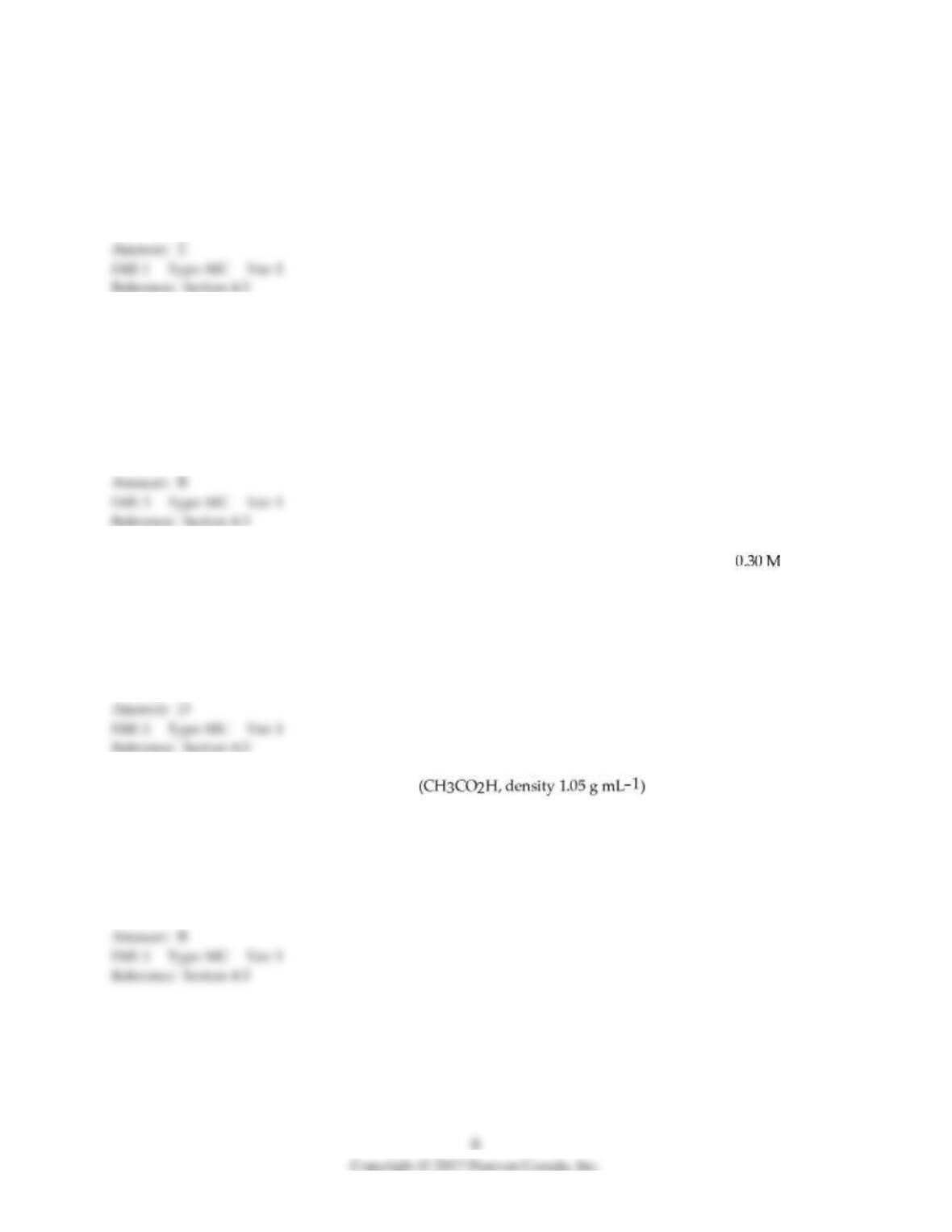
36) What volume of 6.0 M sulfuric acid is required for the preparation of 500.0 mL of 0.30 M solution?
A) 100 mL
B) 50 mL
C) 40 mL
D) 30 mL
E) 25 mL
37) If 5.97 mL of a solution of NaCl contains 2.54 mg of sodium ion, what is the molarity of the sodium
chloride solution?
A) 0.425 M
B) 1.85 × 10⁻² M
C) 1.85 × 10⁻⁵ M
D) 7.28 × 10⁻³ M
E) 0.102 M
38) What mass of trisodium phosphate is required to prepare 250.0 mL of a solution that is in
sodium ion?
A) 37 g
B) 12 g
C) 7.7 g
D) 4.1 g
E) 3.0 g
39) What volume of concentrated acetic acid is needed to prepare 250
mL of a 0.30 M aqueous solution?
A) 4.7 mL
B) 4.3 mL
C) 3.0 mL
D) 2.5 mL
E) 2.2 mL
40) What volume of 2.0 M HCl, in mL, is required to dissolve a 10.0 g piece of Zn?
Zn(s) + 2 HCl → ZnCl2 + H2(g)
A) 76 mL
B) 330 mL
C) 170 mL
D) 310 mL
E) 150 mL
41) How many grams of a solid mixture containing strontium chloride would one need to make 558 mL
of a 0.100 M strontium chloride solution, if the solid mixture contains 58.6% strontium chloride by
weight?
A) 6.62 g
B) 15.1 g
C) 8.85 g
D) 5.19 g
E) 9.52 g
42) How many grams of CrSO4 will be made from 25.0 grams each of Zn, K2Cr2O7, and H2SO4?
4 Zn + K2Cr2O7 + 7 H2SO4 → 4 ZnSO4 + 2 CrSO4 + K2SO4 + 7 H2O
A) 10.8 g
B) 28.3 g
C) 25.2 g
D) 12.6 g
E) 37.8 g
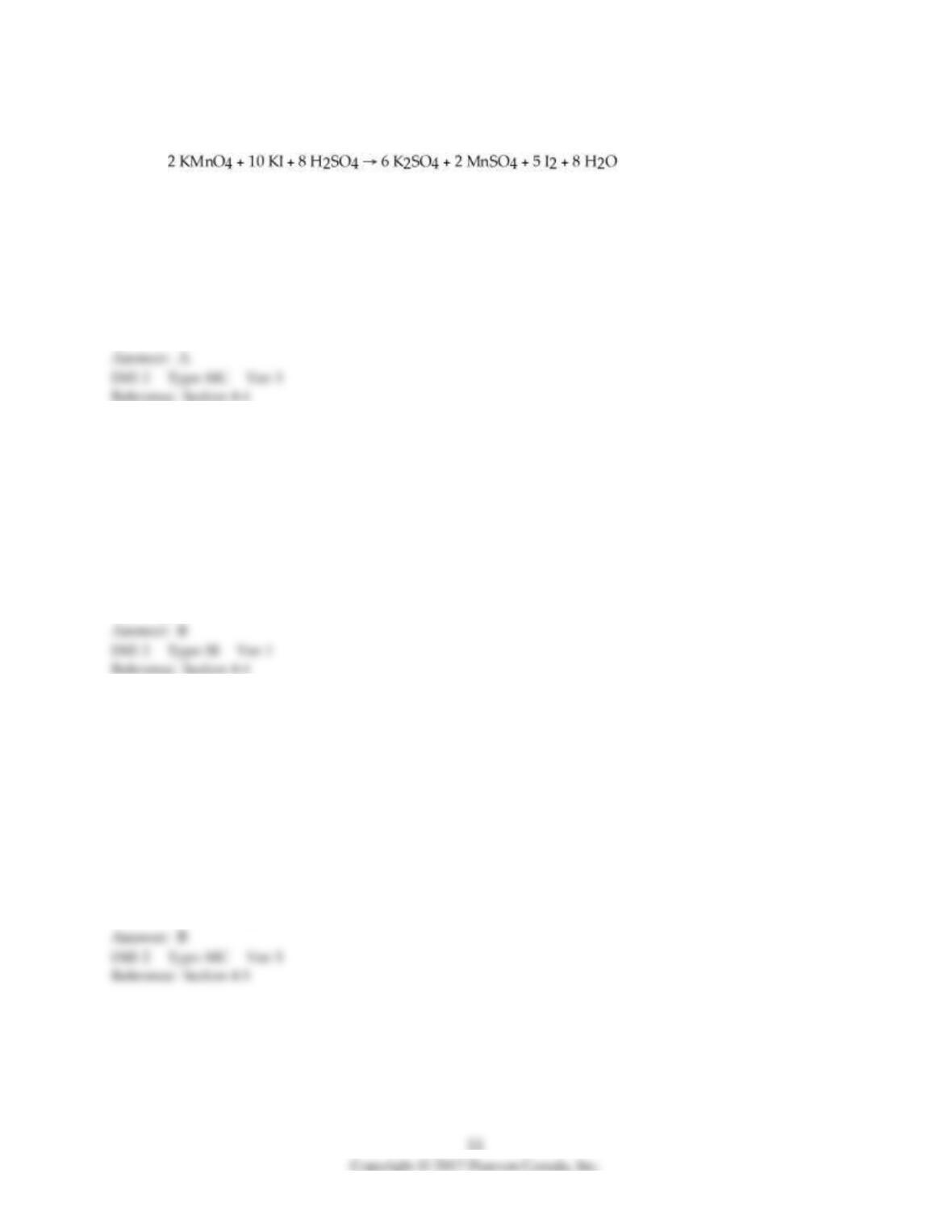
43) Given the reaction:
How many moles of K2SO4 are produced by allowing five moles each of KMnO4, KI, and H2SO4 to
react?
A) 3 mol
B) 1 mol
C) 2 mol
D) 4 mol
E) 5 mol
44) How many grams of ZnSO4 will be made from 41.0 grams each of Zn, K2Cr2O7, and H2SO4?
4 Zn + K2Cr2O7 + 7 H2SO4 → 4 ZnSO4 + 2 CrSO4 + K2SO4 + 7 H2O
A) 67.6 g
B) 38.6 g
C) 101 g
D) 20.6 g
E) 82.5 g
45) 42.6 g Cu are combined with 84.0 g of HNO3 according to the reaction:
3 Cu + 8 HNO3 → 3 Cu(NO3)2 + 2 NO + 4 H2O
Which reagent is limiting and how many grams of Cu(NO3)2 are produced?
A) Cu, 93.8 g
B) HNO3, 93.8 g
C) Cu, 125.6 g
D) HNO3, 125.6 g
E) Cu(NO3)2, 125.6 g
46) Consider the gaseous reaction:
N2H4(g) + 3 O2(g) → 2 NO2(g) + 2 H2O(g)
If the above reaction has a percent yield of 98.5%, what mass in grams of oxygen is needed to produce
49.0 g of NO2(g), assuming an excess of N2H4?
A) 50.4 g
B) 51.9 g
C) 25.9 g
D) 23.1 g
E) 11.5 g
47) If 0.500 mol of CaCl2 is mixed with 0.200 mol Na3PO4, the maximum amount in moles of Ca3(PO4)2
that can be formed is:
A) 0.17
B) 0.20
C) 0.10
D) 0.67
E) 0.50
48) The Haber Process for the production of ammonia is represented by:
3 H2(g) + N2(g) → 2 NH3(g)
If a mixture of 30 g of hydrogen with 10 g of nitrogen produced 8.4 g of ammonia, what was the percent
yield?
A) 84%
B) 69%
C) 49%
D) 28%
E) 20%
49) Given the reaction:
P4(l) + 6 Cl2(g) → 4 PCl3(l)
If the percent yield is 82%, what mass of P4 is required to obtain 2.30 g PCl3 (Cl2 in excess)?
A) 0.63 g
B) 0.52 g
C) 0.43 g
D) 0.16 g
E) 0.95 g
50) Cryolite is a compound needed for the Hall-Heroult process for producing aluminum. Cryolite is
produced by the following reaction:
6 HF + Al(OH)3 + 3 NaOH → Na3AlF6 + 6 H2O
How many grams of cryolite are produced if the reaction has a 94.3% yield and a limiting reagent of 27.8
grams of HF?
A) 275 g
B) 48.6 g
C) 45.9 g
D) 15.0 g
E) 15.9 g
51) One source of iodine is sodium iodate. Iodine is produced by a series of reactions. The first reaction is
a reduction reaction with sodium hydrogen sulfite.
IO3–( aq) + 3 HSO3– (aq) → I– (aq) + 3 SO42- (aq) + 3 H+(aq)
5 I– (aq) + IO3– (aq) + 6 H+ (aq) → 3 I2(s) + 3 H2O
How many grams of iodine are produced from 1.00 × 10² grams of NaHSO3 if each reaction has a 95.0%
yield?
A) 48.8 g
B) 51.4 g
C) 185 g
D) 46.3 g
E) 44.0 g
52) If 8.52 g each of zinc, potassium dichromate, and sulfuric acid are reacted by the reaction:
4 Zn + K2Cr2O7 + 7 H2SO4→ 4 ZnSO4 + 2 CrSO4 +K2SO4 + 7 H2O
how many grams of potassium dichromate will be left unreacted?
A) 1.05 g
B) 2.84 g
C) 7.30 g
D) 4.87 g
E) 3.65 g
53) Given the following reactions:
Fe + Br2 → FeBr2
3 FeBr2 + Br2 → Fe3Br8
If each reaction is 82.0% efficient, what mass of iron is necessary to make 8.45 g of Fe3Br8?
A) 0.870 g
B) 3.73 g
C) 2.14 g
D) 1.75 g
E) 2.61 g
54) For the reaction the stoichiometric number for Al2O3 is:
A) +2
B) +1
C) -1
D) -2
E) 0
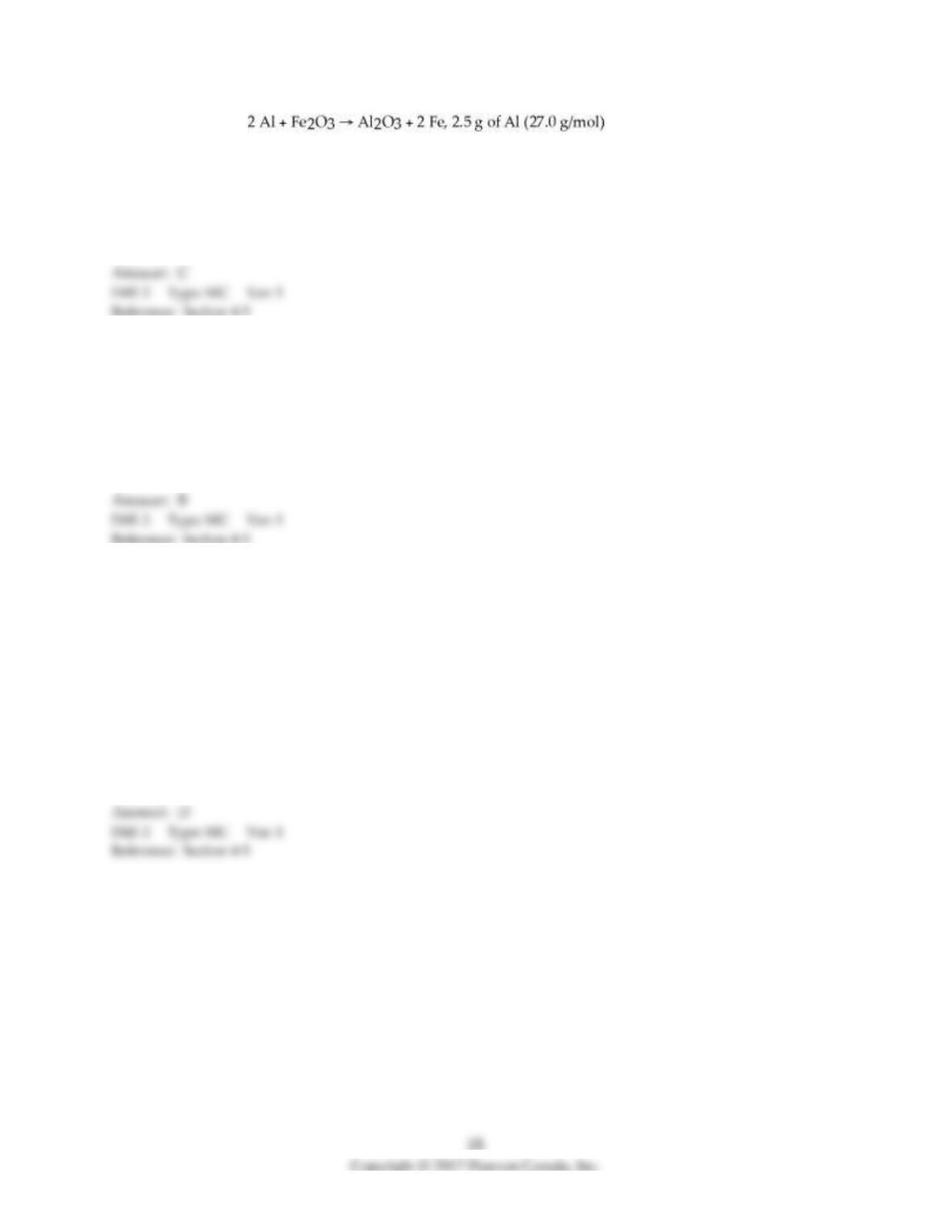
55) For the reaction and 7.2 g of Fe2O3 (159.8 g/mol)
produce 5.03 g of Fe (55.9 g/mol). Calculate the extent of reaction , x.
A) 0.362
B) 0.089
C) 0.045
D) 0.092
E) 0.405
56) If 0.500 mol of CaCl2 is mixed with 0.200 mol Na3PO4, the maximum amount in moles of Ca3(PO4)2
that can be formed is 0.10 moles. Calculate the extent of reaction , x.
A) 0.2
B) 0.10
C) 0.35
D) 0
E) 0.65
57) The Haber Process for the production of ammonia is represented by:
3 H2(g) + N2(g) → 2 NH3(g)
If 30 g of hydrogen is mixed with 10 g of nitrogen and the extent of reaction is 0.247, what is the amount
of ammonia produced?
A) 4.19 g
B) 2.47 g
C) 7.41 g
D) 8.41 g
E) 3.70g
58) What is the sum of the coefficients when the following is balanced with the smallest integer
coefficients?
Al + Fe2O3 → Al2O3 + Fe
A) 4
B) 6
C) 12
D) 9
E) 8
59) What is the sum of the coefficients when the following is balanced with the smallest integer
coefficients?
CaC2(s) + H2O(l) → Ca(OH)2(s) + C2H2(g)
A) 8
B) 4
C) 5
D) 10
E) 9
60) What is the sum of the coefficients when the following is balanced with the smallest integer
coefficients?
KClO3(s) → KCl(s) + O2(g)
A) 11
B) 10
C) 5
D) 7
E) 6
61) What is the sum of the coefficients when the following is balanced with the smallest integer
coefficients?
PCl3(l) + Cl2(g) + P4O10(s) → POCl3(l)
A) 3
B) 18
C) 45
D) 10
E) 23
62) What is the sum of the coefficients when the following is balanced with the smallest integer
coefficients?
Al(s) + HCl(aq) → AlCl3(aq) + H2(g)
A) 13
B) 11
C) 18
D) 19
E) 21
63) What is the sum of the coefficients when the following is balanced with the smallest integer
coefficients?
H2(g) + O2(g) → H2O(l)
A) 4
B) 5
C) 8
D) 9
E) 7
64) What is the sum of the coefficients when the following is balanced with the smallest integer
coefficients?
C2H6 + O2 → CO2 + H2O
A) 5
B) 10
C) 19
D) 21
E) 25
65) What is the sum of the coefficients when the following is balanced with the smallest integer
coefficients?
CH3OH → CO + H2
A) 3
B) 8
C) 5
D) 4
E) 7
66) What is the sum of the coefficients when the following equation is balanced with the smallest integer
coefficients?
H2SO3 + Al(OH)3 → Al2(SO3)3 + H2O
A) 4
B) 5
C) 11
D) 12
E) 14
67) Write the complete balanced equation for the complete combustion reaction expected to occur
between C3H7OH and O2.
A) C3H7OH + O2 → 3 CO2 + 4 H2O
B) 3 C3H7OH + 9 O2 → 6 CO2 + 8 H2O + 3 C
C) 2 C3H7OH + 6 O2 → CO + 8 H2O
D) 2 C3H7OH + 9 O2 → 6 CO2 + 8 H2O
E) 2 C3H7OH + 9 O2 → 6 C + 8 H2 + 10 O2
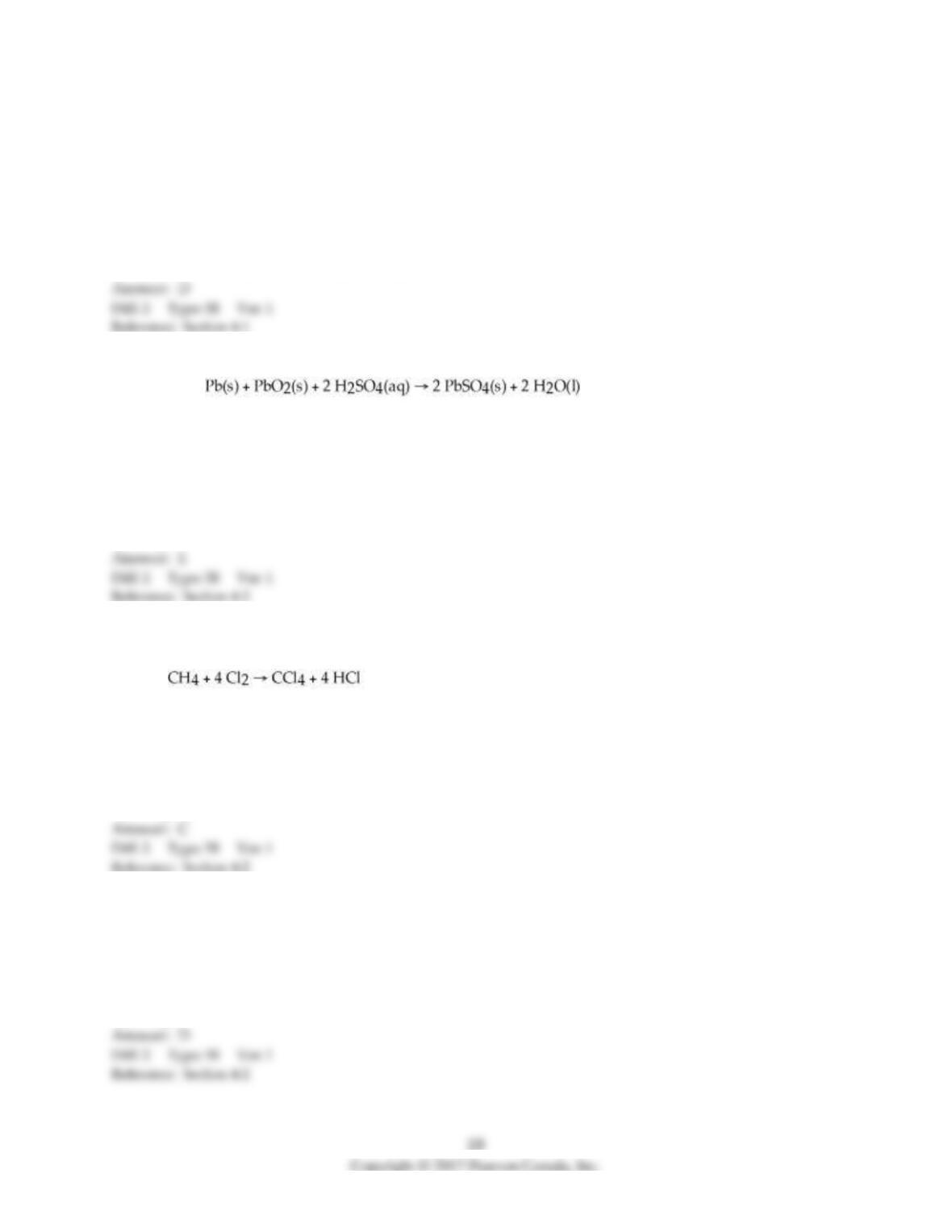
68) The chemical reaction occurring during the discharge of a lead storage battery can be represented by
the equation:
What mass of lead sulfate would result from the complete reaction of 41.4 g of lead?
A) 57.6 g
B) 60.5 g
C) 105 g
D) 115 g
E) 121 g
69) How much Cl2, in g, is required to produce 12.0 g CCl4 according to the following reaction?
A) 12.0 g
B) 5.52 g
C) 22.1 g
D) 1.38 g
E) 11.0 g
70) What mass of water is produced in the metathesis reaction 75.2 g Zn(OH)2 with 43.4 g HCl?
A) 13.6 g
B) 27.3 g
C) 10.7 g
D) 21.4 g
E) 31.8 g
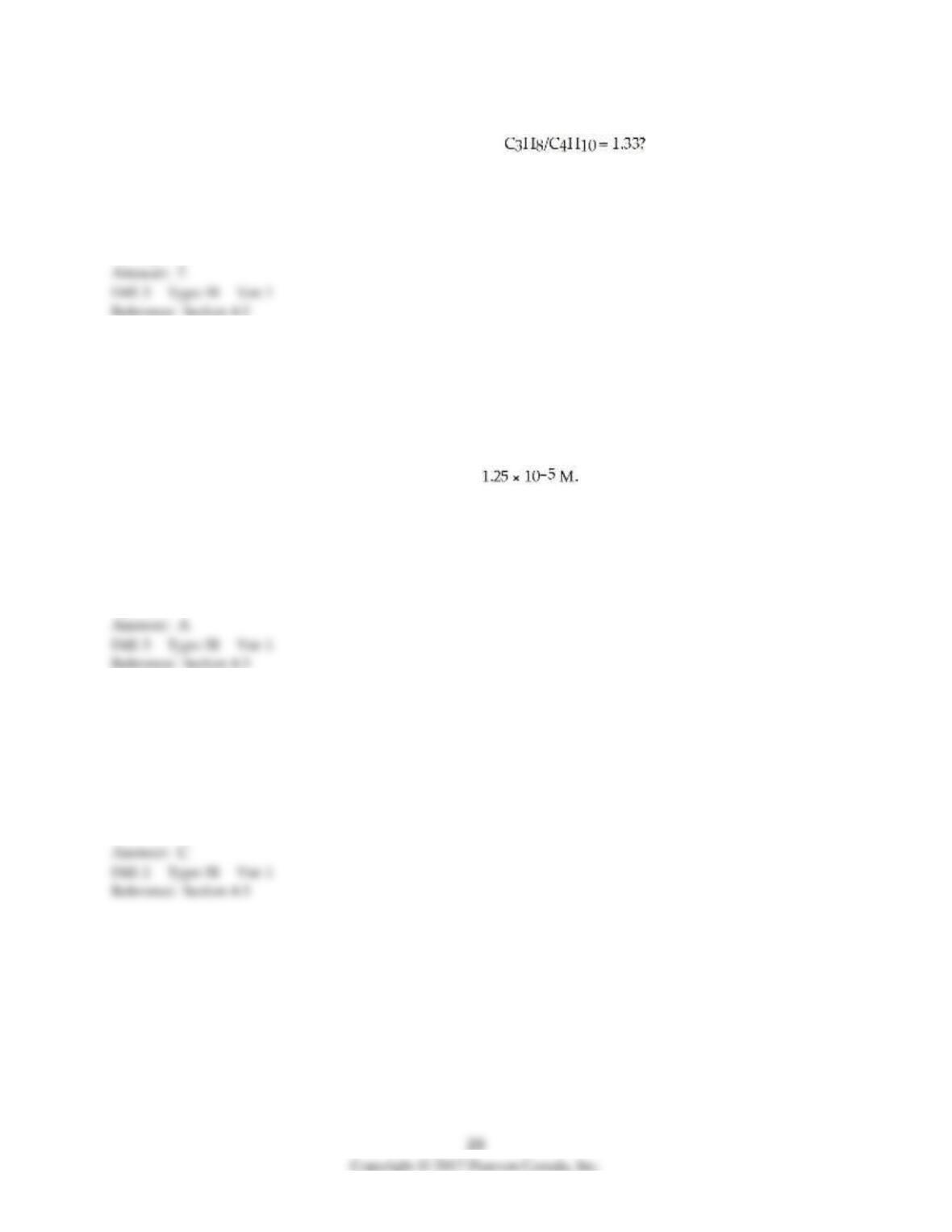
71) What mass of oxygen gas would be consumed by the complete combustion of 7.5 g of a mixture of
propane (C3H8) and butane (C4H10) in the mole ratio of
A) 3.9 g
B) 11 g
C) 14 g
D) 21 g
E) 27 g
72) Our task is to measure the volume of blood in an elephant. One way to do this would be to drain its
blood into a suitable container. Aside from harmful side effects which this method has on the elephant, it
will not be successful, as blood will still remain behind in the tissues. Hence, we will inject 2.00 ml of a
2.00 M solution of a dye which the elephant will not appreciably metabolize or excrete in one hour and
then measure the concentration of this dye in the bloodstream (our sample being taken from another leg
than the point of injection) after 30 minutes, a sufficient time to thoroughly mix the dye in the
bloodstream. The concentration of dye at this point is What is the volume of blood in the
elephant?
A) 320 L
B) 320000 L
C) 3.2 L
D) 80 L
E) 800 L
73) What is the molarity of formaldehyde in a solution containing 0.25 g of formaldehyde (CH2O) per
mL?
A) 2.5 M
B) 25 M
C) 8.3 M
D) 83 M
E) 4.0 M