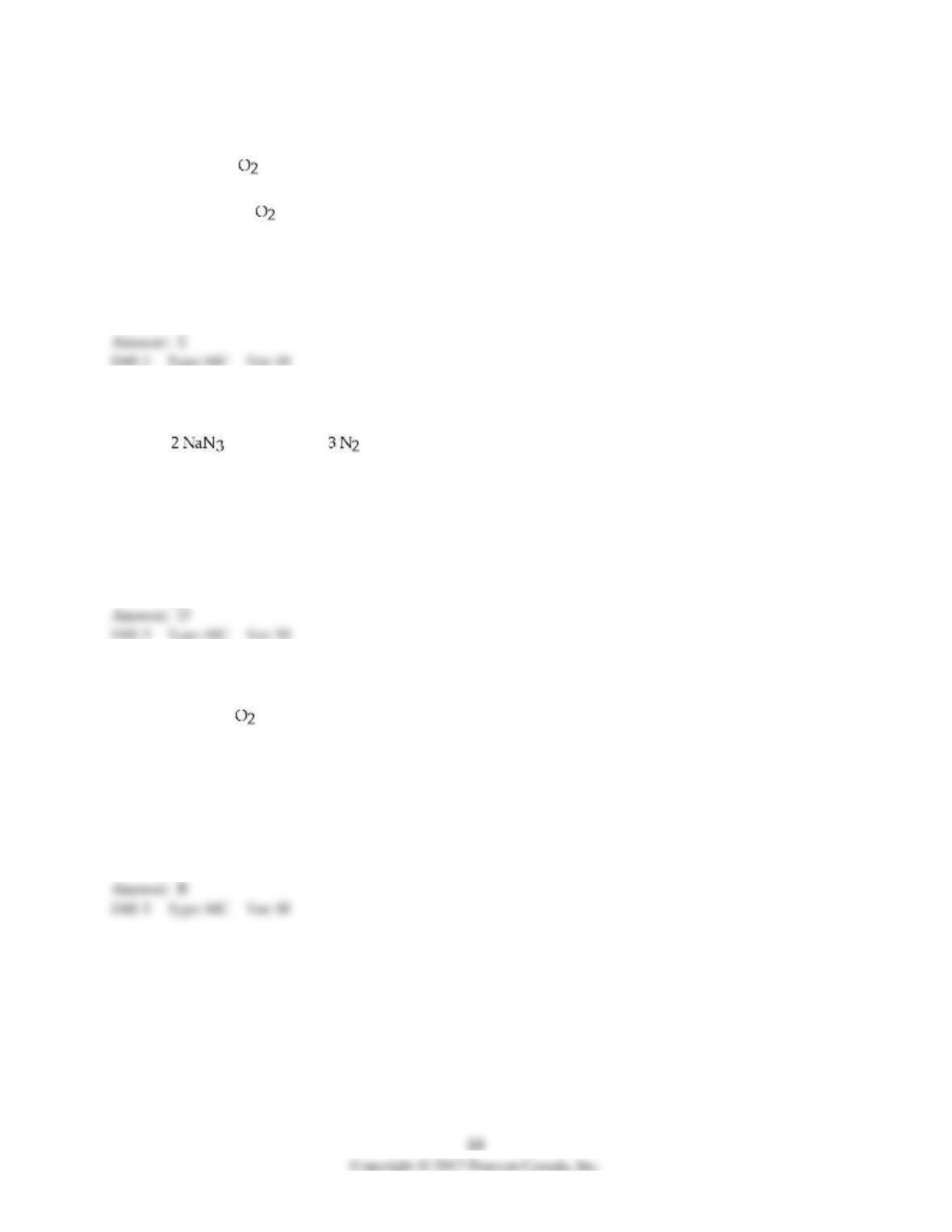
117) Magnesium burns in air with a dazzling brilliance to produce magnesium oxide:
2 Mg(s) + (g) → 2 MgO(s)
How many moles of are consumed when 0.770 mol of magnesium burns?
A) 0.0317 mol
B) 2.60 mol
C) 0.770 mol
D) 1.54 mol
E) 0.385 mol
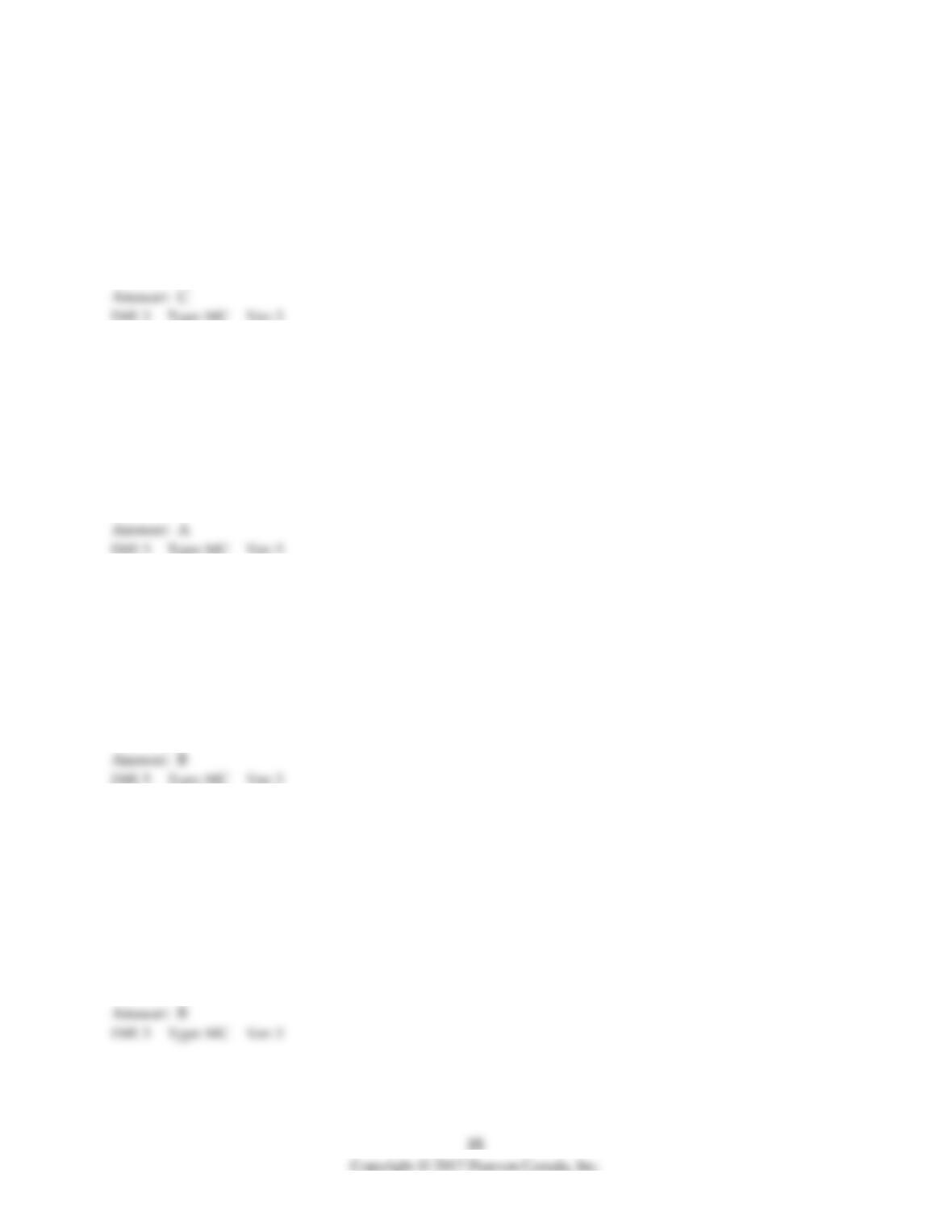
118) Automotive air bags inflate when sodium azide decomposes explosively to its constituent elements:
(s) → 2 Na(s) + (g)
How many grams of sodium azide are required to produce 33.0 g of nitrogen?
A) 1.77 g
B) 0.785 g
C) 76.6 g
D) 51.1 g
E) 114.9 g
119) Magnesium burns in air with a dazzling brilliance to produce magnesium oxide:
2 Mg(s) + (g) → 2 MgO(s)
When 4.00 g of magnesium burns, what is the theoretical yield of magnesium oxide?
A) 4.00 g
B) 6.63 g
C) 0.165 g
D) 3.32 g
E) 13.3 g
120) How many moles of CuO can be produced from 0.900 mol of Cu2O in the following reaction?
2 Cu2O(s) + O2(g) → 4 CuO(s)
A) 0.450 mol
B) 0.900 mol
C) 1.80 mol
D) 3.60 mol
121) How many moles of BCl3 are needed to produce 10.0 g of HCl(aq) in the following reaction?
BCl3(g) + 3 H2O(l) → 3 HCl(aq) + B(OH)3(aq)
A) 0.0914 mol
B) 0.274 mol
C) 0.823 mol
D) 10.9 mol
122) How many grams of calcium chloride are needed to produce 1.50 g of potassium chloride?
CaCl2(aq) + K2CO3(aq) → 2 KCl(aq) + CaCO3(aq)
A) 0.896 g
B) 1.12 g
C) 2.23 g
D) 4.47 g
123) Identify the coefficient of I2(s) when the following reaction is balanced, and determine the number of
moles of iodine that reacts with 30.0 g of aluminum.
(unbalanced) Al(s) + I2(s) → Al2I6(s)
A) coefficient 1, amount 0.741 mol
B) coefficient 3, amount 1.67 mol
C) coefficient 2, amount 2.22 mol
D) coefficient 4, amount 3.33 mol
124) Identify the coefficient of Fe2O3(s) when the following reaction is balanced, and determine the
number of grams of MgO needed to produce 10.0 g of Fe2O3.
(unbalanced) MgO(s) + Fe(s) → Fe2O3(s) + Mg(s)
A) coefficient 2, mass 0.312 g
B) coefficient 3, mass 0.841 g
C) coefficient 4, mass 2.52 g
D) coefficient 1, mass 7.57 g
125) Dinitrogen monoxide gas decomposes to form nitrogen gas and oxygen gas. How many grams of
oxygen are formed when 10.0 g of dinitrogen monoxide decomposes?
A) 0.275 g
B) 3.64 g
C) 7.27 g
D) 14.5 g
126) If the density of ethanol, C2H5OH, is 0.789 g mL-1. How many millilitres of ethanol are needed to
produce 15.0 g of CO2 according to the following chemical equation?
C2H5OH(l) + 3 O2(g) → 2 CO2(g) + 3 H2O(l)
A) 6.19 mL
B) 9.95 mL
C) 19.9 mL
D) 39.8 mL
127) If the percent yield for the following reaction is 65.0%, how many grams of KClO3 are needed to
produce 32.0 g of O2?
2 KClO3(s) → 2 KCl(s) + 3 O2(g)
A) 53.1 g
B) 81.7 g
C) 126 g
D) 283 g
128) If the percent yield for the following reaction is 75.0%, and 45.0 g of NO2 are consumed in the
reaction, how many grams of nitric acid, HNO3(aq), are produced?
3 NO2(g) + H2O(l) → 2 HNO3(aq) + NO(g)
A) 30.8 g
B) 41.1 g
C) 54.8 g
D) 69.3 g
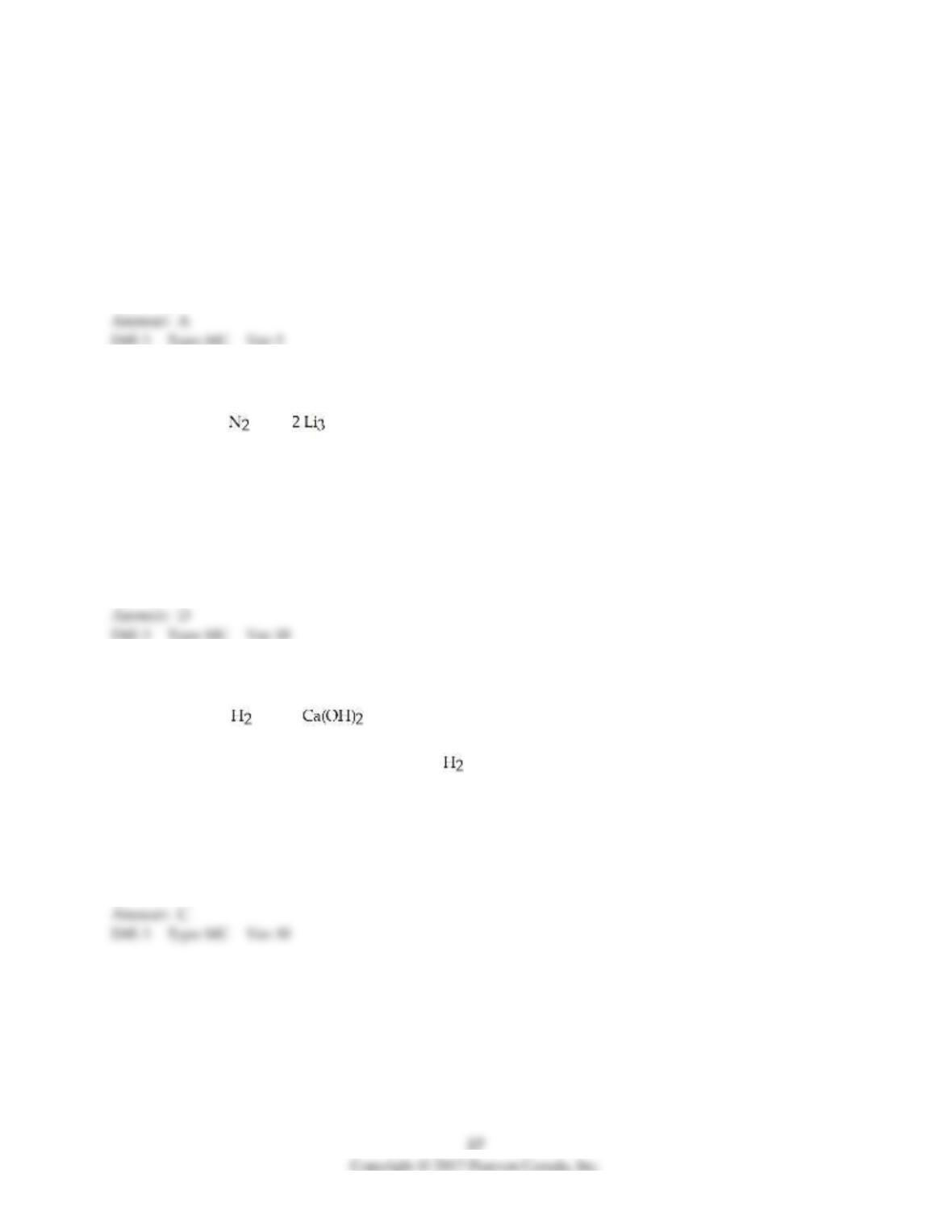
129) Lithium and nitrogen react in a combination reaction to produce lithium nitride:
6 Li(s) + (g) → N(s)
In a particular experiment, 3.50 g samples of each reagent are reacted. What is the theoretical yield of
lithium nitride?
A) 3.52 g
B) 2.93 g
C) 17.6 g
D) 5.85 g
E) 8.7 g
130) Calcium oxide reacts with water in a combination reaction to produce calcium hydroxide:
CaO(s) + O(l) → (s)
A 4.50 g sample of CaO is reacted with 4.34 g of O. How many grams of water remain after the
reaction is complete?
A) 0.00
B) 0.00892
C) 2.90
D) 1.04
E) 0.161
131) If 294 grams of FeS2 is allowed to react with 176 grams of O2 according to the following unbalanced
equation, how many grams of Fe2O3 are produced?
FeS2 + O2 → Fe2O3 + SO2
132) Calcium oxide reacts with water in a combination reaction to produce calcium hydroxide:
CaO(s) + O(l) → (s)
In a particular experiment, a 5.00 g sample of CaO is reacted with excess water and 6.11 g of is
recovered. What is the percent yield in this experiment?
A) 122%
B) 1.22%
C) 7.19%
D) 92.5%
E) 81.9%
133) Sodium metal and water react to form hydrogen and sodium hydroxide. If 5.98 g of sodium react
with water to form 0.26 g of hydrogen and 10.40 g of sodium hydroxide, what mass of water was
involved in the reaction?
A) 4.68 g
B) 5.98 g
C) 10.14 g
D) 10.66 g
134) Which substance is the limiting reactant when 2.0 g of sulfur reacts with 3.0 g of oxygen and 4.0 g of
sodium hydroxide according to the following chemical equation?
2 S(s) + 3 O2(g) + 4 NaOH(aq) → 2 Na2SO4(aq) + 2 H2O(l)
A) S(s)
B) O2(g)
C) NaOH(aq)
D) None of these substances is the limiting reactant.
135) When 7.00 × 10²² molecules of ammonia react with 6.00 × 10²² molecules of oxygen according to the
chemical equation shown below, how many grams of nitrogen gas are produced?
4 NH3(g) + 3 O2(g)→ 2 N2(g) + 6 H2O(g)
A) 1.63 g
B) 1.86 g
C) 4.19 g
D) 6.51 g
136) When silver nitrate reacts with barium chloride, silver chloride and barium nitrate are formed. How
many grams of silver chloride are formed when 10.0 g of silver nitrate reacts with 15.0 g of barium
chloride?
A) 8.44 g
B) 9.40 g
C) 11.9 g
D) 18.8 g
137) When 11.0 g of calcium metal is reacted with water, 5.00 g of calcium hydroxide is produced. Using
the following balanced equation, calculate the percent yield for the reaction.
Ca(s) + 2 H2O(l) → Ca(OH)2(aq) + H2(g)
A) 12.3%
B) 24.6%
C) 45.5%
D) 84.0%
138) 7.0 g of nitrogen is reacted with 5.0 g of hydrogen to produce ammonia according to the chemical
equation shown below. Which one of the following statements is FALSE?
N2(g) + 3 H2(g) → 2 NH3(g)
A) 3.5 g of hydrogen are left over.
B) Hydrogen is the excess reactant.
C) Nitrogen is the limiting reactant.
D) The theoretical yield of ammonia is 15 g.
139) 5.0 g of iron is reacted with 5.0 g of water according to the chemical equation shown below. Which
one of the following statements is FALSE?
3 Fe(s) + 4 H2O(l) → Fe3O4(s) + 4 H2(g)
A) 6.91 g of Fe3O4 are produced.
B) 2.85 g of H2O are left over.
C) Mass is conserved in this reaction.
D) Water is the limiting reactant.
140) Calculate the number of grams of solute in 500.0 mL of 0.189 mol L-1 KOH.
A) 148 g
B) 1.68 g
C) 5.30 × g
D) 5.30 g
E) 1.68 × 10⁻³ g
141) What is the concentration of FeCl3 in a solution prepared by dissolving 20.0 g of FeCl3 in enough
water to make 275 mL of solution?
A) 4.48 × 10⁻⁴ mol L-1
B) 0.448 mol L-1
C) 2.23 mol L-1
D) 2.23 × 10³ mol L-1
142) How many grams of AgNO3 are needed to make 250 mL of an aqueous solution that is 0.135 mol L–
1?
A) 0.0917 g
B) 0.174 g
C) 5.73 g
D) 91.7 g
143) What volume of a 0.540 mol L-1 NaOH(aq) solution contains 11.5 g of NaOH?
A) 0.155 L
B) 0.532 L
C) 1.88 L
D) 6.44 L
144) What is the concentration (M) of sodium ions in 4.57 L of a 0.398 mol L-1 P(aq) solution?
145) What is the concentration (M) of C OH in a solution prepared by dissolving 16.8 g of C OH in
sufficient water to give exactly 230 mL of solution?
146) How many grams of P are in 265 mL of a 1.50 mol L-1 solution of P (aq)?
147) What is the concentration (M) of a NaCl solution prepared by dissolving 7.2 g of NaCl in sufficient
water to give 425 mL of solution?
148) How many grams of NaOH (MW = 40.0 g mol-1) are there in 250.0 mL of a 0.275 mol L-1 NaOH
solution?
149) How many grams of C OH must be added to water to prepare 150 mL of a solution that is 2.0 mol
L-1 C OH?
150) What is the concentration of HCl in the final solution when 65 mL of a 12 mol L-1 HCl(aq) solution is
diluted with pure water to a total volume of 0.15 L?
A) 2.8 × 10⁻² mol L-1
B) 5.2 mol L-1
C) 28 mol L-1
D) 5.2 × 10³ mol L-1
151) How many millilitres of a 9.0 mol L-1 H2SO4(aq) solution are needed to make 0.35 L of a 3.5 mol L-1
solution?
A) 0.14 mL
B) 0.90 mL
C) 140 mL
D) 900 mL
152) A student prepared a stock solution by dissolving 10.0 g of KOH in enough water to make 150 mL of
solution. She then took 15.0 mL of the stock solution and diluted it with enough water to make 65.0 mL of
a final solution. What is the concentration of KOH for the final solution?
A) 0.274 mol L-1
B) 0.356 mol L-1
C) 2.81 mol L-1
D) 3.65 mol L-1
153) How many millilitres of a stock solution of 11.1 mol L-1 (aq) would be needed to prepare 0.500
L of 0.500 mol L-1 ?
A) 0.0444 mL
B) 22.5 mL
C) 2.78 mL
D) 44.4 mL
E) 0.0225 mL
154) A stock solution of is prepared and found to contain 13.5 mol L-1 of (aq). If 25.0 mL of
the stock solution is diluted with water to a final volume of 0.500 L, what is the concentration of the
diluted solution?
A) 0.270 mol L-1
B) 1.48 mol L-1
C) 0.675 mol L-1
D) 675 mol L-1
E) 270 mol L-1
155) A FeCl3 solution is 0.175 mol L-1. How many mL of a 0.175 mol L-1 FeCl3 solution are needed to
make 550 mL of a solution that is 0.300 mol L-1 in Cl– ion?
A) 0.943 mL
B) 314 mL
C) 943 mL
D) 0.314 mL
156) Pure acetic acid ( COOH) is a liquid and is known as glacial acetic acid. Calculate the molarity of
a solution prepared by dissolving 10.00 mL of glacial acetic acid at 25 °C in sufficient water to give 500.0
mL of solution. The density of glacial acetic acid at 25 °C is 1.05 g mL-1.
A) 1.26 × 10³ mol L-1
B) 21.0 mol L-1
C) 0.0210 mol L-1
D) 0.350 mol L-1
E) 3.50 × 10⁻⁴ mol L-1
157) What is the concentration of NO3– ions in a solution prepared by dissolving 25.0 g of Ca(NO3)2 in
enough water to produce 300 mL of solution?
A) 0.254 mol L-1
B) 0.508 mol L-1
C) 0.672 mol L-1
D) 1.02 mol L-1
158) If the reaction of phosphate ion with water is ignored, what is the total concentration of ions in a
solution prepared by dissolving 3.00 g of K3PO4 in enough water to make 350 mL of solution?
A) 0.0101 mol L-1
B) 0.0404 mol L-1
C) 0.162 mol L-1
D) 0.323 mol L-1
159) What is the concentration of an AlCl3(aq) solution if 150 mL of the solution contains 450 mg of Cl–
ion?
A) 2.82 × 10⁻² mol L-1
B) 6.75 × 10⁻² mol L-1
C) 8.46 × 10⁻² mol L-1
D) 2.54 × 10⁻¹ mol L-1
160) A student dissolved 4.00 g of Co(NO3)2 in enough water to make 100 mL of stock solution. He took
4.00 mL of the stock solution and then diluted it with water to give 275 mL of a final solution. How many
grams of NO3– ion are there in the final solution?
A) 0.0197 g
B) 0.0394 g
C) 0.0542 g
D) 0.108 g
161) There are ________ mol of bromide ions in 0.900 L of a 0.500 mol L-1 solution of Al (aq).
162) How many moles of (aq) are present in 0.150 L of a 0.200 mol L-1 solution of Co (aq)?
163) What is the molar concentration of sodium ions in a 0.450 mol L-1 Na3PO4(aq) solution?
A) 0.150 mol L-1
B) 0.450 mol L-1
C) 1.35 mol L-1
D) 1.80 mol L-1
164) Calculate the concentration (M) of sodium ions in a solution made by diluting 40.0 mL of a 0.474 mol
L-1 of an aqueous solution of sodium sulfide with water to a total volume of 300 mL.
165) Identify the coefficient of NO(g) when the following reaction is balanced, and calculate the volume
of nitrogen monoxide gas produced when 8.00 g of ammonia is reacted with 12.0 g of oxygen at 25 °C.
The density of nitrogen monoxide at is 1.23 g L-1.
(unbalanced) NH3(g) + O2(g) → NO(g) + H2O(l)
A) coefficient 4, volume 7.32 L
B) coefficient 1, volume 11.1 L
C) coefficient 2, volume 11.5 L
D) coefficient 3, volume 17.3 L
166) How many millilitres of 0.260 mol L-1 Na2S(aq) are needed to react with 40.00 mL of 0.315 mol L-1
AgNO3(aq)?
Na2S(aq) + 2 AgNO3(aq) → 2 NaNO3(aq) + Ag2S(s)
A) 24.2 mL
B) 48.5 mL
C) 66.0 mL
D) 96.9 mL
167) How many grams of CaCl2 are formed when 15.00 mL of 0.00237 mol L-1 Ca(OH)2(aq) reacts with
excess Cl2 gas?
2 Ca(OH)2(aq) + 2 Cl2(g) → Ca(OCl)2(aq) + CaCl2(s) + 2 H2O(l)
A) 0.00197 g
B) 0.00394 g
C) 0.00789 g
D) 0.0507 g
168) When 31.2 mL of 0.500 mol L-1 AgNO3(aq) is added to 25.0 mL of 0.300 mol L-1 NH4Cl(aq), how
many grams of AgCl are formed?
AgNO3(aq) + NH4Cl(aq) → AgCl(s) + NH4NO3(aq)
A) 1.07 g
B) 2.24 g
C) 3.31 g
D) 6.44 g
169) How many millilitres of 0.200 mol L-1 FeCl3(aq) are needed to react with an excess of Na2S(aq) to
produce 1.38 g of Fe2S3 if the percent yield for the reaction is 65.0%?
3 Na2S(aq) + 2 FeCl3(aq) → Fe2S3(s) + 6 NaCl(aq)
A) 25.5 mL
B) 43.1 mL
C) 51.1 mL
D) 102 mL
46
170) If 100. mL of 0.400 mol L-1 Na2SO4(aq) is added to 200 mL of 0.600 mol L-1 NaCl(aq), what is the
concentration of Na+ ions in the final solution? Assume that the volumes are additive.
A) 0.534 mol L-1
B) 0.667 mol L-1
C) 1.00 mol L-1
D) 1.40 mol L-1
171) How many grams of H2 gas can be produced by the reaction of 54.0 grams of Al(s) with an excess of
dilute hydrochloric acid in the reaction shown below?
2 Al(s) + 6 HCl(aq) → 2 AlCl3(aq) + 3 H2(g)
A) 2.68 g
B) 4.04 g
C) 6.05 g
D) 12.1 g